

Apple's Flash Suppliers Finally Send the Bill
iPhone storage costs jumped from $15 to $66, and this week's Mac price tags show exactly why.
BusinessOne Article and Two Price Tags, Released on the Same Day
On October 28th (local time), Apple unveiled new MacBook Pros with OLED touchscreens. That same day, the Mac Studio finally got a 512GB unified memory option it had long been missing. And that same day, The Wall Street Journal (WSJ) ran a lengthy piece on Apple’s relationship with its flash memory suppliers. The gist: suppliers that Apple had been squeezing for years are now squeezing back.
The article opens with a scene. Scott Nelson, a sales executive at Kioxia, once took a rifle out into the Southern California desert and shot his own iPod to pieces. That’s how much he hated always being on the losing end of every deal with Apple. He still carries an Android phone out of protest, he says, and keeps the shattered iPod fragments on his desk. The iPod, incidentally, was the first device in which Apple ever used flash1.
Put that article next to this week’s Mac price list, and the two become one story. The suppliers’ revenge didn’t stop at Apple. It passed straight through Apple and landed on consumers. Today, I’ll trace that path, number by number.
How Apple Has Bought Flash for 20 Years
Apple’s relationship with the flash industry began in 2001. A 1.8-inch, 5GB hard disk developed by Toshiba (now Kioxia) was the core component of the first iPod. When Apple launched the flash-based iPod nano in 2005, it prepaid five suppliers $1.25 billion for volume through 2010. After the iPhone took off, Apple became the industry’s biggest customer, spending $3 billion to $4 billion a year to buy more than a fifth of the world’s flash supply.
Apple used that position to the hilt. It didn’t just extract the lowest prices in the industry — during price downturns, it would refuse to take delivery of ordered volumes, dumping the resulting inventory back onto suppliers. Suppliers were required to designate Apple a “most favored customer,”2 meaning they promised never to sell to anyone else more cheaply. Apple verified this through audits. More than a decade ago, it discovered that Micron had sold to another customer at a lower price, and after arbitration extracted a settlement worth tens of millions of dollars. Auditing also let Apple see how hard each factory’s lines were running — which meant it could gauge exactly how badly each supplier needed a big order.
The face of these negotiations was procurement chief Tony Blevins. He was known for scheduling meetings with rival sales teams back-to-back so they’d run into each other in the hallway, or dragging negotiations past midnight without so much as offering dinner. When SanDisk rejected a request for additional supply in late 2015, he reportedly said he’d make then-CEO Sanjay Mehrotra “crawl back on his knees.” In 2017, when Western Digital demanded a reservation fee to hold capacity, he wrote the date on a whiteboard and vowed to pay it back. A year later, when flash prices dropped, Western Digital executives showed up with a refund check in hand. Blevins is said to have extracted a promise that they’d never charge a reservation fee again, threatened to bill Western Digital for chip testing costs on top of that, and then had security escort them out.
The year this relationship showed up most starkly in the numbers was 2023. Flash prices had bottomed out at 5 cents per gigabyte. Bernstein estimated that while the entire flash industry posted $19 billion in operating losses that year, Apple earned $14 billion in gross profit simply by selling devices with more storage built in. For the same chips, the makers lost money — and the buyer who packaged them into products made exactly that much.
The purchasing ranking flipped in just 2 years
AI data centers changed the game. According to market research firm TechInsights, two years ago Apple alone bought roughly twice as much flash memory as Microsoft, Amazon, Meta, and Google combined. Now the order is reversed. These hyperscalers3 buy twice what Apple does.
Prices have moved in lockstep. Over the past year, flash prices have roughly quintupled. Flash memory, which cost $68 per gigabyte in 2005 and fell to just 5 cents by 2023, has now climbed back past 30 cents — up more than 550% from its low. TechInsights estimates that Apple will spend $25 billion this year to buy roughly the same volume it bought for $6 billion in 2025.
How can hyperscalers afford this? Two reasons. Flash makes up a small share of a data center’s total build cost. And server spending can be booked as depreciation4, an accounting treatment that spreads the cost across multiple years. That’s a completely different experience from how flash weighs on the cost sheet of a single iPhone. That’s why Meta, Microsoft, and Amazon signed long-term supply contracts with Kioxia this year, locking in higher prices. The structure protects Kioxia’s profits even if the market turns down. SanDisk’s announcement last August that it had signed contracts averaging more than 4 years with 8 customers (Issue No. 183) was part of the same trend.
Apple’s situation was different. Supply-chain reporting in February of this year suggested Apple had agreed to pay Kioxia roughly twice its previous price — and that the deal structure had shifted from multi-year agreements to renegotiation every 6 months. Sources who spoke to the WSJ said Apple, confident it understood the market better than anyone, brushed off analysts’ warnings and got caught off guard.
The weapon Apple wielded for 20 years was, in the end, sheer purchase volume. Most-favored-customer clauses, audits, the right to refuse acquisitions — all of it only worked on the premise that “no customer buys more than we do.” Once a customer emerged that bought more, committed longer, and haggled less over price, that premise disappeared.
In June, then-CEO Tim Cook (chairman of the board since September) told the WSJ in an interview that price increases were unavoidable, calling the current situation a “100-year flood.” He also said Apple could use its balance sheet to help expand supply, but would not build memory fabs itself.
The Profit-and-Loss Statement of One iPhone Storage Tier
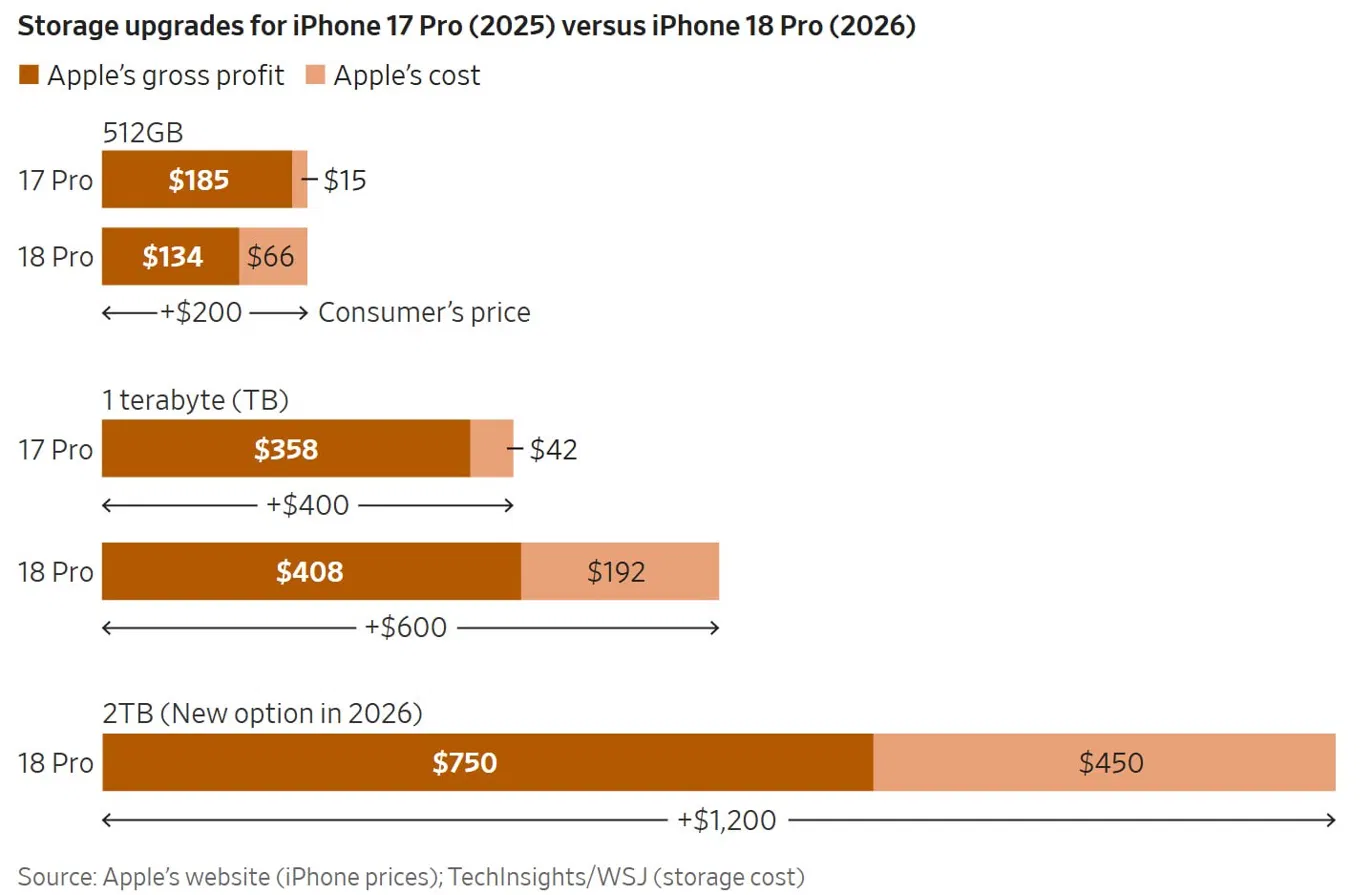
So where did the flood of rising costs actually go? WSJ calculated the profit and loss on iPhone storage upgrades using TechInsights’ flash pricing and Apple’s own website prices. The cost estimate multiplies the added gigabytes by market price, then applies a 0.85 factor to reflect the discount Apple receives as a bulk buyer. Here’s how it breaks down, using the base 256GB model as the reference point for each upgrade:
| Upgrade | Extra consumer price (17 Pro → 18 Pro) | Estimated Apple cost | Estimated Apple gross profit | Margin |
|---|---|---|---|---|
| 512GB | $200 → $200 | $15 → $66 | $185 → $134 | ~93% → 67% |
| 1TB | $400 → $600 | $42 → $192 | $358 → $408 | ~90% → 68% |
| 2TB (new this year) | $1,200 | $450 | $750 | ~63% |
In actual pricing terms, the iPhone 18 Pro starts at $1,199 for 256GB — $100 more than the previous generation. The 512GB model runs $1,399, 1TB is $1,799, and the newly introduced 2TB tier costs $2,399. Looking at 1TB alone, that’s a $300 jump from the prior generation’s $1,499.
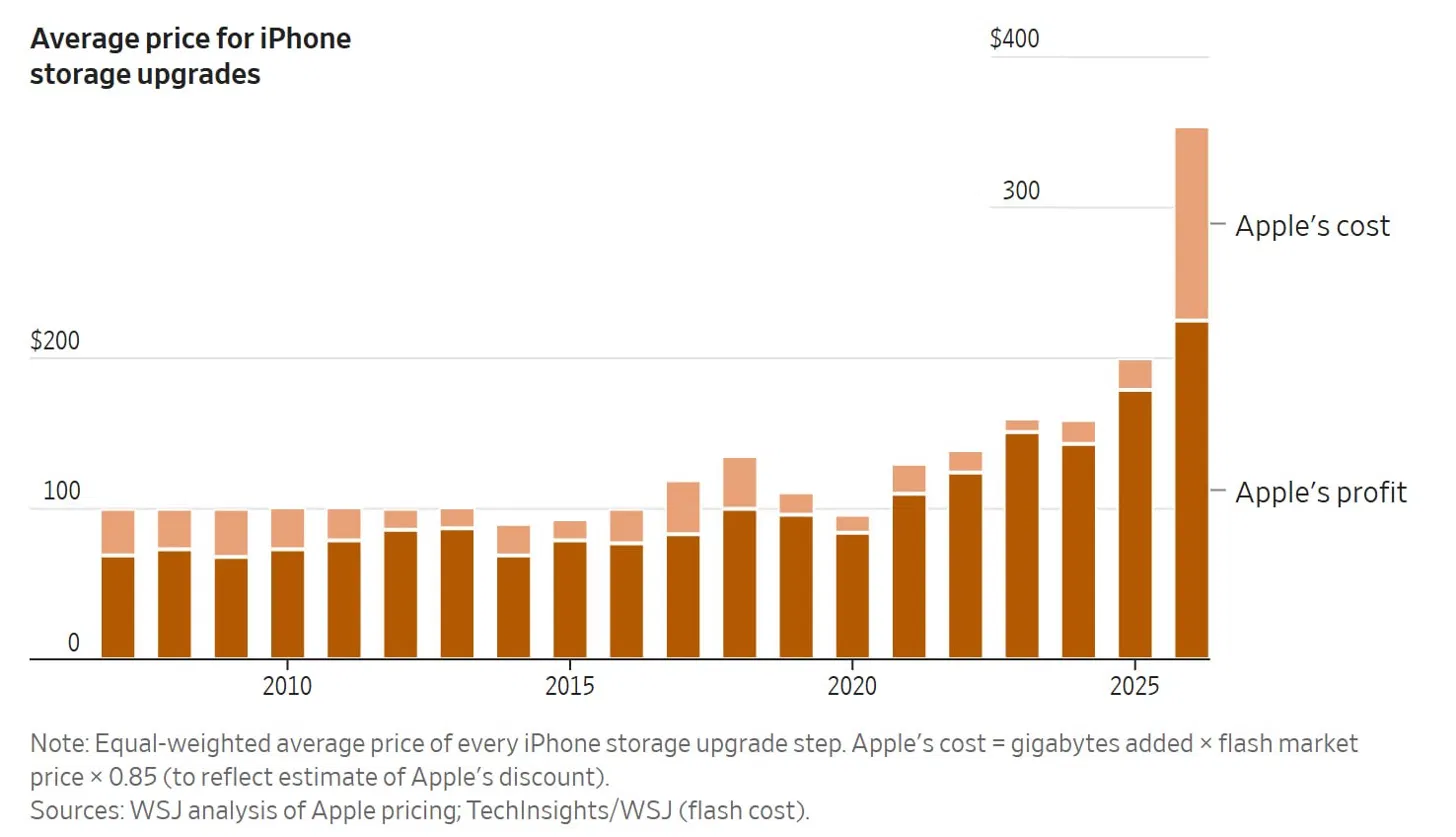
WSJ’s chart, which averages across all iPhone storage tiers with equal weighting, tells the same story. Eyeballing the chart, in 2025 the average price per tier was roughly $200, of which cost accounted for about $20. By 2026, the average price jumped to roughly $350, with cost rising to about $125 — but Apple’s take also grew, from about $180 to about $225. Some of this is inflated by the new 2TB tier pulling the average upward, so read this for direction rather than precise values.
Just how significant these tiers are to Apple becomes clear from IDC’s estimates. Last year, roughly 100 million iPhone buyers paid for a storage upgrade. Applying WSJ’s 85% margin assumption, that gross profit5 alone exceeds $10 billion. Apple has consistently kept more than 80 cents of every dollar it earns from selling extra storage on iPhones and iPads. Even with costs rising more than fourfold, there’s simply no reason for Apple to give up this tier entirely. And lately, Apple has raised prices across nearly its entire product line — according to WSJ, iPhone prices rose by an average of 13%.
For reference, these cost figures are estimates from WSJ and TechInsights. Apple’s actual purchase prices are never disclosed.
The Bill Comes Due on the Mac Price List
The iPhone at least held the line at the entry tier. The Mac is far more blatant about it. Let me walk through how Mac prices moved this year, in order.
June 25th: prices rose with no new products. Apple raised prices across nearly its entire Mac and iPad lineup without announcing anything new. A mid-cycle hike like this had never happened before. Apple explained that it could no longer absorb the cost of memory and storage chips. The base 14-inch MacBook Pro went from $1,699 to $1,999, and the 512GB MacBook Air went from $1,099 to $1,299. The Mac Studio with the M3 Ultra chip jumped $1,300, from $3,999 to $5,299. Around the same time, the price of memory upgrades on the MacBook Pro doubled too — going from the 48GB base configuration to 128GB now cost $2,000, up from $1,000. Cook said during the July earnings call that the increase was reluctant.
October 27th: the entry tier holds the line. The 14-inch MacBook Pro and iMac with the new M6 chip launched at the same prices set in June. No further increase.
October 28th: a new price list for the high end. The OLED touchscreen MacBook Pro starts at $2,899 for the M5 Pro 14-inch model. The same chip’s previous model had gone from $2,199 before the June hike to $2,499 after it — and now it’s jumped another $400 on top of that. The 16-inch M5 Pro is $3,399, and the M5 Max is $4,499 for 14-inch and $4,799 for 16-inch. Since the screen itself was completely redesigned, you can’t pin that entire $400 on memory costs alone.
Components and models differ enough that this can only be a rough comparison, but recall the WSJ’s earlier estimate for the iPhone: adding 1.75TB to reach the 2TB tier cost about $450 — roughly $260 per terabyte. The $500 per terabyte Apple charges on the Mac is about double that.
The Mac Studio has the steepest staircase of all. The M5 Ultra Mac Studio, released in August, starts at $5,499. The configuration with the top-tier chip, 256GB of memory, and 2TB of storage costs $11,299 — compared to $7,499 for the equivalent M3 Ultra configuration launched last March. That’s a $3,800 difference.
The 512GB option introduced on October 28th is even more dramatic. Upgrading from 96GB to 512GB alone costs $15,500. The same upgrade on last year’s M3 Ultra cost $4,000. This option is only available with the top-tier chip ($6,799), putting the starting price at $22,299. Going from 256GB to 512GB in one step costs $11,500 — meaning buying two 256GB models ($21,598 total) is actually cheaper than one 512GB machine. Max out storage to 16TB as well, and the price hits $29,799 — more than double the $14,099 top configuration of last year’s M3 Ultra.
One distinction is worth making here. The Mac Studio’s steep jump comes not from flash but from unified memory6 — that is, DRAM. The WSJ article’s focus was flash, but DRAM rose over the same period for the same reason: AI demand. Cook himself said in the June interview that both memory and storage were problems.

Oswarld's Lens
Look at the pricing on the new MacBook Pro and Mac Studio, and you can see that the bill suppliers handed Apple got passed straight on to consumers. Apple moved the starting line twice — once in June, once again in October. In that span, the cost of bumping the MacBook Pro’s memory up one tier doubled, and the 512GB Mac Studio configuration now costs nearly four times what it did last year. There are places, like the iPhone’s 512GB tier, where Apple absorbed the cost increase itself. But at the upper tiers of the Mac lineup, there’s little sign of that same restraint.
This price sheet isn’t just an abstraction for me, either. I run local models on my MacBook Pro 14-inch (M4 Pro, 48GB memory), and downloading even a handful of them fills up storage fast. So I’ve been looking into keeping the models on an external SSD and plugging it in only when I need it.
In a structure where a single tier of internal storage costs hundreds of dollars, an external SSD is about the only bargaining chip consumers have left. Apple lost its leverage with suppliers — but consumers never had leverage with Apple to begin with.
In Issue 183, I wrote that the moment a customer is the one asking for a long-term contract, the market’s leverage has already shifted away from them. This story shows the same dynamic from the other side. Apple — the world’s largest buyer — was late to get in line for a long-term contract, and even it had to accept the higher price. But it was also in a position to pass that cost on to the next person in line.
Closing
The WSJ article ends with two questions. Will consumers delay upgrading their devices in the face of higher prices, and can Apple win back its negotiating leverage with suppliers? The first question is one we’ll answer ourselves, price tag in hand.
I’ve actually been thinking about upgrading my own Mac to the M6, but seeing the price has given me pause. It’s gone up so much that I’m not sure it’s worth it anymore. Honestly, cloud computing is starting to look like the better deal.
💬 Reader, when you buy your next device, will you drop down a storage tier, or just put off the purchase altogether? Let me know in the comments.
📨 If you have a colleague weighing a Mac or iPhone purchase, send this their way.
Already a subscriber? Sign in to join the conversation


References & Further Reading
Primary sources
- The Wall Street Journal, report on the relationship between Apple and its flash suppliers, 2026.10.28. ··· This is the backbone of today’s piece. Since it’s a paywalled article, I cross-checked the key figures against secondary domestic and international coverage.
- BigGo Finance, “AI Flips the NAND Negotiating Table: Apple Loses ‘Most-Favored Customer’ Clause”, 2026.10.29. ··· A secondary report summarizing the WSJ’s figures and Apple’s position.
- MacRumors, “iPhone 18 Pro’s $100 Price Increase is Actually $300 If You Want 1TB Storage”, 2026.9.9. ··· The source for the iPhone 18 Pro’s storage-tier pricing.
- MacRumors, “Apple’s New Touchscreen MacBook Pro Costs Up to $14,549”, 2026.10.28. ··· Lays out the new MacBook Pro’s starting price and the cost of storage/memory upgrades.
- MacRumors, “Mac Studio With M5 Ultra Now Available With 512GB RAM for $22,299”, 2026.10.28.
- iDrop News, “You Can Finally Order a 512 GB Mac Studio”, 2026.10.28. ··· Compares this to last year’s M3 Ultra 512GB upgrade price ($4,000).
Background
- Reuters (via NST), “Apple raises prices of MacBooks, iPads as memory costs skyrocket”, 2026.6.25. ··· The backstory and Apple’s explanation for the June mid-cycle price hike.
- Digital Trends, “Apple’s historically high tax for RAM upgrades on Macs has now become absurd”, 2026.6.28. ··· A case where the price of MacBook Pro memory upgrades doubled.
- 9to5Mac, “New M6 Macs buck Apple’s second wave of price hikes”, 2026.10.27. ··· A record of the entry-level side holding the line on price.
- PhotoWorkout, “Apple Just Raised Mac Prices Mid-Cycle”, 2026.6. ··· Notes that June’s hike was the first mid-cycle increase, with a rundown of the Mac Studio’s price changes.
- Business Today, “‘100-Year flood on memory pricing’: Tim Cook explains why Apple raised prices”, 2026.7.31. ··· Cook’s remarks from the July earnings call.
- Engadget, “Here’s why Apple’s Mac Studio has become so expensive”, 2026.9. ··· A price comparison between identically configured M3 Ultra and M5 Ultra models.
- AppleInsider, “Supply chain proves Apple is not immune to massive SSD cost increases”, 2026.2.25. ··· Reports that Apple’s contract with Kioxia shifted to renegotiation every six months.
- investingLive, “Apple warns memory chip crunch makes price rises unavoidable, Cook tells WSJ”, 2026.6.18. ··· A summary of the interview where Cook made his “100-year flood” comment.
Related issues worth reading
- The Four-Year Pledge SanDisk Extracted ··· The same story told from the supplier’s side. The scene where a customer shows up first asking for a long-term contract is the mirror image of today’s piece.
- The Next Battlefield in AI Chips Is Memory ··· Traces how memory moved to the center of AI hardware’s cost structure.

📝 Glossary
Footnotes
-
Flash (NAND flash): Storage memory that retains data even when the power is off. The “storage” in smartphones and laptops, as well as SSDs, are all built from this chip. ↩
-
Most-favored-customer clause: A contract term in which the supplier promises not to sell to any other customer on better terms than this one. Apple verified this promise was kept by auditing suppliers’ books. ↩
-
Hyperscaler: A term for companies like Microsoft, Amazon, Meta, and Google that build and operate massive data centers directly. ↩
-
Depreciation: An accounting treatment in which the cost of equipment used over multiple years—like servers—is spread out as an expense over its useful life, rather than booked all at once in the year of purchase. ↩
-
Gross profit: The amount left after subtracting the direct cost of making a product from its selling price, before marketing or R&D expenses are deducted. ↩
-
Unified memory: The DRAM shared by the CPU and GPU in Apple Silicon Macs. Because it’s bundled into a single package with the chip, it can’t be expanded after purchase. ↩
Related issues
Neocloud Shakeout: Why Credit, Not GPUs, Decides Survival
Who can actually borrow money is what separates the neoclouds that survive from those that don't.
BusinessWill Banks Lend to AI Companies With No Land, No Factory?
China's eight ministries are deliberately targeting one thing: how bank tellers think about collateral.
BusinessWhy Civilization Has Only Changed One-Third in 35 Years
Sid Meier and his team explain the rule for sequels—and what happened when Civilization 7 crossed it.
Business
Your take shapes the next issue
What resonated most in this issue, or where has your experience been different?