

Fable 5: Blocked Worldwide Just 3 Days After Launch
A US government directive abruptly cut off access to Fable 5 and Mythos 5, exposing the operational risks of depending on a single AI model.
SocietyFable 5 Was Blocked Worldwide Just 3 Days After Launch
In 1999, Apple put a tank in its ad for the Power Macintosh G4. It turned a real regulatory constraint — the US export restrictions on high-performance computers — into marketing material celebrating the product’s raw power. The ad framed the G4 as a weapon, but the actual issue was a familiar one: computing performance and the export controls tied to where that performance was headed.
On June 12, 2026, customer access to an AI model was cut off. Anthropic announced it was pulling Fable 5 and Mythos 5 from all customers, citing US government export control guidance. This happened just three days after launch. It revealed something important: companies using overseas AI services are exposed not only to their provider’s own policies, but to whatever government regulations that provider must follow.
Launched June 9, Customer Access Suspended on June 12
On June 9, Anthropic unveiled Fable 5 and Mythos 5. Both models run on the same underlying weights, but they differ in safeguards and in who gets to use them. Fable 5, the consumer-facing version, routes high-risk requests to Opus 4.8 among other restrictions, while Mythos 5 was made available only to a limited set of institutions, including participants in Project Glasswing, a cybersecurity partnership program.
According to Anthropic, the government directive arrived at 5:21 PM Eastern Time on June 12. It ordered a halt to foreign nationals’ access to both models — and that halt, notably, extended to US residents and Anthropic’s own employees as well.
To comply, the company said it was suspending customer access to both models entirely, including for US customers. Anthropic’s other models, it added, were unaffected. The company’s description of Fable 5 as “widely available” should not be read as a statement about actual user numbers — the announcement provided no figures on how many people used it during its three days on the market.
Anthropic also pushed back on the rationale behind the order. As the company understands the government’s concern, the jailbreak1 in question is a minor vulnerability that can be found in other publicly available models as well. It said it had run thousands of hours of red-teaming2 before launch and had not found a way to broadly circumvent the various safeguards — though that assessment, it noted, is Anthropic’s own. The company also acknowledged that airtight jailbreak defense is difficult to achieve. The June 12 announcement gave no timeline for when access might be restored.
Why hardware export limits differ from cutting off access to an online model
The G4 was marketed on gigaflops3-class performance — over one billion floating-point operations per second. At the time, export rules for high-performance computers were governed by a separate performance formula called MTOPS, applied differently depending on the destination country and intended use. It wasn’t a simple rule where crossing a certain number of operations per second automatically classified a machine as a weapon everywhere.
Apple used this restriction to its advantage, marketing the G4 as a “personal supercomputer.” Reflecting rising computer performance and the spread of commercial products, the US government eased export thresholds several times between 1999 and 2000. The scope of regulation was adjusted — computer export controls themselves didn’t disappear.
In the Fable 5 case, what should catch a corporate user’s attention is how access gets cut off.
Hardware export restrictions control the movement of equipment across borders. A G4 you already own doesn’t simply stop working because of such a measure. An AI running on a supplier’s servers, by contrast, is convenient precisely because you don’t need to own the hardware or the model — but if the supplier blocks access, you can’t keep using it.
This announcement came with no resumption date. Any company planning to adopt Fable 5 needs to check how quality and cost would change if it switched to an older model or a different provider. And if a company was already running a live service on this model, preparing for that switch would have been far more urgent.
It’s also worth noting that a government directive aimed at restricting foreign access ended up cutting off every customer’s access, regardless of nationality. This is a case where you can no longer judge whether you’ll keep access simply by knowing which countries a service is offered in.
What interests me is what protection customers have when governments and providers disagree about a model’s risks. Comparing model performance and pricing alone won’t reveal the possibility of this kind of shutdown.
For a company using an API, choosing a model also means choosing an operational dependency. If a provider has the authority to cut off access, then notice periods for suspension, data portability, and terms for switching to an alternative model all need to be part of the contract and the technical review.
Service-Discontinuation Risk Enters the Sovereign AI Debate
In Europe, the incident drew political reactions linking it to the need for domestic AI capability.
According to Euronews, Jordan Bardella, leader of France’s National Rally, argued for supporting Mistral AI, saying that a country without its own AI model ends up dependent on another country’s decisions. This shouldn’t immediately be read as a policy shift across all of Europe, but it does reflect a sense that the access cutoff has become a political issue, not just a technical one.
Isaacus, an Australian legal-AI company, stated in an official post that organizations need to prepare for the possibility that AI they use for critical work could disappear. The company said it has allowed its model to be run directly in an air-gapped4 environment—disconnected from external networks—since day one of launch, and that it plans to double down on this approach going forward. It also noted, however, that not many organizations would have already put Fable 5, only three days old at the time, into production use.
Investment related to sovereign AI5 had been rising even before this incident. NVIDIA announced that sovereign AI revenue for fiscal year 2026 exceeded $30 billion, more than triple the prior year. That fiscal year ended in January 2026. Separately, Gartner projected sovereign cloud IaaS spending for 2026 at roughly $80 billion. The latter figure isn’t a market size for AI alone—it’s a forecast for the entire cloud infrastructure market.
Both figures show that related investment is growing. Neither proves that every country needs to build its own frontier-level model. What this incident did was add service continuity as a new rationale to a sovereign AI debate that had previously centered on security and industrial development.
It’s worth considering whether future access conditions for AI models might come to depend on diplomatic and security relationships. That said, this announcement doesn’t mean a policy has been introduced whereby allied countries get the latest models while others get older ones. Whether such tiered access actually becomes policy is a separate question.
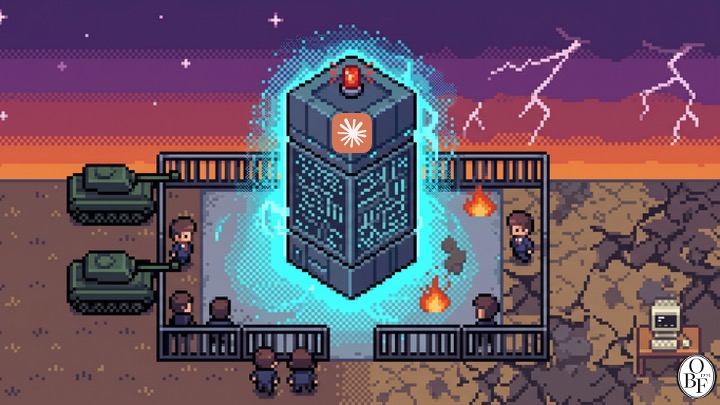
Whether this incident remains a one-off measure or gets repeated with other models can’t be determined from the June 12 announcement alone. Either way, companies now have reason to review how they’d prepare for the discontinuation of a specific service.
Korea, which also relies on overseas models and cloud infrastructure, faces the same dependency problem. Plans to secure domestic infrastructure are already underway. In October 2025, NVIDIA announced plans to build out more than 260,000 GPUs with the participation of the Korean government along with Samsung, SK, Hyundai Motor, and Naver. This doesn’t refer to a government-only allocation, nor does it mean the installation has already been completed. Beyond securing the hardware, the question of which models to keep running on top of it, and under what conditions, also needs attention.
Oswarld’s Lens
Honestly, I’m still a skeptic about sovereign AI. I think we need to weigh whether the returns actually justify the cost of building frontier models from scratch in each country. That said, as an investor I’m watching whether this incident could stimulate demand for self-owned infrastructure. If more countries invest in training and operating their own models, that could affect GPU demand too. The framing that splits training into GPUs and usage into CPUs oversimplifies how AI infrastructure actually works — GPUs are used for inference as well. How much expanded investment translates into revenue for which hardware depends on each country’s budget and its choices of models and equipment.
While building go-to-market strategy, I learned that when you outsource your operations to external infrastructure, the conditions under which you can keep using that service matter enormously. That includes the provider’s ability to shut off the service — often called a kill switch6. In the Fable 5 case, government guidance applied to the provider changed what was available to customers.
Simply acquiring your own computers doesn’t eliminate this dependency. If those computers still call an overseas API, you’re still dependent on an external service. Conversely, even if you secure a model you can run yourself, you still need usage rights, updates, hardware supply, and operating staff. You have to draw a concrete line between what you actually control and what you’re outsourcing.
I think this incident could support the case for expanded AI infrastructure investment. But NVIDIA’s past revenue growth doesn’t guarantee demand after this incident. You need to check actual budget allocations and orders before using this for investment judgments.
For business operations, whether you can keep core operations running if a service goes down may be more urgent than building the highest-performing model yourself. You should test whether you can switch to another model, and if needed, compare the cost of a self-operable model and infrastructure against the alternatives. Air-gapped deployment is also an option worth choosing when it fits the nature of the work and the operating environment.
Closing
Both the 1999 G4 case and the 2026 Fable 5 case involved commercial technology caught up in export controls. But with Fable 5, customers’ internet-based access to the model was cut off immediately. For companies that had already adopted it, or were considering adopting it, that difference matters.
When choosing an AI service, you need to look beyond performance and price to how the provider handles a supply disruption. It’s not enough to hear that alternative models exist. You need to actually migrate a real workload and confirm that the quality, response speed, and cost are all within acceptable limits.
If you’re running a service on top of an AI model, start by checking which functions would stop working if access to that model were cut off. It’s worth also checking whether those functions could be carried on by another model or by manual work, and how long recovery would take.
💬 Do you have a contingency plan in place in case the AI you’re using gets cut off? If you’ve ever had to switch to a different model, share your experience in the comments.
Keep the perspective, not the noise.
We choose one consequential shift and trace what sits beneath it, every other day.
Confirm once to finish subscribing.
Already a subscriber? Sign in to join the conversation


References & Further Reading
Primary sources
- Anthropic, “Statement on the US government directive to suspend access to Fable 5 and Mythos 5”, 2026.06.12. : Anthropic’s official statement in full. You can see the government directive’s content and Anthropic’s counterargument directly.
- CNBC, “Anthropic disables access to Fable 5 and Mythos 5 to comply with government directive”, 2026.06.12. : Lays out the technical differences between Fable 5 and Mythos 5, along with Anthropic’s prior red-team testing record.
- Fortune, “Anthropic disables Fable and Mythos AI models after U.S. government bars it from giving foreigners access”, 2026.06.13. : An in-depth piece that includes Peter Girnus’s comment that “if you market your own product as a weapon, the government will believe you.”
- Euronews, “Why Anthropic is halting access to its Fable 5 and Mythos 5 AI models”, 2026.06.13. : Captures reactions from European politicians on sovereign AI, including France’s Bardella and the UK’s Tugendhat.
Background
-
The White House, Export Controls on Computers, 2000.08.03. : Explains the performance and country-specific standards of computer export controls at the time, and the background behind their revision.
-
NVIDIA, Q4 FY2026 Earnings Call, 2026.02.25.
-
Gartner, Worldwide Sovereign Cloud IaaS Spending Will Total $80 Billion in 2026, 2026.02.09.
-
NVIDIA, South Korea AI Infrastructure, 2025.10.31.
-
Anthropic, Introducing Claude Fable 5 and Mythos 5, 2026.06.09.
-
Louis Anslow, “When the Mac was a Munition”, Pessimists Archive, 2024.01.24. : Looks back at the 1999 Power Mac G4 ad and the export restrictions surrounding it.
-
Futurum Group, “NVIDIA Q4 FY 2026 Earnings: Durable AI Infrastructure Demand”, 2026.02.27.
-
Kwon Seok-jun, “An Asymmetric Strategy for Korea’s ‘Sovereign AI’”, Hankook Ilbo, 2026.06.04. : A contributed piece that structurally analyzes Korea’s computing sovereignty problem.
-
Isaacus, “Our response to the US ban on Fable 5 and Mythos 5”, 2026.06.13. : A concrete example of how a non-U.S. AI company responded to the Fable 5 crisis. Useful for understanding the air-gapped, self-hosted strategy.

Footnotes
-
Jailbreak: A technique for bypassing an AI model’s safety guardrails to elicit responses that are normally blocked. It means neutralizing protections using a specific combination of prompts. ↩
-
Red Team: A security testing group that deliberately plays the role of an attacker to find vulnerabilities in a system. For AI models, it refers to a group of experts who systematically attempt to break through a model’s safeguards. ↩
-
GFLOPS: A unit of speed measuring one billion floating-point operations per second. It’s distinct from GFLOP, which denotes a total operation count. ↩
-
Air Gap: A method of physically isolating a system from external networks such as the internet. It reduces access via the network, but doesn’t eliminate every risk—such as those introduced through removable storage devices or updates. ↩
-
Sovereign AI: An approach in which a nation or organization seeks to secure control over the operating and usage conditions of data, models, and infrastructure. It doesn’t only mean producing all technology and equipment in-house. ↩
-
Kill Switch: An emergency shutoff mechanism that can immediately halt a system or service. In this case, the U.S. government’s export control directive effectively functioned as a kill switch. ↩
Related issues
Remote Work Was Already News in 1979
A 1979 BBC segment on office automation offers a way to measure what AI agents actually change inside organizations.
SocietyKorea Expands Illegal-Image Filtering to Community Uploads
From July, about 80 Korean platforms must screen public image uploads for illegal content, sparking cost and efficacy debates.
SocietyAustralia's Teen SNS Ban: Fewer Accounts, But Then What?
Australia removed 4.7M accounts, but did teen mental health actually improve?
Society
Your take shapes the next issue
What resonated most in this issue, or where has your experience been different?