

Toronto's Rosedale Weighs $200/Month AI Camera Watch
A Toronto neighborhood wants 100 households to pay C$200 a month for AI cameras that track every car on the street.
AI & TechA Proposal to Sign Up 100 Residents for AI Cameras
In Rosedale, one of Toronto’s wealthiest residential neighborhoods, a proposal has surfaced to install AI-powered license-plate recognition cameras throughout the area. The system would log every vehicle passing a resident’s home and send an alert whenever a car on a watchlist shows up. For residents worried about home break-ins, that’s an appealing pitch — but it comes with a catch: the cameras would also capture the movements of everyone who simply drives through the neighborhood.
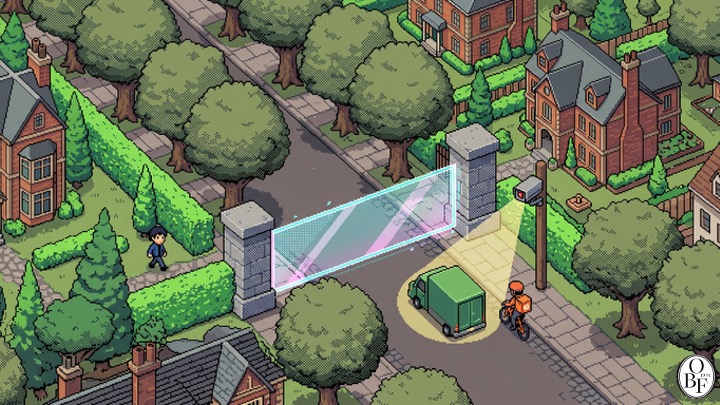
According to an April 7, 2026 report in The Guardian, the organizer behind the plan proposed first recruiting 100 households, each paying C$200 per month (₩200,000, ~$145). Because cameras would replace a physical gate in tracking who comes and goes, the plan was dubbed a “virtual gated community”1. At the time of reporting, residents were still just being pitched on joining.
Reading this, what caught my attention wasn’t just how good the cameras might be — it was how the whole thing would actually be run. Even if residents are footing the bill, someone else entirely controls who stores the data and who gets to access it. Who gets to view the footage, and under what circumstances it might be handed over to other institutions — those are the questions that actually determine what this plan is.
Residents Who Already Split the Cost of Private Security
The Guardian reported that Toronto’s overall crime decline sits at odds with Rosedale residents’ anxiety. It noted that the break-and-enter rate in Rosedale-Moore Park is more than double the city average. Even if citywide statistics have improved, residents who’ve experienced harm near their own homes may still want extra security.
Craig Campbell, who led the initiative, is a resident who runs a home-security company. According to the Guardian, he also holds the Canadian licensing rights for the US firm Flock Safety. In other words, he occupies two roles at once — resident and business operator for the very service being proposed. Residents weighing the proposal’s costs and benefits ought to know about this conflict of interest.
The resident WhatsApp group mentioned in the report numbered about 350 people, of whom as many as 60 were already splitting the cost of private security. This new camera-subscription proposal is a separate matter from that existing security cost-sharing arrangement. Still, knowing that the neighborhood has a history of jointly purchasing security helps explain the backdrop against which the new proposal emerged.
Crime Prevention Claims and the Scope of Data Sharing
Flock Safety sells ALPR2 systems that automatically read and search vehicle license plates. Because timestamps and locations are logged alongside each plate, connecting the records can reveal a vehicle’s entire route. Which data police and private customers can share with each other is the crux of the service.
Flock has used a figure of up to 70% crime reduction in its marketing. But “up to” doesn’t mean the average effect across every installation site. Even a before-and-after comparison around camera installation can be confounded by increased patrols or broader local crime trends. For residents to weigh the cost, they need to examine separately what kind of crime is actually being reduced, and by how much, in their specific area.
License plate misreads also need to be caught during the actual response process. Cameras can misread a plate or link a vehicle record incorrectly. There have been reported cases where innocent drivers faced forceful police responses because of license-plate recognition errors. Not all of these cases can be blamed on Flock’s product specifically, but it’s clear that whoever receives an alert needs to verify the original footage and vehicle information.
A Canadian privacy commissioner’s explainer on ALPR also lays out the problems that arise when a vehicle’s movement records are used to infer a person’s behavior. The registered owner may not even have been in the car at the time. Identifying a vehicle and determining what a specific person did there are two different things.
The scope of data sharing can end up wider than residents expect. An October 2025 report from the University of Washington’s Center for Human Rights confirmed that at least 8 law enforcement agencies in Washington State had directly shared Flock data with U.S. Border Patrol. Border Patrol belongs to CBP, a separate agency from ICE. The report also covered cases where data was accessed for immigration enforcement purposes via other local police departments acting as intermediaries.
This problem is different from an outsider hacking into the system. It means data can be used through sharing settings that local police themselves permitted, or through proxy searches conducted by other agencies. The University of Washington report also documented cases in 2025 where some cities canceled or suspended their contracts. Before adoption, it’s necessary to check not just the agency you’re directly contracting with, but also who that agency might, in turn, pass the data on to.
How do you get consent from a passerby?
Privacy regulators haven’t yet issued a specific ruling on the Rosedale plan. In the Guardian interview, Canada’s privacy authority said it hadn’t reviewed the concrete proposal either, but laid out the general principles of the law.
Canada’s federal privacy law, PIPEDA3, generally requires meaningful consent when personal information is collected, used, or disclosed as part of commercial activity. That means people need to be able to understand what’s being collected, who it’s shared with, and what the consequences are. The regulator’s guidance calls for clarity about the purpose of collection and keeping it to the minimum necessary scope. The fact that information exists in a public space doesn’t erase the obligations that come with collecting it commercially.
The proposed service would retain records for 30 days. The Guardian compared this to the Information and Privacy Commissioner of Ontario’s recommended 72-hour retention window for surveillance footage. But a recommendation aimed at public-sector video surveillance can’t simply be treated as a binding legal standard for this private service. The real question is whether a month’s worth of movement records can be justified by the system’s stated operational purpose.
The project’s backers say license plate records could be deleted upon request. But even with a deletion process in place, that doesn’t undo the fact that a car was captured by the camera in the first place. It’s also still unclear how delivery drivers or visitors would even be informed that their information is being collected and used.
The Same Question Applies to Korea’s Crime-Prevention CCTV
You’ll often hear calls in Korea to install crime-prevention CCTV in alleys or parks too. But it would be too simple to say Koreans universally accept surveillance while Westerners universally oppose it. Judgments shift depending on where the cameras go, what they’re for, and who runs them.
A piece in Statistics Korea’s Window on Statistics, Winter 2024 issue, put the number of CCTV units nationwide at roughly 19,600,000 as of 2022. Given how deeply embedded this equipment already is in daily life, we need to look closely at what changes when AI analysis and inter-agency data sharing get added on top.
For instance, checking footage from a specific time window after a crime has occurred is a very different act — in terms of scope of collection and use — from pooling license-plate records across multiple cameras to trace a single vehicle’s movements. Even under the same banner of “crime prevention,” what readers are actually being asked to consent to isn’t the same thing.
I want to run Rosedale’s proposal through three criteria. These are the same criteria Korea’s public CCTV systems need.
First: who operates it, and who is accountable. A public CCTV system run by a local government and a private service that residents pay for have entirely different contract and oversight structures. Public operation doesn’t automatically make something safe, and private operation doesn’t automatically make it improper. What matters is that there’s a clear party who explains and answers for things when complaints or incidents arise.
Second: who gets to view the data. You need to check retention periods, access rights, and the conditions and records under which data gets handed to other institutions. Simply printing the operator’s name on a signpost at the installation site doesn’t tell you nearly enough about how that data is actually shared.
Third: what criteria determine which vehicles get flagged. The proposal includes using lists of familiar vehicles versus vehicles to watch. Whether a vehicle gets classified as suspicious simply for being an outsider’s car isn’t something you can settle just by reading the public description — if anything, that’s exactly the criterion you need to pin down concretely. There also needs to be a clear process for adding and removing vehicles from the list, so that an ordinary visit or delivery doesn’t turn into an unnecessary report.
Those Who Pay Aren’t Those Who Get Recorded
The panopticon4 is a concept that comes up often when explaining surveillance. It helps explain part of this case too, but we can’t simply call a neighborhood with cameras installed a prison.
Jeremy Bentham’s proposed panopticon is a prison design where a central observer can see all inmates, while inmates can’t easily tell when they’re being watched. Michel Foucault, in Discipline and Punish, examined how the awareness of possibly being observed changes people’s behavior. In Rosedale too, it’s worth thinking about how repeated vehicle logging might affect the behavior of residents and visitors alike.
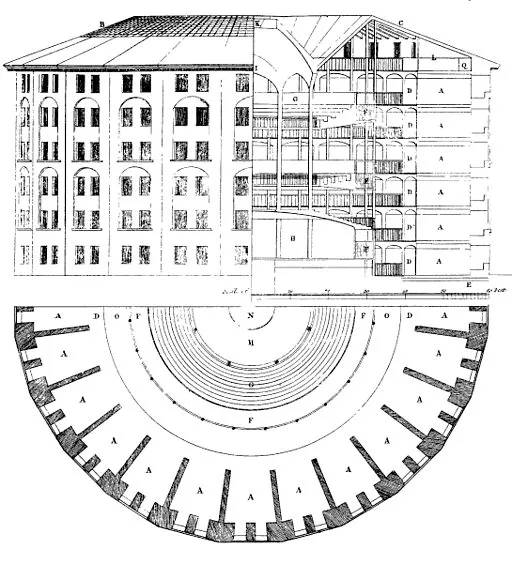
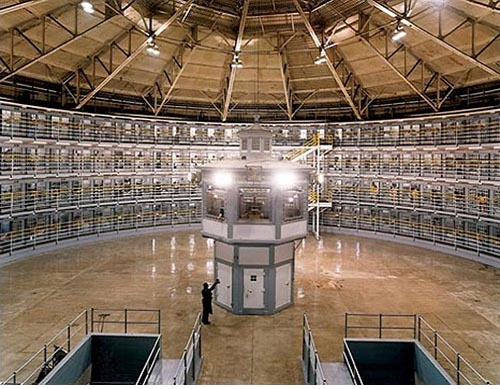
The first image is the panopticon blueprint; the second is the interior of Stateville Correctional Center, an American prison influenced by that design.
Under this proposal, some residents volunteer to pay for the surveillance system. But far more people get recorded by the cameras than the residents who agreed to pay. The question is whether the willingness of the paying residents can substitute for the consent of everyone who passes through the neighborhood.
Shoshana Zuboff’s discussion of “surveillance capitalism”5 helps us see what kind of profit companies extract by collecting behavioral data. That said, it hasn’t been confirmed that Flock sells Rosedale residents’ data as an advertising-prediction product. In this case, the first step is verifying the actual purpose of data use through the actual contracts and sharing settings.
Data collected to protect residents may end up including the residents’ own commute and visit records. Contracts need to spell out what happens to existing records when the operator changes or when a new agency starts receiving shared data.
Oswarld’s Lens
Having spent years building GTM strategy, I see this proposal as a case where you need to look not just at the technology, but at the paying customer and the people affected by the service, together.
First, the scope of the monthly subscription security service needs to be made explicit. Installing cameras and searching footage is one thing; actually preventing crimes or responding to harm is another. In a bundled product that combines a software subscription6 with guard services, you need to check who’s responsible for what, up to what point. I’m also worried about the safety gap that could widen between neighborhoods that can afford this kind of service and those that can’t.
Second, people who never signed a contract are affected too. Delivery drivers or maintenance staff aren’t customers of this security service, but their movements can still end up recorded. The vendor shouldn’t stop at explaining things to the paying residents — they need to tell these non-customers, too, why their data is being collected and how they can object.
Closing
I understand why Rosedale residents are worried about safety. But the decision to install cameras involves more than just crime-prevention effectiveness—it also involves a judgment call about the scope of how those records get used.
If it were up to me, I’d want to confirm three things before rolling this out.
- Whether it would actually help reduce the crimes the neighborhood is trying to address.
- Who uses the license plate and movement data, for how long, and for what purpose.
- How residents and visitors can dispute misclassification or unwanted use of their information.
It’s also worth checking whether what people were told at installation matches how the system actually operates afterward. If a service is introduced in the name of safety, I think it has to account for the rights of the people who never opted into using it in the first place.
The English draft matches the Korean source accurately with no issues found. Here is the fragment unchanged:
Keep the perspective, not the noise.
We choose one consequential shift and trace what sits beneath it, every other day.
Confirm once to finish subscribing.
Already a subscriber? Sign in to join the conversation


References & Further Reading
Primary sources
- The Guardian, “Row over ‘virtual gated community’ AI surveillance plan in Toronto neighbourhood”, 2026. : This is the main source for today’s newsletter. It contains detailed coverage of the Rosedale residents’ meeting and interviews with people involved.
- 404 Media, “Wildlife Conservation Police Are Searching Thousands of Flock Cameras for ICE”, 2026. : An investigative report tracking the latest case of Flock data being used for immigration enforcement.
- University of Washington Center for Human Rights, “Leaving the Door Wide Open: Flock Surveillance Systems Expose Washington Data to Immigration Enforcement”, 2025. : An academic report analyzing Flock audit logs in Washington State.
Background
- Michel Foucault, Discipline and Punish: The Birth of the Prison, Pantheon Books, 1977. : A classic that extends the panopticon concept into a metaphor for surveillance mechanisms across modern society. Worth consulting when thinking through how the mere possibility of being watched shapes behavior.
- Shoshana Zuboff, The Age of Surveillance Capitalism, PublicAffairs, 2019. : A must-read analysis of how surveillance and capitalism fuse in the AI era. The core concept is the “rendering of human experience as raw material.”
- Ivan Manokha, “Surveillance, Panopticism, and Self-Discipline in the Digital Age”, Surveillance & Society, 2018. : An academic paper analyzing how the panopticon concept has evolved in the digital age.
- Office of the Privacy Commissioner of Canada, “Privacy Tech-Know Blog: Who’s Watching Where You’re Driving?”, 2017. : Canada’s privacy watchdog analyzes the privacy implications of ALPR technology.
- Statistics Korea, “The Shift to Fourth-Generation CCTV”, Statistics Window, Winter 2024. : A Statistics Korea report summarizing the state of CCTV deployment in Korea and trends in AI CCTV technology.

Footnotes
-
Gated Community: A residential complex that controls outside access with a gate and security at the entrance. It’s a common form of housing among wealthy Americans, and the “virtual gated community” concept aims to achieve the same effect using AI cameras instead of a physical gate. ↩
-
ALPR (Automated License Plate Recognition): A technology in which cameras automatically photograph the license plates of passing vehicles, and AI reads the characters and cross-references them against a database. Think of it as a massively scaled-up version of a parking-lot payment system. ↩
-
PIPEDA (Personal Information Protection and Electronic Documents Act): Canada’s federal privacy law. It governs how private companies collect, use, and disclose personal information in the course of commercial activity — playing a role similar to Korea’s Personal Information Protection Act. ↩
-
Panopticon: A circular prison designed by 18th-century philosopher Jeremy Bentham. A central tower can see every inmate, but inmates never know whether they’re being observed at any given moment. The awareness that one could be watched is itself the structure that disciplines behavior. The concept became famous after philosopher Michel Foucault used it as a metaphor for modern society as a whole. ↩
-
Surveillance Capitalism: An economic structure analyzed by Shoshana Zuboff, describing how companies collect behavioral data and commercially exploit the predictions derived from analyzing it. ↩
-
SaaS (Software as a Service): A model in which users pay a monthly subscription instead of purchasing software outright. Slack and Notion are representative examples of workplace SaaS tools. ↩
Related issues
Elgg's 2007 Pitch: A Platform With No Features
In 2007, Elgg co-founder Ben Werdmuller unveiled a version with zero built-in features, letting communities choose their own tools.
AI & TechAmazon Buys Globalstar, Teams Up With Apple on Satellites
Amazon's $11.6 billion satellite acquisition signals a bigger push to own telecom infrastructure alongside subsea cables.
AI & TechWhat Data Would AI Need to Tell Smells Apart?
Smell sensors already exist, but turning their readings into AI training data that works across environments remains an unsolved problem.
AI & Tech
Your take shapes the next issue
What resonated most in this issue, or where has your experience been different?