

Amazon Buys Globalstar, Teams Up With Apple on Satellites
Amazon's $11.6 billion satellite acquisition signals a bigger push to own telecom infrastructure alongside subsea cables.
AI & TechAmazon’s Globalstar Acquisition Deal and Apple Partnership
On April 14, 2026, Amazon announced a deal to acquire satellite communications company Globalstar for roughly $11.6 billion. Shareholders can choose between $90 in cash per share or a set ratio of Amazon stock, though the total cash payout is capped. At announcement, the companies targeted a 2027 close, pending regulatory approval and other conditions.
I also paid close attention to the Apple partnership unveiled the same day. Under the agreement, Amazon LEO1 will power satellite services for iPhone and Apple Watch. The deal covers existing features like Emergency SOS and satellite messaging, with both companies committing to jointly develop future services.
Through this transaction, Amazon is securing not just satellites but spectrum rights, operating infrastructure, and a service relationship with Apple. This pattern of Big Tech investing directly in communications networks shows up in subsea cables too.
Submarine Cables Connecting Intercontinental Internet Traffic
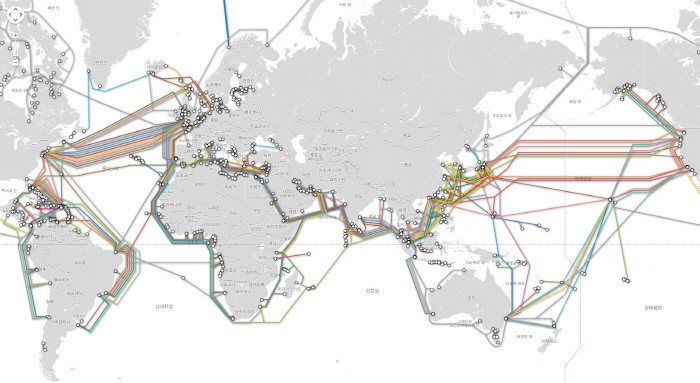
According to 2025 data from the Internet Society, roughly 97-98% of intercontinental internet traffic travels through submarine fiber-optic cables. This figure doesn’t cover all internet usage, including domestic traffic within a single country. The report counts 570 commercial submarine cables in operation as of 2025.
On top of this, cloud and content companies are investing more heavily — driven by the growing data transmission capacity their services require.
2023 data from TeleGeography shows that content providers’ share of international bandwidth usage rose from under 10% before 2012 to 71% in 2022. This category includes companies like Google, Meta, Amazon, and Microsoft. That figure doesn’t mean these four companies own 71% of cable capacity, though.
Some are investing directly in construction. In February 2025, Meta announced Project Waterworth, a roughly 50,000km cable system — described as a multibillion-dollar investment spanning several years.
Submarine cables have historically been built either through joint investment by telecom carriers and others, or owned outright by individual companies. Multiple companies co-investing doesn’t make a cable publicly owned. What’s new now is that large content and cloud companies are increasingly investing directly, on top of simply leasing capacity.
Such investment can expand transmission capacity and improve service quality. But as operation of key routes concentrates among a handful of companies, it’s worth watching the terms under which other operators secure capacity — and what alternatives exist when outages occur.
Satellite Internet and Direct-to-Smartphone Connections
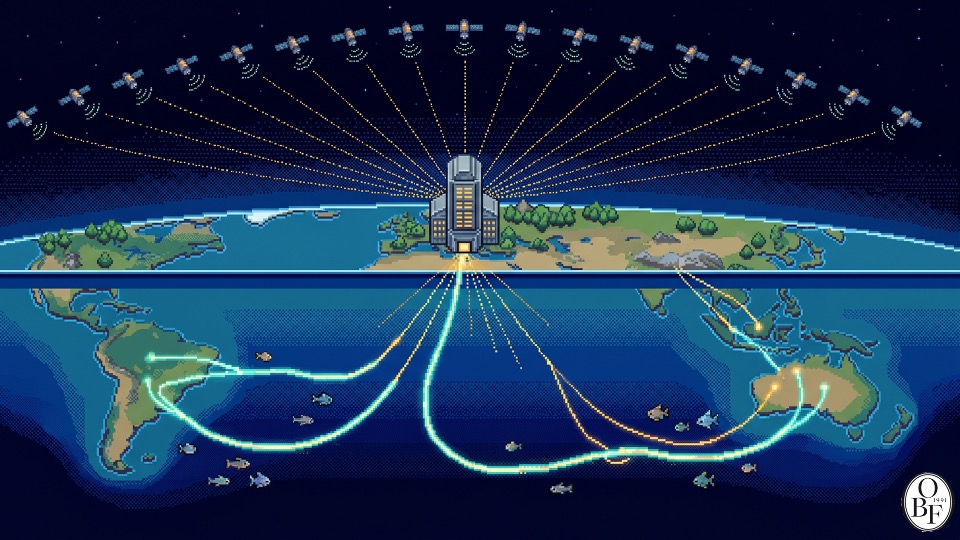
Low-earth-orbit satellite networks provide connectivity to regions that terrestrial networks struggle to reach, as well as to ships and aircraft on the move. Depending on the business, satellites are deployed at different altitudes ranging from a few hundred to roughly a thousand kilometers. Their role isn’t entirely identical to that of subsea cables, which remain the workhorse of high-capacity international communications — the two are better thought of as complementary.
Here are the operators worth comparing to this deal. Their service models and stages of development differ.
Starlink (SpaceX) already operates a large-scale satellite network. The company announced that its subscriber base topped 10 million in February 2026. Beyond its internet service using dedicated antennas, it’s also pursuing a business that connects directly to ordinary mobile phones in partnership with carriers, and it’s expanding into aviation and maritime communications as well.
Amazon LEO (formerly Project Kuiper) is still in the network-building phase. Once its acquisition of Globalstar closes, Amazon will gain existing satellite operations, spectrum rights, and ground stations2. Globalstar’s existing and future satellite networks are planned to operate alongside Amazon’s broadband satellite constellation. Amazon has said it will deploy its own next-generation D2D3 satellite system starting in 2028.
AST SpaceMobile is developing a service that connects ordinary smartphones directly to satellites, leveraging partnerships with carriers such as Vodafone, AT&T, Verizon, and Rakuten. The company says it has signed agreements with more than 50 carriers and has set a target of deploying 45–60 satellites by the end of 2026 — a goal, not a completed track record. Direct connection for ordinary smartphones isn’t a feature unique to AST; supported devices, regions, speeds, and capabilities vary by operator.
The Spectrum Amazon Wants, and Apple’s Partnership section looks accurate. Let me verify against the source.
The Spectrum Amazon Wants, and Apple’s Partnership
Globalstar holds spectrum usage rights and operational experience for mobile satellite services (MSS)4. Beyond building satellites, a company also has to coordinate frequency use to avoid interference with other networks and secure approval from individual countries. Because the International Telecommunication Union (ITU)5 coordination framework works together with country-specific regulations, launching a satellite doesn’t automatically mean a company can start offering service in any given country.
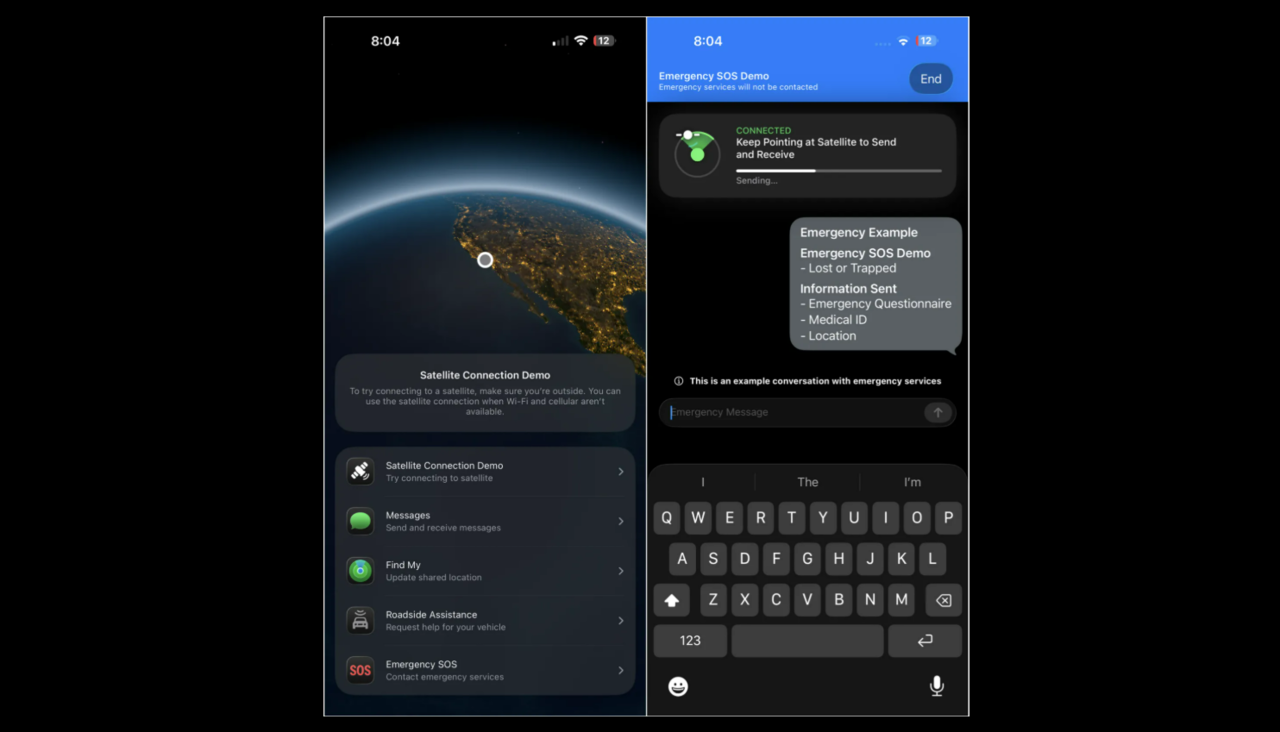
Apple has used Globalstar’s network to provide features like the iPhone’s satellite Emergency SOS. In 2024, it committed roughly $1.1 billion in advance payments to expand the satellite network, along with a separate equity investment in a specific entity. The 20% stake it secured for $400 million isn’t in Globalstar’s parent company as a whole, but in a related special purpose entity (SPE).
This new agreement with Amazon covers continuing service for supported devices that use Globalstar’s existing satellite network, while developing future features on Amazon’s expanded network. It doesn’t mean that all iPhone communications will shift to Amazon’s satellites the moment the announcement goes out.
Once the deal closes, here’s what it means for each company:
- Amazon can expand its satellite business on the back of Globalstar’s spectrum rights, infrastructure, and operational experience.
- Apple keeps its existing satellite features while gaining a foundation to develop new ones with Amazon.
- Competitors like Starlink need to watch how fast Amazon builds out its network and launches services. The acquisition deal alone doesn’t determine competitive outcomes.
Who Runs the Networks — and Do You Have a Choice?
Submarine cables form the core trunk lines for intercontinental communication — the backbone6. Satellite networks offer coverage across wide areas and serve as a fallback where connections have been cut. In both fields, it’s worth knowing who operates them and under what terms.
With submarine cables, large content and cloud companies are growing into major users and investors alike. Still, capacity usage, equity investment, and sole ownership are three distinct things.
In satellite communications, American companies like Starlink, Amazon, and AST are competing. But they’re not the only players in this market. European operators and various countries’ national satellite plans deserve equal attention.
When a country or company depends heavily on a single network, it becomes exposed to that operator’s changing terms of service or a shutdown of operations. That’s why having multiple routes and suppliers to choose from matters just as much as who owns the network.
Communications need to stay up during disasters and security crises too, which ties this back to whether governments secure the necessary technology and backup capacity.
The EU’s IRIS² is a multi-orbit communications network plan that would place roughly 290 satellites in low and medium earth orbit. Official EU materials describe a target service launch in 2030. China is pursuing its own large-scale communications satellite network as well. These plans reflect efforts to reduce dependence on foreign operators — but it’s worth distinguishing between the scale of a plan and the actual service capability it delivers.
Oswarld’s Lens
I see this deal as Amazon’s strategy to directly secure the assets it needs for telecommunications services. Owning the network can make it easier to manage capacity and quality. But that also means bearing the costs of construction and maintenance, and being subject to regulation and competition. A company that owns the network doesn’t necessarily dictate every condition of the market.
Google’s undersea cable investments and Amazon’s satellite network investments can be viewed through the lens of vertical integration7—running services and infrastructure together. Amazon and Apple’s partnership, however, is a collaboration between separate companies. Amazon isn’t taking ownership of the iPhone or Apple’s device business.
Korea is pursuing a low-earth-orbit satellite communications technology development project worth roughly ₩320 billion (~$230 million). The plan calls for building a demonstration network by 2030, including two communication satellites based on the 6G standard, along with ground stations and terminal stations. The lead organizations selected in 2025 are ETRI, handling the communication payload and ground stations; Solid, handling the terminal stations; and KAI, handling the satellite body and system integration.
I, too, feel the scale gap with overseas operators keenly. But you can’t directly compare the number of satellites in a two-satellite demonstration network built to verify technology with a commercial satellite network serving customers worldwide. What matters is what core technologies Korea secures, and how it translates those achievements into actual industry and services. I think we need to weigh both independent technology development and cooperation with overseas operators together.
Closing
I’ve invested in AST SpaceMobile stock ($ASTS) and profited from it, with an average purchase price of $18.35. I should mention that my investment experience may color how positively I view this sector.
There are three things I’ll be watching in this deal.
- Whether Amazon actually closes the acquisition by meeting regulatory approval requirements and deal conditions.
- Whether the spectrum and infrastructure it secures translate into real improvements in satellite service quality and coverage.
- Whether countries and users retain the ability to choose alternative means of communication, rather than becoming overly dependent on a single operator.
As infrastructure investment grows, the odds improve that places once hard to connect will get access to communications. Alongside that benefit, though, I think we also need to keep an eye on what alternatives exist if the service is disrupted or the terms change.
Looking at the fragment, I compared structure, numbers, links, footnotes, and terminology against the Korean source. Everything matches well — headings, footnote count (7), links, image, and numbers are all preserved correctly. No Hangul remains. One minor issue: “Ministry of Science and ICT” should retain consistency, and I’ll verify the video title translation is accurate. The draft looks clean overall.
Keep the perspective, not the noise.
We choose one consequential shift and trace what sits beneath it, every other day.
Confirm once to finish subscribing.
Already a subscriber? Sign in to join the conversation


References & Further Reading
Primary sources
- Amazon, “Amazon to Acquire Globalstar and Expand Amazon Leo Satellite Network”, Amazon Press Center, 2026.4.14. : This is the official press release announced on April 14, 2026. It covers the acquisition terms, the agreement with Apple, and the full D2D strategy.
- Bloomberg, “Amazon to Acquire Globalstar for $90 a Share”, 2026.4.14. : This gives you the details on the acquisition price and deal structure.
Background
- Internet Society, “Enhancing the Resilience of Submarine Internet Infrastructure”, 2025.11. : A policy brief on the vulnerability and resilience of submarine cable infrastructure. It’s a good way to frame why cables matter in the first place.
- The Register, “Hyperscalers tying up the world in submarine cables”, 2024.9. : An article laying out Big Tech’s submarine cable ownership — with concrete figures like Google’s 33 cables and Meta’s 15.
- Ministry of Science and ICT · Korea AeroSpace Administration, “Korea Moves to Fully Address the Age of Low-Earth-Orbit Satellite Communications”, 2025.4. : An update on the progress of Korea’s low-Earth-orbit satellite communications technology development program.
Related videos
- Starlink vs. Amazon vs. AST SpaceMobile — Who Will Dominate the Future of Communications? : A deep-dive video on the competitive landscape among Starlink, Amazon LEO, and AST SpaceMobile.

Footnotes
-
LEO (Low Earth Orbit): This refers to orbits roughly 200–2,000km above the Earth’s surface. The geostationary satellites we’re familiar with from TV broadcasting sit about 36,000km up. LEO satellites are much closer, which means less signal lag and faster internet connections — but because they circle the Earth quickly, you need multiple satellites working together. The exact number needed depends on the service area, capacity, and orbit. ↩
-
Ground Station/Gateway: This is the ground-based facility that exchanges signals between satellites and Earth. It acts as the relay point connecting data received by satellites in space to terrestrial internet networks. Globalstar owns more than 20 of these ground stations worldwide, and this infrastructure alone gives the company considerable value. ↩
-
D2D (Direct-to-Device): This is technology that lets a regular smartphone communicate directly with a satellite, without a dedicated antenna (dish) or separate equipment. It only works if the device, network, and region all meet the required conditions. The iPhone’s satellite Emergency SOS can be seen as an early form of D2D. ↩
-
MSS spectrum (Mobile Satellite Service Spectrum): This is the internationally allocated radio frequency band used to deliver communication services to mobile devices via satellite. It’s important to distinguish between the international allocation/coordination of frequency bands and the actual usage licenses granted to individual operators. Real-world service requires country-specific licensing and interference coordination. ↩
-
ITU (International Telecommunication Union): This is the UN agency responsible for allocating radio frequencies and coordinating satellite orbits. Since radio frequency is a finite resource, any company or country wanting to use a specific frequency has to go through ITU coordination. That’s why it takes new satellite operators years to secure spectrum. ↩
-
Backbone: This refers to the core trunk network that internet traffic flows through. Submarine cables are a critical part of the intercontinental backbone. The role a satellite network plays depends on how it’s designed — it can serve as a user’s access network or as a fallback when connections go down. ↩
-
Vertical Integration: This is a strategy where a single company directly owns and operates multiple stages of a product or service’s supply chain. Apple handling everything from chip design to software to retail operations is a classic example. It’s worth distinguishing between Amazon directly owning satellite infrastructure and Apple supporting device services through a partnership. ↩
Related issues
What Data Would AI Need to Tell Smells Apart?
Smell sensors already exist, but turning their readings into AI training data that works across environments remains an unsolved problem.
AI & TechAI-Run Store Paid Women $2 Less an Hour
A San Francisco store run by AI reportedly paid female staff $2 less hourly than a male colleague, raising questions about how such decisions get reviewed.
AI & TechWhy Hancom's PDF Parser Topped GitHub Trending
Hancom released a PDF extraction tool under Apache 2.0, and developers noticed—here's what the benchmarks and business model reveal.
AI & Tech
Your take shapes the next issue
What resonated most in this issue, or where has your experience been different?