

TikTok's $10 Billion Fee to the U.S. Government
Reports say TikTok's US investors agreed to pay Washington $10 billion on top of their equity stake—here's what that fee actually buys.
BusinessThe $10 Billion Owed to the Government
In March 2026, the Wall Street Journal and the New York Times reported that investors1 joining the TikTok US joint venture had agreed to pay the US government roughly $10 billion in fees. This is on top of, and separate from, the money they’re putting into the venture itself. WSJ report
What’s controversial is that the government is collecting this much simply for approving and brokering the deal. It’s tempting to compare this to an advisory fee paid to an investment bank, but the government also holds the power to approve or block the transaction outright. So the first question to answer is: what, exactly, is this money paying for?
The new entity’s publicly discussed valuation is $14 billion. Divide $10 billion by that figure and you get roughly 71%. Senator Mark Warner made this same comparison in demanding an explanation from the Treasury Department. That said, the 71% figure isn’t an official, established fee rate. How the fee amount was actually calculated still needs to be disclosed separately. Senator Warner’s inquiry
What the New Joint Venture Handles
The law passed by the US Congress in 2024 imposed distribution restrictions within the US on TikTok if it failed to meet requirements for resolving foreign adversary control. After the Trump administration repeatedly delayed enforcement while negotiations proceeded, a new entity, TikTok USDS Joint Venture LLC, launched in January 2026.
According to the official announcement, Oracle, Silver Lake, and Abu Dhabi’s investment firm MGX each hold 15% of the joint venture, while ByteDance holds 19.9%. This entity is responsible for protecting US user data, algorithm security, and content moderation. TikTok’s joint venture announcement
Some commercial activities—advertising, e-commerce, marketing—remain under the control of TikTok Global’s US entity. So describing the new joint venture as having taken over TikTok’s entire US business outright would misrepresent the scope of the deal.
The $10 billion (~$10 billion) fee is a separately reported item attached to this deal. Reporting cited by Senator Warner states that investors have already paid $2.5 billion to the Treasury Department, with the remaining $7.5 billion to be paid in installments. The senator demanded confirmation of the facts, the legal basis, how the amount was calculated, and how the funds would be used. March 17, 2026 inquiry announcement
I think the government owes an explanation here. Restructuring a deal for national security reasons and collecting money for having brokered that deal are two different things, each requiring its own justification and rationale.
Looking at the fragment, I compared it carefully against the Korean source for numbers, meaning, structure, and glossary compliance. The translation is accurate and complete—all numbers match, headings/footnotes/links align, and no Hangul remains. Only minor polish is needed.
Equity Stakes, Veto Rights, and Revenue Cuts Are Not the Same Thing
Since 2025, the U.S. government has inserted itself into private-sector deals through several distinct mechanisms. Even when the intervention looks similar on the surface, we need to distinguish between cases where the government puts up money and receives equity, and cases where it demands authority or payment as a condition for approval.
Equity stakes and stock acquisition rights. Intel announced in August 2025 that it had agreed to an $8.9 billion common-stock investment from the U.S. government. At the time of the announcement, the stake stood at 9.9%, funded by $5.7 billion in unpaid CHIPS Act2 grants and $3.2 billion from the Secure Enclave program. The company explained that the government would be a passive investor without a board seat. Intel announcement
In the case of the rare-earth company MP Materials, the deal included $400 million in convertible preferred stock plus additional rights to acquire stock. The “15%” figure cited at announcement was calculated on the assumption that this preferred stock was converted and the rights fully exercised. MP Materials announcement
The agreement involving Lithium Americas granted the right to acquire 5% each in the company and in its joint venture with GM — not an immediate 10% stake in a single company, as some coverage implied. U.S. Department of Energy announcement Trilogy Metals also announced a planned government investment, but in its fiscal year-end results released in February 2026, it still described this as a conditional investment commitment rather than a completed one. Trilogy Metals announcement
Consent rights over specific management decisions. Nippon Steel’s acquisition of US Steel included a structure granting the U.S. government a “golden share.”3 Under this arrangement, government consent is required for decisions such as scaling back investment commitments, relocating headquarters, or closing or idling certain plants. US Steel announcement
In September 2025, the White House said it had warned that it could invoke this authority, and that the warning alone had stopped a decision to idle the plant in Granite City, Illinois. It’s worth distinguishing between actually exercising this power and merely threatening to. AP report
Export licenses and revenue-sharing demands. In August 2025, reports surfaced that some of Nvidia’s and AMD’s AI chip sales to China would be subject to a condition requiring 15% of revenue to be paid to the government. Nvidia later addressed this in its annual report filed in February 2026, explaining that government officials had expressed an expectation of receiving 15% or more of licensed sales revenue, but that no formal rule codifying this had been published. This is a point where we shouldn’t jump to treating it as an already-established, operating general fee system. Nvidia SEC filing
Transaction fees. The reported $10 billion figure tied to TikTok involves a different flow of money than the earlier cases where the government put up the investment capital — here, investors are the ones paying a separate sum to the government. I don’t think it’s right to ignore that distinction and lump all of these together as the same “investment strategy.”
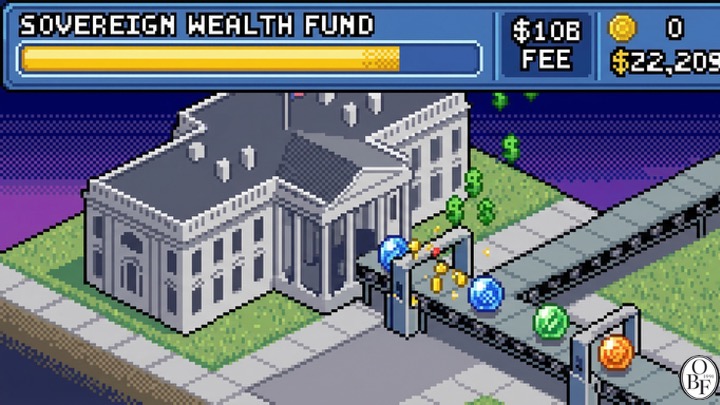
Kevin Hassett, Director of the National Economic Council, has described the government’s corporate investments as an early stage of a sovereign wealth fund4 initiative. Axios report But that statement alone doesn’t settle what the TikTok fee proceeds will actually be used for.
What Evidence to Check, and the Market Impact
I think there are three things worth watching as more deals like this emerge.
The first is the legal basis and the calculation standard the government uses when demanding payment. In a negotiation where a company’s ability to keep operating or to export is on the line, the mere fact that the company “agreed” doesn’t resolve every question. In the TikTok case, too, Senator Warner is demanding documents and explanations from the Treasury Department.
The second is the possibility that investment will flow toward companies backed by the government. Scott Lincicome of the Cato Institute has criticized the way market expectations swelled after the government’s investment in Intel, pointing out that capital allocation could end up being driven more by a company’s relationship with the government than by its actual business prospects. Cato Institute post
I take this concern seriously too. That said, a rising stock price alone doesn’t prove the government is guaranteeing a company’s losses. We need to look at the actual contracts to see what risks the government and private shareholders are each taking on.
The third is the possibility that other countries make similar demands. Once a precedent is set where a government ties market access or deal approval to a separate monetary payment, other governments may take note. This hasn’t become an international standard yet, but for companies operating abroad, it’s a shift worth watching.
Oswarld’s Lens
I’d like to call this pattern “the assetization of regulation.” What I mean is that in the course of exercising its regulatory authority, the government ends up securing money, equity, or a say in a company’s decision-making.
Think of fields like Socar or Toss, where licensing is tightly bound up with the business itself — it’s easy to see how much regulatory conditions matter to a company. The time and resources spent obtaining approval are themselves a cost. But we need to distinguish between the cost of complying with existing rules and paying the government a separate price on top of that.
What worries me is when that price is set through individual negotiation rather than a common rule applied to everyone. If companies running similar businesses end up with very different burdens depending on how their negotiations with the government go, it becomes hard for any of them to predict the cost of their next investment. It also becomes hard to verify whether competitors are held to the same standard.
We also need to look at who actually bears the fee. If, as reported, investors are the ones paying, that could first affect investor returns. It’s plausible that this later ripples into ad pricing, service investment, or creator payouts, but we can’t simply assume the cost will necessarily be passed on to users. The contract terms and business operations need further scrutiny.
The $14 billion valuation, too, needs to be examined starting with what exactly is being valued. Since the new joint venture’s operations and part of TikTok’s advertising and e-commerce business are separated out, it’s hard to directly compare this figure to TikTok US’s total revenue or Snapchat’s entire market cap. Rather than declare the valuation too high or too low, I think we can only properly judge how burdensome the fee is once the assets being acquired and the profit-sharing terms are disclosed.
Closing
The reporting on TikTok’s fee raises a broader question: what should a government receive in exchange for involving itself in a corporate deal? Investing money in Intel and collecting money from TikTok’s investors are two different kinds of transactions. Each one’s purpose, authority, and cost burden need to be examined separately.
I think what matters as much as the size of the revenue or stake the government secures is the process by which its terms are set. The basis for calculating the amount and how it will be used need to be explained, and predictable standards need to apply to competitors as well — only then can companies and readers alike properly evaluate the deal.
Keep the perspective, not the noise.
We choose one consequential shift and trace what sits beneath it, every other day.
Confirm once to finish subscribing.
Already a subscriber? Sign in to join the conversation


References & Further Reading
- Report on TikTok deal fee, WSJ, 2026.03: covers the fee that, separate from the investment itself, was reportedly agreed to be paid to the government.
- Senator Warner’s inquiry to the Treasury, 2026.03.17: raises questions about how the reported payment amount was calculated, its legal basis, and its intended use.
- Official announcement of the TikTok USDS joint venture, 2026.01.23: explains the equity structure and the responsibilities of the joint venture.
- Intel’s government investment agreement, U.S. Department of Energy’s Lithium Americas agreement: documents laying out the investment structure of each deal.
- Announcement of the completed U.S. Steel acquisition: explains the government’s rights included in the golden share.
- Nvidia’s fiscal year 2026 annual report: the company’s own account of China export licenses and the government’s revenue-sharing demands.
- Scott Lincicome, Tracking the Unseen Costs of “State Corporatism”, Cato Institute, 2026.01.30: a critical analysis of how government investment in companies could affect capital allocation.

Footnotes
-
Consortium: an alliance formed by multiple companies or institutions to jointly carry out a specific project or investment. ↩
-
CHIPS and Science Act: a U.S. law enacted in 2022. It includes programs for semiconductor manufacturing support, R&D, and workforce development. Subsidies and tax credits are distinct forms of support. ↩
-
Golden Share: a share that grants its holder special rights, such as veto power or consent rights, over specific matters. The exact powers vary depending on the contract and the company’s articles of incorporation. ↩
-
Sovereign Wealth Fund: a state-owned investment vehicle that manages government-held funds across various assets. The mere fact that a government holds shares in an individual company is not considered the formation of a sovereign wealth fund. ↩
Related issues
Five Takeaways From China's 15th Five-Year Plan
Beijing's 2026-2030 blueprint ties tech self-reliance and AI adoption to a consumption push, with growth targets set year by year.
BusinessPerplexity's Gross Margin vs. Its Overall Losses
I look at how Perplexity classifies costs, converts free users, and expands features—and why staying power, not just paid conversion, matters most.
BusinessMeta Accused of Targeting Teens' Emotions in Ads
A whistleblower's Senate testimony claims Meta flagged teens' insecure moments for advertisers—so what about adults?
Business
Your take shapes the next issue
What resonated most in this issue, or where has your experience been different?