

Samsung Pay Deal Passes, but Unions Split 80.6% vs 21.1%
Samsung's wage deal passed overall, but its two unions split sharply—raising bigger questions about dividing AI-boom profits.
BusinessThe same wage deal, judged differently by each union
On May 27th, Samsung Electronics’ tentative wage agreement was approved with 73.7% in favor. Turnout was 95.5%. But the results diverged sharply by union. According to reports, the Samsung Electronics branch of the Chogi-eop Labor Union (Korea’s inter-enterprise union, whose members skew toward the DS—chip—division) approved it at 80.6%, while the National Samsung Electronics Union (centered on the DX—device—division) approved it at only 21.1%. These aren’t approval rates measured separately across each division’s entire workforce. Samsung Electronics’ announcement
This conflict fed into a broader debate over who gets to divide the profits from the AI boom, and by what standard. Inside the company, compensation criteria came up; so did how the government spends the taxes it collects, and the wages of workers at subcontractors. These issues are connected, but the decision-makers and the funding sources behind each are different.
I’ve raised this case as a question in classes and public talks alike. Was the problem the amount paid? The duration over which it’s paid? Or who gets paid? In my view, this isn’t something you can fix by changing just one of these variables. What comes first is figuring out how to evaluate who actually contributed to performance, and what principle should apply across both boom times and downturns.
Three Proposals Raised Together in May
At the time, reports estimated that a Memory Business Division employee earning an annual salary of ₩100 million (~$72,000) could see performance bonuses reach roughly ₩600 million (~$434,000). That figure combined a special management performance bonus—calculated using the company’s annual profit outlook—with the OPI1 and other payouts. It wasn’t a confirmed figure for every DS employee; it varies by division, individual conditions, and actual performance.
For the DX division, treasury-stock compensation worth about ₩6 million (~$4,300) was mentioned. Comparing that number with the Memory division’s estimated special bonus is where the phrase “roughly a 100x gap” came from. It shouldn’t be read as an apples-to-apples comparison of the two divisions’ total salaries and all bonuses combined.
Why this gap didn’t stay confined to one company’s labor dispute becomes clear in the string of government and labor-management moves that unfolded throughout May.
On May 11, Kim Yong-beom, Senior Presidential Secretary for Policy at the Blue House (Cheongwadae, Korea’s presidential office), posted on Facebook that the gains from the AI infrastructure industry needed to be shared with the public as well. Media reported this as a suggestion that if the semiconductor boom generated tax revenue beyond projections, that surplus should fund a citizen dividend. The Blue House clarified that this was his personal opinion, unconnected to any internal discussion or review.
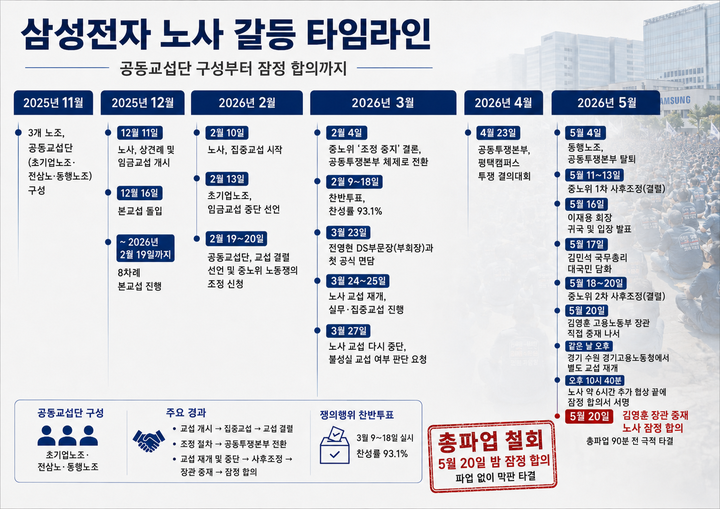
On the night of May 20, Samsung Electronics’ labor and management reached a tentative agreement just ahead of a scheduled general strike. Kim Young-hoon, Minister of Employment and Labor, also stepped in to mediate. The agreement concerned wages and compensation between the company and its employees.
Discussion of a sovereign wealth fund2 followed. On May 30, Deputy Prime Minister Koo Yun-cheol laid out a plan to funnel a significant share of excess tax revenue into such a fund. The idea was to invest the government’s collected resources to generate long-term returns and lay the groundwork for future industries. The specific funding sources and operating principles still need to be worked out separately.
Minister Kim Young-hoon proposed opening a discussion on a “Korean-style social solidarity wage”3. The underlying concern was narrowing the wage gap between primary contractors and subcontractors, and between large corporations and small and midsize enterprises. The Ministry of Employment and Labor had announced a forum for June 1 but postponed it, saying it wanted to gather a wider range of opinions first. No concrete wage system had been finalized at that stage. Report on the forum’s postponement
The citizen dividend is a proposal about who receives tax revenue. The sovereign wealth fund is about how public resources get invested. The social solidarity wage is about how to narrow compensation gaps within the labor market. Treating all three as different ways of splitting up the same pot of money only muddles the discussion.
What Countries That Manage Resource Windfalls Can Teach Us
Countries that have experienced resource booms have long grappled with how to spend a sudden surge in income. Dutch disease4 describes the phenomenon where resource exports drive up a currency’s value, weakening the competitiveness of other export industries. Political corruption and overdependence on a single industry also shape how resource-rich countries fare. It’s hard to pin any single country’s outcome on one cause alone. The IMF’s explanation of the concept
Norway’s GPFG5 was established by legislation in 1990, and the fund received its first capital in 1996. It’s structured to invest oil revenue for the long term while also transferring funds into the national budget. The fiscal rule requires spending to align with the fund’s expected long-term real return, and since 2017 that benchmark has been 3%. Returns aren’t the same every year, nor is it true that the principal can never be touched under any circumstances. The fund’s history · Norway’s government fiscal rule
Alaska pays residents an annual dividend from its Permanent Fund. The Norwegian model—transferring funds into the government budget—and the Alaskan model of paying residents directly differ in who benefits and how the money is disbursed. Whichever model Korea looks to, this distinction needs to be examined first.
Taiwan also implemented a cash payout of NT$10,000 per person in 2025. But you can’t attribute the entire excess tax revenue to taxes paid by semiconductor companies alone, nor can you conclude that the cash payout by itself caused Dutch disease. You have to look at both where the funds came from and their effect on consumption and investment. Taiwan’s Ministry of Finance payout guidance
When applying these cases to Samsung Electronics’ bonus controversy, you need to distinguish between who owns the money and who decides how it’s used. A sovereign wealth fund is an institutional arrangement for managing taxes the government has collected or assets it holds. Samsung Electronics is a private company, and employee compensation is determined by labor-management agreement and the company’s own decision-making. Government tax revenue and company profit may be connected, but they aren’t the same money.
Even within Samsung Electronics, business conditions differ between the semiconductor division and the smartphone/home-appliance divisions. As compensation tied to the semiconductor boom concentrated in one particular business unit, the sense of relative alienation within the DX division grew. Roh Tae-moon, head of the DX division, sent a message saying he feels a sense of responsibility for the disappointment and alienation employees feel.
Samsung Electronics’ Roh Tae-moon: “I feel responsible for the DX division’s sense of alienation” | Yonhap News(Seoul=Yonhap News) By Kang Tae-woo, reporter — Roh Tae-moon, CEO and head of Samsung Electronics’ Device Experience (DX) division, following the passage of the “2026 provisional wage negotiation agreement” on the 27th…Collecting taxes and using them as public funds, and intervening in a company’s terms of employee compensation, are governed by different authorities and procedures. Even if the semiconductor boom is generating debate on an unprecedented scale, it’s not accurate to say there’s no precedent whatsoever for profit-sharing or for gaps in taxation and wages. We need to examine what from existing systems applies here, and what needs to change.
Looking at the fragment, everything appears accurate and complete. One minor fix needed: the ₩ amount format should match the glossary instruction style more precisely.
Why This Debate Extends Beyond Samsung Electronics
Bloomberg also covered Korea’s debate over how AI-driven wealth gets distributed, using Samsung Electronics’ bonus payout as its entry point. Korea is a country where memory-chip manufacturing looms so large in the economy that swings in profits and compensation gaps become visible on a national scale.
The boom at Samsung Electronics and SK Hynix affects more than employee pay—it ripples into supplier revenue, regional consumption, and government tax receipts. That said, annual operating profit and corporate-tax projections can still shift before the actual year-end accounts and tax payments are finalized. Treating a forecast as a locked-in pool of money ready to be divided up calls for caution.
Compensation benchmarks can also shape how other companies compete for talent, since employees compare their pay and bonuses against rivals’. TSMC, too, has seen controversy over its bonus levels and the company’s subsequent explanations reported in the press. Still, it’s a stretch to claim that a single agreement at Samsung Electronics directly triggered another company’s pay-raise decision.
AI’s impact also varies by industry. In some fields, like semiconductors, rising demand drives up compensation; in others, automation is reshaping hiring and job roles altogether. So rather than focusing only on the compensation of sectors where profits have grown, we need to also discuss the jobs and transition costs facing other workers.
Samsung Electronics announced it would set aside ₩5 trillion (~$3.6B) over five years for shared-growth initiatives and future talent development following the agreement. But such commitments can only really be assessed once we see who actually benefits, how the funds are spent, and what results follow. Employee bonuses, corporate social contributions, and government fiscal policy each need to be examined according to their own responsibilities and procedures.
Oswarld’s Lens

Before we even name the three proposals, I think we need to be clear about who’s paying and who’s accountable. If we skip the questions of whose money is being decided by whom, and toward what outcome it’s meant to serve, we end up using the same words to argue completely different things.
In covering corporate tech strategy, I’ve often seen conflict arise when the party that contributes to profit differs from the party that actually receives it. Even a semiconductor fab doesn’t run on the efforts of employees and investors alone — it needs the foundations society provides: electricity, water, roads, education. I think some social return that accounts for those contributions is warranted. That said, we also need to keep in mind that corporate profit is already distributed through multiple channels beyond wages and bonuses — taxes, investment, shareholder dividends among them.
A national dividend, a sovereign wealth fund, and narrowing wage gaps can all be examined together, since the people who need cash support, the sectors that need long-term investment, and the suppliers whose deal terms need improving may all be different groups entirely. Before settling on some fixed ratio for blending the three approaches, we first need to establish who the targets are, what the purpose is, where the funding comes from, and what criteria will measure success.
Companies also face the task of building compensation systems that retain people over the long haul. A bonus calculated from one year’s profit outlook can’t be assumed to repeat at the same level for years running. A large payout might widen an employee’s options, but that alone doesn’t prove it drives more turnover or early retirement. I think what’s needed is a standard that holds up through both boom and bust, designed alongside the substance of the work itself and real opportunities for growth.
South Korea’s experience here could offer a reference point for other countries wrestling with AI-driven profit and compensation gaps. But for that to happen, what needs to be left behind isn’t the headline figures announced, but the actual outcomes of the system. We should be able to verify whether wage gaps actually narrowed, whether investment continued, and whether the support reached the people who needed it.
Closing
The semiconductor boom has raised questions ranging from Samsung Electronics’ internal bonus criteria to how national tax revenue should be used. A citizen’s dividend, a sovereign wealth fund, and a social solidarity wage are proposals with different decision-makers and different aims. I think we need to be clear about these differences before we can talk about how to raise both corporate competitiveness and social contribution at the same time.
Where do you think the extra tax revenue from the semiconductor boom should go? Whether the term “excess profit” is even the right one to use is also up for debate. Let me know in the comments what standard you used to make your judgment.
Keep the perspective, not the noise.
We choose one consequential shift and trace what sits beneath it, every other day.
Confirm once to finish subscribing.
Already a subscriber? Sign in to join the conversation


References & Further Reading
Primary sources
- Bloomberg, “Huge AI Bonuses in South Korea Spark Fight Over Sharing Tech Wealth”, 2026.5.30. : This is the Bloomberg deep-dive that started this whole newsletter. It even includes on-the-ground interviews from Pyeongtaek.
- Hankyung (Korea Economic Daily), “Samsung Bonuses Caught Between the Yellow Envelope Act and the Commercial Act — Is the Shareholder-Labor Conflict Escalating?”, 2026.5.27. : The most detailed breakdown of the vote results and the approval-rate gap between the DS and DX divisions.
- Financial News, “Kim Yong-beom: ‘Turn AI Profits Into a National Dividend’ — Blue House Distances Itself, Calls It a ‘Personal Opinion’”, 2026.5.12. : Covers how the national-dividend proposal came about and how the market reacted.
- Edaily, “Koo Yun-cheol: ‘We’ll Put a Significant Share of Excess Tax Revenue Into a Sovereign Wealth Fund’”, 2026.5.30. : Lays out the official position of Deputy Prime Minister Koo Yun-cheol.
Background
- Munhwa Ilbo, “Semiconductor Excess Tax Revenue and the ‘Sovereign Wealth Fund’ — Do It Properly, Like Norway”, 2026.5.22. : An editorial comparing Norway’s fund with Taiwan’s direct cash payouts. Worth reading with a clear eye for where the facts end and the author’s own policy judgment begins.
- Herald Corp (Herald Economy), “Kim Young-hoon: ‘Emergency Debate on a Korean-Style Solidarity Wage Policy, June 1’”, 2026.5.27. : Explains the background of the solidarity-wage idea alongside Sweden’s Rehn-Meidner model.

Footnotes
-
OPI (Overachievement Performance Incentive): a bonus program at Samsung Electronics that pays employees when a division’s operating profit exceeds its target. Payouts can reach up to 50% of annual salary. ↩
-
Sovereign Wealth Fund (SWF): an investment fund built from a nation’s foreign-exchange reserves or fiscal surpluses, invested long-term to build wealth for future generations. Norway, Singapore, and the UAE are among the best-known operators. ↩
-
Solidarity Wage Policy: a wage policy that traces back to Sweden’s Rehn-Meidner model. It aims for equal pay for equal work regardless of a firm’s size or profitability, structurally narrowing the wage gap between large corporations and small and mid-sized businesses. ↩
-
Dutch Disease: a phenomenon in which a surge in foreign-currency income — say, from resource exports — shifts the real exchange rate and the allocation of productive resources, potentially weakening the competitiveness of other export industries. ↩
-
GPFG (Government Pension Fund Global): Norway’s sovereign wealth fund, which invests oil-related fiscal revenue for the long term. The founding legislation was passed in 1990, and the first capital transfer took place in 1996. Transfers into the national budget are governed by parliamentary decisions and fiscal rules. ↩
Related issues
China Orders Meta to Unwind Its Manus Acquisition
Four months after the deal was announced, Beijing's regulator stepped in—and the founders still can't leave the country.
BusinessAnthropic's $320K Copywriter Job Posting
Anthropic is offering $255K–$320K for an enterprise copy lead—here's what the job actually asks for.
BusinessWhy Starbucks Pulled Its AI Inventory Counter After 9 Months
Starbucks pulled its AI inventory tool after nine months, citing recognition errors staff had to fix by hand.
Business
Your take shapes the next issue
What resonated most in this issue, or where has your experience been different?