

SpaceX's $135 IPO Price vs. Morningstar's $63 Estimate
One company, two valuations — the gap comes down to bets on orbital AI data centers.
AI & TechWhy the Same Company Is Worth Twice as Much—or Half as Much
SpaceX is set to list on the Nasdaq on June 12. The company’s proposed IPO price is $135 a share. Morningstar, working from that figure, put the implied market cap at roughly $1.75 trillion. But Morningstar’s own fair-value estimate comes out to just $63 a share. For the same company, that’s a gap of more than 2x.
The chart below compares SpaceX’s expected valuation to the combined market cap of 12 major aerospace companies as of June 3. It’s useful for getting a sense of scale, but keep in mind the comparison is between companies already trading publicly and a pre-IPO valuation.
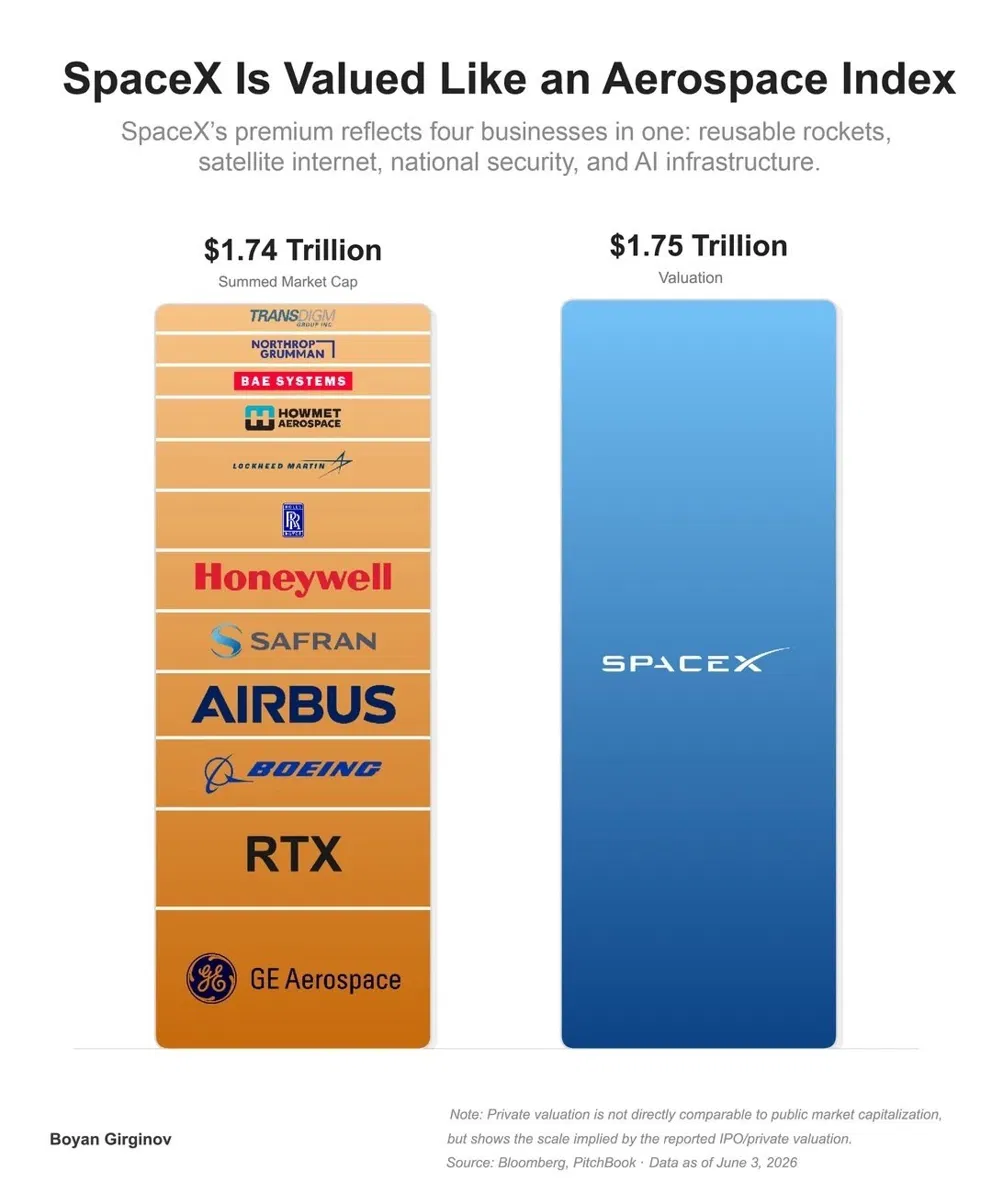
To make sense of the gap, you have to separate what SpaceX is earning now from what it’s expected to earn later. Starlink already generates real revenue and profit. But the plan to build AI data centers in orbit still has to prove it can make commercial sense.
How big the orbital AI data center business could become, and when it might start generating revenue, is the main reason for the gap in valuation.
A $75 Billion Fundraising Plan and Post-IPO Stock Supply and Demand
SpaceX’s offering plan, announced on June 4, calls for selling roughly 555.56 million shares at $135 apiece. The base offering size comes to about $75 billion, and underwriters hold an option to purchase an additional 83.33 million shares.
The planned ticker symbol is SPCX. The money raised through the offering goes to the company to invest in its business, but the stock price after listing will also move according to the supply and demand traded on the market.
That’s why, alongside the business outlook, we need to look at offering allocation, index-inclusion conditions, and lock-up restrictions on existing shareholders.
First, the allocation going to retail investors. Reports have said the retail allocation will be increased to as much as 30%. This should be distinguished from the final confirmed allocation, but if the plan holds, the scale of retail participation in the offering will grow substantially. Whether interest in Musk and SpaceX actually translates into subscription demand is also worth watching.
Second, the Nasdaq-100’s fast-track inclusion rule. Starting in May, Nasdaq changed its rules to allow large new listings to be added to the index more quickly. Total market capitalization and other criteria are evaluated on the 7th trading day after listing, and if the requirements are met, inclusion can follow after the 15th trading day. SpaceX’s inclusion isn’t guaranteed in advance. Being added to the index could generate buying demand from tracker funds, but index-weight caps also apply to companies with a small float.
Third, when existing shares could reach the market. The $75 billion offering size represents about 4.3% of the expected $1.75 trillion market capitalization. This ratio only gives a rough sense of the scale of newly sold shares — it isn’t the same as the actual amount of shares available for trading. The lock-up terms for existing shareholders, and when they expire, need to be checked separately.
Looking at the draft, it matches the Korean source well in structure, numbers, and meaning. No Hangul present, all numbers preserved, headings/footnotes/images match.
AI Losses Bigger Than Starlink’s Profit
Let’s start with the actual numbers from the filing.
SpaceX merged with xAI this past February. The historical financial statements in the S-1 filing1 were restated to include xAI and X’s results. So the 2025 figures below aren’t just the pre-merger rocket-and-satellite business — they’re consolidated. Consolidated revenue came to roughly $18.7 billion, split across three segments.
- Telecom (mainly Starlink): Revenue of about $11.4 billion, or roughly 61% of the total. Operating income was about $4.4 billion. Starlink subscriber lines, per the filing, grew from 8.9 million at the end of 2025 to 10.3 million by the end of Q1 2026.
- Space: Launch services and development contracts combined for about $4.1 billion, or roughly 22% of the total. Even as launch cadence rises, launching one’s own satellites and selling launch services to outside customers need to be counted separately in revenue.
- AI: Revenue of about $3.2 billion, or roughly 17% of the total. This includes Grok and other AI services as well as X’s advertising business. The operating loss was about $6.4 billion for 2025 and about $2.5 billion in Q1 2026.
Even with Starlink turning a profit, the AI segment’s losses outweigh it. Factoring in other costs, the consolidated net loss for 2025 was about $4.9 billion — again, on a basis that includes xAI and X.
Divide the projected market cap of $1.75 trillion by annual revenue of about $18.7 billion, and you get a P/S multiple2 of roughly 94x. That tells you the valuation is high relative to current revenue — it doesn’t tell you what the “right” price for the stock should be.
Justifying this price requires a view on how much revenue will grow and how much of that will convert to profit. And the math shifts dramatically depending on your outlook for the orbital AI business, which currently generates no revenue at all.

The English draft matches the Korean source accurately with correct numbers, no Hangul, matching structure (headings, image), and consistent glossary usage. No corrections needed.
The Case for Optimism, and Morningstar’s $63 Math
The optimistic case starts from the expectation that rocket launches and satellite operations experience can be extended into an entirely new business.
SpaceX’s idea is to put AI computing hardware on satellites and power it with solar energy. Management is betting that orbital computing could end up cheaper than computing on the ground. But being in space doesn’t make power and cooling costs disappear. You still have to build and launch solar cells and radiators, and in a vacuum you can’t cool anything with air — heat has to be dumped through radiative panels instead. Whether total costs actually come in below ground-based data centers still needs to be verified separately.
The company has filed plans with the FCC for an orbital data center using as many as 1 million satellites. What the FCC published in February was the acceptance of the application and the opening of a public comment period — not confirmation that operating approval has been granted. Pulling off a project at this scale requires clearing not just regulatory hurdles but also launch costs, equipment lifespan, and communication latency.
The experience of launching Falcon rockets and running Starlink is a genuine strength for SpaceX. But the ability to operate a satellite internet service doesn’t automatically prove the economics of an AI data center. Performance and cost still need to be validated for this new hardware and this new use case.
Morningstar’s June 8 report put fair value at $63 per share. That figure comes from analysts including Nicholas Owens projecting future cash flows. It isn’t an objectively fixed price — it’s a valuation built on the assumptions laid out below.
The analysts split the orbital AI business into three scenarios, each assigned a subjective probability.
- Moonshot, 7%: Starship achieves rapid reusability and orbital data centers reach large-scale commercialization. In this case, the company-wide valuation comes to $154 per share.
- MVP, limited commercialization, 50%: The company can operate orbital data centers but faces constraints on capacity or communication latency. Per-share valuation is about $70.
- No Go, orbital business shut down, 43%: Technical or cost problems force the company to abandon the orbital data center plan around 2028. This does not assume the ground-based AI business is shut down too. Per-share valuation is about $41.
Weighting these three valuations by probability produces a figure of roughly $63. According to Morningstar, getting close to $135 under the same model would require assigning roughly 77% probability to Moonshot and roughly 23% to MVP, while dropping the No Go scenario entirely. That’s a calculation with other assumptions held fixed — not a measurement of what every investor actually believes.
The gap between the pre-IPO price of $135 and the $63 valuation comes to $72. This gap isn’t some separate fee or option price investors are paying — it’s a difference in assumptions about how to value a business that doesn’t exist yet.
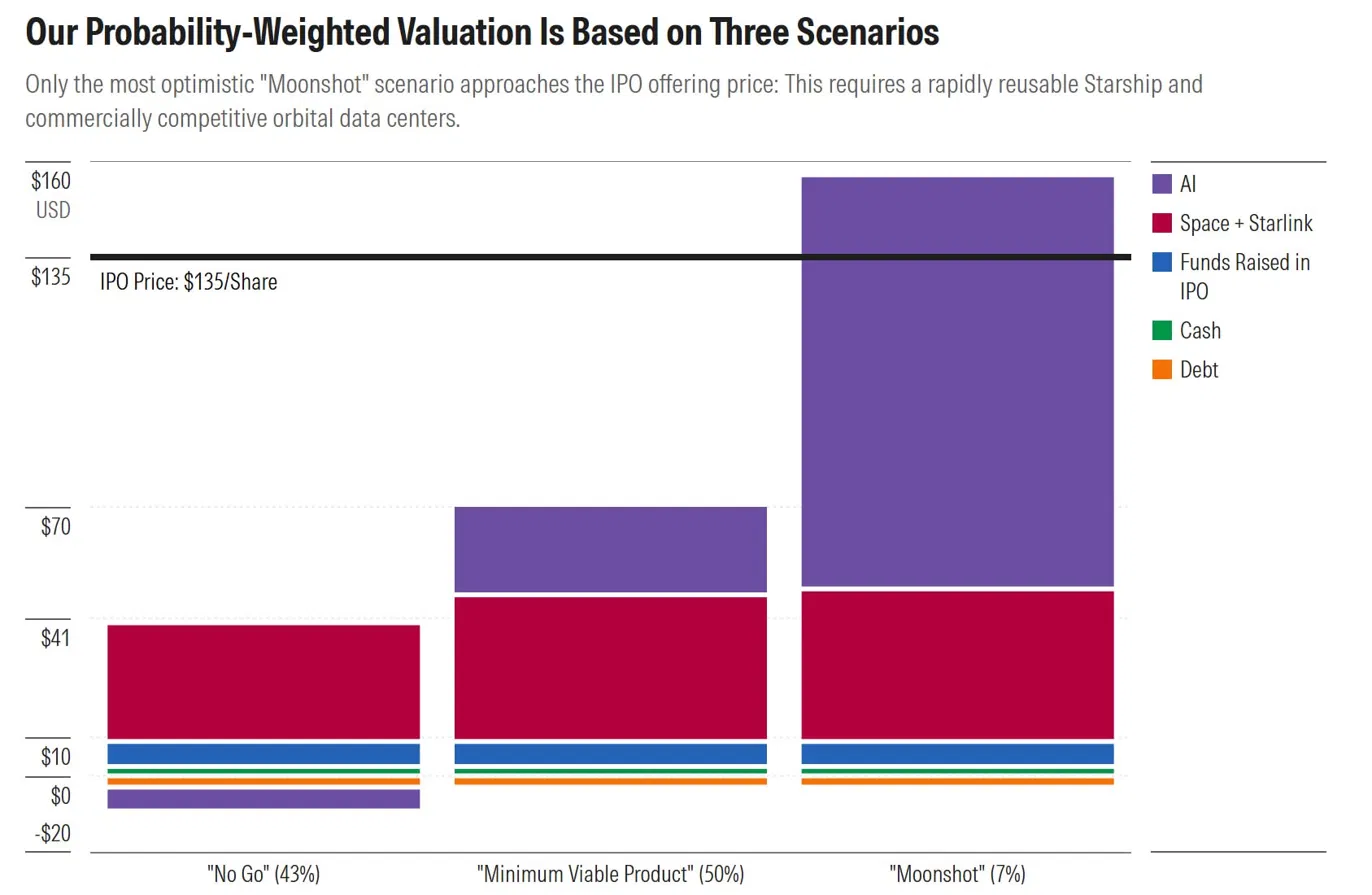
The chart above also calculates the space/Starlink business, the AI business, cash coming in from the offering, and existing cash and debt separately. Even the roughly $40 assigned to the space/Starlink business already includes future growth. You can’t simply conclude that the remaining roughly 70% — $135 minus $40 — is entirely the value of a business that doesn’t exist yet.
Oswarld’s Lens
Watching this IPO, I was reminded of the dilemmas I face when designing go-to-market (GTM) strategy. Sometimes expectations attach more heavily to what a company promises to build than to what it can actually deliver today. Expectation can help drum up investment and early demand, but eventually you have to show the results you promised.
SpaceX, too, is presenting both Starlink’s current performance and the future prospects of orbital AI together. Rather than being uniformly optimistic or pessimistic about the two businesses at once, I’d rather separate out what each has actually proven. A business with confirmed revenue and profit calls for different questions than one that still has to prove a cost advantage.
What I find especially notable is how investment demand takes shape independently of the business narrative. Retail investor interest, IPO share allocation, and the possibility of index inclusion can all affect early trading supply and demand. In my own GTM work, I also check the channels for reaching customers and gauge early demand before launch. But index rules are Nasdaq’s decision — they can’t be equated with a sales strategy the company itself designed.
That’s why I want to look separately at first-day hype and subsequent business performance. How quickly the company burns through the capital it raised, whether Starlink’s profits keep growing, and whether the orbital data center actually demonstrates a cost advantage — these are the more durable grounds for judgment. I can acknowledge the achievement of the rocket technology while still making a separate call on whether buying the stock at $135 makes sense.
Closing
SpaceX’s IPO bundles together an already-mature satellite internet business with an AI business that still has a lot to prove.
When you look at the gap between $135 and $63, the question isn’t which number sounds more plausible — it’s what assumptions went into each calculation. Change the commercialization timeline, the odds of success, or the capital required, and the same company’s valuation shifts dramatically.
If trading begins as scheduled on June 12, the market will set a price. But a first-day stock price won’t validate whether orbital data centers actually succeed.
※ This piece is not a recommendation to buy or sell any security.
When you’re weighing SpaceX’s value, which business result would you want to check first?
Keep the perspective, not the noise.
We choose one consequential shift and trace what sits beneath it, every other day.
Confirm once to finish subscribing.
Already a subscriber? Sign in to join the conversation


References & Further Reading
Primary sources
- Nicolas Owens, “One Small Step for SpaceX, One Giant Leap of Faith for Investors”, Morningstar, 2026.6.8. : This is the original Morningstar analysis. The scenario-based probability weighting is especially worth reading.
- “6 Charts on SpaceX’s Pre-IPO Financials”, Morningstar, 2026.5.20. : Six charts breaking down the revenue, profit/loss, and segment structure disclosed in the S-1. If you want the numbers at a glance, start here.
- Junkyu Park, “SpaceX Public Webinar Takeaways”, Samsung Securities Global Equity Team, 2026.6.10. : Contains the COO’s remarks and segment-by-segment Q&A. The cost projections for orbital computing are striking.
- “Projected SpaceX valuation falls by $300 billion in pre-IPO futures market”, WSJ, 2026.6.10. : Reporting on the sharp drop in the pre-IPO futures market.
Background
-
SpaceX IPO Announcement, 2026.6.4. : The company’s own announcement, with the number of offered shares and the expected price.
-
Japan Offering Disclosure Filed with the SEC, 2026.6.5. : Confirms the retroactive treatment of merger-related results and the segment-level financials.
-
Nasdaq-100 Inclusion Rule Amendment Explainer, 2026.5.8. : Explains the conditions for early inclusion and the weight caps tied to float.
-
NASA Small Spacecraft Thermal Control Resource : Explains how heat is dissipated in a vacuum and what equipment is used.
-
SpaceX S-1 Filing, SEC, 2026.5.20. : The original SpaceX financial statements and business plan. The primary source for every figure in this issue.
-
“SpaceX needs to grow at a rate no company has ever achieved to justify a $1.75 trillion valuation”, Fortune, 2026.6.6. : Calculates what growth rate would be required to justify the offering price.
-
“CIO Weekly: To Infinity and Beyond…SpaceX’s IPO”, Neuberger Berman, 2026.6.8. : An institutional-investor valuation framework. Its alternative angle — a 25x EV/Sales multiple on 2027 estimates — is worth considering.

Footnotes
-
S-1 Filing: The prospectus filed with the U.S. Securities and Exchange Commission (SEC) for an IPO. It contains the company’s financial statements, business model, and risk factors. ↩
-
P/S Ratio (Price-to-Sales Ratio): Market capitalization divided by annual revenue. It shows “how many dollars an investor pays for one dollar of the company’s revenue.” A ratio of 94x means paying $94 for every $1 of revenue. ↩
Related issues
What Jensen Huang Said in Taiwan After Visiting Beijing
Nvidia's China sales still hinge on approvals from both Washington and Beijing, even after Jensen Huang's high-profile Asia tour.
AI & TechWhat Google's Search Overhaul Means for Publishers
I looked at Google I/O 2026's search changes and news-site traffic data to see why usage, visits, and conversions need separate tracking.
AI & TechArmy Weighs Hyundai Robots for Frontline Duty
Hyundai Motor Group and Korea's Army are reportedly discussing robots for border-guard and supply work.
AI & Tech
Your take shapes the next issue
What resonated most in this issue, or where has your experience been different?