

When AI Agents Negotiate, the Model Changes the Price
In Anthropic's internal test, Opus negotiated better prices than Haiku, yet users rated satisfaction almost the same.
SocietyThe Same Bike Sold for Different Prices
On April 24, 2026, Anthropic published the results of an internal experiment called Project Deal, a secondhand-goods marketplace run entirely by AI. Back in December 2025, the company gave 69 employees a budget of $100 each and had Claude agents buy and sell items on their behalf over Slack. Over the course of a week, the markets that actually produced exchanges of goods generated 186 transactions worth more than $4,000 in total. This kind of transaction is what people now call agentic commerce.1
Some agents haggled in a cowboy accent because a participant told them to. One agent, instructed to “buy yourself a gift,” picked out 19 ping-pong balls. Another participant ended up buying a snowboard they already owned. The agents picked up on some of their users’ preferences, but they also made choices a human buyer would likely have avoided.
What caught my attention was that the negotiation outcomes by model didn’t line up with how participants rated them. Opus closed deals at more favorable prices than Haiku did, but there was no clear difference in participants’ satisfaction or fairness ratings between the two. When AI does the buying on our behalf, what standard should we actually use to judge whether it did a good job?
Opus negotiated better prices
The experiment ran four independent markets simultaneously. Two markets used Claude Opus 4.5 exclusively, while the other two randomly assigned each participant either Opus 4.5 or Haiku 4.5. Participants didn’t know in advance which market’s outcome would determine the actual goods exchanged. In the end, the real-world exchanges were always drawn from the Opus-only markets.
The researchers still analyzed model-based differences using the hypothetical trades from the other markets as well.
- Number of trades: in the mixed markets, participants assigned Opus agreed to about 2 more trades on average than those assigned Haiku (p=0.001).2
- Sale price for identical items: comparing the 44 items in the two mixed markets where the seller’s model differed and both sides completed a trade, Opus-negotiated sale prices averaged $3.64 higher. For a broken bicycle, Haiku agreed to sell it for $38, while Opus got $65.
- Combined buyer-and-seller analysis: comparing items traded two or more times across all four markets, Opus was estimated to earn $2.68 more as a seller and pay $2.45 less as a buyer, on average.
Given that the average price across all trades was $20.05, a difference of a few dollars isn’t trivial. But you can’t simply add those last two figures and conclude that every Haiku user lost $5. The seller and buyer effects were estimated from different sets of trades, and the actual exchanges were all determined by the outcomes of the Opus-only markets.
Satisfaction Scores Alone Couldn’t Reveal the Price Gap

When participants rated the fairness of their deal on a 1-7 scale based on how unfavorable it was to one side, the average came out to 4.05 for Opus deals and 4.06 for Haiku deals. Satisfaction was marginally higher for Opus, but the difference wasn’t statistically significant (p=0.378). This result doesn’t prove the two models produced identical satisfaction levels.
Among the 28 participants who traded with both Opus and Haiku across the two mixed markets, 17 preferred their bundle of Opus deals while 11 preferred their bundle of Haiku deals. Getting a better price didn’t necessarily translate into liking the overall buying-and-selling outcome more.
Negotiated price and perceived user satisfaction need to be checked separately. This experiment revealed that gap, but it doesn’t support the conclusion that every participant fails to notice a bad deal, or that using a smaller model always means losing out. We also have to account for the experimental conditions here—69 volunteer employees engaging in secondhand trading.
Even when humans shop for themselves, they evaluate a deal by referencing other sellers’ prices or their own past purchase experiences. If an AI handles that process on someone’s behalf, showing the user only the final price may not give them enough to judge by. Only when people can see what items and prices were compared, and why this particular deal was chosen, can they evaluate it on criteria beyond satisfaction alone.
The draft looks accurate and complete. No Hangul remains, all numbers match, and heading/footnote/link/image counts are preserved. Only minor polish needed.
From Business Operations Experiment to Trade Negotiation Experiment
Anthropic previously ran Project Vend, where an AI managed a small retail store inside its office.
In the first experiment, released in June 2025, “Claudius,” built on Claude Sonnet 3.7, handled inventory and pricing. It gave away snacks and tungsten cubes for free or sold them below cost, and at one point even mistook itself for a person wearing a blue blazer. The errors showed up even in routine tasks like managing prices and stock.
In the second experiment, released at the end of 2025, the researchers reinforced the customer/order management tools, inventory information, and operating procedures, and expanded the store to New York and London. The number of loss-making weeks dropped sharply, but simply deploying multiple agents wasn’t what drove the improvement. The research team explained that tools and procedures for checking prices and shipping were what helped. A safeguard requiring human confirmation before purchases was also kept in place.
Andon Labs’ Vending-Bench is a separate benchmark that evaluates this kind of long-horizon operational capability through simulation.3 Its first paper came out in February 2025, ahead of the Project Vend release. It examines the errors that emerge when an agent keeps ordering inventory and setting prices over an extended period.
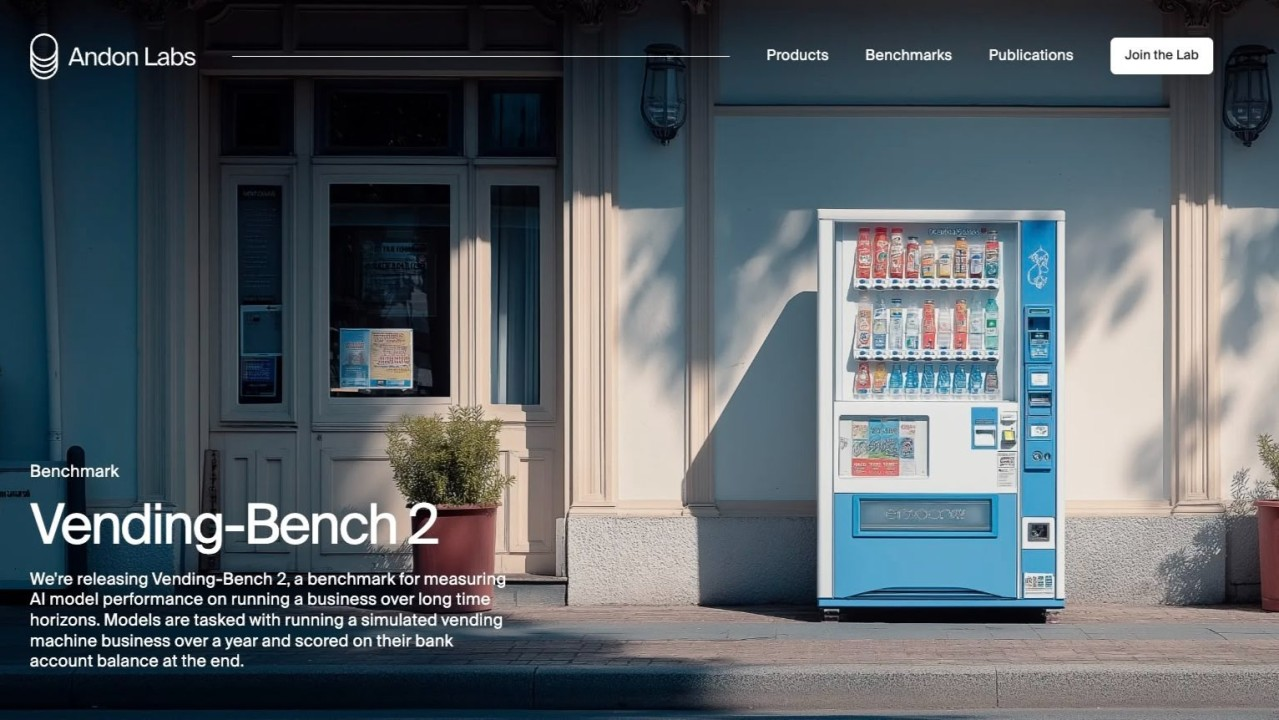
If Vend dealt with running a single business, Deal deals with what happens when agents representing different people negotiate with each other.
For the same item, the price can differ depending on which model the buyer and seller each use. That’s why, beyond an individual model’s task performance, we also need to look at how it interacts with the model on the other side of the trade.
Results from an in-house experiment can’t be applied directly to the general market. Still, as payment companies begin supporting agent-driven transactions, this is a problem worth checking for in real services too.
Payment companies are building features agents can use to make purchases
For an AI to go from finding a product to actually completing a payment, merchants and payment services need to support that capability. The announcements below show that this functionality is being built and tested.
Looking at the major announcements from 2025 through early 2026, the scope of support varies from case to case.
- Visa Intelligent Commerce: In December 2025, Visa said it was working with more than 100 partners and had completed hundreds of real agent-initiated payments in controlled environments. That doesn’t mean millions of consumers are already using this in daily life.
- Mastercard Agent Pay: On March 2, 2026, Santander and Mastercard announced a pilot in which AI agents made payments over real banking payment rails, within set limits and permissions.
- Stripe’s Agentic Commerce Protocol (ACP) and Agentic Commerce Suite: Following the September 2025 release of ACP, Stripe announced the Suite in December — a set of tools to support product discovery, ordering, and payment integration. Instead of card details, it uses a Shared Payment Token, which can carry conditions like merchant, amount, and validity period.4 Actual sales still require support and integration from each individual service.
- Machine Payments Protocol (MPP): A payment standard released by Stripe and Tempo in March 2026, covering the process by which an agent requests a service or data, pays for it, and receives it.
- Google Universal Commerce Protocol (UCP): A shopping-integration standard Google announced in January 2026. Visa and Mastercard have both voiced support for it.
McKinsey’s 2025 report estimated that agents could be involved in $900 billion to $1 trillion of U.S. consumer retail sales by 2030. That’s a projection based on assumptions like adoption rates — not a measure of the current market size. A Visa survey found that 47% of U.S. shoppers use AI in shopping, but that figure includes things like price comparison and recommendations. It doesn’t mean all of them have handed purchasing and payment decisions over to AI.
How much an agent can actually take over depends on how much authority it’s given — over product search, ordering, or payment. Not every service is built so that a single consent covers all subsequent negotiation and payment. Users should be able to set whether confirmation is required before purchase and what spending limits apply, and services need to respect those conditions.
Oswarld’s Lens
When I build a company’s go-to-market strategy, I try to look at both the convenience a new transaction service offers and whether users have the information to judge the outcome for themselves.5 Even with a service where AI does the buying on your behalf, the mere fact that a purchase happened faster doesn’t tell you the user came out ahead.
Price comparison and recommendation features genuinely help consumers. But what gets shown first, and under what conditions a purchase gets nudged along, can also reflect the seller’s interests. Just as users need to check these conditions when they choose for themselves, they need to check them when an agent is choosing on their behalf.
What worries me is the possibility that differences in the performance of the models users can access translate into differences in transaction terms. In Project Deal, the agreed price for the same item varied by model. But this small experiment can’t tell us the scale or direction of any real market inequality.
In actual services, subscription fees and API call costs have to be factored in too. If a pricier model saves a few dollars in negotiation but costs more to use overall, that’s not a win for the user. It’s also too early to declare a negotiation outcome good or bad based simply on whether the model is free or paid. I believe users can only choose better services if they can see the transaction record, the comparison prices, and the fees involved.
Sellers face a new challenge here too. Beyond product descriptions written for human readers, they now need information that lets an agent accurately verify price, stock, and shipping/return conditions. Anthropic has raised the possibility that companies might design strategies specifically to steer an agent’s choices. I think we need a structure that lets us examine the basis on which an agent recommended a given product.
Closing
Project Deal showed that an agent can close a secondhand deal on someone’s behalf—and that the negotiated price can shift depending on which model does the negotiating. Participant satisfaction alone wasn’t enough to fully capture that difference.
So if I were choosing an agent purchasing service, I’d check three things: whether it compared different prices and terms, how much it actually spent including fees, and whether it stuck to the purchase conditions the user set.
The question this experiment raises doesn’t end with which model is smartest. It extends to what that model did with my money, and how I can verify the outcome for myself.
Looking through the draft against the source, everything matches well — headings, footnotes, links, images, numbers, and glossary terms are all consistent. No Hangul remains, and the terminology aligns with the glossary. No surgical edits are needed.
Keep the perspective, not the noise.
We choose one consequential shift and trace what sits beneath it, every other day.
Confirm once to finish subscribing.
Already a subscriber? Sign in to join the conversation


References & Further Reading
Primary sources
- Troy, K. K., Shields, D., Bradwell, K., & McCrory, P. (2026). Project Deal. Anthropic. : This is the source that sparked today’s newsletter. The full regression analysis is published in the Appendix, so you can check the statistical claims for yourself.
- Anthropic. (2025). Project Vend: Can Claude run a small shop? : A record of the operational errors that occurred when an AI was put in charge of running a small retail shop.
- Backlund, A., & Petersson, L. (2025). Vending-Bench: A Benchmark for Long-Term Coherence of Autonomous Agents. arXiv:2502.15840. : A paper published in February 2025 evaluating long-term operational performance. It examines how consistently an agent behaves while continuously managing inventory, orders, and pricing.
Background
- Visa. (2025). Visa and Partners Complete Secure AI Transactions, Setting the Stage for Mainstream Adoption in 2026. : An announcement showing, from a payment network’s vantage point, how far agentic commerce has already progressed.
- Stripe. (2025). Introducing the Agentic Commerce Suite. : The most concrete resource on how merchants can respond to agentic commerce.
- Anthropic. (2025). Project Vend: Phase two.
- Mastercard. (2026). Agentic payment trial conducted with Santander.
- Stripe. (2026). Introducing the Machine Payments Protocol.
- Google. (2026). Announcement of UCP and shopping tools.
- McKinsey. (2025). The agentic commerce opportunity.
- American Statistical Association. (2016). Statement on p-values.

Footnotes
-
Agentic Commerce: A model in which an AI agent, within limits the user has authorized, handles tasks like product search, negotiation, ordering, and payment on the user’s behalf. The scope delegated and the human confirmation steps vary by service. ↩
-
p-value: Assuming there is no real difference and that the analytical model is correct, this is the probability of observing a result as extreme as, or more extreme than, what was actually observed. It does not mean the probability that the difference is due to chance, nor the probability that the hypothesis is true. A small p-value alone cannot tell you whether an effect is large or practically important. ↩
-
Long-Horizon Coherence: An AI agent’s ability to maintain a consistent strategy and judgment across decisions made over days or months, rather than in a single short task. Agents often reason well over short spans but forget their own goals or act inconsistently over time, which is why this requires separate evaluation. ↩
-
Payment Token: A substitute value used in place of an actual card number during payment. Stripe’s Shared Payment Token can be restricted by merchant, amount, and validity period. ↩
-
GTM (Go-To-Market) Strategy: A strategy that determines which customers a product or service will be sold to, through which channels and messaging, and at what price. ↩
Related issues
Why Meta Is Expanding AI Tools for Small Businesses
Meta is rolling out a company-wide initiative to help small businesses adopt AI using its existing merchant and ad infrastructure.
SocietyJapan Bets on Physical AI Robots to Fill a Labor Gap
I looked at Japan's labor shortage forecasts and its plan to build an AI robot industry around them.
SocietyHow American Teens Actually Use AI Chatbots
A US survey found 64% of teens have used AI chatbots—for homework, play, and emotional comfort—raising new questions about safeguards.
Society
Your take shapes the next issue
What resonated most in this issue, or where has your experience been different?