

How American Teens Actually Use AI Chatbots
A US survey found 64% of teens have used AI chatbots—for homework, play, and emotional comfort—raising new questions about safeguards.
SocietyPlaying Pretend with a Cheese Character
Character.AI has a character called Cheese. When I first saw the name and the look of it, I assumed it was some Minions knockoff.
Annabelle Blake, a researcher at the University of Sydney, said encountering this character made her rethink the questions she was asking in her own research. She had been treating teenagers’ relationships with AI mainly as a matter of serious conversation or romance—until she noticed how much of it was actually just play, kids inventing stories with a goofy character.
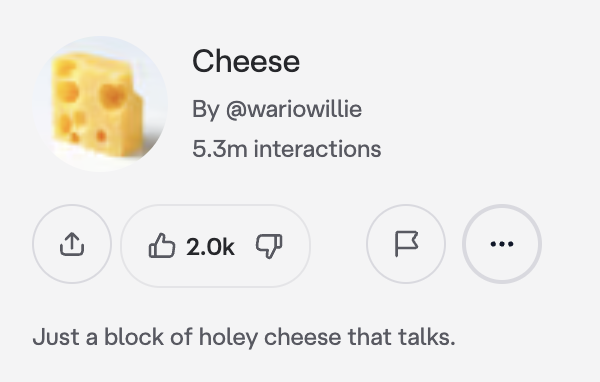
Kashmir Hill of The New York Times spent roughly a year reporting on three teenagers’ chatbot use. Quentin played around, dreaming up absurd scenarios with a virtual character, while Sophia turned to a chatbot for comfort after a breakup. Two teens using the same role-play service, for entirely different reasons.
Lawsuits tied to teen self-harm and death raise serious questions about product safety. But at the same time, we need to understand what teens are actually doing day to day in order to grasp the specific risks and figure out what safeguards are actually needed. I found myself wondering how role-play and emotional dependence show up together in the same experience.
I’ll look at overall usage patterns through survey data, and then turn to reporting and qualitative research to dig into the specifics of what that experience actually looks like.
64% of American Teens Report Having Used AI Chatbots
Pew Research Center surveyed 1,458 US teens aged 13-17 between September 25 and October 9, 2025. 64% said they had used an AI chatbot before, with about 30% of all teens surveyed saying they use one daily, and 16% saying they use one multiple times a day or almost constantly. The daily-use figure is calculated against all teens surveyed, not just chatbot users.
By service, usage experience broke down as ChatGPT 59%, Gemini 23%, and Meta AI 20%. Since teens can use multiple services, these percentages shouldn’t be read as summing to 100%. A February 2026 report drawing on the same survey data found that 54% of all teens surveyed used chatbots for help with schoolwork, 16% for everyday conversation, and 12% for emotional support or advice.
Parents were asked a separate question: whether their child uses a chatbot. 51% said yes, 18% said no, and about 30% said they weren’t sure. This differs from the 64% figure teens themselves reported, but you can’t conclude from this that “half the parents of chatbot-using kids don’t know about it.” What we’re comparing here are the overall response rates to two different questions.
Frequency of use matters, but it shouldn’t get mixed up across different survey questions. A response of “almost constantly” for TikTok and a response of “daily” for chatbots aren’t measuring the same thing. And time spent alone doesn’t let you compare how addictive two services are — you’d need to look at effects on sleep or school life as well.
A study by Yaman Yu, Yang Wang, and colleagues analyzed discussions on Reddit along with interviews of 7 teens and 13 parents. Beyond the learning-and-search use case that parents assumed, the study found a wider range of uses — emotional support, virtual relationships, and more. This research is useful for understanding the gap between actual experience and perception, but a handful of interviews can’t be used to estimate usage rates across the entire teen population.
They experience both role-play and comfort within the same service

Quentin understood his conversations with the virtual character as a game. What’s interesting is that you don’t need to believe the character is a real person for the conversation to feel immersive.
Even knowing something isn’t real, you can still enjoy the act of building a story, and the conversation can still produce genuine feelings. Awareness that something is fiction and how that fiction actually gets used in daily life need to be examined together.
Blake’s research team looked at material from Character.AI-related communities and examined a range of experiences — play, creative writing, comfort, and more. Some users’ conversations closely resembled fan fiction1, where they improvised stories with a favorite character on the spot. We can’t conclude this is representative of how all teenagers use these tools.
The same person might use the service for different purposes depending on the day.
Someone might start making up a silly story out of boredom, then end up venting about a problem with a friend. As in the case of Sophia, who talked to a virtual character about the pain of a breakup, play and emotional use don’t always split neatly into separate categories.
So rather than simply asking whether someone used a chatbot, it seems more useful to ask what kind of conversation they had and what they got out of it.
Chatbot conversations aren’t necessarily visible to the people around you the way a public social media post is. But that doesn’t mean no record of the conversation exists. Different services store, review, and use conversations for training in different ways, so we need to distinguish between conversations that aren’t publicly visible and the data that companies actually process.
Unwanted intimacy is also a problem. In the article, Quentin was creating a story in which he argued with a character, and when the tone suddenly shifted into something romantic, he felt uncomfortable. The story the user had set and the character’s response had come apart.
Blake also addresses complaints from users who want a character that offers comfort but don’t want sexual conversation. The mere fact that someone is talking with a character doesn’t mean they’ve consented to any and all forms of intimate content.
We need to look at conversation design, business metrics, and safeguards together
To understand why a conversation drifts in a direction users didn’t want, you have to examine how the service is designed and how the model is trained.
Settings written in by character creators, the model’s training data and tuning methods, and the metrics used to evaluate user responses can all play a role. Engagement optimization2 aimed at increasing time-on-app and return visits is also worth examining. But you can’t pin down a single cause just by looking at individual conversations.
On social media, questions of product safety and corporate accountability are now playing out in court. New Mexico’s Department of Justice announced on March 24, 2026 that a jury had ordered Meta to pay $375 million in civil penalties for violating consumer protection law. This is a verdict in a specific case concerning the protection of minors — it doesn’t prove how every chatbot works or establish harm across the board.
Character.AI and Google, among others, have faced lawsuits alleging that their products contributed to teen deaths and mental health harm, and in January 2026 reports emerged of settlements in some of these cases. Claims from bereaved families, court rulings, and settlements need to be kept separate. A settlement doesn’t mean causation has been established or liability admitted for every claim.
On October 29, 2025, Character.AI announced it would eliminate open-ended chat for users under 18. The announcement and its actual protective effect need to be verified separately. Reports of a minor user in news coverage who was still able to access the service afterward are reason enough to scrutinize age verification and how broadly the policy applies. But that fact alone doesn’t prove the company deliberately loosened its safeguards.
Teens struggling with difficulties need more careful protection. Even if a chatbot feels comforting, we can’t overlook situations where sleep and daily activities decline and it becomes harder to seek help from actual people.
The US FTC, too, demanded data from seven companies on September 11, 2025 regarding chatbots’ effects on children and teens and how safety is evaluated. This is a fact-finding inquiry. It covers what risks the products anticipated and tested for, and what was disclosed to parents and users.
Langdon, who appears in the article, described a long stretch of time during which she found it hard to stop chatting. An account of starting out as light play and an experience of struggling to control usage can both show up in the same person.
Oswarld’s Lens
I keep seeing, in the debate over AI chatbots, the same problem I think we missed with social media. I worry that companies only start scrutinizing product design and protections for teens after usage has already scaled up.
It’s true that many factors shape adolescent mental health. But that doesn’t mean companies get a pass on examining the risks their own products might create. At the same time, you can’t point to a single case and say one particular service caused every problem. What I want to see is what companies are actually testing, and what results they’re making public.
Chatbots respond instantly to what a user says, and depending on their design, they carry forward the context of previous conversations. That can make the experience feel like talking to someone one-on-one. This kind of intimacy can bring some users comfort or enjoyment — but in other circumstances, it can make it hard to stop using the product. That’s worth examining closely.
From a GTM strategy standpoint, I’m curious what metrics companies count as success. If long conversations and frequent return visits are the only things valued, companies may miss situations where usage actually needs to be curbed. Keeping a conversation going and actually helping the user aren’t always the same thing.
I also want to hear more about why teens turn to chatbots in the first place. Whether it’s for fun, because they want to write, or because they have something on their mind they can’t say to a person — the right response differs depending on the reason.
In Quentin’s story too, loneliness and friendship turn out to be central.
He had an online friend who lived far away. Looking at relationships like this, I don’t think you can call something a fake relationship just because it started online. We can’t apply the American case directly to Korea, but it’s worth asking here too whether teens have people they can talk to comfortably, and the time to do so.
Loneliness can drive someone to a chatbot, and depending on how it’s used, that can in turn reshape their daily life and relationships. There’s no single answer, for everyone, about which comes first. I think we need both the necessary usage limits and safeguards, and the question of why someone is turning to this service in the first place.
Closing
Later in the reporting, Quentin says his chatbot use dropped, and his sleep and daily life got better. He started dating Sofia and began seeing a counselor. Since several changes overlapped in one person’s experience, we can’t generalize that a relationship or quitting the chatbot alone solved the problem. Even as he regrets the long stretch of use, he feels there were parts of it—writing, expressing his emotions—that genuinely helped him.
What I want to hold onto from this case is that the verdict isn’t singular. You can find something fun and helpful while still regretting the time you spent on it. Saying it was enjoyable doesn’t guarantee safety, and saying there was a problem doesn’t explain every part of the experience either.
Korea has its own services for building characters and stories. We need to look at how they handle terms of use for adults versus teenagers, controls over unwanted conversations, and reporting and support features. Overseas survey figures alone can’t tell us how prevalent this use is among Korean teenagers, or how safe it actually is.
A good place to start is simply asking teenagers which chatbots they use, what they find fun about them, and whether they’ve had any uncomfortable conversations. Listening to those conversations, we need to examine both the impact on daily life and the safeguards built into the service. I believe understanding how something is used and responding to its risks can happen at the same time.
Keep the perspective, not the noise.
We choose one consequential shift and trace what sits beneath it, every other day.
Confirm once to finish subscribing.
Already a subscriber? Sign in to join the conversation


References & Further Reading
-
Kashmir Hill, What Teens Are Doing With Those Role-Playing Chatbots, The New York Times, April 4, 2026.
-
Annabel Blake, The New York Times, Character AI and Cheese, April 7, 2026. : A researcher’s own account, weaving together her research and the NYT’s reporting on the same case.
-
Pew Research Center, What parents say about their teen’s AI use, February 24, 2026.
-
FTC, Launches Inquiry into AI Chatbots Acting as Companions, September 11, 2025.
-
Character.AI, Announces Changes to Chat Features for Under-18 Users, October 29, 2025.
-
New Mexico Department of Justice, Announces Jury Verdict Against Meta, March 24, 2026.
-
Pew Research Center, “Teens, Social Media and AI Chatbots 2025”, December 2025. : A survey of 1,458 American teens aged 13-17 on the reality of teen AI chatbot use.
-
Pew Research Center, “How Teens Use and View AI”, February 2026. : Covers how teens actually use chatbots, from homework help to emotional support.
-
Yaman Yu et al., “Exploring Parent-Child Perceptions on Safety in Generative AI”, arXiv, 2024. : A study using Reddit analysis and interviews to examine teens’ use of generative AI and the gap in parental awareness.
-
NPR, “Jury finds Meta and Google negligent in social media harms trial”, March 2026. : Useful background on the context and significance of the jury verdict against Meta and YouTube.
-
CNN, “Character.AI and Google agree to settle lawsuits over teen mental health harms”, January 2026. : Reports on the progress of settlements in some of the lawsuits against Character.AI.

Footnotes
-
Fan fiction: stories fans create using characters or settings from existing works. Some chatbot role-play works similarly, continuing a conversation to build out a story. ↩
-
Engagement optimization: tuning a service to increase engagement metrics like usage frequency, number of conversations, and time spent. The specific goals and methods vary by service, and a higher score on these metrics isn’t always better for the user. ↩
Related issues
Fewer People Post on Social Media as AI Use Rises
Ofcom's 2026 report shows active posting on social media declining just as AI tool use climbs among UK adults.
SocietyAlex Karp Warns Humanities Majors About AI's Job Impact
At Davos, Palantir's CEO said AI could hurt humanities majors' job prospects—unless paired with other skills.
SocietyWhy Companies That Tried AI Can't Scale It Up
Testing AI and embedding it in daily work are different challenges, as corn-seed diffusion research and Moore's chasm theory reveal.
Society
Your take shapes the next issue
What resonated most in this issue, or where has your experience been different?