

Why Companies That Tried AI Can't Scale It Up
Testing AI and embedding it in daily work are different challenges, as corn-seed diffusion research and Moore's chasm theory reveal.
SocietyTesting AI vs. Embedding It in Everyday Work
Trying AI once and entrusting it with your daily work are two different decisions. When you’re testing it, you can simply judge how plausible its answers sound—but in actual operations, you have to work out who checks for errors and how much that costs.
There’s research worth referencing when thinking through this distinction: a study of how Iowa farmers in the 1940s adopted new corn seed varieties, and chasm theory, which describes how tech products spread beyond their earliest customers.
Let’s start by looking at what the AI surveys actually asked. In McKinsey’s 2025 survey, 88% of respondents said their organization regularly uses AI in at least one business function. About a third said their organization had begun scaling up AI use. McKinsey survey
In Deloitte’s 2026 survey, 25% of respondents said their organization had moved more than 40% of its AI experiments into full production. Here, that 40% isn’t the share of companies—it’s the share of projects each organization pushed into production. In PwC’s 2026 CEO survey, 56% said they had seen neither revenue growth nor cost savings from AI over the past 12 months. That doesn’t mean AI had no effect at all, once you factor in things like faster workflows or employee satisfaction. Deloitte survey, PwC survey
Because these surveys asked different questions of different populations, you can’t just subtract the figures to calculate some AI failure rate. What they do show is that adoption, scope of use, and financial performance need to be examined separately. Of these three, I want to connect the question of scaling up use to Geoffrey Moore’s Crossing the Chasm.
What Convinced Farmers to Switch Seeds
A chasm refers to the gap where a technology product that has won over early customers struggles to spread to a broader customer base. Behind this concept lies diffusion of innovations theory, which studies how new technologies spread among people.
In 1941, Iowa State University sociologist Bryce Ryan and graduate student Neal C. Gross investigated the spread of hybrid corn seed adoption across two rural communities. At the time, farmers were being introduced to new seed varieties with improved yields and growing performance, but the timing of adoption varied widely from farmer to farmer.
According to the research process as summarized by Rogers, Gross interviewed 345 farmers, and of these, 259 responses met the study’s criteria for analysis. Of that group, 257 had adopted the new seed sometime between 1928 and 1941. Salesmen were most often cited as the channel through which farmers first learned about the seed, while neighboring farmers were most often cited as influencing the decision to actually adopt it. In other words, between hearing about the new seed’s advantages and deciding to plant it in one’s own field, there stood the experience of other people.
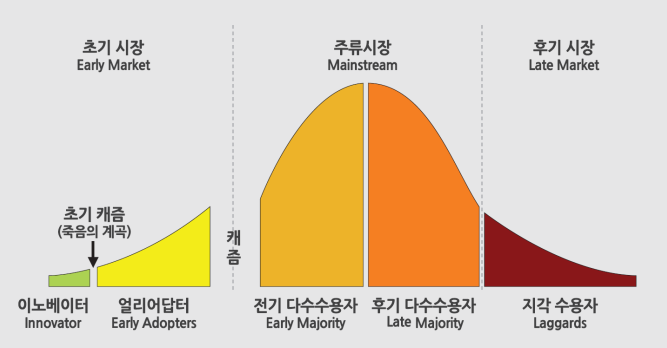
This is a conceptual diagram of chasm theory — not a graph plotting the actual survey figures from the Iowa farmers.
This paper, published in 19431, later became a key starting point for research on the diffusion of innovations. Everett Rogers synthesized related studies and published Diffusion of Innovations in 1962. Rogers divided adopters into five groups based on the relative timing of when they embraced something new.
- Innovators, 2.5%: The group that tries new technology first.
- Early Adopters, 13.5%: A group that adopts relatively early and also influences the judgment of those around them.
- Early Majority, 34%: A group that adopts earlier than average, but carefully examines the experiences of other users first.
- Late Majority, 34%: A group that adopts only after the technology has become widely established nearby and the uncertainty around adoption has diminished.
- Laggards, 16%: The group that adopts the technology last.
These percentages represent a theoretical breakdown of adoption timing based on a normal distribution. The same ratios don’t hold across every market, and any given person doesn’t necessarily belong to the same group for every technology. Plotting the cumulative number of adopters over time typically produces an S-curve. This has a different vertical axis than the bell-shaped curve shown above, which divides adopters by time period.
Moore, who applied this model to the marketing of technology products, paid particular attention to the difference between early adopters and the early majority. His point was that the reasons the first customers loved a product are rarely enough, on their own, to persuade the next wave of customers.
The Chasm Geoffrey Moore Identified
Geoffrey A. Moore studied American literature at Stanford and earned a PhD in English literature at the University of Washington. He moved from teaching at university into sales and marketing at technology firms, and did marketing consulting at Regis McKenna. His work involved handling both the technical features of a product and the reasons customers actually buy it.
Teams building a product tend to emphasize new features. But buyers first check whether that feature is useful for their own work, and whether they’ll get support after adopting it. Moore’s argument is that you need to understand this gap in purchasing criteria if you want to sell to the next set of customers.
Moore published Crossing the Chasm in 1991. The book addresses the problems that arise when a company repeats the same marketing that worked for early customers, unchanged, on mainstream customers.
What he called the chasm is the difficult stretch between the early-adopter market and the pragmatic mainstream market. It’s less a law that every product hits at the exact same moment than a framework a tech company can use to check itself as it tries to expand its market.
In Moore’s account, visionaries adopt a technology even when it’s unfinished, as long as they see large future gains. They’re also willing to solve problems themselves and adapt the product to their own use.
Mainstream customers, by contrast, place more weight on results already proven in similar industries and similar jobs. A case where a tech-savvy team succeeded through extraordinary effort isn’t enough to convince them it will work in their own organization too. The point is that the purchase decision only gets made once the necessary installation, training, and support are all in place. Introduction to Moore’s book

Building a Product the Next Customer Can Actually Use
Building on Moore’s ideas of choosing a narrow customer segment and delivering a whole product, I’ve distilled four things worth examining when it comes to market expansion. Tesla’s case is included here simply to illustrate the point.
First, you have to narrow down the customer problem you’ll solve first. Decide which task within which industry you’re solving, and build a product that customer can actually use. From there, you can expand toward customers with similar needs. Tesla didn’t launch every vehicle class simultaneously either. Its 2006 master plan laid out a path starting with the expensive electric sports car, the Roadster, and expanding toward cheaper models from there.
Second, you need to have in place all the support required for the customer to achieve their purchase goal. Moore calls this the whole product2. Someone buying an electric car needs not just the vehicle, but somewhere to charge it and somewhere to service it. Tesla building out its Supercharger network alongside vehicle sales can be seen through this lens.
Third, you need to give customers confidence that they can keep using the product. Whether it’s compatible with other products, whether the supplier will keep providing support, whether other companies in the ecosystem use the same technology—all of this shapes a purchase decision. Tesla’s 2014 patent announcement was also an attempt to broaden the use of its EV-related technology. It was a pledge not to bring patent lawsuits against anyone who met certain good-faith usage conditions—not a wholesale renunciation of its patent rights.
Fourth, you need to lower the burden of initial adoption. That means weighing not just price, but the time it takes to learn the product and the cost of changing existing habits. Tesla expanding its lineup to target lower price points is an example of reducing that price burden. For enterprise software, this might mean integrating with existing systems or letting customers pilot the product on a limited set of tasks first.
Oswarld’s Lens
The question I find most important in chasm theory is whether the first successful customer and the next customer need the same conditions. It’s worth checking whether you’re demanding of the next user something that only a skilled early adopter managed to solve on their own.
I think this question is useful for AI too. Menlo Ventures estimated enterprise generative AI spending at $37 billion for 2025. That’s roughly 3.2 times the $11.5 billion figure for 2024, recalculated using the same scope for comparison. The estimate combines a survey of 495 AI leads at US companies with market analysis, and excludes spending on semiconductors or inference services. It’s evidence that investment is growing, but as with the PwC survey I mentioned earlier, whether individual companies are actually seeing financial returns needs to be checked separately.
Diffusion across customer segments in a market and expanding AI within a single company aren’t the same thing. Still, both cases share something in common: you need to find out what the next user is worried about. A task that’s easy for the team that built the AI can be difficult for someone on the front line, and whoever has to take responsibility when something goes wrong may demand a stricter standard of proof.
If I were expanding AI use at a company, here are the four things I’d check first.
- Scope of work: Choose a concrete task — sorting customer inquiries, reviewing code — and verify that processing time and error rates actually improve.
- Operational readiness: Connect the necessary data, and prepare access permissions, staff training, and a process for handling problems when they arise, all together.
- Evaluation criteria: Decide in advance what counts as a pass, and compare before-and-after results using the same standard.
- Adoption burden: Consider whether you can start with an assistive task that a human reviews. As you increase automated execution, you need to build in commensurate controls.
Just as neighbors’ experience mattered in the study of Iowa farmers, results from similar work can help inform AI adoption decisions. That said, rather than importing another organization’s success wholesale, you should check how similar the data, personnel, and operating conditions really are.
If model performance is lacking, you need to improve or replace the model; if the data connections or review procedures are lacking, you need to fill in that gap. I believe convincing the people on the fence and actually putting the adoption conditions in place have to happen together.
Closing
To broaden a new technology’s early success, you need to understand the next user’s actual work. You need to ask concrete questions: what can they solve on their own, where do they need support, and what results would keep them using it.
Rather than rolling out AI across every department at once, I think it’s better to first confirm both the performance and the operational burden in a single function. Once you have that result, you can decide how far to expand—and that gives you a real basis for recommending it to other departments.
Keep the perspective, not the noise.
We choose one consequential shift and trace what sits beneath it, every other day.
Confirm once to finish subscribing.
Already a subscriber? Sign in to join the conversation


References & Further Reading
- Geoffrey A. Moore, Crossing the Chasm. Covers how to expand from early adopters to the mainstream market.
- Bryce Ryan & Neal C. Gross, The Diffusion of Hybrid Seed Corn in Two Iowa Communities, Rural Sociology 8, 15–24, 1943. The bibliographic source for the Iowa seed-diffusion study.
- Everett M. Rogers, Diffusion of Innovations, 5th Edition, 2003. The publisher’s public excerpt lays out the corn study’s sample and findings.
- McKinsey, The State of AI in 2025. Surveys the scope and stage of AI adoption.
- Deloitte, State of AI Report 2026. Covers the share of AI pilots that have moved into actual operations.
- PwC, 29th Global CEO Survey, 2026. Asked CEOs about revenue and cost shifts driven by AI.
- Menlo Ventures, 2025: The State of Generative AI in the Enterprise. Explains the estimates and scope behind the enterprise generative-AI market figures.
- Tesla, 2006 Master Plan, Patent Pledge. Lays out the terms of the product-expansion roadmap and patent policy.

Footnotes
-
Ryan & Gross (1943) studied the diffusion of hybrid corn seed across two rural communities. Per Rogers’s account, 345 people were interviewed, 259 were included in the analysis, and 257 had adopted the seed by 1941. ↩
-
A “Whole Product” is a product bundled with all the services and support a customer needs to actually achieve their purpose in buying it. For software, this can include installation, integration with existing systems, training, and maintenance. ↩
Related issues
Linux Just Added a Birthdate Field to User Records
A tiny systemd change reveals how age-verification laws are quietly reshaping the data structures operating systems keep on us.
SocietyAmerica's New Cyber Strategy vs. CISA's Shrinking Budget
The White House wants stronger offense and defense alike, but CISA's staff and budget are being cut—so who actually executes the defense?
SocietySilicon Valley's New Obsession With 'Taste'
I compare Paul Graham's and Kyle Chayka's clashing claims about taste to ask what judgment AI-era creators actually need.
Society
Your take shapes the next issue
What resonated most in this issue, or where has your experience been different?