

Gallup Data Links Low AI Use to Tech Layoffs
A correlation between AI usage and layoffs isn't proof of causation—here's what else to check first.
SocietyGallup’s Survey on AI Usage Frequency and Layoff Experience
Gallup recently released survey results looking at both currently employed and laid-off workers in the US. The headline was provocative: “Tech workers who don’t use AI are 3 times more likely to be laid off.” Everyone from Bloomberg to the Boston Globe picked up that number and ran with it.
I found myself wondering how much this number actually explains. Even if there’s a relationship between AI usage frequency and getting laid off, you can’t conclude that using AI less caused the layoff. You also need to look at the role and industry involved, and the tools and support the organization actually provided.
62% of laid-off workers were AI non-users
Gallup surveyed the employment landscape in Q1 2026, comparing how often currently employed people and people unemployed due to layoffs used AI at work. Among laid-off respondents, 80% said they’d been let go within the past year, and 91% within the past two years.
The results were fairly stark. 62% of laid-off employees were AI non-users, meaning they used AI once a year or less. Among currently employed workers, that figure was 50%. Conversely, frequent AI users—those using it several times a week or more—made up 28% of employed workers but only 22% of laid-off ones. Gallup noted this gap held even after adjusting for age, education, industry, and timing of the layoff.
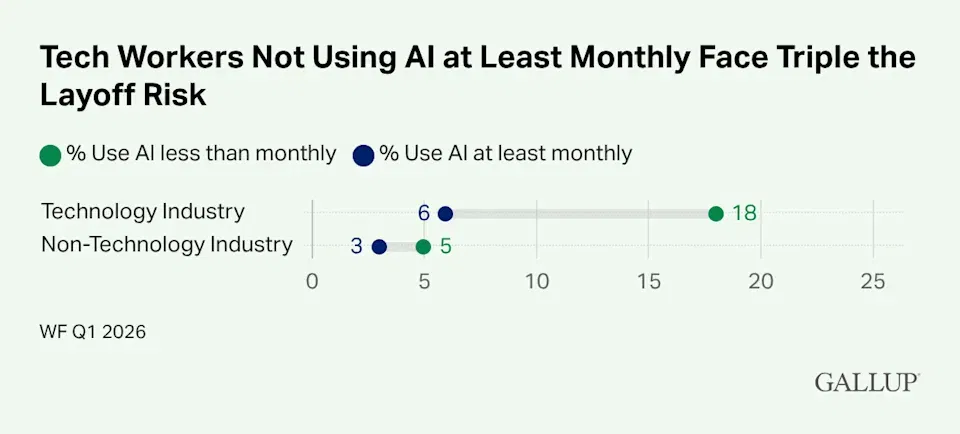
The gap was especially extreme in tech. Among tech employees who used AI at least monthly, 6% were currently laid off; among those who used it less, that figure was 18%. That’s a 3x difference within this sample—not a forward-looking prediction of any individual’s odds of being laid off. Non-tech industries showed the same directional gap (3% vs. 5%), but far less dramatically than tech did.
This needs to be read alongside broader U.S. layoff trends. Nationally, the share of employees who said their employer was reducing headcount rose from 8% in Q2 2022 to nearly triple that—21%—by Q1 2026. The share who said their employer was still hiring (34%) remains higher, but it’s held roughly steady since Q3 2025.
What stands out here is that the tech industry itself appears disproportionately exposed to layoffs. Tech workers made up 13% of laid-off respondents, but only 6% of the currently employed overall. This means tech workers were overrepresented among the laid-off group—though these two proportions alone don’t let us calculate precise layoff probabilities by industry. Fully remote workers showed a similar pattern: 25% of laid-off respondents worked fully remote, versus just 13% of employed respondents.
These numbers alone don’t let us conclude that not using AI causes layoffs. The same survey asked about something else too: the reasons laid-off workers themselves gave for losing their jobs.
Only 1% of Layoffs Cited AI as the Reason
Gallup asked laid-off employees, in an open-ended question, why they thought they’d been let go. The share who named AI or automation as the cause was just 1%. The most commonly cited reasons were organizational restructuring (15%), cost-cutting (11%), and economic downturn (11%), followed by government budget cuts (5%), business closures (5%), and internal politics (5%).
Looking at that 1% figure alone, AI seems to have almost nothing to do with layoffs. But read it alongside what companies announced that same week, and the picture changes.
Jack Dorsey’s Block cut 40% of its workforce this past February — from 10,000 employees down to under 6,000. Dorsey named the reason directly: “the rapid acceleration of AI.” And just last week, Block disclosed that its internal AI tool, BuilderBot, is now handling 15% of production code changes — performing 200,000 tasks a day and automatically merging roughly 1,500 pull requests1 a week. These corporate disclosures are evidence that AI is being put to work inside these companies. That said, figuring out exactly how much of the headcount reduction or profit change is attributable to AI requires separate analysis.
Block isn’t alone. Google CEO Sundar Pichai said in April that roughly 75% of new code is now AI-generated. Spotify co-CEO Gustav Söderström said in February that some of the company’s top engineers hadn’t written code by hand since last December. Microsoft CEO Satya Nadella has likewise said that AI writes 20-30% of the company’s code.
Gallup itself seems aware of this gap. The report states that “explanations like restructuring or cost-cutting may themselves be reflecting the influence of AI.” In other words: employees are told it’s a “restructuring,” but AI may well have shaped that decision behind the scenes. The survey can’t tell us how large that share is. Which means that if you only look at the 1% figure, you risk underestimating AI’s indirect influence.
And the scale here isn’t small. In Q1 2026 alone, roughly 78,000-80,000 people were laid off across the global tech sector. According to Nikkei Asia, nearly half of those layoffs are estimated to be related to AI or automation. That’s more than 2.5 times the 29,845 layoffs recorded in the same period in 2025, and a sharp increase over Q1 2024’s 57,269 as well.
Korea hasn’t yet seen large-scale layoffs where companies openly cite AI as the reason, the way U.S. firms have. There has been testimony from labor union representatives that Google Korea is reducing mid-level staff to free up budget for AI investment, but this hasn’t spread across the broader industry. Instead, Korea is showing a different kind of signal. As of March 2026, entry-level job postings at large and mid-sized companies fell 45% year-over-year. In a survey of 650 HR managers, “growing preference for experienced entry-level hires” (candidates with some work experience applying for entry-level roles) ranked as the top HR issue. The Korea Development Institute (KDI, a state-run economic think tank) estimates that about 3.41 million employed people in Korea — 12% of the total — hold jobs highly susceptible to AI replacement. The shift is happening less at the point of firing and more at the point of hiring. Layoffs make headlines; changes in hiring criteria don’t show up as easily from the outside.
Organizational Support Deserves as Much Scrutiny as AI Usage Frequency
Let’s go back to the Gallup data. The interpretation that “using AI helps you avoid layoffs” is intuitive, but Gallup’s data shows correlation, not causation.
Gallup itself acknowledged this near the end of its report. Whether the difference in AI usage frequency reflects a skill gap, a difference in job type, or some other unmeasured factor still needs further verification. The study controlled for age, education, and industry, but variables like “curiosity,” “adaptability,” and “speed of learning” are hard to capture in a survey.
It’s also difficult to interpret AI usage frequency as a measure of individual proficiency alone. How well a tool fits the task at hand, and whether the organization supports its use, matter too.
A separate Gallup analysis from April 2026 looked at employees at organizations that provide AI tools. Among employees who strongly agreed that their managers actively supported AI use, 78% used AI frequently — compared to 44% among those who didn’t feel that support. Integration with existing work systems, support for experimentation, and clear policies were all associated with usage frequency. The “7.4 times more likely to use AI” figure doesn’t come from this. That 7.4x number is tied to a different item — the perception that “AI gives me a chance to use my strengths.”

Judging technical competence or attitude by AI usage volume alone risks overlooking differences in organizational environment.
ManpowerGroup’s 2026 Global Talent Barometer2 points in the same direction. The share of employees who use AI regularly rose 13 percentage points year-over-year to 45%. But at the same time, confidence in their own technical proficiency dropped 18%. People are using AI more, but they’re actually less sure they’re using it well. The share of employees worried about losing their jobs to automation within two years also rose 5 percentage points year-over-year, to 43%.
There are also concerns about data security, ethics, and usefulness surrounding AI adoption. Gallup’s April analysis notes that such concerns, along with existing work habits, can influence experimentation and usage frequency. It’s hard to lump every reason for non-use together as simply “doesn’t know how” or “dislikes change.”
This survey alone can’t support the conclusion that companies lay off employees based on their attitude toward change. We’d need to separately verify which specific differences were tied to layoffs, and whether organizational support was actually adequate.
This dividing line doesn’t fall neatly along generational lines, either. In a separate Gallup survey of Gen Z (1,572 respondents, ages 14-29), the share using AI was similar to the previous year, but skepticism toward AI actually increased. 69% said they trust work done without AI more. Being a digital native doesn’t automatically translate into embracing AI. Still, this result alone can’t tell us which matters more — age or attitude.
Oswarld’s Lens
Looking at this Gallup data, I felt it echoed a pattern I’d seen firsthand in the field before.
There’s a pattern I’ve watched play out again and again while building GTM strategies. Whenever a new channel, tool, or methodology gets introduced, the early gap between “people who use it” and “people who don’t” tends to show up directly as a performance gap. Over time, I came to see two things at once: the effect of the tool itself, and the difference in how prepared and practiced each team was at adopting it.
Watching CRM rollouts, I noticed that teams who already managed customer data systematically found the tool easier to use. That’s my own experience of how a tool’s features and a team’s existing work habits interact. It doesn’t mean CRM itself has no effect.
I think the same logic applies to AI adoption — you need to look at both the productivity gains the tool creates and the process by which employees learn and apply it. That said, this is my interpretation, not a cause proven by the layoff investigation discussed earlier.
Amazon’s Math: Cut 30,000, Hire 10,000The cracks exposed by employees who gamed the AI usage leaderboardStill, there’s something that worries me. If “capacity to adapt to change” becomes a layoff criterion, there’s a real risk that organizations use employees’ non-use of AI as grounds for termination — without ever properly supporting AI adoption in the first place. A good number of employees who aren’t using AI aren’t failing to because they “don’t know how” — they can’t, because the organization never gave them guidelines or tools. Given that manager support correlates with how often employees use AI, we need to examine not just individual employees, but the environment the organization has built around them.
Closing
In the Gallup survey, how often tech employees used AI correlated with whether they were laid off. But usage volume alone can’t tell us the cause of the layoffs or how adaptable any given person is. I think what matters just as much is checking whether the organization provided tools, training, and usage standards suited to the work.
The next time “adopting AI tools” comes up at a team meeting, I’d suggest examining not just how capable the tool is, but “what our team can actually use it for, and how.” And that question shouldn’t be aimed only at individual team members. Leaders and managers need to be asked, too, whether they’re building the environment needed for that change.
💬 Have you started using AI tools in your work recently? If so, I’d love to hear in the comments what prompted you to start — and if not, what’s holding you back.
Keep the perspective, not the noise.
We choose one consequential shift and trace what sits beneath it, every other day.
Confirm once to finish subscribing.
Already a subscriber? Sign in to join the conversation


References & Further Reading
Primary sources
- Mary Page James & Ryan Pendell, “U.S. Workers Continue to Report Downsizing”, Gallup Workplace, 2026.6.17.: This is the core data source for today’s newsletter. The chart on layoff probability by AI usage frequency is the key piece.
- Andy Kemp, “AI in the Workplace: What Separates Adopters and Holdouts”, Gallup Workplace, 2026.4.12.: This lets you look separately at managerial support, AI usage frequency, task integration, and employee perception.
Background
- “Block Builderbot Handles 15% of Production Code”, GNCrypto News, 2026.6.17.: Covers the current state of Block’s AI coding tool alongside the context of its 40% workforce reduction.
- “Nearly 80,000 tech workers have already lost their jobs in 2026”, TechRadar, 2026.: Summarizes the scale of global tech layoffs in Q1 2026 and their connection to AI.
- “Has AI swallowed mid-sized companies’ office jobs too?”, Kyunghyang Shinmun, 2026.4.23.: Covers changes in Korea’s hiring market, including data showing a 45% drop in entry-level job postings.
- “AI and Labor Market Change”, KDI Center for Economic Information & Education.: An analysis of AI substitutability for 3.41 million employed workers in Korea.

Footnotes
-
Pull Request: The process by which a developer asks a teammate to review code before it’s merged into the team’s official codebase. It’s similar to posting “please take a look at this code.” ↩
-
Global Talent Barometer: An annual global labor market survey published by ManpowerGroup. It measures workers’ AI adoption rates, job satisfaction, and confidence in their skills. ↩
Related issues
'Rested' vs. NEET: Why the Youth Stats Don't Match
Korea's 'rested' status and Britain's NEET measure different age groups and definitions, complicating youth comparisons.
SocietyRemote Work and Rising Mental Distress, 2011-2024
A Science study tracked 588,322 US survey respondents from 2011 to 2024, linking remote work to rising isolation and distress.
SocietyPolymarket's Promo Videos Weren't Real Trades, WSJ Says
WSJ found that Polymarket's promotional clips staged trades that never actually happened on the platform.
Society
Your take shapes the next issue
What resonated most in this issue, or where has your experience been different?