

Students Booed Eric Schmidt's AI Graduation Speech
Grads booed Schmidt's 'just get on the rocket' line, echoing Luddites who resisted the terms of machines, not the machines themselves.
SocietyThe Boos That Greeted an AI Commencement Speech
There was an awkward scene at the University of Arizona’s commencement last May. The speaker was Eric Schmidt, Google’s former CEO, and his subject was AI—and the students booed him. Not once, but repeatedly. Schmidt eventually said, “I know how you feel. I can hear you.”
Schmidt has a metaphor he’s used for years: if you’re offered a seat on a rocket, don’t ask which seat—just get on. It’s the line that became famous as advice he gave Sheryl Sandberg in 2001. It did not land the same way at a commencement in 2026.
The weavers of 1811 and the graduates of 2026 weren’t reacting out of hatred for machines. Both groups were asking exactly the same question: who is bringing in this machine, for whom, and on what terms? In the 200 years since, the answers have changed. The question hasn’t.
Why 65% of Knowledge Workers Miss the Pre-AI Way of Working
In March 2026, the consulting firm Adaptavist asked 2,500 knowledge workers across the UK, US, Canada, Germany, and Spain. 65% said they regularly miss how work was done before AI became widespread.
That result alone is unsurprising. But the breakdown reveals what’s actually behind the nostalgia.
- 42% said they now spend more time verifying AI output than the time AI saves them
- 52% said a colleague regularly has to fix work produced by AI
- 31% believe AI erodes human creativity so much that it would be better to eliminate it entirely
- 46% feel frustrated that work which used to require expertise can now be done by almost anyone
So this nostalgia isn’t “I wish there were less work.” It’s dissatisfaction with how the nature of work itself has shifted. People have moved from creating to correcting, from writing to checking. I think the accurate term for this is the verification tax, a cost that rarely gets counted as its own line item of work hours or budget1.
There’s evidence this isn’t just a subjective impression. A study published in Harvard Business Review in February 2026 directly observed a US tech company with roughly 200 employees for eight months. Researchers visited the site twice a week, tracked internal messaging, and conducted in-depth interviews with about 40 people. As the study’s title states, AI didn’t reduce work — it increased work density.
Three specific patterns emerged. First, job scope expanded: PMs write code, researchers do engineering, and people now handle tasks that would previously have been outsourced. Second, boundaries collapsed: “just one more prompt” before stepping away became routine, erasing the breaks between tasks. Third, the number of simultaneously open tasks grew.
And people at this company felt more productive. At the same time, they reported being just as busy as before — or busier. The feeling of higher productivity and the report of increased busyness showed up together, in the same person.
There’s one more twist here. In the Adaptavist survey, the share preferring the pre-AI era was 42% among Gen Z and 26% among Gen X. Digital natives are the ones missing it more. Given these numbers, the “grumbling of an older generation that couldn’t adapt” reading doesn’t hold up.
1811: They Didn’t Smash Just Any Machine
Luddite2 has become shorthand for a technophobe today. When a newspaper calls something “Luddite thinking,” it means backward resistance to progress. But the actual history looks quite different.
The movement that began in 1811 in Nottingham, England, wasn’t led by an ignorant mob. Its members were among the most skilled workers of their era. They’d mastered their trade through long apprenticeships, and that trade let them support their families and hold standing in their communities.
What they smashed were knitting frames. But they smashed selectively. They didn’t smash just any machine. The machines of employers who paid fair wages and produced properly made goods were left untouched. Their targets were specific factory owners who used machines to break existing wage agreements, churn out cheap mass-produced goods, and replace skilled workers with cheap, unskilled labor.
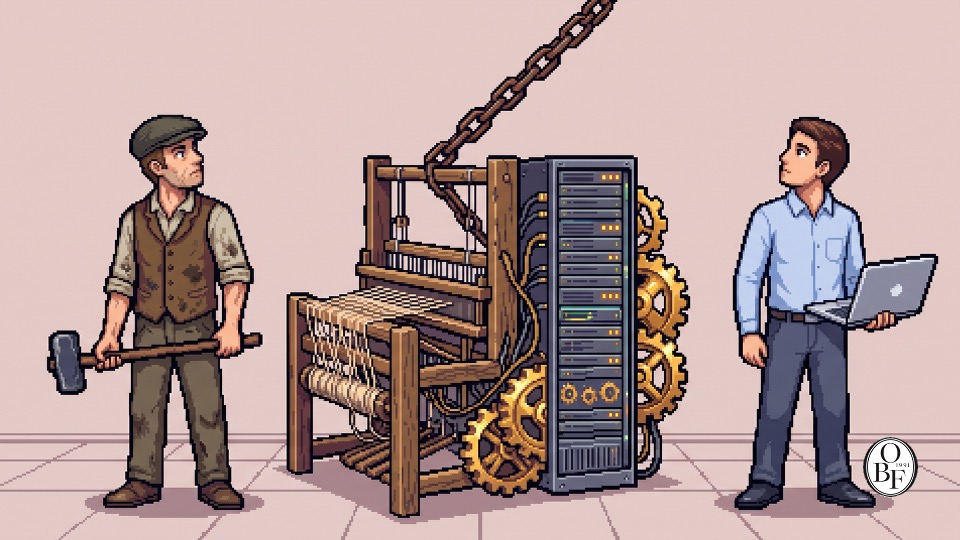 In other words, what they opposed wasn’t technology itself but the terms on which it was introduced. That’s the core point Brian Merchant makes in Blood in the Machine. The Luddites didn’t hate machines — they were asking whose pockets the profits from those machines would end up in.
The answer the British government gave to that question tells you everything you need to know. In 1812, Parliament made machine-breaking a capital offense. It chose the gallows over the negotiating table. The poet Byron, in his first speech to the House of Lords, opposed the bill and argued these were people stripped of their livelihoods, not criminals. It made no difference.
The image we’ve inherited — “Luddite” as a synonym for fear of technology — is the story left behind by the side that won this fight.
Where Two Rebellions, 200 Years Apart, Converge
Comparing the Luddites of that era with today’s pushback against AI adoption, I think three parallels stand out.
First, the ones resisting aren’t the unskilled — they’re the skilled. The handloom weavers of 1811 were the professionals of their day. The group most uneasy about AI adoption in 2026 fits the same pattern. In an Adaptavist survey, 33% of general knowledge workers said they’d considered switching industries — but among C-level executives, that figure was 46%. The anxiety runs deeper in the executive suite than on the front lines.
Second, technology doesn’t eliminate labor — it redistributes it. The power loom didn’t destroy work. It converted skilled labor into unskilled labor and shifted the difference in value to the factory owner. AI today isn’t eliminating work either. It’s converting the labor of making into the labor of verifying. The problem is that this verification labor doesn’t show up in anyone’s performance metrics. Individuals absorb it quietly, on their own.
Third, the backlash erupts precisely at the moment control shifts from the individual to the organization. Until quite recently, companies were encouraging employees to experiment freely with AI. But once AI companies moved to token-based pricing3 and costs became visible, the direction reversed toward tightening usage. From an employee’s perspective, they received the exact opposite instruction within six months — from “use your own judgment” to “don’t use it.”
The technology didn’t change. Who holds the decision-making power did. That’s precisely what the Luddites were angry about too.
There’s one more thing worth adding here: the question of creativity. There’s actually an experiment that examined this directly.
In a 2024 study published in the journal Science Advances, 300 writers were given AI-generated ideas, and 600 raters scored the results. Stories from the group that used AI most heavily scored 8.1% higher on novelty and 9% higher on usefulness. Writers who started out less creative saw even bigger gains — up to 10.7% in novelty and 11.5% in usefulness. For the individual, the benefit is clear.
But in the same dataset, similarity among the writers’ stories rose by 10.7%. Individuals got better; the group got more alike.
A brainstorming experiment by Wharton researchers, published in 2025 in Nature Human Behaviour, is even more striking. Across 45 statistical comparisons, idea diversity was significantly lower in the AI-using group in 37 of them. In a task asking participants to design a toy using bricks and a fan, 94% of ChatGPT users produced overlapping concepts — and nine people independently gave their toy the exact same name: “Build-a-Breeze Castle.” In the human-only group, no such duplication occurred.
So the intuitive complaint that “AI hurts creativity” turns out to have real evidence behind it — at least at the group level.
We should also question whether pre-AI was really better
If I stop here, this piece is only half-finished. Nostalgia itself tends to paint the past in prettier colors than it deserves.
Was the pre-AI content industry really so diverse? Major studios and publishers were recycling proven formulas long before AI arrived — sequels to sequels, remakes of remakes. There was never an era when every piece of creative work was an experimental masterpiece.
The same goes for concerns about younger generations losing out on learning. It’s a fair worry: if AI does all the entry-level work, what will new hires actually learn? But was the alternative we’re implicitly comparing it to — the apprenticeship model at law firms and banks, where junior staff repeated the same rote task a thousand times over — really the best way to learn? Did it persist because it was the only proven method, or because it was cheap and customary?
If we don’t answer that question honestly, we won’t be recovering something we lost — we’ll just be reclaiming something familiar. Those are not the same thing.
The Luddites weren’t exempt from this either. The apprenticeship system they were trying to protect was itself exclusive and hard to enter. History sides with them not because that system was perfect, but because the cost of change was unjustly billed to them alone.
Oswarld’s Lens
I see this problem not as a failure of adoption but as a design omission.
There’s something I’ve noticed over and over while building GTM strategies. When an organization brings in a new tool, it calculates two things: how much money it saves, and how much faster the work gets done. But almost nowhere does anyone ask who ends up doing the new work this tool creates.
I’ve rarely seen an AI adoption plan where the word “verification” appears next to an actual person’s name. The time saved gets logged as a win in the company’s performance reports, while the newly created work of verification gets quietly absorbed by individuals after hours. The finding that 42% said “I spend more time checking than I save” shows exactly how heavy that verification burden is. In my experience, you have to audit any work design that never assigned a name and a time budget to begin with.
That’s why I think AI training has to come paired with a genuine redesign of the actual work. Teaching people to write good prompts is easy, and it shows. But writing down, in an actual document, “who is finally accountable for this team’s AI output, and how many hours per week are allocated to verifying it” — that’s hard, and it doesn’t show at all. It never shows up as a performance metric, but it’s the work that actually needs to happen.
And if this diagnosis is right, the graduates who jeered weren’t rejecting the technology itself. Faced with the advice to “just get on the rocket,” they were asking under what conditions, and who bears the risk. I think that’s an entirely reasonable question to ask.
Closing
The 65% who say they miss the pre-AI way of working can’t simply be dismissed as resistant to change. I think it’s also tied to the fact that verification work has piled up alongside creation work, without that added burden being properly acknowledged. It’s the same structure as the Luddites, who resisted not the machines themselves but the terms under which they were introduced. So the question we should be asking now isn’t “should we use AI or not,” but “whose job is it to count the new labor AI has created?”
I’d suggest trying just one thing this week. Time how many minutes you actually spend reviewing what AI produces. If that verification time exceeds the time you saved, that’s a signal to examine not just the tool’s quality but how the work itself is designed.
Have you had a moment lately, while using AI, where you thought “this wasn’t supposed to be my job”? Tell me in the comments which tasks that verification work ended up landing on. I’ll gather readers’ examples of where verification work actually piles up most and put together a summary in the next issue.
📨 If you know a colleague who’s worn out from cleaning up after AI outputs these days, send them this piece.
Keep the perspective, not the noise.
We choose one consequential shift and trace what sits beneath it, every other day.
Confirm once to finish subscribing.
Already a subscriber? Sign in to join the conversation


References & Further Reading
Primary sources
- The Adaptavist Group, Understanding the Human Cost of AI Transformation, March 2026. Link ··· This survey forms the backbone of today’s piece. It covers 2,500 knowledge workers across the UK, US, Canada, Germany, and Spain, and the generational cross-tabs are especially worth a look.
- Aruna Ranganathan & Xingqi Maggie Ye, “AI Doesn’t Reduce Work, It Intensifies It”, Harvard Business Review, February 2026. Link ··· Its strength is that it’s an 8-month field observation, not a survey. That said, it’s a single-company case, so generalize with caution.
- Anil R. Doshi & Oliver P. Hauser, “Generative AI enhances individual creativity but reduces the collective diversity of novel content”, Science Advances, 2024. Link ··· This paper quantifies how individual creativity and collective diversity move in opposite directions. I’d recommend starting with the similarity analysis in Section 3.
- Lennart Meincke, Gideon Nave & Christian Terwiesch, Nature Human Behaviour, 2025. Link ··· This is the experiment where 9 people ended up naming the same toy. The diversity decline was verified across 45 comparisons.
- “Former Google CEO Eric Schmidt booed during graduation speech about AI”, NBC News, May 2026. Link ··· This is the source for the opening scene. The full transcript of the remarks is laid out here.
Background
- Brian Merchant, Blood in the Machine: The Origins of the Rebellion Against Big Tech, Little Brown, 2023. Link ··· This book recovers the Luddites not as technophobes but as a labor movement. Today’s historical section leans heavily on it.
- Kwangseob Ahn, People Who Outsource Their Thinking: Homo Brainless, Jpub, 2025. Link ··· This book treats the problems of verification labor and delegated judgment at greater length.
A past issue worth reading alongside this one
- INLEVEL9 Letter, “The People Who Switch Off Their 20-Watt Brains”

📝 Glossary
Footnotes
-
verification tax: This refers to the time and effort spent checking and fixing AI-generated output to make sure it’s correct. It’s not an official term — it’s a phrase used to describe the cost that quietly eats into whatever time was supposedly saved. ↩
-
Luddite: A movement of skilled textile workers in England between 1811 and 1816 who destroyed knitting machines. The name comes from a fictional figure called “Ned Ludd,” whose name signed their manifestos. Today the word is used to mean someone who hates technology, but originally it was a fight over wages and working conditions. ↩
-
token-based billing: A pricing model in which AI services charge based on the volume of text processed rather than the number of users. Because costs rise with usage, this gives companies an incentive to manage how much AI their employees use. ↩
Related issues
The Harvard Student Who Fed ChatGPT an Entire Novel
A Harvard student mistook a 1962 novel for Old English, revealing how reading itself is splitting society in two.
SocietySolve 12 Problems With AI, Then Quit Faster Alone
MIT, Wharton, and Carnegie Mellon studies suggest AI use may weaken persistence and critical thinking, with limited samples and timeframes.
SocietyAfter AI Help, Solo Accuracy Fell Below Control Group
In one test, a group that got AI help scored 57% on the final unaided problem vs. 73% for those who worked alone throughout.
Society
Your take shapes the next issue
What resonated most in this issue, or where has your experience been different?