

OpenAI Plans to Shut Down Sora After ChatGPT Shopping Revamp
OpenAI is winding down Sora while retooling ChatGPT shopping and courting enterprise clients—here's what that reveals about its priorities.
AI & TechOpenAI Announces Plan to Shut Down Sora
On March 24, 2026, U.S. time, OpenAI announced plans to shut down the Sora app. That’s roughly 6 months after the app launched. The company said it would share the shutdown timeline and how it plans to preserve user-generated videos at a later date.
That same day also brought news of a ChatGPT shopping feature overhaul and changes to executive roles. The day before, on the 23rd, Reuters reported that OpenAI was pursuing enterprise AI business jointly with private equity firms.
Reading these stories together, I see OpenAI re-ranking its priorities for products and customers. It’s winding down the video app while improving ChatGPT’s product-discovery features and searching for sales channels to bring in more enterprise customers.
It’s still too early to tell what results this shift will produce. But we can already see which businesses OpenAI is scaling back and where it’s choosing to put more resources.
From the Sora shutdown announcement to the shopping feature and enterprise sales push, let me walk through what’s confirmed for each and what caught my attention.
Shutdown Announced Six Months After Launch, Disney Partnership Falls Through
The Sora app launched on September 30, 2025, alongside Sora 2. OpenAI emphasized that it could generate video and sound together and render physical movement more naturally. Users could share the videos they made directly within the app.
On December 11, a partnership with Disney was announced. Disney would invest $1 billion in OpenAI and license more than 200 characters for use in Sora videos and elsewhere over three years. At the time, the announcement explicitly noted that deal-closing conditions—including a final agreement and approvals—remained outstanding.
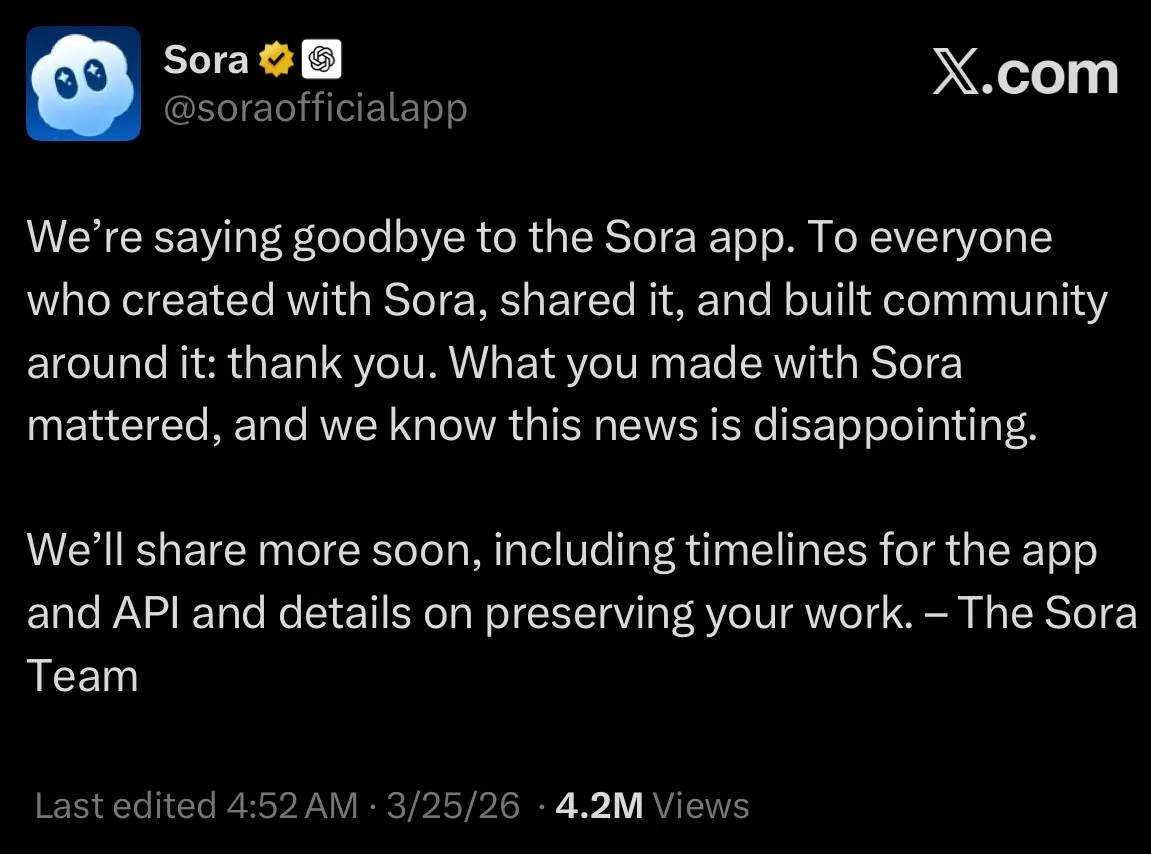
The March 24 shutdown announcement scuttled this partnership too. Citing sources, Reuters reported that the deal never actually closed and no money changed hands. This isn’t a case of Disney putting $1 billion into Sora and then losing all of it.
The Sora team’s notice above states that the shutdown timeline for the app and API, along with how to preserve users’ work, would be announced later. Reading this announcement as meaning the service disappeared immediately would lead users to badly misjudge how much time they have to respond.
On the reasons behind the shutdown, Reuters relayed sources’ explanations that running Sora required substantial compute resources1 and was affecting resources needed by other teams. It also reported a shift in focus toward coding tools and enterprise products. This supports the interpretation that OpenAI is reprioritizing its business, but per-product costs and revenue haven’t been disclosed in enough detail to pin the shutdown on any single cause.
Reorganizing the Company and Landing Enterprise Clients
There were changes on the organizational side, too. According to Reuters, Altman decided he would no longer receive direct reports from the safety and security teams, and Fidji Simo’s title changed from CEO of Applications to “CEO of AGI Deployment.”
The Information covered both Altman’s shifting role and preparations for the next-generation model, “Spud.” An internal memo cited in that report said Altman is focusing on capital raising, supply chains, and data center construction. What tasks a CEO personally takes on is a clue to reading what challenges the company needs to solve.
The title “AGI Deployment” emphasizes the role of applying research results to actual products and services. There’s no basis to read it as a technical announcement that AGI2 has already been achieved.
The report that Spud’s pre-training3 is complete and could launch within weeks was also based on the internal memo. This should be read as distinct from an announcement with a confirmed official launch date. Research related to Sora also deserves separate attention for its potential use in robotics and world models4 after the app is discontinued.
I see this reorganization as a move to place clearer responsibility on product deployment and infrastructure procurement. That said, an org chart alone can’t tell us the investment priority of each business line, or whether Sora will succeed or fail technically.
The approach to securing enterprise clients comes into sharper focus in a March 23rd Reuters report. It states that as OpenAI discussed forming joint ventures with private equity (PE)5 firms, it proposed terms guaranteeing a minimum 17.5% return on preferred stock6 investments. The report was based on sources familiar with the negotiations, and OpenAI and some of the firms named declined to comment.
If a joint venture is formed, the PE firm could introduce AI tools to its portfolio companies and support their adoption. This would let OpenAI quickly gain access to multiple clients, rather than pitching to individual companies one by one. Still, partnering with a PE firm doesn’t mean every company under it will sign on as a client.
ChatGPT Shifts Toward Product Discovery and Comparison Instead of Direct Checkout
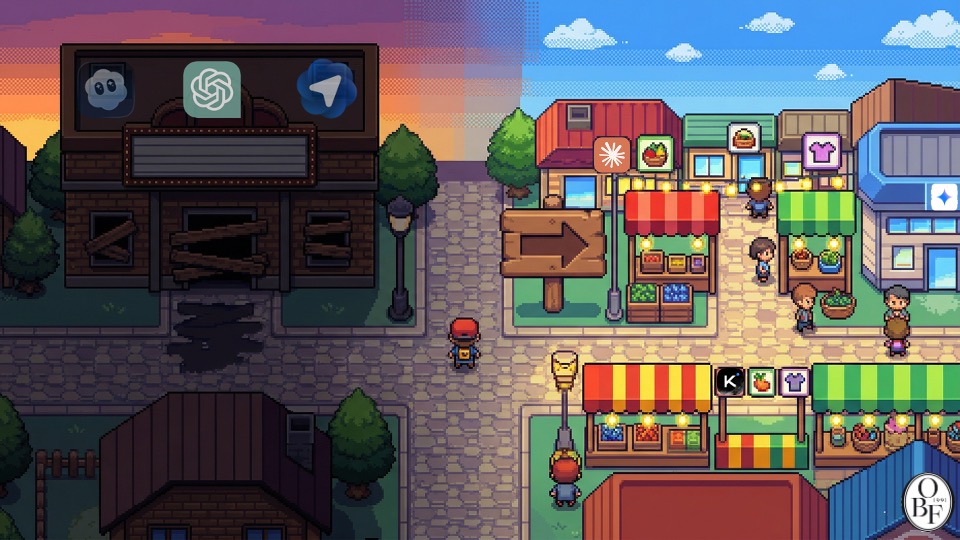
The overhaul of ChatGPT’s shopping feature was officially announced on March 24. What OpenAI emphasized was improving the process of discovering and comparing products.
The original “Instant Checkout” was a feature that let users complete purchases inside ChatGPT. OpenAI explained that the initial approach lacked sufficient flexibility, and said it would let merchants use their own checkout experience while ChatGPT focuses on product discovery.
The new feature lets users upload an image to find similar products, and compare price, reviews, and features side by side. At the time of the announcement, it was set to roll out over the course of a week. Merchants including Target, Sephora, and Nordstrom were said to connect their product information through ACP7.
How checkout is integrated varies by merchant. Shopify products are searched through the catalog, and purchases take place in the app’s in-app browser, leading to the merchant’s own storefront. Walmart, by contrast, offers a separate ChatGPT app that links Walmart accounts and payment directly. The Walmart feature was planned to launch on the web first, with the mobile app to follow.
I think it’s a realistic move for OpenAI to rely on the checkout systems merchants already operate, while ChatGPT concentrates on what it does well — comparison and recommendation. Securing a position that influences product selection could create real business opportunities. But actual purchase conversion and revenue will need to be judged based on how the rollout actually performs.
Oswarld’s Lens
When I look at a GTM strategy, I don’t just look at product features — I look at who it’s sold to, what channels carry it, and what resources operating it requires. In this OpenAI shift, what caught my attention was how these three pieces connect.
Sora’s shutdown can be read as portfolio pruning8 — a company running several products and choosing to concentrate people and resources on the businesses it now prioritizes. How bad Sora’s unit economics actually were, and how much revenue the new shopping feature can generate, are both hard to compare using public information alone. So it’s premature to treat the shutdown and relaunch themselves as proof of improved profitability.
I also read the revenue guarantee reportedly offered to PE firms through the lens of customer acquisition cost. It’s an attempt to give distribution partners a financial incentive in order to gain more touchpoints with enterprise customers. I’d want to judge the success of this approach not by the number of partners signed, but by the number of companies that actually adopt the product and the retained revenue that follows.
Here’s where you can’t assume AI services run at near-zero marginal cost.9 Every time a customer uses the product, inference costs accrue, and connecting it into enterprise systems requires engineers and operational support. To sustain a revenue guarantee, there has to be enough revenue left over even after accounting for those costs.
In an earlier issue, I covered the falling cost of AI video generation. As unit prices drop, users benefit, but suppliers have to absorb both price competition and operating costs at the same time. In a market like this, whether to keep running a video app or redirect resources to another product is a separate business call. Price competition alone can’t fully explain why Sora was shut down, but it’s the context that came to mind as I read this news.
Winding down a product also creates costs that existing users and partners have to bear. People who made videos with Sora and built workflows around it now need to back up their files and prepare to migrate to other tools. How adequate the shutdown notice and the guidance on preserving work turn out to be is, I think, also a matter of trust in how the product is run.
Closing
By announcing the shutdown of its video app, OpenAI is doubling down on enterprise customers and shopping features. Going forward, I want to watch how many enterprises actually adopt these tools and keep using them, and how well product recommendations translate into actual purchases.
The organizational restructuring and new partnerships are the means to that end. Just as important as the scale of the announcements is whether the business structure can actually sustain operating costs and customer support.
If you’re a Sora user, the first priority is checking the shutdown timeline and export instructions, and backing up any important work separately. If you’re switching to another video tool, don’t just look at generation quality — check whether it can work with your existing files and what the usage terms are.
Both the ability to ship new products quickly and the ability to retire old ones responsibly matter. I plan to judge the outcome of this transition by looking at how the new features perform alongside how OpenAI follows up with Sora users.
Keep the perspective, not the noise.
We choose one consequential shift and trace what sits beneath it, every other day.
Confirm once to finish subscribing.
Already a subscriber? Sign in to join the conversation


References & Further Reading
- OpenAI, Sora 2, 2025.09.30. This is the original announcement of the app and model.
- OpenAI·Disney, Announcement of investment/licensing partnership with Disney, 2025.12.11. Covers the investment target and deal-closing conditions.
- Reuters, OpenAI drops AI video tool Sora, startling Disney, sources say, 2026.03.24. Covers the shutdown announcement, the Disney deal, and organizational changes.
- The Information, OpenAI CEO Shifts Responsibilities, Preps ‘Spud’ AI Model, 2026.03.24. Reports on Altman’s shifting role and preparations for the next-generation model.
- OpenAI, Powering product discovery in ChatGPT, 2026.03.24. Explains the scope of product comparison and seller-specific checkout integration.
- Reuters, OpenAI sweetens private equity pitch amid enterprise turf war with Anthropic, sources say, 2026.03.23. Reports on joint-venture negotiations and proposed terms.

Footnotes
-
Compute resources: refers to the processing power of GPUs, servers, and other hardware used for AI training and inference. Beyond equipment, this also requires power and operating costs. ↩
-
AGI (Artificial General Intelligence): a concept aimed at AI capable of performing a wide range of intellectual tasks. Specific goals and criteria vary by company. ↩
-
Pretraining: the stage in which a model’s base capabilities are trained on large amounts of data. Further training, evaluation, and deployment are still needed afterward. ↩
-
World model: a model that predicts how an environment’s state changes in response to actions. It’s studied for uses such as robots predicting the outcomes of their actions. ↩
-
Private equity (PE): a fund that uses capital pooled from investors to acquire equity stakes and the like in companies. The management firm maintains relationships with multiple portfolio companies. ↩
-
Preferred stock: shares designed to give holders priority over common shareholders in matters like dividends or distribution of remaining assets upon liquidation. Specific rights and return terms vary by contract. ↩
-
ACP (Agentic Commerce Protocol): an open protocol developed by OpenAI and Stripe to let sellers and services exchange information during AI-mediated product discovery and transactions. ↩
-
Portfolio cleanup: the process by which a company reviews the various businesses or products it runs and decides to maintain, scale back, or discontinue them, reallocating resources accordingly. ↩
-
Marginal cost: the additional cost of providing one more unit of a product or service. For AI services, this must account for factors like inference costs and customer support costs tied to usage volume. ↩
Related issues
Nvidia GTC 2026: How to Read Its $1 Trillion Pitch
I unpack Nvidia's Groq integration and the token-factory logic behind its infrastructure sales pitch.
AI & TechAsk 70 AI Models the Same Question, Get the Same Answer
Different AI models can converge on strikingly similar ideas—here's what the Artificial Hivemind study found.
AI & TechCould a One-Cent Stamp on Email Kill Spam?
Adding a tiny fee or computational cost to every message might curb spam—here's what an old proposal gets right, and where it stalls.
AI & Tech
Your take shapes the next issue
What resonated most in this issue, or where has your experience been different?