

When Meetings and Approvals Stall Work: Lessons from a 1944 Manual
Reading the OSS sabotage manual, I revisited the unnecessary meetings and approvals I've seen in consulting.
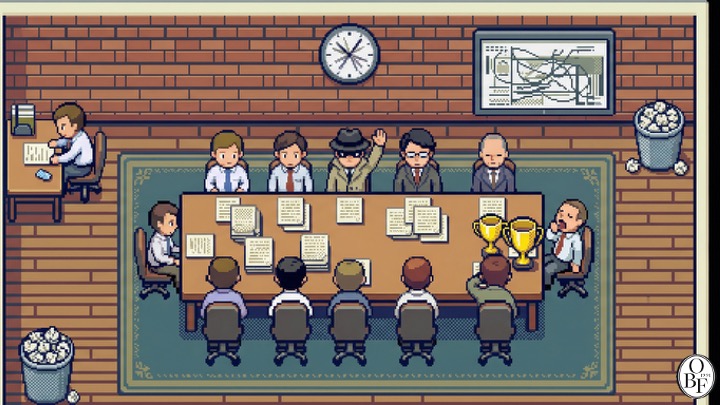
BusinessWhile consulting, I’ve watched ten people sit in a meeting that three could have handled, and watched work stall as teams re-confirmed decisions they’d already made. I’ve seen an organization where sending a single email required three levels of approval.
So when I read the OSS’s Simple Sabotage Field Manual, produced by American intelligence in 1944, a lot of it felt familiar. It instructs readers to delay decisions, call unnecessary meetings, and multiply approval steps. I’d actually written about this document on my blog back in 2022.
What struck me was how closely a document designed to sabotage an enemy nation during wartime resembles the everyday operations of an ordinary company. What I want to look at again here is when a procedure meant to help work actually starts to delay it.
The Meetings and Approvals Described in a Wartime Sabotage Manual
The OSS was the American intelligence agency that preceded the CIA. Issued on January 17, 1944, this manual was meant to encourage citizens in enemy or occupied territories to obstruct the war effort in small, everyday ways. According to the CIA’s own account, OSS Director William Donovan had parts of it released publicly, distributed through leaflets and broadcasts.
The document covers several domains, but here I want to focus on the “General Interference with Organizations and Production” section within Chapter 5. If you group together its guidance on organizations, meetings, and managers, it reads roughly as follows. The points below summarize the original text.
- Delay decisions. Insist that everything go through channels, push issues to the largest possible committee for consideration, and bring back for further discussion questions already decided at the last meeting.
- Misalign performance and reward. Give undeserved promotions to people who do poor work, and discriminate against or criticize without cause the people who do good work.
- Multiply unnecessary procedures. Hold meetings when there is more important work to be done, produce duplicate paperwork, and demand that three people approve something one person could sign off on.
The original text notes that the ordinary errors of judgment and uncooperative behavior that occur in any organization can already cause delays on their own. The idea was to deliberately amplify that behavior, wasting the enemy’s time and manpower.
What to Watch For When Comparing This to Today’s Meeting Culture
In a 2024 survey published by Asana’s Work Innovation Lab, individual contributors reported spending 3.7 hours per week on unproductive meetings — up 118% from 1.7 hours in 2019. Managers reported 5.8 hours per week, an 87% increase from 2019.
These figures reflect how burdened survey respondents felt by meetings. They don’t mean meeting time increased at the same rate across every company. And the mere fact that unproductive meetings are common doesn’t by itself explain why organizations end up this way.
In a 2016 HBR article, Gary Hamel and Michele Zanini estimated that excess bureaucracy costs the U.S. more than $3 trillion a year, or roughly 17% of GDP at the time. This, too, should be read as the authors’ own estimate.
Placing this data alongside the manual, we can start to think about how procedure itself can delay work. But there isn’t enough evidence to conclude that all inefficiency in modern organizations stems from the same cause, or that every company has naturally drifted into following the manual’s playbook.
Meetings serve a real function: aligning disparate information and assigning responsibility. Approval processes exist, in part, to catch errors or prevent misconduct. To judge whether a procedure is actually necessary, you have to look at what role it’s actually playing.
Check the Purpose Before You Cut the Procedure
Reading this document in reverse does surface things worth examining. But it’s hard to apply “the opposite of a big committee is always a small team” as a blanket rule. Issues that require deep expertise or involve complex, competing interests may genuinely need review by many people.
For a meeting, it should be clear what needs to be decided, whether the people needed for that decision are actually present, and who will execute afterward. If it’s simply a status update, sending a document might work better. If the same decision keeps getting re-discussed every time, it’s worth checking whether that’s because new information has emerged, or because it was never clear who had decision-making authority in the first place.
The same goes for approvals. If each approver is reviewing a different kind of risk, multiple steps may be warranted. If everyone is just formally rubber-stamping the same content, there’s room to cut the redundancy. Rather than simply counting the number of steps, the better question is what actually changes at each one.
Recognition for performance also needs to connect back to the actual purpose of the work. If contribution and evaluation keep diverging, people start wondering what, besides doing good work, actually gets them recognized. I think this is the part of the manual most worth reading as a checklist for how an organization is actually run.
Oswarld’s Lens
The manual explains that getting people to act deliberately foolish requires motive and incentive. Reading that, I found myself thinking that in today’s organizations, assuming malice on someone’s part first is rarely helpful. Even if every individual is trying to be careful, when approvals and confirmations pile up, the whole operation can still slow to a crawl.
The meetings and approval chains I’ve seen in the field were hard to explain through diligence alone. I had to look at the structure of the work itself to understand why ten people needed to sit in the same meeting, or why an already-settled matter had to be re-confirmed.
From a data perspective, how you record lost time matters. The start and end of a meeting are easy to measure. But the other work delayed because of it, the decisions pushed back, the opportunities missed as a result — none of that shows up neatly in the same spreadsheet. Without a record, it’s hard to even notice that this cost is recurring.
Along with how many meetings get cut, I want to see how long it takes from an item being raised to a decision being made, and whether the decision actually gets executed afterward. A meeting that ends quickly but pushes everything to the next meeting without deciding anything hasn’t necessarily made things faster.
An 80-year-old document doesn’t need to be treated as the definitive diagnosis of an organization. But it can serve as an occasion to re-examine procedures we’ve stopped noticing because they’ve become routine. The point is to move one step past “that’s just how we’ve always done it,” and ask whether the procedure is still necessary now.
Keep the perspective, not the noise.
We choose one consequential shift and trace what sits beneath it, every other day.
Confirm once to finish subscribing.
Already a subscriber? Sign in to join the conversation


References & Further Reading
- CIA, The Art of Simple Sabotage, April 1, 2019. Introduces the background and key contents of the OSS manual.
- OSS, Simple Sabotage Field Manual, January 17, 1944. The full text is available via Project Gutenberg. The section covered here is item (11) of Chapter 5.
- Asana, The rise of unproductive meetings and the hangovers they leave behind, April 8, 2025. Describes the 2024 survey findings.
- Gary Hamel & Michele Zanini, Excess Management Is Costing the U.S. $3 Trillion Per Year, September 5, 2016.
- You Can Do It Too! A Field Manual for Ruining Your Organization — a piece I wrote in 2022 introducing this document.

Related issues
Anthropic's AI Jobs Report: What 74.5% Really Means
I read Anthropic's March 2026 report and found the 74.5% figure measures something very different from job-loss risk.
BusinessNetflix Acquires an AI Studio as Labels Sign AI Licenses
UMG and Warner struck AI licensing deals with Suno and Udio while Netflix bought Ben Affleck's AI filmmaking startup, InterPositive.
BusinessRunning GTM at Gamma: Choosing Customers, Setting Prices
Reflections from running GTM at Gamma on picking the right customers, pricing, and what turns interest into repeat purchases.
Business
Your take shapes the next issue
What resonated most in this issue, or where has your experience been different?