

What SaaS Stock Crashes Reveal About Growth, Not Just AI
Software stocks are sinking, but the real story started before AI fears—it's about how SaaS pricing models stopped scaling.
AI & TechMy First Thought Watching SaaS Stocks Fall
Software company stock prices are dropping sharply. SaaS—Software as a Service—is a business model where instead of installing and owning software, you access it over the internet and pay a subscription fee. Lately, worries have grown that AI could replace what these products do.
In a February 9, 2026 analysis, Bain noted that major software indices had fallen roughly 15% over recent weeks, and about 25% from their 12-month highs. Bain frames this less as customers’ existing contracts suddenly evaporating, and more as a shift in investors’ expectations about future growth. Bain analysis
Watching this decline, my first reaction was, “it’s finally here.” While building GTM (go-to-market) strategy, I’d already seen the limits of pricing models that depend on growing user counts. Even before the fear around AI intensified, I believed we needed to look at slowing growth as its own issue.
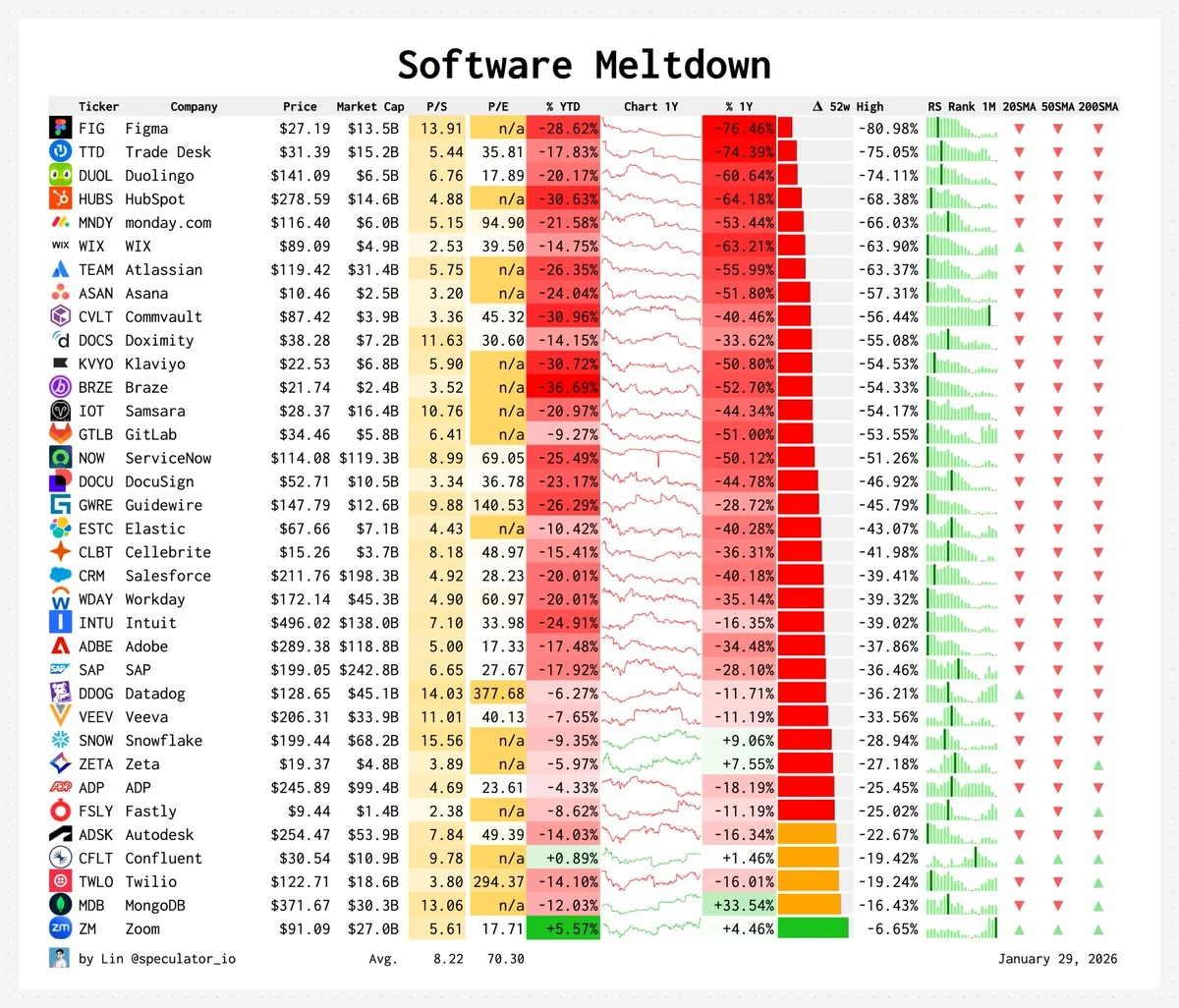
A comparison of software stocks as of January 29, 2026. Created by Lin (@speculator_io). Note that year-to-date return, 1-year return, and decline from 52-week high are measured on different bases.
The English draft matches the Korean source accurately in meaning, structure, numbers, and formatting. No corrections needed.
Revenue Growth from Price Hikes vs. New Customer Growth
Jason Lemkin of SaaStr also recently analyzed the downturn, emphasizing the SaaS growth slowdown that has continued since 2021 and the shift in corporate budgets. His argument is that we need to distinguish between revenue growth driven by raising prices on existing contracts or selling more to existing customers, and the ongoing acquisition of new customers. Lemkin’s post
Revenue from price increases is still revenue. But how long that kind of growth can be sustained is a separate question. If investors expect lower growth rates going forward, they may assign a lower valuation to a company even if it generates the same revenue.
Bain explains that as core features become more widely adopted, additional purchases from existing customers slow down, and user-seat growth no longer contributes to growth the way it used to. The metric to watch here is Net Revenue Retention (NRR). It shows how much revenue from an existing customer base remains or grows after a given period, reflecting not just add-on purchases but also price increases, contract downgrades, and churn. Exceeding 100% doesn’t necessarily mean the number of users or usage has actually grown.
On top of this, as AI adoption budgets rise, purchases of new software or additional accounts may get pushed back. Even if a product is still needed, if customers shift their spending priorities, it creates a drag on the vendor’s growth.
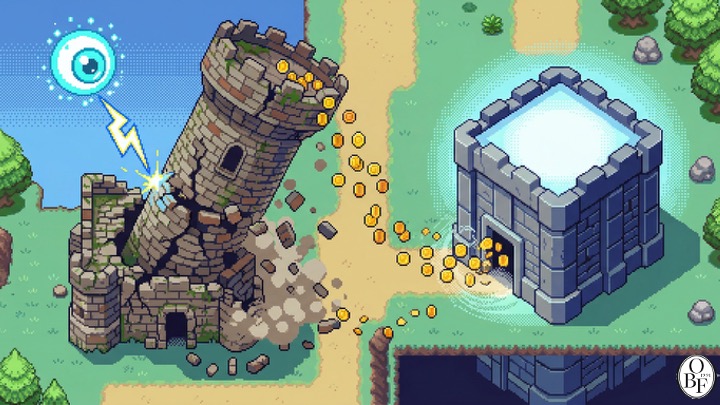
Can you escape the race to build similar features?
When I look at today’s AI app market, I’m reminded of the era when smartphone apps were multiplying rapidly. There were countless bus-route apps, and even domestic messengers had several rivals — KakaoTalk, MyPeople, NateOn. As time passed, some services disappeared and users consolidated around a few.
AI apps are following a similar pattern, with many products touting similar features. Not every category will collapse into a single winner, but I think it’s becoming harder to differentiate on the strength of general-purpose AI features alone.
Presentation generation is one example. On February 24, 2026, Anthropic released a research preview letting Claude connect Excel and PowerPoint add-ins to turn analysis results directly into presentation decks. Anthropic’s announcement Users can now get AI assistance without ever leaving the office software they already use.
At Gamma, I ran GTM for a strategy targeting customers with heavy security requirements. For this customer segment, what mattered wasn’t just content-generation features but where data lived and how it was operated. In the strategy I worked on, on-premise deployment — running on the customer’s own servers — and security specialization were the key directions.
The point is: when you’re competing on the same features as general-purpose AI, you need to find which customer needs you can solve better. For the segment I worked with, security and the operating environment could be exactly that differentiator.
“If Claude or Gemini offers this same feature, does the customer still have a reason to keep using our product?” I believe SaaS teams need a concrete answer to this question — one that goes beyond a feature list to include the customer’s security requirements and existing ways of working.
AI works inside the tools people already use
AI’s role is expanding from summarizing and drafting to actually operating the tools themselves. It’s no longer just suggesting what an email should say—it can help edit documents or move a contract process forward within connected services.
It’s worth noting that this shift is happening through connections to existing software. Anthropic’s announcement on February 24 included connections to Google Workspace, Docusign, and other enterprise plugins. Docusign, for its part, announced that it had connected its own contract management features for use within Cowork. It’s a case of existing software staying in the loop even as AI handles the work. Docusign announcement
Google began including Gemini features in Workspace’s Business and Enterprise plans starting in January 2025. Think email summaries and drafting in Gmail, document work in Docs, meeting transcripts in Meet. What matters here isn’t that every task gets handled automatically, but that AI features are built into the products people already use. Google announcement
I think this mode of use is meaningful AI adoption. Instead of going off to learn some separate AI app, you get help while doing the work you were already doing. If you’re on a team selling a new SaaS product, you need to explain why what you offer beats the AI features already built into the products people use.
Oswarld’s Lens
From my own experience running GTM, I’m wary of the assumption that seat count will keep driving revenue growth. When a client’s user base expands and new clients keep signing on, per-seat pricing works in your favor. But once adoption saturates and headcount at existing clients stops growing, that same growth model gets harder to sustain.
If AI takes over some of the work, the need to buy more seats could shrink. That doesn’t mean per-seat pricing stops working right away, though. The impact depends on which tasks get automated and how much, and whether a company charges for usage or some other metric instead of seats. I see this shift as a reason to re-examine product features and pricing strategy together.
I also don’t buy the argument that the entire software market is disappearing. In its forecast dated February 3, 2026, Gartner projected that worldwide software spending would grow 14.7% this year to roughly $1.4336 trillion. That figure isn’t SaaS-specific, but it does mean you can’t call overall software spending a shrinking market. That said, this spending won’t be distributed evenly across every company. Gartner’s forecast
CRM and ERP systems that manage a company’s customer records or accounting and HR data aren’t easy to replace just by cloning a few features. Data has to migrate, integrations with other systems have to be rebuilt, and employees have to adapt to new workflows. Tools that handle simple, standalone tasks, by contrast, impose much less switching burden on customers moving to another service.
What I want to keep checking going forward is whether customers have a reason to keep paying. I’ll be watching whether a product holds the records essential to daily operations, whether it’s wired into other systems to actually get work done, and whether it provides the database, security, and monitoring that running AI requires. If that role is weak and growth depends purely on price hikes, I think growth projections deserve a more cautious read.
That’s exactly the problem I see in this week’s stock decline. With growth already slowing, and AI competition layered on top, the question is how companies will change their products and pricing. For any team running a SaaS business, I think the starting point is figuring out exactly why customers have stopped buying more.
Keep the perspective, not the noise.
We choose one consequential shift and trace what sits beneath it, every other day.
Confirm once to finish subscribing.
Already a subscriber? Sign in to join the conversation


References
- Bain & Company, Why SaaS Stocks Have Dropped and What It Signals for Software’s Next Chapter, February 9, 2026.
- Jason Lemkin, The 2026 SaaS Crash: It’s Not What You Think, February 2, 2026.
- Anthropic, Cowork’s Enterprise Plugins and Office App Connections, February 24, 2026.
- Docusign, Announcing Contract Management Integration with Cowork, February 24, 2026.
- Google, Empowering Businesses with AI Features Built Into Workspace Plans, January 15, 2025.
- Gartner, 2026 IT Spending Forecast, February 3, 2026.

Related issues
When Currency Forecasters Get It Wrong, Then What?
Trading mostly in dollars, I've learned to judge pundits by how they explain a bad call, not just by the ones they got right.
AI & TechWhy Companies Are Quietly Choosing Chinese AI Models
Airbnb's Brian Chesky praised Qwen's speed and cost, and open-weight models are reshaping how developers weigh adoption.
AI & TechDoes Big R&D Spending Actually Attract Top Talent?
Korea ranks near the top in R&D spending but 31st in global talent competitiveness, raising questions about what conditions actually draw researchers.
AI & Tech
Your take shapes the next issue
What resonated most in this issue, or where has your experience been different?