

From Wuxia's Ming Cult to Persian Fire Religion and Oil
A wuxia fan's curiosity about the Ming Cult leads to Manichaeism, Persian fire worship, and Iran's oil history.
BusinessThe Ming Cult I Discovered in Wuxia Novels
I read pretty much everything in the wuxia genre—classic wuxia, time-loop wuxia, fusion wuxia, even wuxia webtoons—without much discrimination. One faction that keeps showing up across these stories is the “magyo” (魔教, “demonic cult”). Depending on the work, it’s cast as a straightforwardly evil organization, or sometimes the story follows a protagonist who actually lives within it. In Jin Yong’s Heaven Sword and Dragon Saber, there’s a sect that calls itself the “myeonggyo” (明教, “the Cult of Light”) but is branded a demonic cult by every rival faction.

What I found fascinating is that this fictional Myeonggyo was modeled on a real religion: Manichaeism. Follow Manichaeism’s origins back far enough and you land in the religions of Persia—and the history of that region includes both a tradition of venerating fire as sacred and, later, the story of oil development. Today I want to walk through these topics one at a time. They’re connected to each other, but I don’t want to string them together as if one directly caused the next.
The Cult of Light in Fiction and Historical Manichaeism
In The Heaven Sword and Dragon Saber, the novel’s “Mingjiao” (明教, the “Cult of Light”) is headquartered at Guangmingding (“Radiant Summit”), and is described as a religion transmitted from Persia. Martial arts like the Shenghuoling techniques (the “Sacred Flame Insignia” arts) and the Qiankun Danuo (“Great Shift of the Universe”) also appear in the story. These fighting styles and the sect’s organization are fictional inventions — they aren’t a direct transcription of any real religious practice.
The historical inspiration for that setting is Manichaeism (摩尼教)1, a religion founded by Mani in the 3rd century. It originated in Mesopotamia, then under Sassanid Persian rule, and spread both east and west from there. It’s a distinct religion from Zoroastrianism, which is often (and inaccurately) called “fire worship.”
Manichaeism emphasized dualism2 — the idea that light and darkness are two opposing principles. It shared common ground with Zoroastrianism and was also influenced by Christianity, Buddhism, and other religious traditions. But if you assume it simply borrowed Zoroastrian doctrine wholesale and renamed it, you’ll miss the real differences between the two faiths.
Manichaeism reached China via the Silk Road3, and records of its activity survive from the Tang dynasty. Later, in southern China, it came into contact with Buddhism and Daoism and became known as Mingjiao. There were periods when it was suppressed and its followers kept their faith alive in secret. Jin Yong, the celebrated wuxia novelist, drew on this history as material for the Mingjiao of his fiction. Not every “evil cult” that appears in other wuxia works shares the same religious background.
There’s also a theory that the name of the Ming dynasty derived from Mingjiao. The historian Wu Han proposed a connection between Mingjiao and the Red Turban Army, which Zhu Yuanzhang — the founding emperor of the Ming dynasty — had once joined. The Red Turban Army was tied to beliefs associated with the White Lotus Sect4. But other research disputes any real relationship between Manichaean believers and the Red Turban Army. The mere fact that “Ming” (明) and “Mingjiao” (明教) share a character doesn’t settle where the dynasty’s name actually came from.
Sacred Fires in Temples, and Fire Rising from the Ground
Now let’s move on to another Persian religion: Zoroastrianism.
Zoroastrianism is an ancient Iranian religion rooted in the teachings of Zarathustra. Scholars disagree considerably on when its founder was actually active. The religion centers on Ahura Mazda, emphasizing truth and righteous living, and treats the struggle against evil as a central concern. While its influence on later religions is a subject of study, it’s hard to assert definitively that concepts like heaven, hell, and judgment all originated first in this religion.
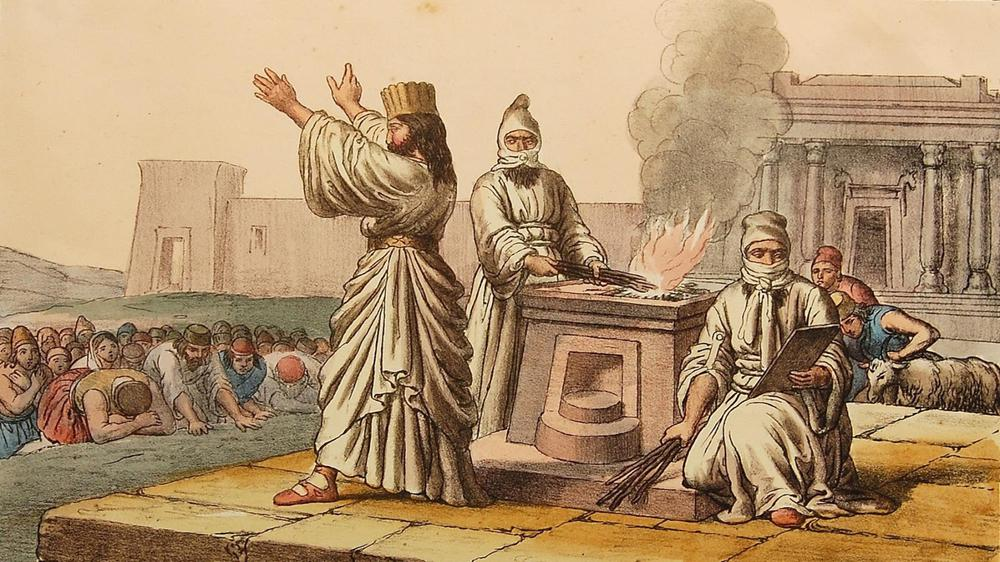
Fire holds deep significance in Zoroastrian ritual. Sacred fires representing purity and truth are tended and maintained in temples. In Yazd, Iran, there’s a sacred fire said to have burned continuously for over 1,500 years. “Maintaining” the fire here means it has been kept alive by continually replenishing fuel. The sacred fires in Zoroastrian temples are sustained by burning wood.
Meanwhile, in places like Iran and Azerbaijan, underground gas sometimes seeps naturally to the surface and ignites. This, along with oil seeps5 where petroleum appears at the surface, serves as a clue for locating underground resources. Giuseppe Etiope of Italy’s Institute of Geophysics and Volcanology has studied the relationship between ancient natural gas eruptions and religion and tradition. His point is that there are cases—like the fire near Baku—where naturally occurring gas seeps became linked to religious belief.
That said, we need to distinguish between gas fires emerging from the ground and temple sacred fires that people actively fuel. We can’t generalize that every sacred fire sat atop an oil field.
And even when gas or oil appears at the surface, that doesn’t immediately confirm a commercially viable oil field. Reserves and extraction feasibility still need to be surveyed, and actual drilling still has to happen.
D’Arcy’s Investment and Reynolds’s Expedition
The man who invested in Persia’s oil exploration in the early 1900s was William Knox D’Arcy. He was a British businessman who had made his fortune in Australian gold mining. He received a proposal while the Persian side was searching for European investors, and he sent an agent to negotiate mining rights.
Behind this venture lay already-known traces of oil, exploration intelligence, capital, and concession negotiations. There’s little basis for the story that D’Arcy alone uncovered the secret of oil after hearing an oral legend about sacred fire.
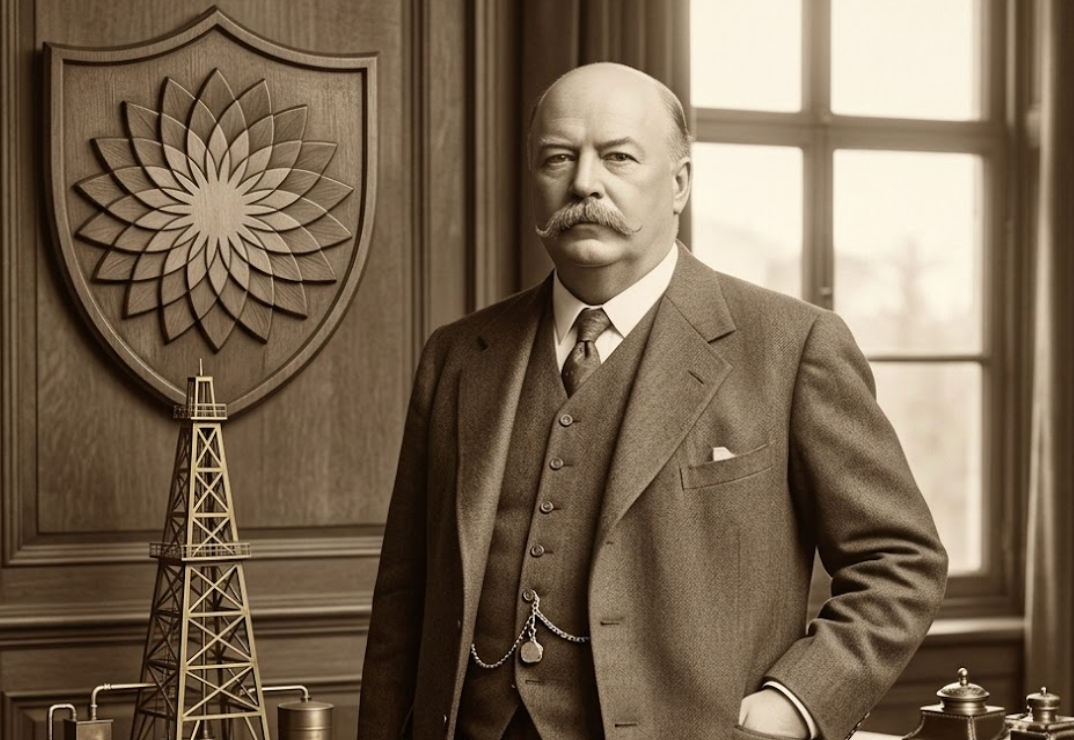
An illustration depicting an oil businessman.
On May 28, 1901, D’Arcy obtained a 60-year oil exploration and development right from Mozaffar ad-Din Shah. This agreement is known as the D’Arcy Concession6. The terms were £20,000 in cash, an equal amount in shares, and 16% of annual net profits paid to the Persian government. Mindful of Russian influence, the concession covered a vast area excluding the five northern provinces.
The engineer George Reynolds, who had drilling experience, took charge of the field exploration. In an environment where transportation and water supply were difficult, costs kept rising, and the venture ran into financial trouble. In 1905, the Burmah Oil Company joined the project, allowing the exploration to continue. This wasn’t a venture that survived seven years on D’Arcy’s personal perseverance alone.
According to exploration records introduced by BP, in early May 1908, an order came down that if the last two wells also produced no results, the operation should be shut down and the team should return home. On the 26th of that same month, Reynolds’s exploration team discovered oil at Masjed Soleyman. This became a crucial turning point marking the start of large-scale commercial oil development in the Middle East.
Based on this discovery, the Anglo-Persian Oil Company was established in 1909. This is the company that would later become BP. The Drake Well in Pennsylvania, USA, in 1859 is known as an important starting point for the American oil industry, but there is also a history of drilling and oil use that predates it. So rather than unconditionally calling the Persian discovery or the Drake Well the “world’s first,” it’s more accurate to look at what role each played in the industrial development of its region.
The Fight Over Oil Profits and Control
In 1914, the British government acquired a 51% stake in the company. This was when the British Navy was expanding its use of oil as fuel for warships, and it needed to secure a stable supply. Persian oil was directly tied to Britain’s military and diplomatic interests.
In Iran, dissatisfaction persisted over how oil revenues were calculated and divided. In 1932, Reza Shah cancelled the existing concession, and a new agreement was signed the following year. It reduced the concession area and changed the payment terms, but extended the contract period to 1993. The fact that a foreign company’s control over the resource was extended even further became a point of controversy later on.
In 1951, Iran’s parliament decided to nationalize the oil industry7, and Mohammad Mosaddegh, who became prime minister, pushed the policy forward. This was Iran’s attempt to take direct control of its resources and revenues. Amid a tangle of conflict with Britain, economic pressure, Cold War-era calculations by the US and UK, and internal power struggles within Iran, the Mosaddegh government was toppled in a coup in August 1953. Declassified US documents record the involvement of the CIA and British intelligence. To explain this simply as “they broke the contract, so it was taken back” misses both the point of nationalization and the nature of the outside intervention.
After the coup, Shah Mohammad Reza Pahlavi’s power was consolidated. In 1954, a consortium8 was formed with participation from oil companies from Britain, the US, France, and others, with the Anglo-Iranian Oil Company—later BP—holding a 40% share. Afterward, a buildup of factors, including backlash against the authoritarian rule of the Pahlavi dynasty, led to the 1979 revolution and the establishment of the Islamic Republic. Oil is significant in this history, but it is not the sole cause explaining decades of political change.
Oswarld’s Lens

What I find interesting about this story is that people attach different meanings to the same natural phenomenon. Fire can be an object of ritual, or it can be a clue for a geologist to investigate.
But there’s a long distance between interpreting something differently and actually turning it into a business. Persia’s oil venture also required field surveys, repeated drilling, additional investment, and negotiations with the government. Looking back with the outcome already known, it’s tempting to compress everything into one person’s insight—but I think we need to look at the process in between, too.
I find myself thinking something similar about AI. The same chatbot is understood by some as a writing tool, and by others as a technology that will transform search or how work gets done. These differences in interpretation can spark new attempts. What comes after should be checking what problem was actually solved, and at what cost and under what constraints.
If I had to pick one lesson from D’Arcy’s case, it would be the process of gathering the people and capital needed to turn a possibility into a verified business. To understand the process of discovery, you have to look at Reynolds’s role running the field exploration as well as the role of the company that supplied the additional funding.
Closing
I love this experience of getting hooked on real history after reading wuxia novels. Look into the background of the Ming Cult, and you run into Manichaeism and the religious history of China; read about the history of Persia, and you end up with questions not just about religion, but about resources and politics too.
That said, you don’t need to force different events into a single chain of cause and effect just to make for a more compelling story. Manichaeism became material for fiction, some natural gas fires got tied to religious belief, and Persia’s oil was developed through investment and exploration. It’s plenty interesting to read while keeping track of exactly how far each connection can actually be verified.
Lastly, Zarathustra — the name of the founder of Zoroastrianism — also appears in Nietzsche’s Thus Spoke Zarathustra. In Ecce Homo, Nietzsche explains that he borrowed the name of the figure who explained the world through the opposition of good and evil in order to re-examine that very moral framework. This is Nietzsche’s own philosophical interpretation — it doesn’t mean the historical Zarathustra actually thought the way Nietzsche did.
Keep the perspective, not the noise.
We choose one consequential shift and trace what sits beneath it, every other day.
Confirm once to finish subscribing.
Already a subscriber? Sign in to join the conversation


References & Further Reading
Primary sources
- Encyclopaedia Iranica, China–Iran Relations, Manichaeism in China: on the transmission of Manichaeism and theories linking it to the Ming Cult and the Red Turbans.
- Encyclopaedia Iranica, Atašdān, Fire Holder, Ātaš, Fire: on Zoroastrian sacred fire and the use of wood fuel.
- Encyclopaedia Iranica, Oil Agreements in Iran, William Knox D’Arcy: on concession terms and the process of investment and exploration.
- BP, text of Angela Strank’s 2014 lecture: the company’s own record of the Reynolds exploration team and the 1908 discovery.
- National Security Archive, declassified documents on the 1953 Iranian coup: records of US and British involvement.
- US Department of State Office of the Historian, 1954 assessment document on Iran: the ownership stakes of individual companies in the oil consortium of the time.
Background
- Springer, introduction to research on ancient “eternal fires” and geology, May 18, 2015: a press release covering Giuseppe Etiope’s research on gas seepage and folklore.
- Wikipedia, Ming Cult: useful for checking how the Ming Cult is depicted in The Heaven Sword and Dragon Saber.
- Friedrich Nietzsche, Ecce Homo: Nietzsche’s own explanation of why he chose the name Zarathustra.
- Nietzsche, Thus Spoke Zarathustra: personally, I’d recommend the Minumsa, a Korean publishing house, translation.

Footnotes
-
Manichaeism: a religion founded by Mani in the 3rd century. It emphasized the opposition of light and darkness, and spread from the Roman Empire all the way to China. ↩
-
Dualism: a school of thought that explains the world through two opposing principles. Different religions describe the nature and relationship of these two principles differently. ↩
-
The Silk Road: an umbrella term for the various trade routes that connected Eurasia. Religion, technology, and culture traveled alongside goods. ↩
-
Bailianjiao (White Lotus Society): a name for various Chinese folk religious sects. Because their character varied by era and group, it’s difficult to lump them together with Manichaeism as a single religion. ↩
-
Yujing (oil seep): traces of oil appearing at the surface. Alongside natural gas seepage, this can serve as a clue for exploration, but it doesn’t immediately prove commercially viable reserves. ↩
-
Concession: a contract in which a government grants a particular operator the right to conduct business under certain conditions and for a set period. Here, it refers to rights such as oil exploration and development. ↩
-
Nationalization: a policy of transferring assets or industries previously owned and operated by private or foreign companies into state ownership and control. ↩
-
Consortium: an alliance formed by multiple companies to jointly participate in a business venture. ↩
Related issues
Jury Verdict Holds Meta, Google Liable for App Design
A $6 million verdict against Meta and Google raises real questions about design liability, but it doesn't rewrite the rules for every platform.
BusinessWhat Your Favorite Books Reveal About Personality
A study linking 60,000+ personality surveys to book preferences shows both promise and limits for recommendation engines.
BusinessDelve Faces Fraud Claims Over Compliance Audits
Allegations of fabricated audit evidence and unlicensed open-source use have put this compliance automation startup under scrutiny.
Business
Your take shapes the next issue
What resonated most in this issue, or where has your experience been different?