

Adobe's $150M Settlement Over Cancellation Dark Patterns
The DOJ's Adobe settlement reveals how subscription cancellation friction ties directly to retention metrics.
AI & TechAdobe’s Subscription Cancellation Lawsuit Settlement
I once spoke as a guest on Longblack about dark patterns—interface designs that push consumers into choices they didn’t actually want to make. Watching this Adobe settlement unfold, I found myself thinking about how these same design choices connect to a company’s customer retention metrics.
The U.S. Department of Justice announced that it filed a $150 million settlement agreement with Adobe in court on March 13, 2026. Of that, $75 million is a civil penalty, and the remaining $75 million represents the value of free services to be provided to customers. At the time of the announcement, the settlement was still awaiting court approval, and it doesn’t involve returning the full amount to customers in cash. Adobe stated that it settled without admitting wrongdoing.
The lawsuit centered on two questions: whether Adobe adequately disclosed subscription terms upfront, and whether it made cancellation excessively difficult. What caught my attention in particular was a remark from an executive quoted in the complaint. Describing the early-termination fee, the executive reportedly called it “like heroin” for Adobe. It’s a line that makes you wonder just how dependent the company had become on termination-fee revenue and customer retention.
Monthly Payments and a 1-Year Commitment
The plan at issue was “Annual, Paid Monthly.” You sign a 1-year contract but pay for it in monthly installments. According to the complaint, if you canceled after the first 14 days, Adobe charged an early-termination fee equal to 50% of the remaining contract value. That’s a very different deal from a month-to-month plan, which you can cancel anytime with no penalty.

This is the actual plan screen used as evidence. You have to check the monthly display price and the contract length together.
In the lawsuit it filed in June 2024, the U.S. government argued that Adobe buried the 1-year commitment and the early-termination fee in fine print or behind links, making them hard to notice. The complaint also alleged that Adobe added unnecessary steps and waiting periods to the cancellation flow, only surfacing the termination fee prominently at the end — enough to make people give up on canceling. Both how the sign-up terms were disclosed and how the cancellation process worked came under fire in this case.
Adobe’s revenue for fiscal year 2025 was about $23.77 billion. The $75 million cash penalty amounts to roughly 0.32% of that. But you can’t judge how much this actually stings the company just by comparing it to revenue. What I find more notable is that the settlement also required Adobe to clearly disclose early-termination fees before sign-up and to offer an easy way to cancel. It’s not just about paying money — it’s about being forced to change how the business operates.
Designing Choices to Be Difficult
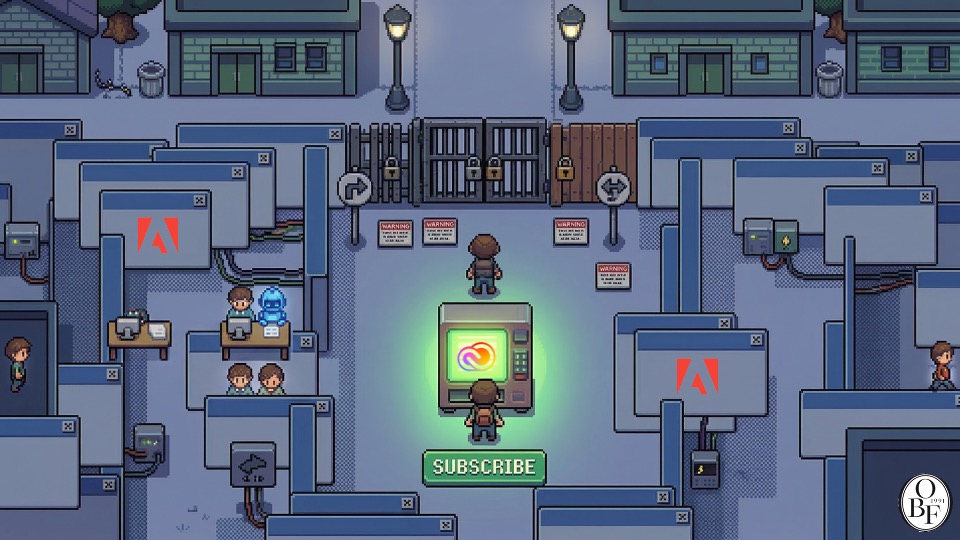
“Dark patterns,” a term UX designer Harry Brignull introduced in 2010, refers to designs that deceive users or steer them toward choices they wouldn’t otherwise make. Examples include making cancellation procedures hard to find even after a user has expressed intent to cancel, or keeping cost information that’s essential to a decision out of plain view.
The allegations in the Adobe case can be explained through two categories.
- Making cancellation harder than sign-up (Roach Motel)1: Signing up is simple, but canceling requires navigating multiple screens or going through a consultation process.
- Disclosing costs too late (Hidden Cost): Keeping cost information that matters for a contract decision hard to find. In this case, disclosure of the early-termination penalty was the point at issue.
Common dark patterns also include tactics that use visual emphasis and wording. For instance, making the “keep subscription” button large while shrinking the “cancel” button to nudge users toward a particular choice, or using language that makes declining feel like the user is bringing harm on themselves. The latter is called “confirmshaming.”2 These two are simply examples used to illustrate the categories.
In a 2024 ICPEN investigation that included the FTC, at least one suspected dark pattern was found in roughly 76% of 642 selected subscription-service websites and apps. Roughly 67% showed multiple types. The investigation covered a selected set of subscription services, and the survey itself did not make legal determinations for each case.
How the US, EU, and Korea Are Responding
In the US, individual corporate lawsuits and subscription rule revisions are moving forward in parallel. The EU and Korea, too, are addressing online designs that obstruct consumer choice through legislation.
In September 2025, the FTC and Amazon reached a settlement worth $2.5 billion — $1 billion in civil penalties and $1.5 billion in consumer refunds. The FTC estimated that roughly 35,000,000 consumers were affected by unwanted Prime enrollments or delayed cancellations. The settlement requires Amazon to clearly disclose enrollment terms and let consumers cancel using the same method they used to sign up.
The FTC’s 2024 “Click-to-Cancel” rule, which was meant to make subscription cancellation easier, was struck down by a federal appeals court in July 2025. The problem was procedural — how the FTC had conducted its economic-impact analysis during rulemaking. But that doesn’t mean the regulatory debate is over. In March 2026, the FTC reopened the matter for public comment, putting several options on the table: keeping the existing rules, reintroducing parts of the invalidated rule, or pursuing other alternatives.
The EU’s Digital Services Act (DSA) governs online platforms that design interfaces to deceive users or undermine their free decision-making. In 2025, the European Commission gathered public input while preparing the Digital Fairness Act. Under discussion are dark patterns, addictive design, unfair personalization, and misleading influencer marketing. This law is still in the preparatory stage.
In Korea, since February 14, 2025, the amended E-Commerce Act and its subordinate regulations have regulated six categories of dark patterns: hidden renewals, drip pricing, pre-selected options, false hierarchy, obstruction of cancellation/withdrawal, and nagging. For example, if a company raises the price of a recurring subscription or converts a free service into a paid one, it must obtain advance consent and disclose the cancellation terms and method. Each category comes with its own set of obligations and exceptions.
For businesses, this means there’s now good reason to scrutinize not just the sign-up screen, but also how price changes are disclosed and how the cancellation process itself works.
Oswarld’s Lens
What stayed with me longer than the size of the settlement was a line in the complaint attributed to a company executive: removing the cancellation fee, or even making it clearer to customers, would deal a serious blow to the business. That’s the government’s characterization in the filing, not the company’s own words, but it still made me stop and ask what exactly we mean when we call customer retention a success.
From my own experience building go-to-market strategy, when churn rate becomes the target metric, you have to look just as closely at why customers are staying. If the only mandate is “lower the churn number,” then improving the product and simply making cancellation harder end up looking like the same achievement. In the short-term data, both show up as retention.
The same problem shows up when you look at the numbers themselves. A customer who gives up trying to cancel gets counted as “retained,” but that number says nothing about satisfaction or loyalty. Retention rate alone can’t tell you how many paying customers are quietly frustrated. You need to look at actual usage frequency, complaint volume, and how long it takes someone to get from attempting to cancel to actually completing the cancellation.
I don’t think this is a problem you can hand off to the UX team alone and call it solved. If a team makes cancellation easier, churn ticks up, and their performance review suffers for it, the improvement won’t last. Leadership needs to examine retention targets and compensation criteria together, not treat them as separate conversations.
Closing
The Adobe case shows how much it matters, in a subscription business, how you disclose contract terms and handle cancellation requests. Even when managing retention rates, you need to be able to spot the customers who are staying only because canceling is a hassle. Only then can you read the retention number as a genuine verdict on your product.
If it were up to me, I’d look at cancellation completion rates, processing times, and recurring complaints alongside the retention report. That’s the only way to get an accurate read on why customers are actually sticking around.
Keep the perspective, not the noise.
We choose one consequential shift and trace what sits beneath it, every other day.
Confirm once to finish subscribing.
Already a subscriber? Sign in to join the conversation


References & Further Reading
- U.S. Department of Justice, Announcement of Adobe settlement, 2026.03.13. Explains the cash penalty, free-service terms, and operational-improvement conditions.
- Adobe, Statement on the settlement, 2026.03.13.
- FTC, Unredacted Adobe complaint, 2024.07.23. Contains the government’s allegations regarding subscription-term and penalty disclosures, and cancellation procedures.
- Adobe, Fiscal Year 2025 results, 2025.12.10.
- FTC, Bringing Dark Patterns to Light, 2022. A report describing types and examples of dark patterns.
- FTC, 2024 ICPEN survey results.
- FTC, Announcement of Amazon settlement, 2025.09.25.
- FTC, Public comment request on subscription rules, 2026.03.
- Korea Fair Trade Commission, Amendments to the Enforcement Decree and Rules of the E-Commerce Act, 2025.02.10. FTC materials posted by the Gangwon-do Consumer Living Center.
- European Parliament, Regulating dark patterns in the EU, 2025.
- European Commission, Guide to the Digital Fairness Act public consultation, 2025.07.17.
- Longblack, “Dark Patterns: UX Design That Deceives Consumers — Hearing the Original Whistleblower’s Solution”, 2024.06.14. A piece on dark patterns I participated in as a speaker.
- Kwangseob Ahn, “Psychological Effects You’ll Eventually Use: 101”. My own writeup on psychological effects.

Footnotes
-
Roach Motel: a dark-pattern term for designs that make signing up easy and canceling hard. The name comes from the roach traps of the same name. ↩
-
Confirmshaming: a technique that phrases opt-out choices to make users feel embarrassed or guilty for declining. For example, a subscription decline button reading “I don’t want to miss out on useful information.” ↩
Related issues
Memory Stocks Fall After Google's TurboQuant Debut
Google's TurboQuant compresses the KV cache stored in GPU HBM, but that's different from cutting overall memory demand.
AI & TechOpenAI Plans to Shut Down Sora After ChatGPT Shopping Revamp
OpenAI is winding down Sora while retooling ChatGPT shopping and courting enterprise clients—here's what that reveals about its priorities.
AI & TechNvidia GTC 2026: How to Read Its $1 Trillion Pitch
I unpack Nvidia's Groq integration and the token-factory logic behind its infrastructure sales pitch.
AI & Tech
Your take shapes the next issue
What resonated most in this issue, or where has your experience been different?