

Why AI Agents Could Send Server CPU Demand 6x by 2030
BofA forecasts the server CPU market—long seen as GPU's sidekick—will grow sixfold to $210 billion by 2030.
AI & TechMost of an AI agent’s working time runs on the CPU
When you hand a task to an AI agent, what you see on screen is a stream of execution: opening a browser, running code, organizing files, reading through search results. The actual reasoning time—when the model generates an answer—is short. Everything else is execution work. And that execution work runs not on the GPU, but on the CPU.
On the 13th, Bank of America (BofA) put out a forecast that reflects exactly this shift: the server CPU market will grow 6x by 2030. The computing demand of the agent era isn’t just inflating GPU demand—it’s also lifting demand for the CPU, a component that had long been treated as a mere supporting player feeding data into the GPU.
BofA’s 2030 Server CPU Market Outlook
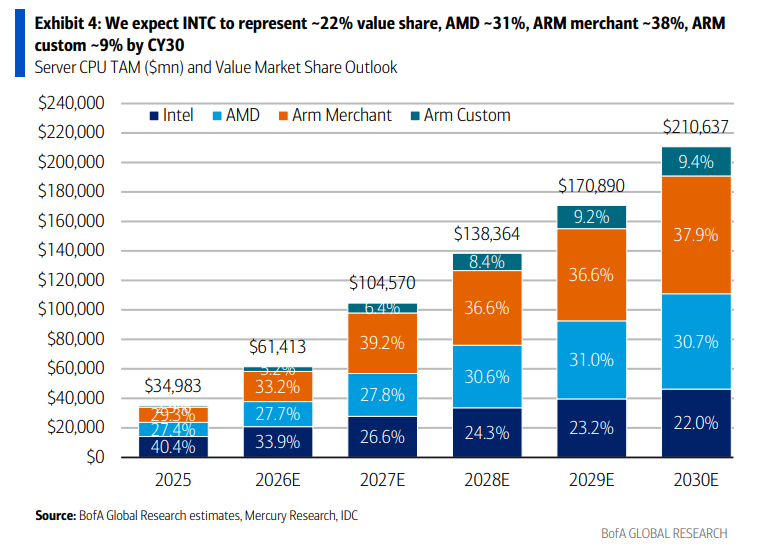
BofA analyst Vivek Arya’s team has put the 2030 server CPU market size (TAM1) at over $210 billion. Given that this market was worth roughly $35 billion in 2025, that’s a 6x jump in five years — a compound annual growth rate of 36%.
What’s interesting is that this isn’t the first time BofA has floated a number like this. Their 2030 forecast climbed from $125 billion to $170 billion, and now to $210 billion. That’s two upward revisions in just a few months, and the reason was the same each time: agentic AI.
 What BofA emphasized is the ratio of GPUs to CPUs. In the training-centric era, the standard AI server configuration was four GPUs to one CPU — a 4-to-1 setup. The CPU was just a support player, feeding data to the GPUs. But BofA argues that in the agentic inference era, this ratio approaches 1-to-1. The CPU becomes the control plane2 that directs the entire agentic system — what BofA calls the data center’s “control hub.”
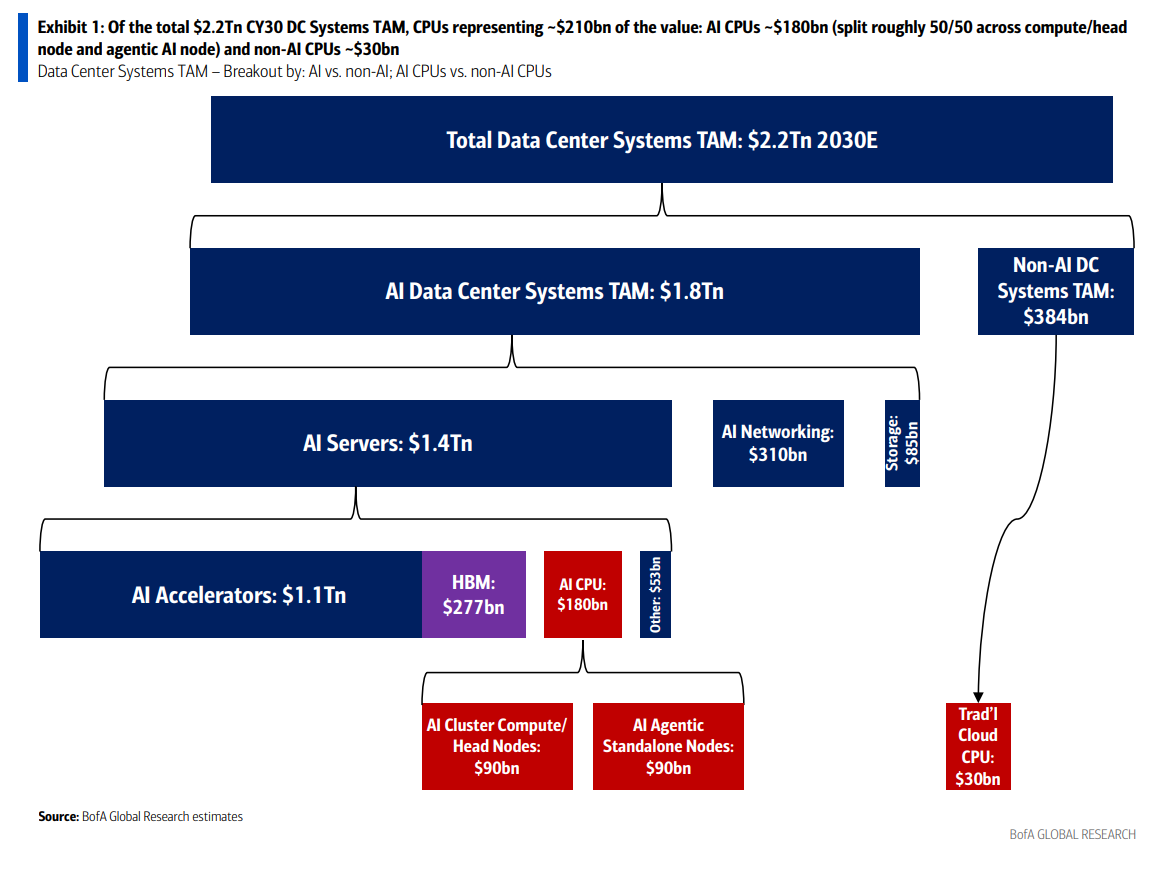
Breaking the market size down by category makes this clearer. Of the $2.2 trillion BofA projects for the total 2030 data center systems market, $180 billion is AI CPUs — and that figure splits into two equal halves. One is $90 billion for head nodes3 that command GPU clusters. The other is $90 billion for agent-dedicated nodes that run on CPUs alone, with no GPUs at all. That second category is the protagonist of today’s story.
What Agents Actually Do, and the CPU Demand Behind It
Why dedicated agent nodes are needed becomes clear once you look at what tasks agents actually repeat.
In the chatbot era, AI’s job was simple: take a question, spit out an answer, done. 100% of the work was model inference — GPU work. Agents are different. They plan (inference), open a browser to look things up (execution), write and run code (execution), review the results (inference), and organize everything into files (execution). Just as a human employee works by using software, an agent works by using software too. And browsers, code execution environments, file systems, and databases all belong to the realm of general-purpose computing — the CPU’s domain.
 So if you break down an agent’s working time, the inference stretches where the GPU is used are short, while the execution stretches where the CPU is used make up most of it. Deploying a single agent is, in effect, like handing that agent its own computer — the same way you issue a new hire a laptop on day one.
This connects to the workload data I covered last week. The fact that tokens per task keep rising means agents are working longer, in more steps. As the number of steps grows, so does the execution work sandwiched between those steps. It’s a structure where bigger inference pulls bigger execution along with it.
Still, you need to be precise about the scope here. The 1-to-1 ratio is a ratio of unit counts, not of dollar figures. Even in 2030, the AI accelerator market will still be $1.1 trillion — six times the size of the AI CPU market. This doesn’t mean CPUs are pushing GPUs aside; the more accurate reading is that the CPU market, which had barely registered in budgets until now, is about to grow sixfold.
The market grows, but Intel’s share gets cut in half
The forecast also tells us who captures this growing market.
Server CPUs have been an Intel-dominated market for almost 30 years. But according to BofA’s share forecast, Intel’s revenue-based share drops from 40.4% in 2025 to 22.0% in 2030—cut roughly in half. AMD rises from 27.4% to 30.7%, and if the forecast holds, it overtakes Intel for the first time as soon as next year (2027). AMD is also BofA’s top pick among CPU stocks.
The camp gaining the most share sits outside x864 entirely: the ARM ecosystem. Merchant ARM chips sold as finished products, like Nvidia’s Grace, reach 37.9%, while custom silicon5 designed in-house by big tech firms—Amazon’s Graviton, Google’s Axion—reaches 9.4%. Combined, that’s 47% of the server CPU market by 2030. Nearly half.
 This isn’t some distant future scenario. According to IDC, non-x86 servers—ARM-based and others—already accounted for 47.9% of server revenue in Q1 of this year, up 107.6% year over year. That figure needs a careful read, though. It’s tallied by attributing an entire server’s price to whichever CPU architecture it uses, so a single Nvidia NVL72 rack costing up to $6.5 million gets counted entirely as ARM revenue just because it runs Grace CPUs. Still, the direction is unmistakable. Nvidia plans to ship 4 million Grace and Vera CPUs this year alone, while x86 server revenue fell 2.9% over the same period.
Let’s do the math fairly for Intel too. Even with its share cut in half, the market itself grows sixfold, so Intel’s actual server CPU revenue still more than triples, from roughly $14 billion to roughly $46 billion. Revenue isn’t shrinking—it’s just growing far more slowly than its rivals’. But the stock market weighs the direction of market share more heavily than absolute revenue. A company that cedes half its share while the market grows sixfold simply can’t command the same valuation as one that’s gaining share in that same market.
Oswarld’s Lens
Doing AI-adoption consulting means I regularly review infrastructure quotes, and there’s one blank spot common to almost every single one. GPU and token costs are itemized meticulously, but the actual runtime environment where the agent does its work—sandboxes, browser instances, orchestration servers—doesn’t even appear as a line item. People are budgeting for agents using a chatbot budget template. I read BofA’s $90 billion “agent-dedicated nodes” figure as a number that shows, at industry scale, exactly how expensive that blank spot really is.
That said, there’s something I always tell students in my data classes: when you see a market-share number, ask about the denominator first. Today’s figures are a textbook case. IDC’s claim that “ARM accounts for half of servers” uses server revenue—including GPU value—as its denominator, while BofA’s 47% uses only CPU chip value as its denominator. Two numbers measuring different things happen to look similar, and if you lump them together, you end up roughly doubling ARM’s actual present-day position. And the fact that sell-side forecasts were revised upward twice within a few months is simultaneously a signal of strong demand and a sign that the projections are still catching up to reality. The fact that they were “rewritten twice” tells us more than the $210 billion figure itself does.
So here’s how I’d sum up this report’s core point: AI isn’t replacing existing compute demand—it’s expanding it. As agents proliferate, demand grows in lockstep for the most ordinary kinds of computing: browsers, databases, operating systems. Last issue, I talked about margin shifting from models to infrastructure. Today’s story is that even within that infrastructure layer, demand isn’t concentrating solely on accelerators like GPUs—it’s broadening out to include CPUs too. And the fact that the HBM market is projected to hit $277 billion by 2030, larger even than the AI CPU market, is a bonus piece of good news for readers in Korea.
The draft looks accurate and complete. Here is the fragment with no changes needed:
Closing
There are three key points here.
First, BofA expects the server CPU market to grow sixfold to $210 billion by 2030. That’s because agents spend more time on execution tasks (CPU) — browser use, code execution, file organization — than on model inference (GPU). Second, half of that market goes to the ARM camp, while Intel’s share shrinks from 40% to 22%. The market grows, but the outlook says the top spot changes hands. Third, keep in mind that 1-to-1 is a unit ratio, not a dollar ratio, and IDC’s 47.9% figure has GPU value baked into the denominator. Trust the direction, but scrutinize the magnitude.
If you’re currently evaluating agent adoption, here’s one thing worth doing this week: add an “execution infrastructure” line item next to “GPU/tokens” in your pilot budget — covering sandboxes, browsers, orchestration, and log storage. If that line is still blank, you’re planning your agent on a chatbot template.
For the record, this piece is an industry-structure analysis, not investment guidance on any specific company or asset. I’d encourage you to verify the Intel, AMD, and ARM figures directly against the primary sources linked below. And for what it’s worth, I’m a regular user of the skill below, built by Cloudflare. If you have a skill you rely on often, let me know.
GitHub - cloudflare/computer: Give your agent a computer 👾Give your agent a computer 👾. Contribute to cloudflare/computer development by creating an account on GitHub.Reader, where is your organization running its agents? Whether your cloud CPU instance costs came in far higher than expected, or you haven’t even thought about the execution environment yet — I’d love to hear about it in the comments. I’ll gather the stories and pick this up in a follow-up piece on agent infrastructure.
💬 Tell me in the comments where and how you’re running your agent execution environment. I’ll factor it into the next issue. 📨 If you have a colleague who works on AI infrastructure budgets, please share this piece with them.
Looking at the fragment, everything appears accurate and complete. Let me verify against the checks:
Keep the perspective, not the noise.
We choose one consequential shift and trace what sits beneath it, every other day.
Confirm once to finish subscribing.
Already a subscriber? Sign in to join the conversation


References & Further Reading
Primary sources
- BofA Global Research (Vivek Arya team), server CPU TAM forecast report, 8.13.2026. ··· This is the backbone of today’s piece. Both the $2.2 trillion TAM tree (Exhibit 1) and the share forecast (Exhibit 4) come from here.
- Yahoo Finance UK, “BofA lifts server CPU TAM to $210bn+ on the rise of AI agents”, 8.2026. ··· This lays out the report’s core thesis and explains the shift from a 1-to-4 ratio to a 1-to-1 ratio.
- Tom’s Hardware, “Arm servers capture over 45% of data center market revenue”, 2026. ··· This is the original article behind IDC’s Q1 tally. You can check here what the denominator behind that 47.9% figure actually is.
Background
- Forbes, “Vera CPU Is Strategic For Nvidia, Not A Side Show”, 7.21.2026. ··· An analysis of why Nvidia is building CPUs into a strategic business rather than a side project.
- Benzinga, “BofA Sees $210B CPU Boom: AMD, Intel, ARM”, 8.2026. ··· A summary piece focused on implications for individual stocks.
Past issues worth reading alongside this one
- The four-year pledge SanDisk extracted ··· Another scene where power has shifted toward infrastructure. This is the storage-market version of the re-rating story.

📝 Glossary
Footnotes
-
TAM (Total Addressable Market): The theoretical total market a given product could reach. It’s not actual revenue but a ceiling figure for the market, so definitions and sizes can vary from one forecasting firm to another. ↩
-
Control Plane: The management layer that directs what happens, when, and how — separate from the part of a system that actually does the work. Think of a factory: not the production line, but the control room. ↩
-
Head Node: A CPU server in a GPU cluster responsible for work distribution, scheduling, and data preparation. For thousands of GPUs to move as one, this coordinating server is indispensable. ↩
-
x86: The traditional CPU architecture used by Intel and AMD. It has been the server-market standard for the past 30 years; its rival, ARM, started out in smartphones and entered servers on the strength of power efficiency. ↩
-
Custom Silicon: Semiconductors that Big Tech companies design in-house for their own workloads instead of buying off-the-shelf chips. Amazon’s Graviton, Google’s Axion, and Microsoft’s Cobalt are prime examples. ↩
Related issues
Why Renaming Giorgione Turns a True Sentence False
A 1971 philosophy argument shows why being identical doesn't guarantee two names are interchangeable.
AI & TechBerners-Lee's Model URL Died in Four Months
His own 1998 essay on link rot still loads today, but the URL he praised as a good example vanished within months.
AI & TechHow Corporate Reports Shaped ChatGPT's Writing Style
ChatGPT now uses em dashes less often than humans do, and The Economist's 1.2M-word comparison reveals four real markers of AI prose.
AI & Tech
Your take shapes the next issue
What resonated most in this issue, or where has your experience been different?