

Can You Tell AI Search Not to Use Your Content?
The UK's CMA now forces Google to let publishers block AI search from using their content—how does that compare to Korea's copyright rules?
BusinessCan You Tell AI Search Not to Use Your Content
On June 3, the UK’s Competition and Markets Authority (CMA)1 imposed a new conduct requirement on Google. The measure lets anyone who publishes web content choose to opt out of having that content used in AI search and similar features. The CMA has billed it as the first move of its kind anywhere in the world. That said, the core requirement doesn’t take effect until 6 months after notice, and the page-by-page opt-out function won’t kick in for 9 months. Announcing the rule didn’t mean every feature was ready on day one.
This matters for anyone publishing in Korea too.
When AI summarizes an article right on the search results page, readers can get the information they need without ever visiting the original source. That forces news outlets, bloggers, and newsletter writers who relied on search traffic for ad or subscription revenue to rethink the terms under which their content gets used. Separate from the question of copyright infringement, which gets litigated case by case, this UK measure imposes a competition-law obligation tied specifically to Google’s dominant position in search.
It also connects to the search changes we covered in a recent newsletter on Google I/O 2026. Korea has its own separate search channels, like Naver, but those platforms are expanding their AI search features too. The impact will differ depending on which platform brings readers to you, but it’s hard to argue that Korea sits outside this shift.
One Search Bar Is Reshaping the Food ChainHow Google’s expanding AI search is reshaping content distributionWhat Obligations Has Google Been Given?
This conduct requirement applies to Google’s generative AI outputs served to UK users, among other things. It covers not just control over how content is used, but also source attribution and the provision of usage metrics. CMA Conduct Requirement Notice
Content providers must be able to opt their work out of search features like AI Overviews2 or AI Mode. This is called opting out3. Google may not demote or otherwise disadvantage a publisher in general search rankings because of that choice. This doesn’t mean search rankings are frozen or guaranteed.
The way content is used for training and answer generation is also subject to control. This covers not only search-facing AI but other generative AI services such as Gemini and Vertex AI. Fine-tuning4, a form of additional training, is included as well. That said, the CMA’s interpretative guidance clarifies that it does not require removal of content that has already been ingested into search AI models. CMA Interpretative Guidance
Google must take reasonable steps to clearly and accurately attribute content and ensure readers can access the original source. It must also explain how content is being used and provide usage metrics — such as impressions and clicks in AI search — because publishers need to know what they’re getting in return before they can decide whether to allow their content to be used.
The legal basis for all this is the Digital Markets, Competition and Consumers Act (DMCCA)5, enacted in 2024. The CMA opened its investigation in January 2025 and, in October, designated Google’s general search service as holding Strategic Market Status. This designation is what enabled the current obligations. It doesn’t amount to a complete regulatory framework for AI search, and the CMA has said it will continue to assess whether further action is needed.
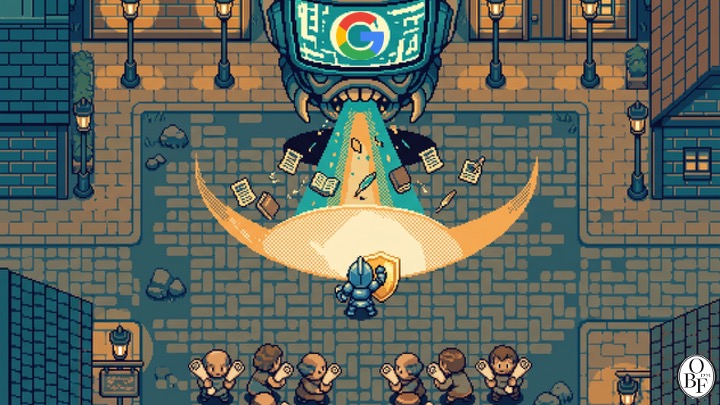
On June 3rd, Google announced it was testing new Search Console controls with a subset of UK website operators. It explained that exclusion from AI search would not be used as a ranking signal in general search, and said it planned to roll the feature out globally after the trial. It’s worth distinguishing between what the UK’s legal requirement actually covers and how far Google is voluntarily extending these controls on its own.
When Search Visibility Doesn’t Translate Into Site Visits
Behind content producers’ concerns lies a real drop in search referral traffic. Still, we shouldn’t lump together different studies’ numbers and blame it all on AI search.
According to Chartbeat data cited in the Reuters Institute for the Study of Journalism’s 2026 report, Google search referrals across more than 2,500 news sites fell 33% in November 2025 compared to November 2024. In the US, the drop was 38%. This reflects changes among the tracked sites — it doesn’t mean every publisher worldwide saw its annual total traffic fall by the same percentage. Report’s data description
Ahrefs compared desktop search data across 300,000 keywords. After accounting for the fact that click-through rates also declined for keywords without AI summaries, they estimated that the click-through rate (CTR)6 for the #1-ranked page on keywords with AI Overviews was about 58% lower than what would have been expected without the summary. This is an observational analysis using December 2023 and December 2025 data. It doesn’t mean every site saw exactly a 58% drop caused by AI. Original Ahrefs post
Pew Research’s analysis of March 2025 search histories from 900 US adults points in a similar direction. Among visits to search results pages that included an AI summary, only 8% clicked a regular search link, versus 15% when no summary was present. Separately, just 1% clicked a source link within the AI summary itself. These figures are based on search-page visits, not head counts, and this wasn’t a controlled experiment that randomized for differences in search queries. Pew Research analysis
It’s not just news sites — sites offering study materials or practical everyday information can be affected too. When a search results page already provides a sufficient answer, the need to click through to the original source diminishes. That said, actual drops in traffic can also stem from other causes mixed in, like changes in search rankings or shifts in demand. Each site owner needs to break down which specific queries and pages were actually affected.
This puts content providers in a bind. Being included in an AI answer creates a chance to reach readers, but some users will read just the summary and leave. Opting out means giving up whatever visibility and visits that AI feature would have brought. Which choice is better depends on the nature of the content, its revenue model, and the actual referral patterns involved.
Tools like Google-Extended or search snippet controls already existed. What matters about this new measure is that it prevents publishers from being penalized in regular search results simply for opting out of AI search use, and requires that publishers be given the information they need to make that choice. After implementation, we’ll need to watch how granular the opt-out function actually is and what real changes in visibility follow.
We should also distinguish between Google’s search-ad revenue and content providers’ own ad revenue. Because Google can monetize the ads shown directly on the search results page, a drop in visits to outside sites doesn’t automatically translate into an equivalent drop in Google’s ad revenue. Even if platform revenue rises in the short term, if original content creators lose revenue, that could put long-term pressure on the supply of quality content.
Korea’s Copyright Disputes and Platform Policy Are Moving Together
In Korea, too, the questions of AI search usage and content compensation are being debated in tandem.
Opensurvey’s first-half 2026 report finds that ChatGPT usage has grown to a majority of respondents, while experience with Gemini has also risen sharply. The findings come from surveys of 1,000 people each in March and December 2025. This kind of usage-experience survey isn’t equivalent to search market share or a publisher’s traffic-decline rate, but it does confirm that the paths people take to find information are diversifying.
On February 26, 2026, Korea’s Ministry of Culture, Sports and Tourism and the Korea Copyright Commission published guidelines for determining fair use in generative AI training. The guidelines explain that judgments should weigh factors such as the purpose of use, the nature of the work, the amount used, and the impact on the market. It isn’t a document that blanket-declares all news-training or summarization services legal or illegal. Government announcement
The UK’s conduct requirements and Korea’s guidelines play different roles.
The CMA’s measures impose specific obligations on Google as a designated firm. Korea’s fair-use guidelines are a reference document for applying existing copyright law. The guidelines themselves don’t create a new opt-out button or compensation obligation, but that doesn’t mean Korean content creators have no copyright or contractual rights at all. In any dispute, rights and responsibilities still have to be judged under existing law and contracts.
Research to calculate the value of content is also needed. Still, an estimate tied to a particular outlet’s material can’t be read directly as a licensing fee that must legally be paid. The value and the negotiated amount can shift depending on what’s being trained on, how it’s used, and the licensing terms.
For individuals who run a blog or newsletter, the terms of content use matter too. The CMA’s notice defines “publisher” broadly, covering anyone who publishes content on the web. But whether a creator operating within a platform like YouTube can exercise the same kind of individual controls as a website operator is a separate question. Owning content and holding configuration authority over search bots can be two different things.
What Korea might usefully take from this is the concrete mechanism of separating general search exposure from AI-use permission, and requiring that actual usage information be disclosed. Even while waiting for copyright disputes to be resolved, there’s room to discuss how to improve platform opt-in/opt-out features and information disclosure.
Oswarld’s Lens
I think this move can improve the negotiating position of content creators. I’ve repeatedly seen how, once a structure of supplying content to platforms for free becomes locked in during GTM strategy planning, it becomes difficult for suppliers to demand new terms afterward. That’s why setting usage terms from the outset matters.
Opting out alone doesn’t guarantee revenue. You could lose traffic that was coming in through AI search. Still, having the option to refuse usage is what allows content providers to propose terms in the first place. The CMA itself explained that this measure can strengthen bargaining power in content transactions.
I believe Korea also needs a system where content providers can choose the scope of usage and verify actual usage volume. Separate from existing copyright enforcement procedures, there needs to be a mechanism that lets providers negotiate AI usage terms while still maintaining search visibility. And the process needs to be simple enough that even small creators can use it.
Naver announced “Naver Mate” on May 28. It’s a program that selects roughly 3,000 creators each month based on citation counts in AI briefings and provides them with an activity stipend. This differs from a system that pays a fee for every single citation across all content. Still, it’s worth watching as an attempt to connect compensation to the creators of content that AI references. Naver’s announcement
Naver Mate — Naver Premium ContentI think legal obligations and voluntary compensation programs need to be evaluated together. We need to check whether opt-out settings are actually being honored, which content is being used and how much, and who ends up receiving the compensation. Both the UK’s system and Naver’s attempt deserve continued observation to see how they play out.
Closing
In AI search, the terms of the relationship between the people who create original content and the platforms that display the answers are becoming critical.
The UK’s CMA imposed obligations on Google around content-use refusal, information disclosure, and source attribution. It’s a move meant to give content creators some leverage at a time when search-driven traffic keeps shrinking. In Korea, too, alongside existing copyright protections, we need to spell out usage controls and compensation terms that creators can actually enforce in practice.
Do you actually use AI’s search-summary feature much? Do you tend to just read the summary and move on, or do you click through to the original source? Let me know in the comments.
Keep the perspective, not the noise.
We choose one consequential shift and trace what sits beneath it, every other day.
Confirm once to finish subscribing.
Already a subscriber? Sign in to join the conversation


References & Further Reading
Primary sources
- UK Competition and Markets Authority, “CMA secures fairer deal for publishers and improves Google Search services in UK”, 2026.6.3. : This is the core evidence behind today’s newsletter — you can see all three pillars of the regulation firsthand here.
- Google, “New controls for website owners”, 2026.6.3. : Covers the specifics of the opt-out toggle Google added to Search Console.
- Ahrefs, “Update: AI Overviews Reduce Clicks by 58%”, 2026.2. : An analysis of 300,000 keywords estimating the click-through rate gap with and without AI summaries.
- Press Gazette & Chartbeat, “Global publisher Google traffic dropped by a third in 2025”, 2026.1. : Reports on changes in Google search traffic across more than 2,500 news sites, comparing November 2025 to November 2024.
Background
- Kluwer Competition Law Blog, “AI Overviews Are Harming Competition, Letting Publishers Opt-out Won’t Help”, 2026.4.
- Ministry of Culture, Sports and Tourism & Korea Copyright Commission, “Guidelines on Fair Use Under Copyright Law for Generative AI’s Learning from Copyrighted Works”, 2026.2. : A government announcement introducing the guidelines’ purpose and the criteria for judging fair use.
- Opensurvey, “AI Search Trend Report 2026”, 2026.1. : Data on the AI shift in Korea’s search market — you can see Naver’s decline and ChatGPT’s rise in hard numbers.

Footnotes
-
CMA (Competition and Markets Authority): The UK’s Competition and Markets Authority, which plays a role similar to Korea’s Fair Trade Commission. Since 2025, it has held new powers to directly regulate major tech companies in digital markets. ↩
-
AI Overviews: AI-generated summaries that Google has displayed at the top of search results since 2024. The AI synthesizes multiple web sources to directly answer a user’s question. ↩
-
Opt-out: Requesting that your own content or data be excluded from a particular service or feature. The reverse — choosing to participate — is called opt-in. ↩
-
Fine-tuning: The process of additionally training an already-trained AI model on data from a specific domain. Think of it as precision-tuning a general-purpose model for a specific use case. ↩
-
DMCCA (Digital Markets, Competition and Consumers Act 2024): The UK’s Digital Markets, Competition and Consumers Act. It provides the legal basis for designating major tech companies with “Strategic Market Status” (SMS) and imposing tailored conduct requirements. It is the UK’s counterpart to the EU’s Digital Markets Act (DMA). ↩
-
CTR (Click-Through Rate): The ratio of actual clicks to the number of times search results are displayed. A low CTR means that although search results are shown, people aren’t actually clicking on them. ↩
Related issues
Samsung Pay Deal Passes, but Unions Split 80.6% vs 21.1%
Samsung's wage deal passed overall, but its two unions split sharply—raising bigger questions about dividing AI-boom profits.
BusinessChina Orders Meta to Unwind Its Manus Acquisition
Four months after the deal was announced, Beijing's regulator stepped in—and the founders still can't leave the country.
BusinessAnthropic's $320K Copywriter Job Posting
Anthropic is offering $255K–$320K for an enterprise copy lead—here's what the job actually asks for.
Business
Your take shapes the next issue
What resonated most in this issue, or where has your experience been different?