

Companies Laid Off Workers for AI—Now Want Them Back
Layoffs have slowed, but it's only experienced hires getting the callback.
BusinessLaid off because of AI, now they’re asking me to come back
On October 30, CNBC ran a story with a long headline: AI-driven layoffs are creating a new category of “boomerang employees”1, and companies are realizing they pulled the plug too early. That phrase—“pulled the plug too soon”—came from Lucy Beaumont, Global SVP of Product and Design at SHL, a talent-assessment firm.
The claim rests on an SHL survey of 2,036 workers in the US and UK, conducted in June and July 2026. Among respondents who had been laid off or replaced by AI, 19% in the US and 13% in the UK said their original employer had asked them to come back. That’s roughly one in five American workers.
On the face of it, this looks fairly dumb. A company that fires people only to rehire them doesn’t look great, and neither does a worker who accepts the offer—there’s a dignity problem on both sides. Of course, from the worker’s perspective, a paycheck is a paycheck, so taking the offer is often not really optional. Still, you’d think they could at least ask for a higher salary this time around.
So I looked into two things: why this is happening, and which job categories seem immune to it. My starting point was the tracking data from TrueUp, which compiles tech-industry layoffs every single day.
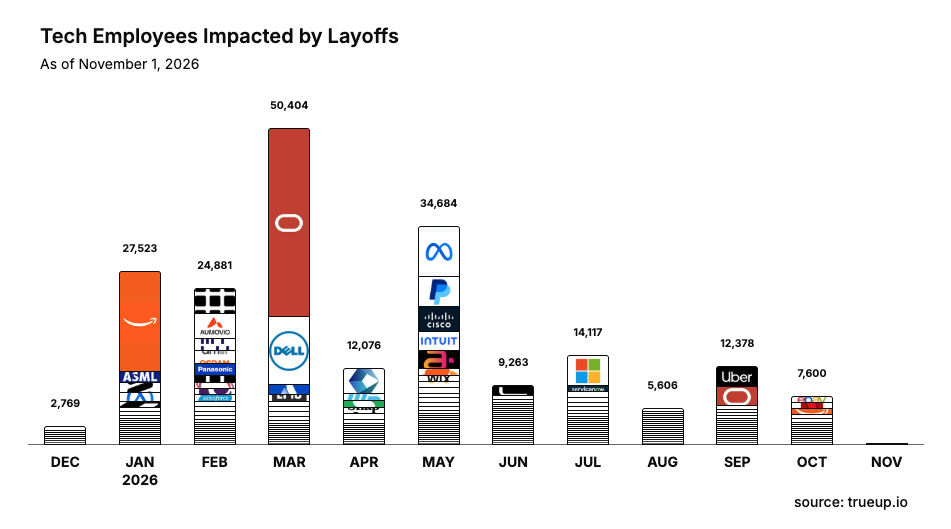
The layoff curve bent downward since summer
TrueUp is a hiring platform that tracks layoff news from Big Tech and startups. As of October 31, tech layoffs in 2026 stood at 678 incidents affecting 198,532 people — an average of 653 people per day. For all of 2025, the totals were 783 incidents, 245,953 people, and 674 per day.
The mood at the start of the year was different. As of May 25, TrueUp’s numbers showed 340 incidents, 142,985 people, and 986 per day. Articles kept appearing saying that at this pace, 2026 would surpass 2025. Lining up three snapshots from the same tracker tells the story:
| As of | Cumulative incidents | Cumulative people | Daily average since Jan 1 |
|---|---|---|---|
| May 25 | 340 | 142,985 | 986 |
| Jul 9 | 441 | 165,406 | 871 |
| Oct 31 | 678 | 198,532 | 653 |
A daily average counted from the start of the year that keeps falling means the pace of recent months has slowed well below where it started. Between July 9 and October 31 — 114 days — the headcount grew by 33,126 people. That’s roughly 291 people a day, about a third of the pace seen through May.
The number of incidents, though, went up. Over that same 114-day span, incidents rose by 237. Through July 9, each layoff event affected an average of 375 people; after that, the average dropped to 140. Layoff announcements kept coming — they just got smaller each time.
If you simply extrapolate the remaining 61 days at the recent pace, the 2026 total comes out to roughly 216,000 people — lower than 2025. But that’s an arithmetic projection, not a forecast. A single large round of cuts before year-end could change the number entirely.
There are also reasons to read tracker numbers carefully. TrueUp compiles figures from news reports, company announcements, and employee tips, so past numbers sometimes get revised later. Different trackers also use different criteria. As of the same late-October date, Skillsyncer counted 232,946 people, while GoLayoffs — which counts only securities filings, company-confirmed cuts, and state WARN notices2 — counted 69,361. That’s a gap of more than three times. So it makes more sense to watch how the trend shifts within a single tracker than to compare absolute values across them.
The reason they’re hiring again comes down to a gap between forecast and reality
When recruiting firm Robert Half asked roughly 2,000 US hiring managers this past April, 32% said they’d refilled a position they’d eliminated because of AI—either with the same role or a similar one. By industry, finance topped the list at 44%, followed by HR at 35% and tech at 32%.
The reasons for rehiring are specific. 40% said the role required organizational knowledge and context that AI couldn’t substitute for. 38% said the position needed far more human oversight and quality control than expected. 35% said the productivity gains fell short of what they’d anticipated. A survey by organizational design consultancy Orgvue found something similar: among the executives who had cut jobs citing AI adoption (39% of respondents), 55% admitted the decision had been flawed.
All three reasons point to the same root cause. What companies had in hand when they made the cuts was closer to a forecast than a confirmed outcome. They eliminated the positions first, betting that AI would handle the work—and when they actually ran it, the math didn’t hold up.
Specific cases show exactly where the math broke down. IBM’s AI handled about 94% of HR requests. It got stuck on the remaining 6%, which required ethical judgment. IBM has since announced it will triple US entry-level hiring in 2026. Ford brought in an AI quality-inspection system with roughly 900 cameras—but it missed defects that a skilled technician would have caught. In June, Ford announced it had hired or promoted around 350 veteran engineers (the exact figures and timeframes vary slightly by report). Even if you automate 90% of a job, accidents tend to happen in the remaining 10%—and the people who used to handle that 10% were already gone from the company.
Costs didn’t track with forecasts either. Uber burned through its entire 2026 AI coding-tool budget in just four months, and its COO admitted it was hard to tie that spending to any measurable improvement. Uber subsequently imposed a monthly usage cap per employee.
In some cases, AI wasn’t really the reason to begin with. Bloomberg’s analysis found that job losses in the UK blamed on AI actually stemmed from broader economic factors. This is “AI washing”3—slapping the AI label on cost cuts that were going to happen anyway. In these cases, there was never a real plan for AI to take over the work, so when the backlog piled up, companies had no choice but to hire humans again.
The counterarguments deserve equal attention. Klarna rejects the word “reversal.” Its position is that AI is still doing the work of more than 800 people, and that rehiring humans is simply a pilot for premium consultation services. Amazon, which cut roughly 30,000 jobs between October 2025 and January 2026, has been reaching out to its entire workforce since September about AI, machine learning, and cloud roles—but the company says this is just its usual rehiring practice, not a reversal of the layoffs.
The math behind Amazon cutting 30,000 jobs and hiring 10,000It’s also worth noting that Robert Half and SHL, which conducted these surveys, make money from recruiting and assessment services. So rather than “half of companies regret it and are rehiring,” the numbers more accurately support the claim: “a significant number of companies are refilling some positions.”
It’s also worth watching how these two trends overlap within the same industry. Finance, which had the highest rehiring rate, is still cutting jobs citing AI. According to the TrueUp financial layoff tracker, financial firms had made 153 layoff announcements totaling 64,620 jobs as of October 28th. On October 22nd, Barclays cut 5,000 jobs citing AI-driven cost reduction, and on October 1st, Citi cut middle- and back-office staff citing automation. It’s not that some companies are cutting while others are rehiring—both are happening simultaneously within the same industry.
The Cards Held by the Boomerang Employee
So does the person who returns come out behind? HR analytics firm Visier tracked rehiring within 15 months of layoffs between 2018 and 2024, using data from 142 companies and 2.4 million workers. Employees who returned saw their pay rise by an average of 5%, compared to 2% for colleagues who stayed on without ever being laid off. Most came back within 10 months. Keep in mind this wasn’t an analysis isolated to AI-driven layoffs specifically.
The data also shows who gets called back. Top performers were rehired at a rate 120% higher than other employees, managers 68% higher, and those with 10-15 years of tenure 42% higher. The people companies move fastest to recover are the ones carrying institutional knowledge — how things get done and what judgment calls look like — in their heads.
Returning employees are setting their own terms, too. In an SHL survey, when asked what it would take to accept a return offer from a former employer, 51% said a substantial pay raise and 42% wanted documented job security guarantees. The “you can ask for higher pay” I mentioned earlier turns out to be exactly what’s happening.

Where the Boomerang Doesn’t Come Back
Now for the second question: which job categories aren’t experiencing this at all? There are two branches.
One is work that saw almost no AI-driven cuts to begin with — nursing aides, caregiving, nursing itself, skilled trades, care labor — jobs with low AI exposure. According to the Stanford Digital Economy Lab, as of April 2026, employment among 22–25 year-olds in the highest-AI-exposure occupations fell 3.8% year-over-year, while employment in the same age bracket in the lowest-exposure occupations actually rose 2%. If you were never cut, there’s nothing to come back to.
The other branch is heavier. These are the jobs where AI displacement has genuinely stuck.
First are new graduates. According to the Stanford research team’s “canary in the coal mine” study, updated on August 12, employment among 22–25 year-olds in high-AI-exposure occupations is roughly 19% lower than the same age bracket in low-exposure occupations. The team attributed this decline not to rising layoffs or attrition, but to hiring simply drying up.
These people never show up on layoff trackers like TrueUp. You can’t be laid off from a job you were never hired into, and you won’t be called back to one you never had. This is why the news that layoffs have peaked means almost nothing to new graduates. The market research firm Forrester has forecast much the same: even as experienced workers get quietly rehired, entry-level job seekers will keep struggling to find openings, and many companies will use this moment to shift toward cheaper labor overseas.
Ferrari’s Designers Still Start With a PencilNext are freelancers doing general writing, translation, and basic customer response work. An analysis of 5 million job postings on the freelance platform Upwork found that after ChatGPT went mainstream, writing, translation, and customer service gigs saw the steepest declines. These workers weren’t handed pink slips — their orders simply stopped coming in. And even if the work returns, there’s no guarantee it goes back to the same person.
Last is the front line of customer support. Demand may come back, but not to the same seats. Gartner projects that 50% of companies that cut call-center staff citing AI will rehire people to do similar work by 2027 — though the job titles may change. Some of this rehiring, analysts note, gets routed offshore or comes back at lower pay. Headcount can recover while the quality of the jobs quietly shifts underneath it.
Put it together, and a dividing line emerges between where the boomerang comes back and where it doesn’t. Slavinski argues that the roles getting rehired are mostly ones where AI can assist with the work but can’t be held accountable for the outcome. Flip that around: wherever AI can produce output cheaply enough, and getting it wrong doesn’t cause real damage, the boomerang simply never comes back.
Oswarld’s Lens
When I first saw this story, I thought both the company and the rehired workers looked a bit foolish. At the same time, I understood that for the workers, their livelihood was at stake — they had no choice — and that this gave them leverage to demand higher pay. When I checked the numbers, that second part turned out to be exactly what was happening. Half of the rehired workers made a pay raise a condition of their return, and they actually came back earning more than colleagues who had stayed on.
When I design enterprise deliverables or consulting engagements, I always work from the premise that “the model only gets better from here.” Even when setting up closed-network environments for public institutions, I plan the project around the level of open-source and open-weight models expected to arrive in 6–12 months.
But that’s designing a system in anticipation of performance that’s coming — not letting go of people working today on the faith that future performance will cover for them. Most of the rehiring cases this time, I think, started from failing to distinguish between those two things.
What troubles me more are the positions where there’s no one left to call back. If you read the shrinking numbers on layoff trackers as a sign that hiring is recovering, you still miss the entry-level jobs that never opened in the first place — they stay invisible all along.
Closing
Being laid off because of AI and then getting rehired happens when a company cuts people based on predictions instead of confirmed performance. The ones who get rehired are the experienced hires who carry context and judgment, while the entry-level positions that never opened in the first place show up in neither the layoff statistics nor the boomerang statistics.
💬 Has your company ever eliminated a position citing AI adoption, only to fill it again later? If so, let me know in the comments — did it come back under the same title, or a different one?
📨 If you have a colleague facing layoffs or hiring decisions, please share this piece with them.


References & Further Reading
Primary sources
- TrueUp, “Tech Layoffs Tracker”, as of 2026.10.31: the source for today’s layoff count, number of people affected, daily average, and job posting figures.
- TrueUp, “Finance Layoffs Tracker”, as of 2026.10.28: the record of layoffs at Barclays, Citi, and other financial firms.
- CNBC, “AI-driven layoffs are creating a new class of boomerang employees”, 2026.10.30: the article with the SHL survey and the “pulled the plug too quickly” remark.
- Fast Company, “The ‘AI boomerang’: Why some companies are rehiring employees they laid off due to AI”, 2026.6.5: covers the Robert Half survey and Slavinski’s comments.
- Stanford Digital Economy Lab, “Canaries in the Coal Mine? Six Facts about the Recent Employment Effects of Artificial Intelligence”, updated 2026.8.12: the source for the 19% employment gap among 22-25 year-olds and the interpretation of declining hiring.
Background
- IBTimes, “AI Layoffs Backfire as 32% of Bosses Rehire Roles They Thought Robots Could Do”, 2026: summarizes the Robert Half survey’s figures by industry.
- TechSpot, “The AI boomerang effect: more data suggests employers are reversing AI layoffs”, 2026: covers reasons for rehiring, Forrester’s forecast, and the Uber case.
- TechSpot, “More companies rehiring workers they replaced with AI”, 2026: covers the Orgvue survey and IBM’s expanded entry-level hiring.
- Axios, ""Boomerang” hires suggest AI layoffs aren’t sticking”, 2025.11.4: the article that first introduced Visier’s rehiring analysis.
- The Interview Guys, “Layoffs Are Cutting the Exact People Companies Rehire Most”, 2026: summarizes Visier’s analysis of rehiring rates by seniority and tenure.
- Forkast, “The AI rehire correction paradox”, 2026: includes the Ford quality-inspection case and Klarna’s counterargument.
- Fast Company South Africa, “The problem with AI-attributed layoffs”, 2026.7.15: introduces Bloomberg’s analysis of UK AI layoffs.
- Let’s Data Science, “Amazon Reaches Out to Former Workers for AI and Cloud Roles”, 2026.9: covers Amazon reaching back out to former employees and the company’s explanation.
- HCAMag, “When AI redundancies backfire: Employers now scrambling to rehire humans”, 2026: Gartner’s forecast on call-center rehiring.
- Entrepreneur, “AI Is Impacting Jobs. Here Are the Gigs Affected the Most”: an analysis of 5 million Upwork job postings.
- Skillsyncer, “Tech Layoffs Tracker”, GoLayoffs, “Tech Layoffs Tracker 2026”: used to compare counting criteria across different trackers.

📝 Glossary
Footnotes
-
Boomerang Employee: an employee who left a company and later returned to that same company. The term originally referred to people who quit and came back on their own, but it’s now used more broadly to include rehiring after layoffs. ↩
-
WARN notice: under the U.S. Worker Adjustment and Retraining Notification (WARN) Act, companies conducting layoffs above a certain size must notify state governments and employees in advance. Because only layoffs exceeding the legal threshold get captured, the tallied figures tend to undercount the real total. ↩
-
AI Washing: labeling decisions or products as AI-driven when they actually have little to do with AI. In the context of layoffs, this refers to cases where cuts driven by economic conditions or cost-cutting are instead attributed to AI adoption. ↩
Related issues
Apple's Flash Suppliers Finally Send the Bill
iPhone storage costs jumped from $15 to $66, and this week's Mac price tags show exactly why.
BusinessNeocloud Shakeout: Why Credit, Not GPUs, Decides Survival
Who can actually borrow money is what separates the neoclouds that survive from those that don't.
BusinessWill Banks Lend to AI Companies With No Land, No Factory?
China's eight ministries are deliberately targeting one thing: how bank tellers think about collateral.
Business
Your take shapes the next issue
What resonated most in this issue, or where has your experience been different?