

Why Bloomberg Terminals Still Dominate Finance
A Bloomberg command in an Iranian official's post got me asking why traders still pay for the pricey terminal.
BusinessA Bloomberg Command Turns Up in an Iranian Speaker’s Post
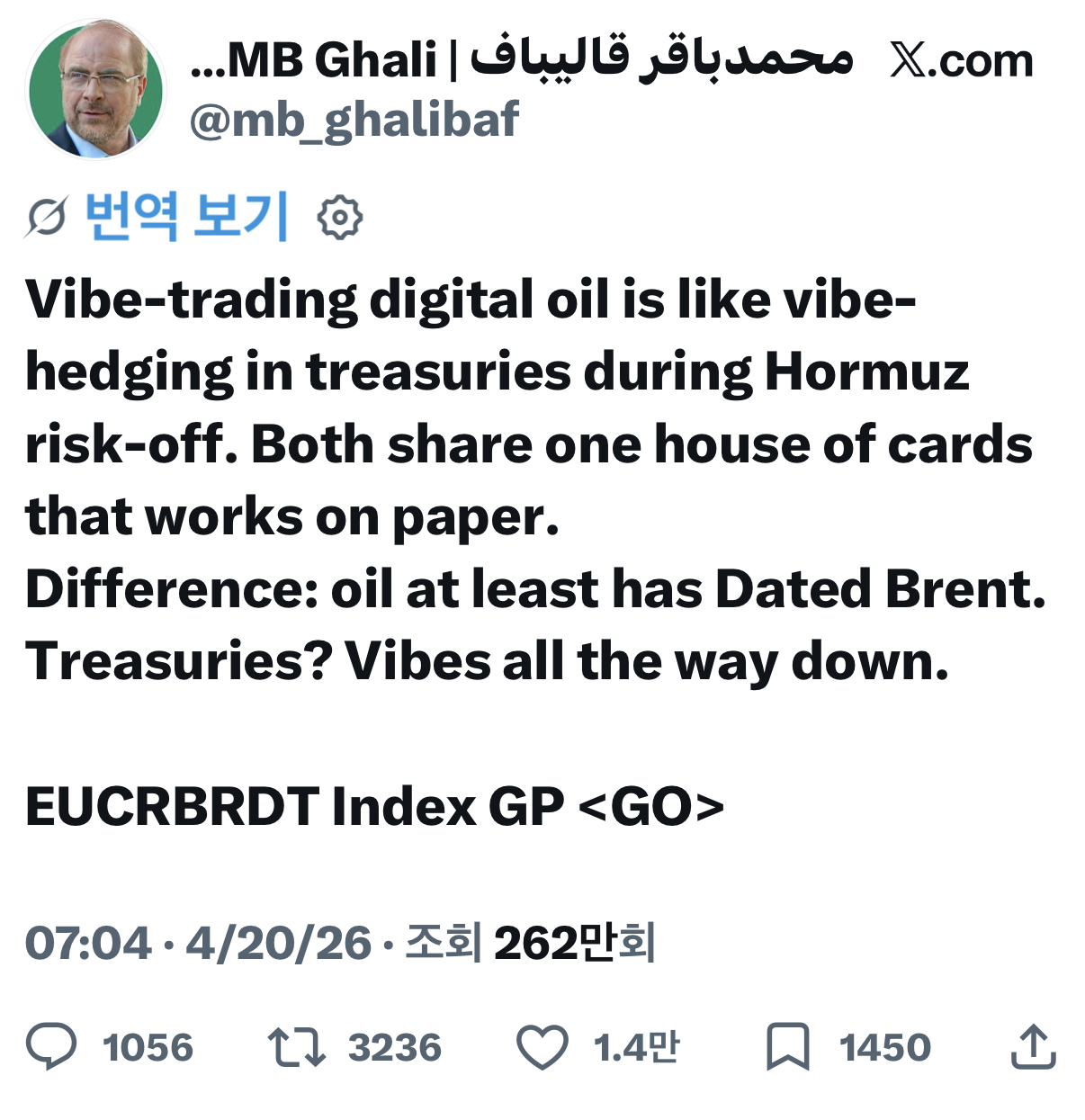
In April 2026, a Bloomberg Terminal command showed up in a post on X by Mohammad Bagher Ghalibaf, Speaker of Iran’s Parliament. According to a WANA report from April 20, the post — which criticized the crude oil and U.S. Treasury markets — ended with this line:
EUCRBRDT Index GP <GO>
It’s the command that pulls up a chart of the Brent crude spot price. But the mere fact that he typed this string doesn’t tell us whether Ghalibaf actually logged into a terminal himself, or whether he traded oil. It’s not evidence that he dodged sanctions or profited from any trade, either.
Seeing this post made me wonder why the finance industry keeps using Bloomberg at all. The commands look unfamiliar the first time you see them, and the subscription isn’t cheap — yet it has stayed the primary work tool for a long time.
Let’s start by looking at what this command actually does, then walk through the terminal’s costs and the burden of switching to another service.
This Command Opens a Brent Crude Spot Price Chart
A command breaks down into a price-data code, an asset class, and a function to run.
EUCRBRDT is the ticker for Brent crude spot price data.123 On the ECB Data Portal, it’s registered under the name “Bloomberg European Dated Brent Forties Oseberg Ekofisk (BFOE) Crude Oil Spot Price.” Here, “spot” doesn’t necessarily mean delivering the oil today. It’s an indicator tied to the price of an actual crude cargo with a set delivery schedule.
Index is a marker that tells the system to look for this data under the index category.4 Yellow keys on the Bloomberg keyboard—GOVT, CORP, EQUITY, INDEX—are used to distinguish asset types.
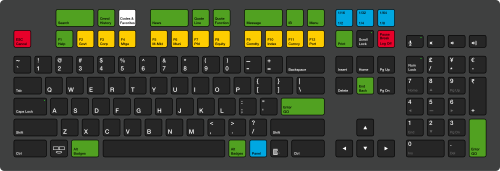
GP is the function that pulls up a price chart.
The final <GO> is the key that executes the command. It works much like the Enter key on a regular keyboard.
So this command means: check the trend in Brent crude spot prices, displayed as a chart.
Once you know the price-data code and the function name, a short command opens exactly the screen you need.
Running this command on the terminal requires authorized access. But the command itself can be learned from public materials or someone else’s explanation. The fact that a post contains the command and the fact that its author holds account access are two separate things.
Who wrote the post, or how they came to know the command, can’t be confirmed from the phrase alone.
So what kind of thing is the Bloomberg Terminal, that it runs on a command system like this?
Market data, news, analysis, and communication—all in one place
The Bloomberg Terminal is a financial information service that provides real-time market data, news, analytical tools, messaging, and trading functions. Hundreds of thousands of finance professionals around the world use it. Despite the name “terminal,” it no longer refers to a single dedicated machine—it now covers both the services and the work tools accessible from a PC and other devices.
Michael Bloomberg left Salomon Brothers in 1981 and founded Innovative Market Systems (IMS). Its early product, Market Master, was installed at Merrill Lynch in late 1982 and later became known as the Bloomberg Terminal.

Beyond displaying market data, the early terminal offered tools for calculating and comparing bond prices and yields. It meant analyses that required comparing multiple bonds—like a yield curve5—could be done within a single system. Over time, news and communication functions were added, expanding the scope of what the terminal could do.
What matters is that Bloomberg didn’t just keep selling its original product unchanged. It has kept the familiar screens and commands while continuously adding data, analytics, and trading-related features.
The subscription runs tens of thousands of dollars a year, per seat
In Korea, the terminal is sometimes nicknamed “Bl-daeri”—a blend of “Bloomberg” and “daeri,” a junior-manager job title common in Korean companies—suggesting the subscription costs as much as an employee’s annual salary. It’s not a claim that the price matches any actual salary figure exactly.
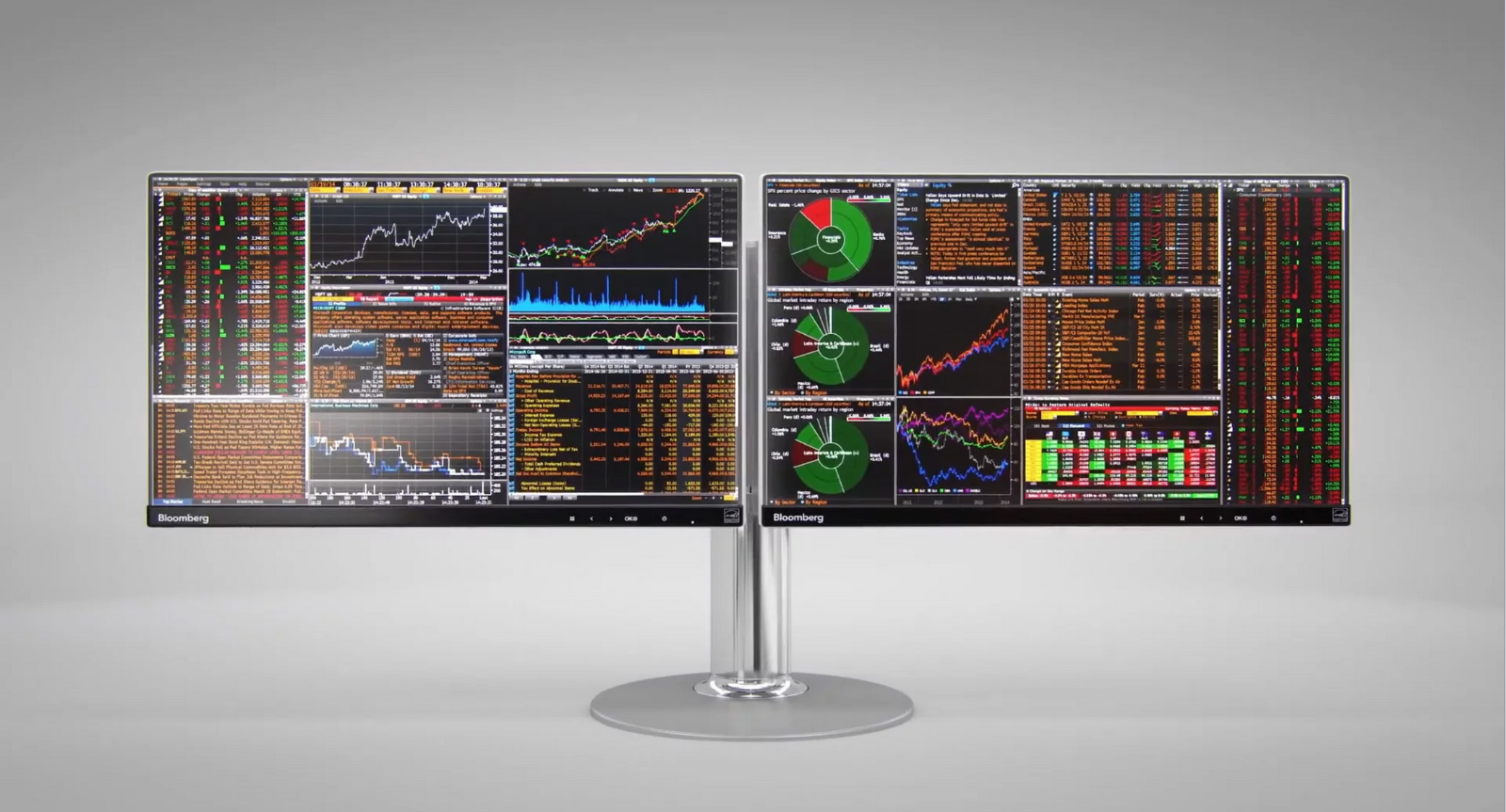
According to a report by NeuGroup citing an October 2024 customer notice, the 2025 rates for new and renewed contracts were $31,980 a year for a single seat and $28,320 per seat annually for multi-seat contracts. These rates apply to two-year subscription agreements. Actual costs depend on the timing of the contract and the specific data and add-on services required.
There’s even a YouTuber in Korea who subscribes to the terminal directly and broadcasts financial market commentary. I’m personally a fan of Oh Sun.
As the number of seats grows, so does the cost burden. Just doing simple math on the multi-seat rate above, 10 seats would run $283,200 a year. This gives organizations plenty of reason to examine who uses which data and functions, and which tasks could be handled with alternative tools instead.
Four Reasons Switching Tools Is Harder Than It Looks
I’ll admit that a Bloomberg screen looks clunky and overcomplicated at first glance. Learning the commands and functions takes time, too. Even so, I keep using it because it delivers not just data and features, but the existing way of working and the connections to trading counterparties that come bundled with it.
Alternatives like FactSet and LSEG do exist. But the data coverage, access rights, and analytics and trading functions differ from service to service, so comparing them on price alone is difficult. Some firms have in fact moved certain employees to other services. That doesn’t mean nobody can replace Bloomberg.
Let me break down, into four parts, what has to be rebuilt when you switch to another tool.
First, there’s the matter of handling the needed data consistently. Beyond just collecting equity, bond, FX, and commodity data, you have to align each dataset’s identifiers and formats, and handle errors and revisions. Competitors offer this capability too, but it’s hard to argue that it can be easily replicated just by throwing money at it.
Second, there’s the benchmark used for analysis and performance evaluation. The Bloomberg US Aggregate Bond Index, known as the “Agg,” is the leading index for comparing performance in the US investment-grade bond market.6 Asset managers use it to report how many bp7 of outperformance they’ve generated relative to this benchmark. To maintain the same standard as your existing reporting and analysis process, you need to check whether the new tool can provide the same index data and calculation methods you need.
That said, switching indices and switching terminals are separate decisions. Bloomberg’s index data is also available through third-party platforms. Having a contract that references the index doesn’t necessarily mean you must keep subscribing to the terminal.
Third, there’s the means of contacting trading counterparties. On Instant Bloomberg (IB), financial professionals exchange market information, research, trade inquiries, and quotes.8 What matters here is that the necessary contacts and chat history are woven into daily workflow.
Bloomberg also offers functionality that links IB conversations to order and trade-related systems. But not every quote offered in a chat automatically becomes a binding order, nor does every conversation lead to execution and settlement. It depends on the trade terms, the agreement between the parties, and the systems in use.
If your frequent trading counterparties use IB, you have a stronger reason to stay on the same service. This phenomenon is called a network effect.9 If switching to another service means you also have to rework how you reach your counterparties, that creates switching costs — lock-in.10 This doesn’t mean no other means of communication is available.
Fourth, there’s familiarity with usage and workflow. Each function has its own command: DES pulls up a security description, GP brings up a price graph, PORT loads portfolio analysis, and so on. Once you’ve internalized the commands and screen layouts you use most, you cut down the time spent navigating multi-step menus.
Adapting analysis screens, data connections, and reports you’ve used for years to a new platform takes time. It doesn’t end with relearning keyboard shortcuts. Companies need to weigh subscription-fee savings against these migration costs together. It can’t simply be assumed that migration costs outweigh savings for every user.
The black background, orange text, and command-driven interface are Bloomberg’s familiar hallmarks. But that doesn’t mean it’s unusable without a mouse or a dedicated keyboard. The screen’s impression and its actual functionality are two different things.
A tool that’s hard to learn isn’t automatically more competitive. The burden on first-time users is a clear downside. The advantage that longtime users can work quickly in familiar ways, and the learning burden on new users, exist side by side.
AI features are also being wired into existing workflows
AI can be used to summarize financial documents or find information within them. Bloomberg, too, is adding these kinds of features to its existing analytics tools.
Bloomberg’s research team published the BloombergGPT paper in March 2023. It described a finance-specific language model with 50 billion parameters11, trained on a combination of 363 billion finance-related tokens12 and 345 billion tokens of general data. It’s worth distinguishing between the research model as announced and the underlying models actually powering the individual AI features later added to the terminal — not every feature has been confirmed to run on BloombergGPT.
In 2024, a generative AI feature for summarizing earnings call content was introduced. It helps users locate things like a company’s guidance13 — its earnings outlook — or major business changes buried in lengthy documents. In a 2025 interview with IT Brew, the people behind the feature described its document-summarization and research-Q&A capabilities.
Amanda Stent, Bloomberg’s head of AI strategy and research, described this in the same interview as an evolution of an existing service — layering increased use of generative AI on top of the machine learning already used for market sentiment analysis14. She also said the company prioritizes protecting client and data-vendor information, providing sourcing back to original documents, repeated evaluation, and stable operation. These are operating principles the company describes about itself, not a guarantee that every AI answer is accurate.
Having a summarization feature built into the terminal lets users verify documents while still working with their existing data and communication tools. External AI tools may have their own advantages, but the convenience of not having to move your materials elsewhere every time is an edge Bloomberg is positioned to offer.
Oswarld’s Lens
Watching this case, I found myself thinking that you have to look at a product’s features together with how they fit into a user’s actual workflow. Even if two services offer the same price chart, the tool’s value changes depending on who you contact after seeing that chart, and where you go to analyze and report on it.
It’s hard to explain why the financial industry uses Bloomberg purely as a matter of habit with an old screen. My view is that when communication with counterparties, research, and analysis are all wired together in one place, it’s difficult to switch over all at once even when a cheaper service comes along offering some of the same features. That said, this doesn’t mean the platform monopolizes the entire market or that all financial work happens exclusively within it.
Collecting public data is also different from providing financial data that’s actually usable for work. The evaluated prices of thinly traded bonds15, dealer price lists16, and private deal terms exchanged between counterparties simply aren’t available on the open web as-is. Evaluated prices are estimates, and this doesn’t mean that private conversations between counterparties become data disclosed to every subscriber.
Ghalibaf’s post can be read as a case of Bloomberg commands being used as a message aimed at financial markets. We don’t actually know what tool he used to check the price himself. What’s worth examining beyond this single case is why financial professionals use specific data, tools, and channels of communication together in the first place.
Whether there’s reason to keep using Bloomberg or reason to switch to another tool is ultimately something each person has to judge based on their own work.
Closing
When comparing financial information services, I’d first check what it takes to migrate my existing workflow — beyond just the subscription fee and the feature list.
- Whether the price, security data, and analytical criteria I need are also available on the new service
- How I’d carry over communication and order-related work with counterparties
- How long it would take to rewire existing report and data connections, and to learn the new interface
Seen this way, a phrase like “got a call from an IB” refers to communication with a trading counterparty, and “40bp of outperformance against the Aggregate” means a return 0.4 percentage points higher than the benchmark index. A terminal is a tool where all these different tasks come together.
It’s also worth comparing how well new services — FactSet, LSEG, and AI-driven alternatives — support each of these specific tasks. Even if none of them replaces everything at once, a service that cuts the cost and time of a particular task can still be a real option.
Keep the perspective, not the noise.
We choose one consequential shift and trace what sits beneath it, every other day.
Confirm once to finish subscribing.
Already a subscriber? Sign in to join the conversation


References & Further Reading
Primary sources
- WANA. Ghalibaf Warns Global Oil Market Stakeholders, 2026.04.20. : Reports on a post containing command-line instructions.
- NeuGroup. Bloomberg Terminals: How Much More You’ll Pay Next Year, 2024.10.09. : Cites a client notice regarding rates that took effect in 2025.
- European Central Bank Data Portal, “Bloomberg European Dated Brent Forties Oseberg Ekofisk (BFOE) Crude Oil Spot Price”. : Confirms the data name and time-series classification for EUCRBRDT.
Background
- Harry McCracken. How the Bloomberg Terminal Made History—And Stays Ever Relevant, Fast Company, 2015. : Covers the early terminals and their subsequent evolution.
- Bloomberg. Instant Bloomberg feature guide.
- Bloomberg. Fixed income index methodology.
- Bloomberg. Feature guide for finance education.
- Wu et al. BloombergGPT: A Large Language Model for Finance, 2023.03. : Describes the model and training materials released by the research team.
- IT Brew, “Inside the Bloomberg Terminal’s AI”, 2025.11. : An interview in which the people behind the AI features explain how they were rolled out and the principles used to evaluate them.

Footnotes
-
Ticker: A code used to identify a financial instrument or price data series. It’s used together with a market/asset designation to specify the target. ↩
-
Brent: One of the major benchmark prices used in international crude oil trading. Dated Brent is the standard used to assess the spot price of crude cargoes with a fixed delivery schedule. ↩
-
Spot: Refers to a transaction in which the actual asset is delivered relatively soon after the trade. Delivery conventions differ by commodity, so it shouldn’t be understood simply as “delivered today.” ↩
-
Asset-class key: Bloomberg’s GOVT (government bonds), CORP (corporate bonds), EQUITY (equities), INDEX (indices), and similar codes specify the asset category being queried. ↩
-
Yield curve: A graph comparing the yields of bonds with different maturities. Factors beyond maturity should also be considered when interpreting it. ↩
-
Benchmark: A standard used to compare investment performance. The index chosen should match the fund’s investment targets and objectives. ↩
-
bp (basis point): A unit for expressing differences in interest rates or yields. 1bp equals 0.01 percentage points, so a yield that is 40bp higher means it’s 0.4 percentage points higher. ↩
-
Quote: A stated price at which a party is willing to transact. Whether it’s a reference price or an actually executable price, and under what conditions, must be checked case by case. ↩
-
Network effect: A phenomenon in which a service’s value increases because it allows connection with other users. ↩
-
Lock-in: A situation in which switching to another service incurs costs — data migration, retraining, changing connections with counterparties, and so on — leading users to stick with the existing service. ↩
-
Parameter: A numerical value that a model adjusts as it learns. Performance can’t be judged from parameter count alone. ↩
-
Token: The unit into which a language model splits text for processing. Token length varies depending on the language and the tokenization method used. ↩
-
Guidance: A company’s forward-looking projection of revenue, profit, and similar figures. It’s distinct from confirmed results. ↩
-
Sentiment analysis: A method of analyzing the positive or negative tone expressed in text such as news or disclosures. The results don’t guarantee future prices. ↩
-
Evaluated pricing: A price estimated using information such as trades, quotes, and comparable bonds. There’s no guarantee that a trade will actually execute at that price. ↩
-
Dealer runs: A list of prices and other details for various securities that a dealer provides to clients. Whether it’s a reference display or a firm trading offer depends on the terms. ↩
Related issues
What Apple Store Staff Faced Launching Vision Pro
Apple flew hundreds of staff to Cupertino for secret training, but Vision Pro sales still fell short.
BusinessHormuz Tolls and a 428-Year Maritime History
Reports of Iranian tolls in Hormuz recall Denmark's centuries-old Sound Dues and the legal regimes governing global straits and canals.
BusinessLegal AI Startup Harvey Hits $11 Billion Valuation
As law firms adopt AI that cuts document-review time, how will they split the savings with clients under hourly billing?
Business
Your take shapes the next issue
What resonated most in this issue, or where has your experience been different?