

BYD's 5-Minute Charge: Why EV Drivers Should Care
I compared BYD's new 5-minute EV charging claim with my own waits in a Tesla Model Y and an Ioniq 5.
BusinessWhy a 5-minute charge matters to anyone who drives an EV
When you drive an EV, the wait for charging to finish stays in the back of your mind. That’s why BYD’s announcement of a “5-minute charge” caught my attention. If charging could take about as long as filling up with gasoline, the burden of long-distance trips would ease considerably.
On March 5, 2026, BYD unveiled its Blade Battery 2.0 alongside a Flash Charger capable of up to 1,500kW1. The company’s stated charging times are 5 minutes from 10% to 70% battery, and 9 minutes from 10% to 97%. At -30°C, it claims 12 minutes to go from 20% to 97%.
This brought to mind my own Tesla Model Y and the Ioniq 5 I used to drive. In my experience, DC fast charging on the Ioniq 5 took about 40 minutes, while a Tesla Supercharger took roughly 20 minutes. These are just the times I personally experienced under the conditions I used — not an official comparison of the two models’ charging performance. Because of that experience, the idea that charging could be done in 5 to 10 minutes felt even more welcome.
That said, charging time depends on starting battery level, target level, temperature, and vehicle model. A charger with several times the maximum output doesn’t automatically mean charging is always that much faster. So what exactly did BYD change, and what conditions need to be in place for a driver to actually experience this speed?
The subject turned out to be complicated enough that I wrote and deleted this several times. Let me walk through it in order — starting with battery structure, then charging-station equipment, and finally the state of the U.S. market.
They redesigned the battery and the charging station together
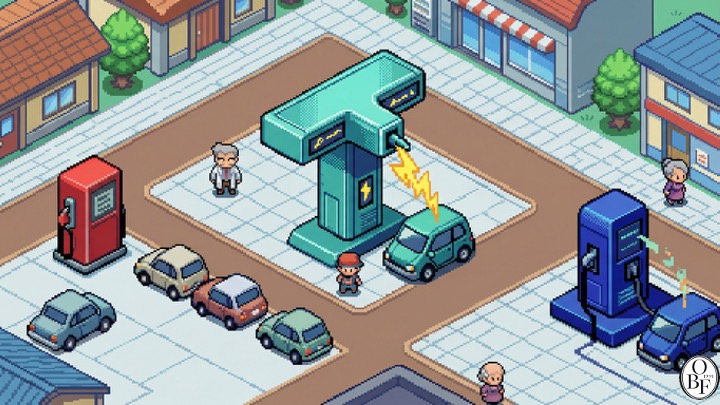
Even if a charger sends a huge amount of power, charging speed is capped if the battery can’t absorb it. BYD sped up ion movement inside the battery and designed both the vehicle and the charger to handle higher power loads. It also attached a battery to the charging station itself, to store power in reserve.
The Blade Battery 2.0 is an LFP, or lithium iron phosphate2, battery. According to BYD, the company changed the particle structure of the cathode material3, raised the ionic conductivity of the electrolyte4, and improved the structure through which ions enter the anode material5. The design lets lithium ions move faster during charging, cutting internal resistance and heat buildup.
The company said it raised charging speed while also improving energy density6 by 5% over the previous generation. In vehicles using this battery, it cited a range of over 1,000km under China’s CLTC test standard7. Some reports described it as LMFP, with added manganese, but BYD’s official announcement this time specified LFP.
In the China-market spec, the charger delivers up to 1,500kW through a single connector. The cable hangs from a T-shaped post. Because it moves along a rail and pulley system, it doesn’t drag on the ground and can be connected to match the position of the car’s charging port. It’s a design meant to cut down on the hassle of handling a heavy cable, alongside the fast charging itself.
What I found interesting is the ESS, or energy storage system8, at the charging station. It draws electricity from the grid and stores it in a battery, then supplies it alongside grid power when a car is charging. That means the station doesn’t have to pull the entire surge of power needed at the moment of charging straight from the grid. Still, once the stored power runs out, it needs to be recharged. In locations with constant traffic, both grid capacity and the size of the storage unit need to be sufficient.
Why making so many parts in-house actually helps
BYD develops not just batteries but motors, power semiconductors, and vehicle and charging technology in-house. This approach — handling multiple stages of production internally — is called vertical integration9. UBS’s 2023 teardown analysis of the BYD Seal also pointed to this structure, where battery cells, the drivetrain, and electronics are developed together, as a source of cost competitiveness.
This same approach showed up in the Super e-Platform BYD unveiled in March 2025. BYD announced a 1,000V vehicle power architecture, charging up to 1,000kW, and its own in-house SiC power semiconductors10 all together. This latest 1,500kW charging capability is a further advance on that power-handling technology.
Ultra-fast charging requires the battery to withstand high charging current, the vehicle’s internal wiring and power electronics11 to handle it safely, and the charger and control software to work in sync. Developing multiple components in-house makes it easier to hit design targets and coordinate fixes when problems arise. Companies that rely on outside suppliers can do this too, but it means more conditions to align across more parties.
So simply installing a 1,500kW charger doesn’t mean every EV can charge in 5 minutes. Both the power a vehicle can accept and the power a charging station can deliver need to rise together.
It’s Not Just BYD’s Story: Three Battery Technologies CATL Revealed
CATL12 is also changing charging speed and battery materials. Unlike BYD, which builds complete vehicles, CATL supplies batteries to multiple automakers. At its first “Super Tech Day” on April 21, 2025, it unveiled three technologies — an event that took place about 11 months before BYD’s announcement.
Shenxing Gen 2 focuses on fast charging. CATL announced a maximum charge rate of 12C13 for its LFP battery and a maximum charging power of 1.3MW. It also cited a figure of 15 minutes to charge from 5% to 80% at -10°C. 12C is a peak instantaneous value, meaning that speed isn’t sustained throughout the entire charge. When comparing speeds with BYD, you also need to look at the same charge-level range and temperature.
Naxtra is a battery that uses sodium instead of lithium14. In its 2025 announcement, CATL cited an energy density of 175Wh/kg15, a range of 500km, and a cycle life of over 10,000 charge-discharge cycles. The approach aims to reduce dependence on lithium resources while improving low-temperature performance.
In February 2026, CATL unveiled a passenger car with a sodium-ion battery in partnership with Changan Automobile. The vehicle’s stated range at the time was over 400km, with market launch slated for mid-2026. It’s worth distinguishing between the battery technology announcement and the actual vehicle launch.
In its February announcement, CATL explained that the battery retains over 90% of its capacity even at -40°C. It also stated that in tests involving crushing and damage from drills and saws, no smoke or fire occurred. These tests were designed to demonstrate low-temperature performance and safety in the event of damage.
Freevoy Dual Power is a design that uses two different zones within the battery pack differently. It combines a zone for everyday driving with a zone that stores more energy for long-distance trips. There are multiple configurations, including sodium+LFP, LFP+LFP, and combinations using NCM16. The two zones don’t necessarily need to have different chemical compositions.
The 1,500km-plus range CATL cited applies to a configuration combining NCM with an NCM-based “self-forming anode” battery, under the condition of fitting over 180kWh of capacity into a sedan with a roughly 3m wheelbase. Using the same new technology, CATL also announced a 50% improvement in energy density by weight and 60% by volume. These figures shouldn’t be read as representing the performance of every Freevoy configuration.
BYD is aligning its own vehicles with its own charging stations, while CATL is expanding the range of battery configurations that multiple automakers can choose from. That’s because the requirements differ for vehicles where fast charging matters most, vehicles meant for cold regions, and vehicles that need long range.
Looking at both companies’ announcements together shows that the competition extends beyond charging speed to battery materials, low-temperature performance, range, and supply arrangements. We shouldn’t lump the progress of sodium-ion batteries together with BYD’s 5-minute charging as if they were a single technology.
To Scale That Speed Across the US
Gil Tal, an EV researcher at UC Davis, told WIRED that ultra-fast charging is a genuine improvement, but it may not be enough to change daily habits for most drivers. His reasoning: many existing EV owners in the US can charge at home, and they mostly turn to public fast chargers for long trips.
That logic makes sense to me. But I keep thinking about drivers who haven’t bought an EV yet. Tal himself acknowledged that drivers coming from internal combustion engines tend to measure the experience against refueling at a gas station. For someone who can’t easily charge at home, or who needs to charge frequently while on the move, a shorter charging time could be a much more decisive factor. It’s hard to describe an entire region with just one pattern of use.
On the ground, at the installation site, the power grid17 is what matters most. You have to check whether simply swapping out the charger is enough, or whether you also need to expand the transformer18 and distribution equipment. If the existing infrastructure has no spare capacity, you’ll need to negotiate supply capacity with the utility and carry out construction work. An ESS can reduce momentary load spikes, but it doesn’t eliminate the total energy a charging station consumes.
I think there’s an opportunity here for Korean transformer and cable manufacturers to get involved. That said, a charger announcement doesn’t automatically translate into orders. You can only gauge real demand by looking at actual charging-station investment plans and equipment procurement.
In the US, development is also underway on megawatt charging systems for heavy trucks, like MCS19. Tesla’s V4 charging design likewise points toward higher voltage and higher output. But for passenger-car drivers to actually benefit from this widely, both charger deployment and vehicle support specifications need to align.
Investment conditions differ, too. On March 12, 2026, Honda scrapped development and launch plans for the Honda 0 SUV, Honda 0 Saloon, and Acura RSX, which it had intended to build in the US. The company cited shifting US EV policy support, softening demand, tariffs, and declining competitiveness in other markets.
The losses tied to Honda’s electrification strategy review — estimated at up to ¥2.5 trillion (~$16.3 billion), including future fiscal years — don’t mean the company has already booked that entire loss just by canceling these three models. Honda said it would strengthen its hybrid lineup and reassess how it allocates investment. Even as charging technology improves, if demand and policy remain uncertain, investment in both vehicles and charging infrastructure can still be delayed.
Oswarld’s Lens
What I want to see going forward is where these announced top speeds can actually be used. BYD says that as of March 5, 2026, it had installed 4,239 flash-charging stations in China, with plans to expand to 20,000 by year-end. We need to separate the number of stations already installed from the future target.
More stations means more reasons to pick a compatible vehicle. But “can connect to other companies’ cars” and “every car charges at top speed” are different claims. Beyond availability, we need to check actual charging times by vehicle model.
If multiple automakers adopt CATL’s battery, ultra-fast charging technology could spread to other vehicle lines. Still, installing the battery isn’t the whole story. Each vehicle’s power-system design and charging-station rollout have to keep pace.
Company-reported figures need to be read alongside their test conditions. BYD’s 1,500kW spec applies to China’s charging standard, and in its March announcement the company said final specifications for European vehicles would be disclosed later. The name of a connector alone can’t tell us the upper limit of charging speed in Europe.
Battery safety and lifespan are separate matters too. BYD said there was no thermal runaway20 in nail-penetration tests after 500 fast-charge cycles, while CATL presented charge/discharge lifespan figures for Naxtra. We can’t compare different test results as if they were the same durability metric. We also need to see how much capacity degrades over long-term use.
Turning charging speed into a genuine product advantage requires having the car, the charging stations, and the power supply all lined up together. What I’m watching is how consistently that design and rollout continue. A single record-breaking number matters less to a purchase decision than whether drivers can reliably charge at the places they actually go.
Closing
I wrote this piece after digging through quite a few sources and revising it several times. The tech events I personally follow are Apple’s WWDC, Nvidia’s GTC, and CATL’s Super Tech Day. What draws me to them is seeing how each company plans to translate new technology into actual products and business.
This time, as someone who actually drives an EV, I was especially curious about how much less time I’d spend waiting to charge. BYD’s announcement is welcome news, but I’ll only really feel the difference if that speed is available at chargers I can actually use and in the car I actually drive. Going forward, I plan to pay attention not just to a charger’s peak output, but also to compatible vehicle models, real-world charging times, and the location and rollout pace of charging stations.
Keep the perspective, not the noise.
We choose one consequential shift and trace what sits beneath it, every other day.
Confirm once to finish subscribing.
Already a subscriber? Sign in to join the conversation


References & Further Reading
- BYD, Blade Battery 2.0 and FLASH Charging, March 5, 2026. The official announcement, laying out the charging-percentage bands, low-temperature conditions, China-market specs, and charging-station rollout plans.
- BYD, Super e-Platform with Megawatt Flash Charging, March 17, 2025. The announcement of the previous generation’s vehicle power architecture and charging technology.
- CATL, Naxtra Battery Breakthrough & Dual-Power Architecture, April 21, 2025. The announced specs for Shenxing 2nd generation, Naxtra, and Freevoy.
- CATL, CATL and CHANGAN Launch Sodium-Ion Passenger Vehicle, February 5, 2026. Confirms the announced specs and launch plans for an actual production vehicle.
- UBS, BYD Teardown, September 7, 2023. An analysis of the Seal’s vertical integration and cost structure.
- Aarian Marshall, How BYD Got EV Chargers to Work Almost as Fast as Gas Pumps, WIRED, March 2026. The article that started this whole piece — it includes an interview with Gil Tal.
- Honda, Losses Associated with Reassessment of Automobile Electrification Strategy, March 12, 2026. The official announcement on the cancellation of three models, projected losses, and future strategy.

Footnotes
-
kW (kilowatt): A unit of electrical power. In chargers, it indicates the rate at which energy is delivered. 1,500kW equals 1.5MW; actual charging time also depends on battery capacity and how output changes during charging. ↩
-
LFP (lithium iron phosphate): A battery that uses lithium iron phosphate as its cathode material. Widely used in EVs for its cost, lifespan, and safety advantages. ↩
-
Cathode material: The material on the side that releases lithium ions when a lithium-ion battery charges. Affects capacity, safety, and other characteristics. ↩
-
Electrolyte: The substance inside a battery that allows ions to move between the cathode and anode. ↩
-
Anode material: The material on the side that receives lithium ions during charging. Graphite and similar materials are used in lithium-ion batteries. ↩
-
Energy density: The amount of energy that can be stored per unit of weight or volume. ↩
-
CLTC: China’s vehicle range testing standard. Figures can’t be directly compared with other testing standards or real-world driving range. ↩
-
ESS: A system that stores energy and supplies it when needed. Here, it refers to battery storage installed at charging stations. ↩
-
Vertical integration: A structure in which a single company handles multiple stages of production and distribution — raw materials, components, and finished products. ↩
-
SiC (silicon carbide): A material used in power semiconductors that handle high voltages, among other applications. ↩
-
Vehicle power architecture: The design that connects and controls how the battery, motor, charging unit, and wiring exchange electricity. At the same current, higher voltage delivers more power. ↩
-
CATL (Ningde Era, Contemporary Amperex Technology Co., Limited): A battery maker headquartered in Ningde, China, serving the EV and energy-storage markets. ↩
-
C-rate: A ratio indicating how large the charge/discharge current is relative to rated capacity. Sustaining 1C for one hour moves a charge equal to the rated capacity. Because current varies during actual charging, a peak figure like 12C alone can’t be used to calculate full-charge time. ↩
-
Sodium-ion battery: A battery that charges and discharges via the movement of sodium ions instead of lithium ions. It can draw on abundant raw materials, but cost and performance vary depending on materials, production scale, and design. ↩
-
Wh/kg: A unit of energy stored per kilogram of weight. It’s worth checking whether a figure is measured at the cell level or the full battery-pack level. ↩
-
NCM: A family of cathode materials containing nickel, cobalt, and manganese. Performance varies with the ratio of materials and the design. ↩
-
Power grid: The transmission and distribution system that delivers electricity from power plants to points of use. ↩
-
Transformer: A device that raises or lowers voltage. Also reviewed when planning the power supply capacity needed for a charging station. ↩
-
MCS: Refers to megawatt-class charging systems and related standards intended for use in heavy commercial vehicles and similar applications. ↩
-
Thermal runaway: A phenomenon in which heat generation inside a battery cascades and causes a rapid temperature spike. Can lead to fire or explosion. ↩
Related issues
Apple at 50: How Devices and Services Grew Together
I've used Apple products since the iPhone 3GS, and for its 50th anniversary I dug into revenue, active devices, and how ecosystem ties shape customer choice.
BusinessEconomists Are Using AI to Speed Up Research
Economists are using AI to code, clean data, and polish papers—raising real questions about speed versus rigor.
BusinessTikTok's $10 Billion Fee to the U.S. Government
Reports say TikTok's US investors agreed to pay Washington $10 billion on top of their equity stake—here's what that fee actually buys.
Business
Your take shapes the next issue
What resonated most in this issue, or where has your experience been different?