

NASA's Artemis II Launches, 53 Years After Apollo
Artemis II has launched toward the Moon, kicking off a look at US-China lunar plans and the rules for using its resources.
AI & TechAstronauts Head Back to the Moon
As a kid, I devoured the space series by Isaac Asimov that my mother bought me. In my memory, by the 1990s space stories already felt like a subject whose moment had passed. Lately, though, lunar exploration is back in the headlines.
No human has set foot on the Moon since Apollo 17 in December 1972. In the decades since, uncrewed probes have surveyed the lunar surface and astronauts have racked up long stretches in Earth orbit, but crewed missions to the Moon itself never resumed.
At 6:35 PM US Eastern Time on April 1, 2026, NASA’s Artemis II launched carrying four astronauts. That’s 7:35 AM on April 2 in Korea time. The SLS rocket lifted the Orion spacecraft into space, beginning a roughly ten-day test flight that loops around the Moon and returns to Earth. This isn’t a mission to land on the Moon or enter lunar orbit — it’s a free-return trajectory1 that uses the Moon’s gravity to bring the spacecraft home.
Alongside the launch, what caught my attention was a change to the follow-up mission that NASA announced on February 27. It reveals what further testing is needed for sustained trips to the Moon — and what’s driving the urgency amid competition with China.
Sustaining a big budget for moon exploration proved difficult
The Apollo program was driven not just by scientific exploration but by Cold War rivalry. When the Soviet Union launched Sputnik 1 in 1957, the US felt pressure to lead in space technology, and landing on the Moon became a national goal.
Exploration continued after the first Moon landing in 1969, but budgets and political priorities shifted. NASA had to split its limited rockets and funding between lunar missions and Earth-orbit space station plans. After Apollo 20 was cancelled in 1970, two more lunar missions were scrapped, making Apollo 17 the last landing. The program didn’t stop because there was nothing left to learn from the Moon.
The reasons for returning to the Moon today go beyond scientific exploration — they include the potential to use local resources and competition among nations.
Water on the Moon could help sustain long-term stays. A research team analyzing NASA radar data carried aboard India’s Chandrayaan-1, launched in 2008, published findings in 2010 indicating the presence of water ice in craters at the Moon’s north pole. The estimate of more than 600 million tons was based on assumptions about ice thickness and other factors — it wasn’t a confirmation that this amount could be mined right away.
If water can be extracted, it could be used as drinking water or, with added energy, split into hydrogen and oxygen to serve as propellant. Helium-32 is also being studied as a candidate fusion fuel, but the technology and economics of extracting it from the Moon for commercial power generation aren’t established yet.
China’s exploration capabilities have also grown. China operates its own space station, Tiangong, and in 2024 brought samples from the far side of the Moon back to Earth with Chang’e 6. It has stated a goal of a crewed Moon landing “before 2030.”
In announcing its own mission changes, NASA also cited geopolitical competition as a reason to move faster. Science, resource utilization, and national influence are all working together here.
What Tests Are the US and China Preparing For?
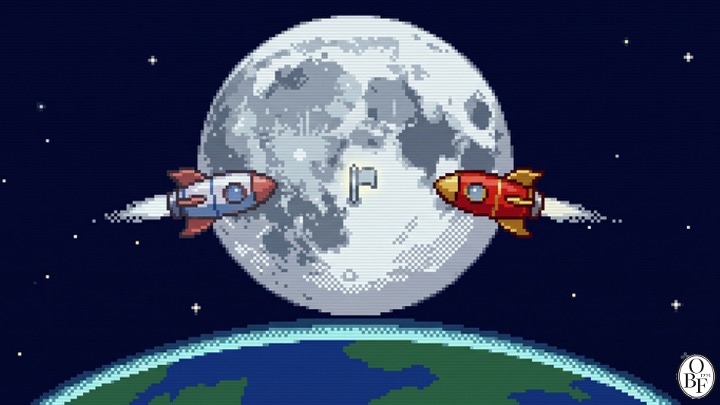
The US: Adding an Earth-Orbit Test Before Landing
Cost and schedule management are Artemis’s biggest challenges. NASA’s Office of Inspector General projected in a 2021 report that spending related to fiscal years 2012 through 2025 would total $93 billion. It also estimated that production and operating costs for the SLS-Orion system used in Artemis I through IV would run about $4.1 billion per launch. That $4.1 billion figure is neither the price of a single SLS rocket nor the full cost of a lunar landing. The fact that the SLS3 is expendable makes repeated exploration all the more expensive.
During Artemis I in 2022, Orion’s AVCOAT4 heat shield eroded more than expected. NASA explained that gases generated inside the material couldn’t escape fast enough, causing cracking and damage. After analysis and ground testing, the agency decided to keep the existing heat shield for Artemis II but adjust the reentry trajectory instead. It was a technical issue that had to be resolved before the crewed test flight.
On February 27, 2026, NASA announced it would convert Artemis III into a low-Earth orbit5 test in 2027. In this mission, Orion would rendezvous and dock with a commercial lander from SpaceX or Blue Origin and test the connected systems. The actual lunar landing is now targeted for Artemis IV in 2028. According to NASA’s explanation in March, the 2028 landing target itself is a schedule the agency has held since mid-2025. What changed is that NASA inserted one more test phase and renumbered the landing mission.
NASA also outlined a plan to standardize the SLS configuration rather than using the originally planned Exploration Upper Stage (EUS) and Mobile Launcher 2. The agency said it would keep a launch configuration close to the existing Block 1 while still reviewing alternatives for the upper stage. Rather than making major design changes for each mission, the plan is to build up test experience with a similar configuration and then move to annual lunar missions afterward.
China: Testing the Rocket, Spacecraft, and Lander
China has built up experience through crewed spaceflight and its space station program. “Project 921,” launched in 1992, is a crewed space development program, and the landing phase of this crewed lunar mission was officially launched in 2023. Having a long history of preparation is not the same as saying the same lunar plan has been running for 30 years.
The published plan calls for two Long March 10 rockets to separately launch the crewed spacecraft Mengzhou and the lander Lanyue. After rendezvousing in lunar orbit, two astronauts would transfer to Lanyue and descend to the lunar surface. Once the mission is complete, they would rendezvous with the spacecraft again and return to Earth.
A comprehensive verification test of Lanyue’s landing and liftoff took place on August 6, 2025. A low-altitude flight test of the Long March 10 and a maximum dynamic-pressure escape test for Mengzhou were conducted on February 11, 2026. Not all of these tests were completed in February. Even after each individual test succeeds, the integrated verification needed for an actual lunar mission still has to continue.
The Starship HLS6 that the US is developing requires technology to transfer cryogenic propellant in space7. The concept of on-orbit refueling itself isn’t new. In a 2024 flight, SpaceX tested transferring liquid oxygen between tanks inside a single Starship. But transferring large quantities of cryogenic propellant between separate spacecraft and using it for a lunar mission is a much bigger challenge.
China’s published plan doesn’t rely on that kind of refueling approach. Instead, it needs to succeed at two separate launches, docking in lunar orbit, and landing and liftoff. Rather than concluding that the risk is low simply because the approach looks familiar, we should look at what each plan has yet to verify.
What Rules Govern Lunar Resource Use?
As lunar exploration expands, who gets to use resources—and how—becomes a critical question. The 1967 Outer Space Treaty bars states from claiming sovereignty over celestial bodies, including the Moon, or appropriating them through occupation. It also requires that private activities receive government authorization and ongoing supervision, and that states show due regard for other nations’ activities. Space is not a lawless zone.
That said, real debate remains over how much latitude to give commercial resource extraction rights and on-site operations, and over how to interpret the treaty’s finer points.
The Artemis Accords, launched by the US and others in 2020, are a political commitment setting out principles for exploration cooperation. They started with 8 countries and grew to 61 when Oman signed on January 26, 2026. Signatories share the interpretation that extracting resources does not, by itself, amount to the kind of national territorial claim the Outer Space Treaty prohibits. But the Accords aren’t a blanket authorization for every mining method.
China and Russia haven’t joined the Accords and are instead pursuing their own International Lunar Research Station (ILRS)8. The two countries signed a memorandum of understanding on joint construction in 2021—a plan to recruit partner nations for building and operating the station. The Accords and the ILRS project are different in nature, but it’s worth noting that each could expand its backers’ influence through its own network of partnerships.
The most contentious issue in the Artemis Accords is the concept of “safety zones.” The idea is to disclose activity locations and coordinate to avoid dangerous interference—for instance, if operations at one facility could damage a nearby facility, the two would need to coordinate in advance.
The problem is the possibility that such zones could be drawn excessively large, or used to effectively block other countries’ access. The real question is how to distinguish safety coordination from de facto monopolization of a location. Simply having safety zones written into the Accords doesn’t, on its own, create sovereign rights.
How the first countries and companies to arrive establish their operating practices could become an important precedent when rules are debated later. So alongside the technology needed to reach the Moon, we also need to watch what procedures get applied on-site and how countries negotiate with one another.
Oswarld’s Lens
Watching this competition, I find myself paying attention to both the exploration achievements and the institutional design behind them.
When building a go-to-market strategy, having good technology matters as much as getting other participants to adopt that technology and approach. Once a standard is set, the way products connect and services get delivered falls in line with it. Of course, proposing a standard first doesn’t guarantee winning the market. You still have to bring in participants willing to use it together and actually make it work.
From this angle, I’ve been watching the expanding membership of the Artemis Accords closely. It signals that a growing number of countries are starting to share the interpretation and cooperation principles the US originally proposed. South Korea joined as the tenth signatory in 2021.
China and Russia forming their own separate cooperative framework brings to mind the kind of great-power-centered bloc politics we see in international relations. But space research cooperation shouldn’t be mapped directly onto the same lines as NATO or BRICS. You need to look at which specific research and technology partnerships each country is actually part of.
The cost structure that determines how long an exploration effort can be sustained also matters. Reusable launch vehicle technology from commercial providers could lower costs, but the target cost and the actual total cost of a crewed lunar mission can diverge. You can’t just look at the cost of a single rocket launch — you have to compare including additional launches, landers, spacecraft, and ground operations.
What worries me is the possibility that as on-site activity increases, concrete coordination rules never get agreed upon. The basic principles of the Outer Space Treaty still apply, but if multiple countries build facilities in the same narrow, resource-rich areas, they could end up disputing what counts as dangerous interference. The Artemis Accords aren’t a new binding international treaty covering every country, either. Even across different cooperative frameworks, there needs to be a way to share activity information and mediate disputes.
Closing
When I read books about space as a kid, what fascinated me most was how far humans could actually go. Now I find myself wondering something different: once we arrive, can we keep exploring, and what will we actually do with what we find there? Between the theoretical possibility of using water and the real economics of mining it, there are still technical hurdles to clear — and the question of who has the right to use these resources remains unsettled too.
The launch of Artemis II matters because it marks the first time in 53 years that humans have headed back toward the Moon. In the next phase, I want to look not just at the results of the flight and landing tests, but at how the participating nations respect and coordinate with one another’s activities.
If you’re curious about the rules governing resource use, I’d recommend reading the explainers on the Outer Space Treaty and the Artemis Accords linked below. Separating the principles already written into the treaty from the interpretations currently being debated makes the real points of contention much easier to see.
Keep the perspective, not the noise.
We choose one consequential shift and trace what sits beneath it, every other day.
Confirm once to finish subscribing.
Already a subscriber? Sign in to join the conversation


References & Further Reading
-
NASA, Artemis II Launch Announcement, April 1, 2026. Covers launch time, spacecraft, and mission details.
-
NASA, Adds Mission to Artemis Lunar Program, Updates Architecture, February 27, 2026. Follow-up mission architecture details, March 3.
-
NASA Office of Inspector General, NASA’s Management of the Artemis Missions, IG-22-003, November 15, 2021. Includes spending projections and estimated ranges for per-launch production and operations costs.
-
NASA, Orion Heat Shield Char Loss, December 5, 2024. Root-cause analysis of the Artemis I heat shield damage.
-
NASA, Lunar North Pole Ice Study Announcement, March 2, 2010.
-
China Manned Space Agency (CMSE), Lanyue Landing and Ascent Tests, August 7, 2025; Long March 10 and Mengzhou Tests, February 11, 2026.
-
China National Space Administration (CNSA), Early Plan for Crewed Lunar Exploration, 2023; China-Russia ILRS Cooperation Memorandum of Understanding, March 9, 2021.
-
NASA Technical Report, Guidelines for In-Space Cryogenic Propellant Transfer, 2025. Summarizes the challenges and prior tests in cryogenic propellant transfer.
-
United Nations Office for Outer Space Affairs, Outer Space Treaty. Covers foundational principles including use and occupation under Articles I-II and oversight of private activity under Article VI.
-
NASA, Artemis Accords and Announcement of Oman as 61st Signatory, January 26, 2026.
-
The Artemis Accords: Evolution or Revolution in International Space Law?, International & Comparative Law Quarterly, 2021. Addresses resource extraction and interpretive disputes over the Outer Space Treaty.

Footnotes
-
Free-return trajectory: a flight path designed so a spacecraft that has approached the Moon uses lunar gravity to swing back toward Earth. This still requires trajectory corrections, life support, and re-entry procedures, so it doesn’t mean an automatic safe return if something goes wrong. ↩
-
Helium-3: a helium isotope with 2 protons and 1 neutron, studied as a candidate fusion fuel. Mining it on the Moon for use as an energy source still requires technical and economic validation. ↩
-
SLS: NASA’s heavy-lift rocket. It reuses engines and technology from the Space Shuttle program, but the rocket itself is not fully recovered and reused. ↩
-
AVCOAT: a heat shield material that protects a spacecraft by ablating — its surface breaking down and burning away as it absorbs heat during re-entry. ↩
-
Low Earth orbit (LEO): generally refers to Earth orbits below about 2,000 km in altitude. The International Space Station orbits at roughly 400 km. ↩
-
HLS: a lander system that transports astronauts between lunar orbit and the Moon’s surface. SpaceX and Blue Origin are each developing their own versions. ↩
-
On-orbit refueling: replenishing a spacecraft’s propellant in space. The Starship HLS requires technology to handle liquid oxygen and liquid methane, both stored at extremely low temperatures. ↩
-
ILRS: the International Lunar Research Station, a joint program pursued by China and Russia. It aims to build facilities on the lunar surface and in orbit for scientific research and technology demonstration. ↩
Related issues
Inside Apple's US Chip Supply Chain Buildout
A WSJ reporter toured Apple's US chip facilities, revealing a gap between announced investment and actual production capacity.
AI & TechAdobe's $150M Settlement Over Cancellation Dark Patterns
The DOJ's Adobe settlement reveals how subscription cancellation friction ties directly to retention metrics.
AI & TechMemory Stocks Fall After Google's TurboQuant Debut
Google's TurboQuant compresses the KV cache stored in GPU HBM, but that's different from cutting overall memory demand.
AI & Tech
Your take shapes the next issue
What resonated most in this issue, or where has your experience been different?