

Smart Glasses Cameras Went Dark. AI Went to the Factory
Camera and computer-vision tech kept advancing, but social acceptance didn't — so intelligence moved to the factory instead.
BusinessMeta Turned Off Its Own Product’s Camera
On July 7, 2026, Meta pushed a forced update to its smart glasses. The feature: if the small white light on the side of the frame — the capture LED that signals to bystanders “this is recording right now” — is detected as physically tampered with or destroyed, the camera shuts down entirely. The update hit the second-generation Ray-Ban Meta, Oakley Meta, and the $299 Meta Glasses that launched in June, across the board.
The market created the need for this update. According to reporting by 404 Media, one individual was selling a $60 service that modified the internal circuitry of the glasses to permanently kill the LED. Since covering the light with tape already stopped the camera from recording, the workaround escalated to physically removing the component. Meta took down thousands of related ads and marketplace listings and said it’s considering legal action.
That same week, the California State Assembly’s Privacy and Consumer Protection Committee passed SB 1130 — the Wearable Device Privacy Protection Act — by a vote of 8 to 2. The bill criminalizes disabling a recording indicator light. A state where a company locked its own door coincided with a legislature adding a second lock to that same door.
Here’s where I think reading this purely as a privacy story misses half the picture. What the glasses lost wasn’t the ability to film. What they lost was the ability to keep filming without anyone noticing — in other words, always-on capture. And right now, the single most capital-intensive line of research in the AI industry needs exactly that: always-on capture.
What World Models Are Fed to Grow
On September 1, 2026, World Labs, led by Fei-Fei Li, unveiled Atlas. It’s a world model1 — one trained from the start on text, images, video, and 3D jointly. What’s unusual is the input format. Camera position and angle, along with a depth map recording the distance to every point on screen, aren’t afterthoughts — they’re native input types. Feed it one photo, and it generates the same scene from a different angle; feed it more photos, and it relies less on imagination and reconstructs something closer to reality.
The robotics application is the core of this story. World Labs filmed two large spaces with a phone camera, reconstructed them in 3D using only 24 frames each, then simulated a robot walking through those spaces and even generated what the robot’s body-mounted camera would see. Scanning spaces like this used to require expensive, specialized equipment.
Why does this matter? The single biggest bottleneck in robot learning has always been the cost of actually running robots to collect data. There’s a hard ceiling on how much data one robot can generate by picking things up and putting them down all day. A world model functions as a factory that mass-produces that data instead. Which means it isn’t that physical AI came after world models — world models became the raw-material supply line for physical AI.
The same direction is being confirmed from the opposite corner of the field. After leaving Meta in November 2025, Yann LeCun officially launched AMI Labs on March 10, 2026, raising a $1.03 billion seed round — a $3.5 billion pre-money valuation and the largest seed round in European history. Rather than generating pixels directly, the company is pushing the JEPA2 family of architectures, which predict abstract representations instead. Despite being close to pure fundamental research, its investor list includes Nvidia, Samsung, and Toyota Ventures. And its first partner is a healthcare startup working directly in hospitals.
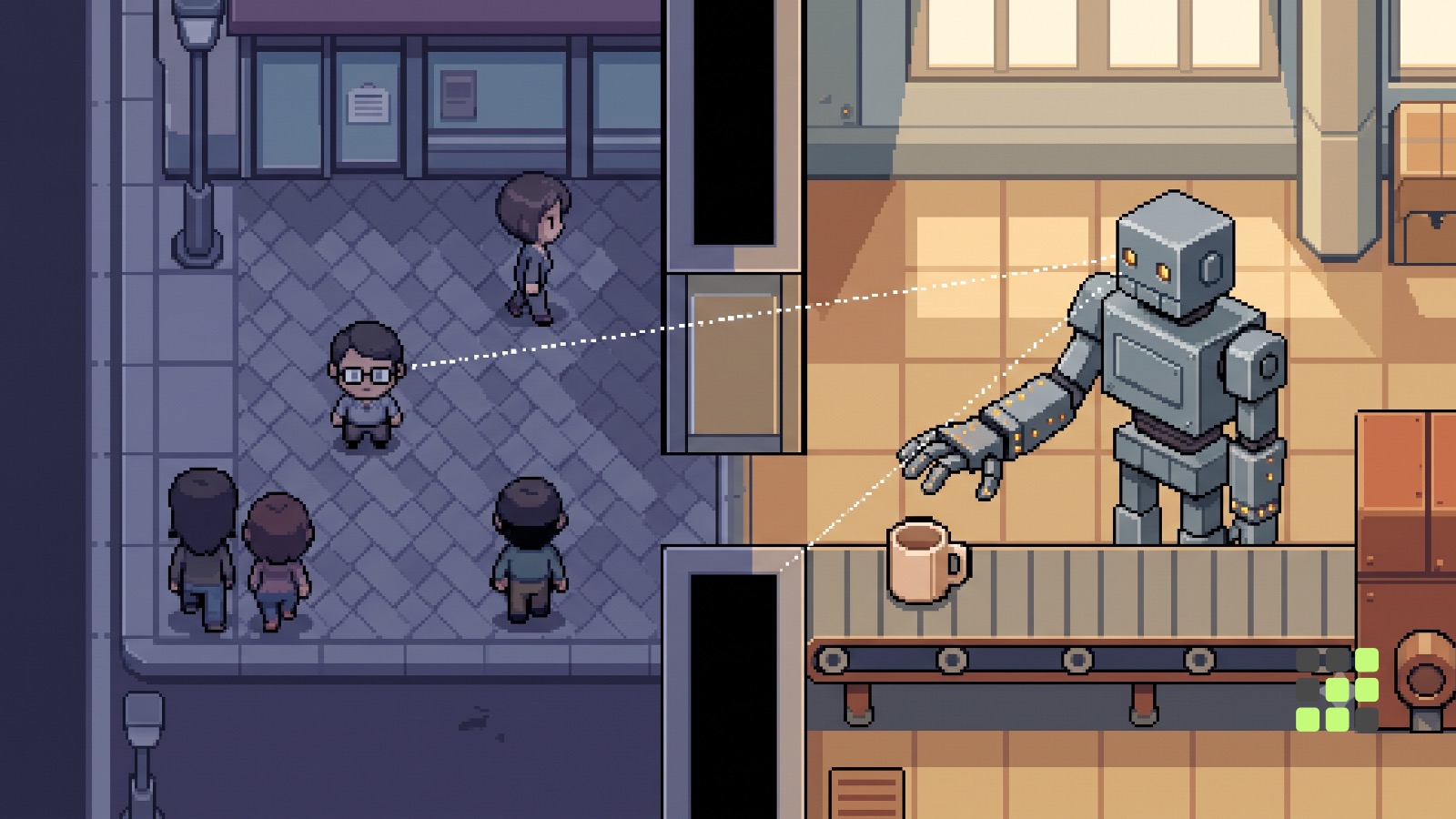
Here’s the summary. **What this entire camp is actually trying to do isn’t to learn language — it’s to learn the world, and learning the world requires continuously capturing it. Yet the camera strapped to a human face just had that exact capability revoked — by law, and by public opinion.
 How the Price of Distance Went Up
Meta’s July update didn’t come out of nowhere — it’s the result of a year’s worth of pressure.
In January 2026, the BBC reported cases across the UK of people wearing camera glasses to secretly film women. In February, the New York Times reported, citing internal Meta documents, that the company had explored a feature letting glasses-wearers identify the person in front of them. Internally, it was called “Name Tag.” That single report triggered opposition from roughly 70 civil society groups. Over the summer, courts, restaurants, and theaters in the US and UK actually began banning camera glasses. Courts in New York State and Philadelphia went so far as to ban even prescription versions of the product.
Around the same time, Europe’s data protection board was preparing a report on the social acceptability of smart glasses. The objections raised by French and German regulators go a bit deeper: it’s not about whether an indicator light is on or off, but that there’s no legal basis at all for filming a passerby who hasn’t consented.
This is where Meta’s predicament becomes visible. Two days after the company effectively elevated the indicator light to the status of a safety mechanism on July 7, the Financial Times reported that Meta was prototyping so-called “super sensing” glasses that take a photo every few seconds and continuously record audio. And word emerged that the company had no plans to turn on a recording light in that mode. The two reports look contradictory, but for the company they’re really one and the same sentence: it can’t give up constant recording, yet if it discloses that it’s recording constantly, society won’t allow it.
The market has already reacted. Even Realities, a company that makes glasses with no camera at all, raised $150 million at a $1 billion valuation. Not having a camera isn’t a flaw — it’s become a feature you can put a price on.
But glasses were an insufficient sensor to begin with
Ending the story at the consent problem tells only half of it. There’s a more fundamental gap in what glasses data can capture.
Kwangseob Ahn, CEO of Korean physical AI company RealWorld, put it this way when unveiling a robotics foundation model in May: no matter how much footage you collect, information that never made it into the pixels simply won’t show up.
What does that mean? No camera can film how hard you need to grip a cup so it doesn’t slip but also doesn’t shatter. The force at your fingertips and the torque at your joints have no weight in pixels, so they live outside the frame entirely. Even if you strap a camera to someone’s head and film the world all day long, you still won’t capture half of what a robot needs to know to handle objects.
That’s why RLDX-1, RealWorld’s model, processes force, touch, the moment of contact, and working memory in a single model alongside vision and language. The company calls this approach Dexterity-First, explaining that dexterity isn’t an add-on feature that trails behind intelligence — it’s the channel through which intelligence acts in the physical world.
So a robot body solves two problems at once: permission to film, and the range of what it can sense. Glasses can do neither. That’s the real reason intelligence shifted platforms in 2026. On one side, the cost of permission kept rising; on the other, the cost of producing data kept falling. The two curves crossed.
Why Factory Consent Was Cheap
Someone photographed on the street has no contractual relationship with the person holding the camera. That means there’s essentially no way to obtain consent, and all that’s left is public opinion and the law.
Factories are different. The subject being filmed is a place of business, and the people inside are already bound by an employment contract, industrial safety regulations, and CCTV notices. There’s no need to invent consent from scratch — you just extend the existing contract. The same gravity explains why Nvidia, Samsung, and Toyota Ventures are investors in AMI Labs, and why its first partner is a hospital. Even the purest basic research gets pulled toward wherever the data can actually be obtained.
Korea and Japan have taken this one step further. When RealWorld raised $26 million in a Seed2 round in February 2026 — bringing its cumulative total to $41 million — the company described the round as an alliance expansion with strategic investors who control industrial sites. The list of names makes that clear: SK Telecom, LG Electronics, CJ Logistics, Lotte, Kakao Investment, a Mirae Asset–Emart consortium, and, from Japan, KDDI and ANA Holdings.
These are companies that own logistics centers, hotels, and airports. This looks less like fundraising and more like a trade of equity for site access. While the U.S. gets turned away on the street, this region opened the door with contracts instead. That same month, RealWorld also joined the government’s sovereign AI foundation model ecosystem through the Upstage consortium, and it has publicly stated that its next target is a 4D+ world model.
But Korea’s factory access is getting expensive too
Here’s where this piece takes a turn. Korea isn’t a country where factory permission comes cheap. The price has already been set, and the bill has already arrived.
Hyundai Motor Group unveiled its next-generation electric Atlas at CES 2026 in January, announcing plans to deploy it at the company’s Georgia plant in the US starting in 2028 for parts sequencing, expanding to full assembly by 2030. The union’s position: not a single Atlas unit enters the shop floor without an agreement.
The 2026 wage and collective bargaining negotiations began with a first meeting on May 6 and took 111 days to reach a tentative agreement on August 25. In between, there were 60 hours of strikes, including a full-day walkout on August 21—the first in 10 years. The production line reportedly sat idle for roughly 120 hours in total. Looking at the outcome, the company won an opening for labor and management to jointly respond to the introduction of physical AI and robotics, while the union secured an extension of the retirement age and 500 new technical hires—200 in the second half of 2027 and 300 in 2028.
Here’s how I’d read these numbers: in Korea, permission to film inside a factory came with a price tag of 111 days and 60 hours of strikes. In the US, you pay in public opinion and litigation on the street; in Korea, you pay at the bargaining table inside the plant. The method differs, but nowhere is it free.
The pattern holds across the industry. The Korea Enterprises Federation surveyed 100 manufacturing firms with 500 or more employees and found that 84.0% had already adopted physical AI or planned to. Yet 61.9% believed that expanding adoption would shrink total employment, and the top obstacle cited in the adoption process was opposition from unions and workers, at 27.4%.
Permission always comes with a price
This lets you compare the numbers in this article directly — how the same permission led to different bills depending on the location and factory, and what glasses simply can't capture in the first place.
Only who sets the price differs — nowhere is it free
Pick one side. It changes who approves filming permission and how, and what was paid in return.
What happened that year
All numbers here are drawn from the article's body text. Hyundai Motor's 2026 wage negotiations took 111 days from the first meeting on May 6 to the tentative agreement on August 25, during which the strike lasted 60 hours, and the production line is reported to have actually stopped for around 120 hours. The KEF survey covered 100 manufacturing companies with 500 or more employees.
What gets captured in the same scene
Tap an item. It shows the split between what a camera on glasses can capture and what a robot body can capture.
Filled bars: info glasses also captureEmpty bars: info only the robot body captures
World Labs' Atlas takes camera position, angle, and depth maps as native input types rather than as afterthoughts. Real World's RLDX-1 processes vision and language plus force, touch, contact timing, and working memory all in one model, and the company calls this direction Dexterity-First. The seven items are taken directly from the information types mentioned in the article, and the takeaway verdict follows the article's explanation.
Oswarld’s Lens
What worries me most about this shift isn’t privacy or jobs. It’s verification.
Back when models were trained on web text, the data was open to anyone. If you doubted someone’s claims, you could run the tests yourself. Not because the benchmarks were perfect, but because at least everyone had access to the same raw material. Now that intelligence is moving inside the factory, the training data, the robot hardware, and the evaluation environment have all become private property. The path of least consent turned out to be the path of highest verification cost.
Honestly, every time I watch a domestic Physical AI company’s announcement, I find myself holding back judgment. This isn’t my technical area, so I’m not in a position to say what’s right or wrong on the engineering side. So instead I look at what I can actually check.
Take RealWorld as an example. The company announced that RLDX-1 outperformed both Nvidia’s GR00T N1.6 and Physical Intelligence’s π series across eight public benchmarks — 70.6 points on RoboCasa Kitchen, 58.7 points on GR-1 Tabletop, 10.7 percentage points above GR00T N1.6. What matters here isn’t the score, but how these numbers came to exist. RealWorld itself reproduced and measured the comparison models’ results. That’s standard practice in this field, not something worth objecting to on its own. The problem is that no independent leaderboard exists to cross-check those numbers against.
So my hesitation isn’t about distrusting this particular company. RealWorld open-sourced the weights, training code, and technical documentation for three 8.1B models on GitHub and Hugging Face, and Professor Jinwoo Shin of KAIST (Korea Advanced Institute of Science and Technology), the company’s chief scientist, led the technical sessions. There’s a clear difference between a company that ships something verifiable and one that merely makes announcements. What frightens me is the fact that clearing 70 points in a simulated kitchen and lasting a full shift at a CJ Logistics warehouse are entirely different events, and the further fact that there’s still no way to check that gap from outside the company.
This isn’t any single company’s fault — it’s a structural side effect of this transition. In fact, RealWorld itself has stepped forward to help build a dexterity-evaluation standard together with domestic simulation and robotics firms. The fact that the company building the standard is the same one that first noticed the problem tells you a lot about the situation.
So when a domestic conglomerate opens its production floor to a foundation-model company, I think there’s a question that needs to come before “how much equity do we get?” It’s whether we can independently verify the performance of a model trained on data from our own factory floor. Stacking years of automation plans on top of unverifiable results is a dangerous order of operations.
Closing
If you compress what happened in 2026 into two sentences, it’s this: the machine that wanted to keep filming the world got turned away on the street, and went into the factory instead. On the street, public opinion and the law set the price. In the factory, negotiation sets the price.
Korea is a country that’s already received this second bill. The number 111 days is the evidence — and that’s not a sign of falling behind, but of having gotten there first. Other manufacturing powerhouses will soon be sitting at the same negotiating table.
What’s still unsettled, though, is what the side that paid the price and opened its doors actually gets in return. Equity stakes and hiring commitments are the outcome of a negotiation, not a right to the data itself. And right now, only the side building the models has any way to verify how well those models, trained on that data, actually perform. I think these two blank spaces are going to be the real battleground over the next few years.
💬 When your company brings in robots or automation equipment, does the contract spell out who takes the on-site data and under what terms? I’d love to hear about real cases you’ve encountered.
📨 If someone around you is actually negotiating automation deployment on a manufacturing or logistics floor, please pass this letter along. Sections 5 and 6 are probably exactly what they need right now.
Keep the perspective, not the noise.
We choose one consequential shift and trace what sits beneath it, every other day.
Confirm once to finish subscribing.
Already a subscriber? Sign in to join the conversation


References & Further Reading
Primary sources
- World Labs, “Atlas: A World Model for Spatial Intelligence”, September 1, 2026. ··· This post includes diagrams showing the architecture that takes camera poses and depth maps as native inputs, along with the process of building robot simulations from 24 frames of phone video.
- Abner Li, “Meta & Ray-Ban glasses rolling out mandatory update that disables the camera when privacy light is broken”, 9to5Google, July 7, 2026. ··· This piece quotes Meta’s official blog post directly to lay out the scope of the update.
- Romain Dillet, “Yann LeCun’s AMI Labs raises $1.03B to build world models”, TechCrunch, March 9, 2026. ··· In this interview, CEO Alexandre Lebrun predicts that “world model” will become a buzzword — which is exactly why it’s worth separating the label from the substance.
- Chi-gyu Hwang, “RealWorld unveils robotics foundation model ‘RLDX-1’”, Digital Today, May 7, 2026. ··· Covers the design decision to make force and touch native modalities, along with remarks from CEO Junghee Ryu.
- RLWRLD, “RLDX-1 Technical Report”, arXiv, 2026. ··· The document to check if you want to verify the actual conditions behind the benchmark comparison table — it details how the baselines were reproduced.
- Moo-kyung Shin, “Hyundai Motor, on the verge of adopting AI and robotics, may be running out of time”, Sidae Ilbo, August 26, 2026. ··· Combines findings from the Korea Enterprises Federation’s survey of 100 manufacturers with details of the tentative wage agreement.
Background
- Brian Cheung, “Meta’s Ray-Ban Glasses Now Disable Their Camera If You Tamper With the Privacy LED”, Forkast, July 10, 2026. ··· Examines how the progress of California’s SB 1130 intersects with the company’s own self-regulation.
- Mike Oitzman, “RLWRLD releases RLDX-1, a dexterity-first foundation model for robot hands”, The Robot Report, May 11, 2026. ··· Breaks down the roles of the motion module and physics module in more depth than domestic Korean coverage.
Related past issues
- “Why Big Tech Wants a Camera on Your Face” (/issues/big-tech-face-cameras) ··· The prequel to this piece — today’s edition answers the question left open there.
- “China Has Efficiency, Japan Has Command, Korea Has… ₩800 Trillion (~$576B)” (/issues/china-japan-korea-800t) ··· The issue that first pointed out the empty space where intelligence should sit atop the physical layer.

📝 Glossary
각주
-
World Model: An approach in which AI builds an internal model of the structure of the world, so it can predict what happens next and plan actions accordingly. Rather than learning the statistics of language, it learns the statistics of space and time. ↩
-
JEPA (Joint Embedding Predictive Architecture): Instead of generating pixels or tokens one at a time, this architecture is trained to predict abstract representations of missing parts from observed context. Yann LeCun proposed it in 2022. ↩
Related issues
Click 'Delivery Accident,' Get a Refund Policy Instead
I compared Korea's official rider guidance against the actual law, line by line, on where injured workers should actually file a claim.
Business97% of Factories Get a Discount. Is Yours One?
The tariff overhaul took effect in April, but four variables separate the average cut from your actual bill.
BusinessWhy I Split AI Work Into Four Steps Before Choosing Tools
Naming a single AI app rarely captures how work actually moves through discovery, coordination, execution, and verification.
Business
Your take shapes the next issue
What resonated most in this issue, or where has your experience been different?