

97% of Factories Get a Discount. Is Yours One?
The tariff overhaul took effect in April, but four variables separate the average cut from your actual bill.
BusinessThe Tariffs for 514 Businesses That Applied for a Grace Period Change on October 1
Starting April 16, 2026, the time-of-use structure for industrial (eul)1 electricity tariffs changed. The 514 businesses (provisional figure) that applied, saying they needed more time to adjust their operations, will keep the old rates through September 30 and switch to the revised tariffs on October 1.
When the Ministry of Climate, Energy and Environment released the overhaul, it estimated—based on 2025 electricity consumption data—that rates would fall for about 97% of industrial (eul) companies, roughly 38,000 businesses. But the same announcement also included another number: 514 businesses, or about 1.3% of industrial (eul) customers, had applied for the grace period. By sector, food products led with 60 businesses, followed by primary metals with 55 and non-metallic minerals with 49. The government’s take was that this wasn’t concentrated in particular industries so much as it reflected each company’s own electricity consumption patterns.
If a rate cut were guaranteed, there’d be no reason to apply for extra time to prepare. In other words, a single tariff table can’t tell you which side your business falls on.
What Changed Isn’t the Rate Level—It’s the Value of Each Time Block
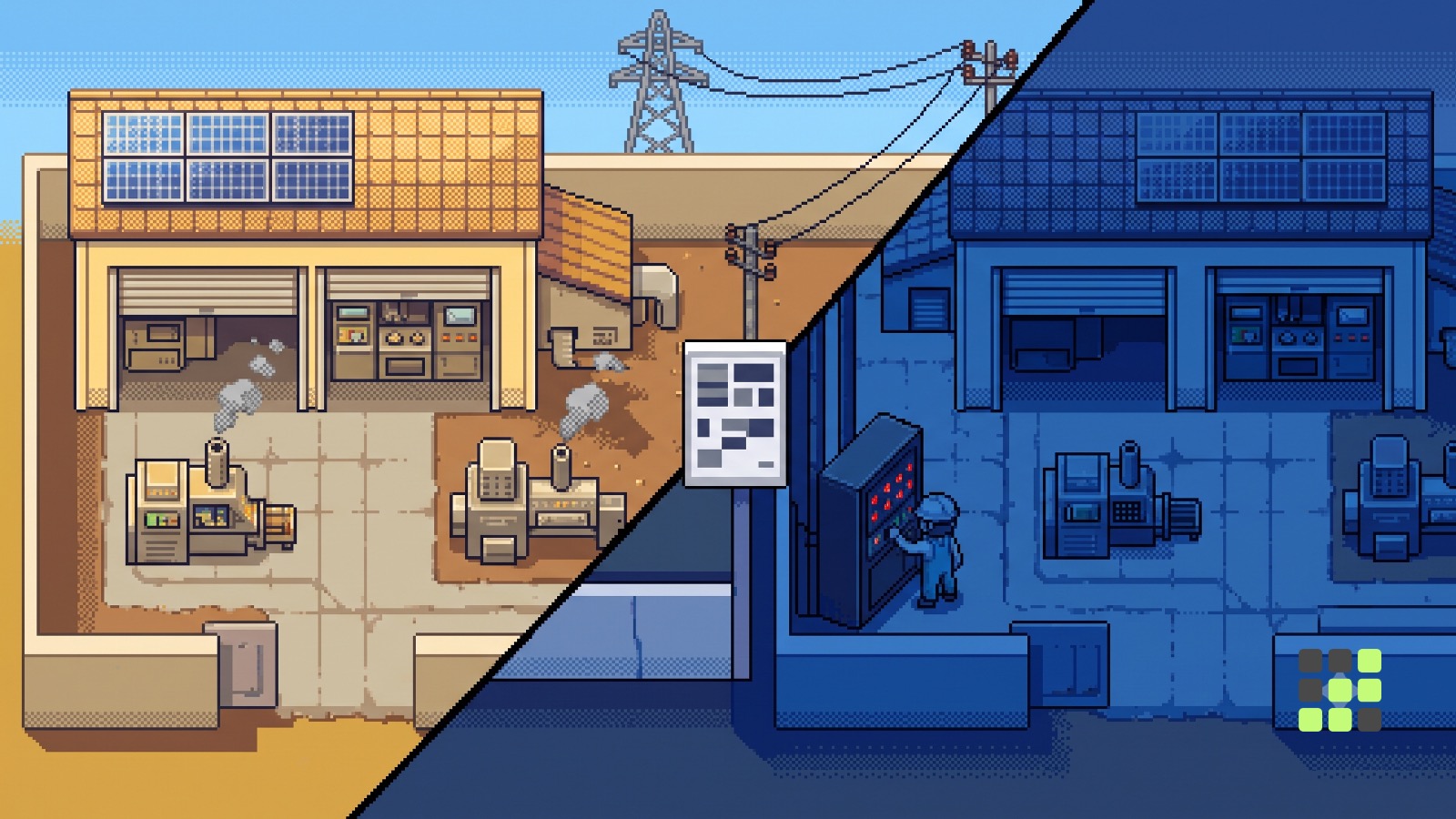
The heart of this overhaul is redrawing the time-block boundaries. The peak-load2 rate that used to apply on weekdays from 11:00 to 15:00 has been reclassified as mid-load, while the mid-load rate that used to apply in the evening from 18:00 to 21:00 has been bumped up to peak-load. Per the government’s explanation, the hours from 9:00 a.m. to 3:00 p.m. are now uniformly classified as mid-load.
Unit prices moved too. Off-peak rates rose ₩5.1 (~$0.004) per kWh, while peak rates fell ₩16.9 in summer and winter and ₩13.2 in spring and fall—an average cut of ₩15.4. On weekends and public holidays during spring (March–May) and fall (September–October), the volumetric charge gets a 50% discount from 11:00 a.m. to 2:00 p.m.
| Category | Before | After |
|---|---|---|
| Weekdays 11:00–15:00 | Peak-load | Mid-load |
| Weekdays 18:00–21:00 | Mid-load | Peak-load |
| Off-peak unit price | Baseline | +₩5.1/kWh |
| Peak-load unit price | Baseline | –₩16.9 (summer/winter), –₩13.2 (spring/fall) |
| Weekends/holidays, spring & fall, 11:00–14:00 | N/A | 50% off volumetric charge |
The rollout isn’t happening all at once, either. The first group, covered starting April 16, is industrial (eul)—which accounts for about 46% of national electricity consumption—along with EV charging power. Other categories that use seasonal, time-of-use pricing, such as industrial (gap) II, general (gap) II, general (eul), and education (eul), follow starting June 1. The government explained that small-scale users who aren’t subject to seasonal, time-of-use pricing in the first place will feel limited impact from this overhaul. The new system runs through December 31, 2030, with a built-in basis for reviewing an extension depending on how much participation there is in shifting demand.
Where the Same Rate Table Turns Into Different Bills
The government’s own announcement already contains the disparity. The average cut for industrial (B) rates is about ₩1.7 per kWh, but a business that draws power 24 hours a day, 365 days a year gets only about a ₩1.0 cut, while a company that operates only on weekday mornings from 9 a.m. to 6 p.m., with no weekend or overnight shifts, can expect a cut of ₩16–18. On the same rate table, one business gets ₩1 and another gets ₩17. What creates the gap isn’t the rate table — it’s when the electricity gets used.
There are four variables worth checking.
First, the contract type. Depending on whether the contract type listed at the top of your bill reads Industrial (B) or Industrial (A), even the timing of when the new rates take effect differs. Industrial (B) covers large-scale users billed by time-of-day rates, while Industrial (A) runs on a comparatively simple rate structure.
Second, the basic charge is set by peak demand, not by consumption. Under the basic supply terms, the “billing demand”3 is set as the highest value among the maximum demand recorded in December, January, February, July, August, and September of the preceding 12 months (including the current billing month) and the current month’s maximum demand — and if that figure comes in below 30% of the contracted capacity, 30% of the contracted capacity is applied instead. Maximum demand is calculated cumulatively in 15-minute intervals, and the figure used is whichever is larger between the mid-load and peak-load time bands. This round of reform touched the energy-usage charge; the formula that sets the basic charge is untouched. Get even 15 minutes wrong, and that number can follow you for up to a year.
Third, the optional rate plan. KEPCO offers optional rate plans in which the split between the basic charge and the energy-usage charge varies according to load factor4. Customers with a high load factor benefit more from a plan with a larger basic charge and smaller energy-usage charge. Once you choose an optional plan, you generally can’t switch for a year — but KEPCO notes that changes are allowed within that year in cases such as a change in contract type or a change in the seasonal/time-band classification. Whether this reform qualifies is worth checking with your local KEPCO office.
Fourth, the 15-minute usage curve. A monthly total tells you nothing about how much of that usage falls in the 18:00–21:00 window. You can check time-of-day metering data through KEPCO ON and Power Planner, and Power Planner also offers, as add-on features, electricity-cost consulting reports and rate-plan/load-shifting simulations for general and industrial customers.
Shift Your Operating Hours, and the Costs Shift With You
If you only look at the rates, the answer seems simple: empty out the evening peak and shift production to daytime or nighttime hours. But whichever hours you move to come with their own bill attached.
If you shift to nighttime, the off-peak unit price itself went up by ₩5.1 per kWh in this revision. On top of that, Article 56 of the Labor Standards Act requires a premium of at least 50% on ordinary wages for night work performed between 10 p.m. and 6 a.m. If you’re instead chasing the 50% weekend-daytime discount, you run into the holiday-work premium. The same article requires a 50% premium for holiday work up to 8 hours, and 100% for anything beyond 8 hours. Saturday shifts may also count as overtime, depending on how that day is classified in your company’s work rules.
If you consolidate operations into daytime hours instead, you need to watch the base charge. Moving evening production to daytime raises your maximum demand during the mid-load time band, and your contracted demand charge is set based on that peak value. Whatever you save on the energy charge can come right back to bite you on the base charge.
There’s also compensation available on the demand-increase side. The government has said that if you combine this with the Plus Demand Response program5 — which pays you for increasing consumption when there’s a power surplus — you can buy electricity at ₩31–50 per kWh, roughly 20–30% of the weekday peak rate.
So here’s the order in which you should actually check things.
| What to Check | Where | Why It Matters |
|---|---|---|
| Contract type and contracted capacity | Electricity bill, KEPCO ON (KEPCO’s online customer portal) | Determines whether you’re covered at all, and whether your effective date is April or June |
| Whether you applied for the grace period | Internal records, your local KEPCO office | If you applied, the new rates kick in from October 1 |
| Share of usage during 18:00–21:00 | Time-of-use data in Power Planner | This is the band that rose the most in this revision |
| Peak demand over the last 12 months | Contracted demand charge on your bill, Power Planner | Tells you at what point your base charge is already locked in |
| Your current rate plan | Electricity bill, your local KEPCO office | The optimal plan changes as your load pattern changes |
| Labor cost of shifting operating hours | Work rules, collective agreements, Article 56 of the Labor Standards Act | Needs to sit in the same table as your savings for a real comparison |
Oswarld’s Lens
If you read this overhaul as a rate-cut story, there’s nothing left to analyze. If the finding that 97% of businesses see lower bills is accurate, your bill shrinks whether you do anything or not. But 514 sites applied for a preparation period, and the government’s proposed reduction rates themselves range from ₩1.0 (~$0.0007) to ₩18 (~$0.013). What these numbers point to isn’t the direction of rate policy — it’s the fact that every business has a different production schedule.
Looking at the same data, I’d argue this change is less a price cut than a signal reallocation. The government has stated its intent: use solar power generated during the day, and cut back on LNG generation in the evening. The rate table shifted accordingly. So any operation that has to run its equipment in the evening drifts away from the discount, while any business with a high share of daytime operation gets the benefit just by standing still. Whether you can shift your operating hours is what now determines your rate outcome.
Closing
The time-band divisions, unit prices, and effective dates have all been fixed by the government announcement. What’s left is plugging your own facility’s usage curve into that rate table—and that data is already sitting with KEPCO.
One more thing worth adding: the spring/fall weekend discount applies in September and October. If your facility hasn’t applied for a grace period, what your weekend operations look like between 11am and 2pm right now directly affects your next bill. That said, what I’ve covered here is limited to the published rate structure and terms of service—whether it applies to your specific contract needs to be confirmed with your regional KEPCO office. This piece can’t do that calculation for your facility instead of you, Reader.
💬 Let me know in the comments whether your 18-21h operations can actually be shifted, or whether your equipment makes that impossible. 📨 Please forward this to a colleague or production manager who tracks energy costs.
Already a subscriber? Sign in to join the conversation


References & Further Reading
Primary sources
- Ministry of Climate, Energy and Environment, “Lower rates by day, higher in the evening… Seasonal and time-of-day electricity rate overhaul takes effect”, April 14, 2026. ··· The original document laying out the results of the grace-period applications, the breakdown by industry sector, and the October 1 implementation schedule.
- Korea Policy Briefing, “Industrial electricity rates cut by up to ₩16.9 (~$0.012) per kWh during daytime… 50% weekend discount for daytime use in spring and fall”, March 13, 2026. ··· A data-driven look at the size of the rate changes and the expected savings by operating pattern.
Background
- Korea Electric Power Corporation (KEPCO), “Major electricity rate schemes (load-factor-based optional pricing)”. ··· Explains the structure of optional pricing plans, restrictions on switching, and exceptions.
- Korea Electric Power Corporation (KEPCO), “Basic Supply Terms (Calculation and Payment of Charges)”. ··· The original text describing how billed demand is determined.
- Korea Electric Power Corporation (KEPCO), “KEPCO Power Planner”. ··· An app for simulating time-of-day usage, optional rate plans, and load-shifting.

📝 Glossary
Footnotes
-
Industrial (B): A contract category for industrial power applied to large-load businesses, billed according to time-of-day rates split into off-peak, mid-peak, and peak periods. Industrial (A) is a simpler scheme mainly applied to small factories. ↩
-
Off-peak, mid-peak, and peak: Blocks of time into which a day is divided based on the level of power demand. The same 1kWh costs a different per-unit energy rate depending on which block it falls into. ↩
-
Billed demand: The power figure multiplied into the base charge calculation. Because it uses the single highest maximum demand recorded during a set period — not the sum of usage — a peak hit even once keeps showing up on every subsequent bill. ↩
-
Load factor: The ratio of average power to maximum power over a given period. The more evenly electricity is used throughout the day, the higher the load factor. ↩
-
Plus Demand Response program: A scheme that compensates users for increasing consumption during periods when there is surplus power. It can be applied on top of, and separately from, rate discounts. ↩
Related issues
Why I Split AI Work Into Four Steps Before Choosing Tools
Naming a single AI app rarely captures how work actually moves through discovery, coordination, execution, and verification.
BusinessChina AI's Smile Curve Puts Models at the Bottom
What Bank of America's chart reveals—and conceals—about who captures value in Chinese artificial intelligence.
BusinessChip Companies Are Now Financing Their Customers
Broadcom's AI chip revenue jumped 221% year-over-year — but the bigger story is how buyers are funding all that hardware.
Business
Your take shapes the next issue
What resonated most in this issue, or where has your experience been different?