

Chip Companies Are Now Financing Their Customers
Broadcom's AI chip revenue jumped 221% year-over-year — but the bigger story is how buyers are funding all that hardware.
BusinessChip companies are helping their customers find the money, too
Broadcom’s fiscal Q3 earnings, released on September 2, show AI semiconductor revenue of $16.7 billion — up 221% from a year earlier and 54% from the previous quarter. That’s for the quarter that ended August 2.
Total company revenue came to $29.6 billion, with free cash flow of roughly $13.7 billion. That’s operating cash flow minus capital expenditures, and it works out to about 46% of revenue. That doesn’t mean the company can spend all of it freely, though — there are other obligations, like debt repayment, still to cover. Broadcom also runs both a fabless semiconductor business and a software business, which makes it hard to compare directly with manufacturers that operate their own fabs. Broadcom earnings release
Meanwhile, the big tech companies buying up AI infrastructure are burning through enormous amounts of cash on capital equipment. This got me thinking about something beyond the chipmakers’ revenue growth: how exactly are their customers coming up with the money to pay for all this? Nvidia and Broadcom have gone beyond simply supplying chips — they’ve started working with financial firms to help customers arrange financing for their purchases.
Cash flow forecasts and confirmed results aren’t the same thing
The BofA chart cited in the original piece compares 12-month forward free cash flow forecasts for big tech companies and semiconductor companies. The forecasts for companies buying AI infrastructure are trending down, while forecasts for the companies supplying it are trending up.
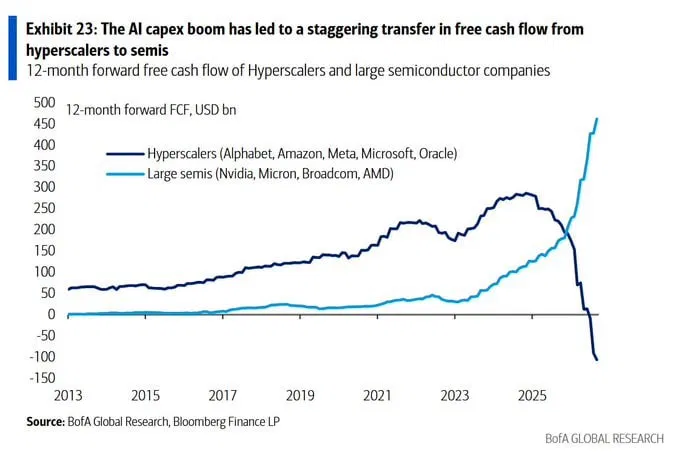
The numbers in this chart are projections of future cash generation. They differ in timeframe and nature from the quarterly results Broadcom just reported. Nor does the decline in one group’s cash flow map neatly onto the increase in the other’s — chipmakers have other customers too, and the cash left over after subtracting costs from revenue varies company by company.
Negative free cash flow doesn’t automatically mean a company is unprofitable or out of money, either. A company can generate plenty of cash from operations and still post negative free cash flow if it’s investing even more into capital equipment. To really understand a company’s financial position, you need to look at its cash on hand, the maturity of its debt, and payments it expects to receive.
What I’m curious about is where the money for continued investment will actually come from. On top of operating cash flow and existing cash reserves, how much will companies need to raise through corporate bonds, loans, and leases? And if financing conditions tighten, will customers still receive the equipment they’ve ordered on schedule?
Nvidia’s $500 Billion Is a Fundraising Target
On August 10, Nvidia announced it was pursuing an independent AI infrastructure financing platform with Apollo, BlackRock, Blackstone, Brookfield, Goldman Sachs, and KKR. The plan is to attract more than $500 billion in outside capital over an extended period. This was a memorandum-of-understanding-stage announcement, contingent on finalizing definitive agreements. Nvidia’s announcement
In remarks the following day, Jensen Huang explained that the financial firms would each underwrite customers, demand, utilization, cash flow, and residual asset value. He said Nvidia could offer up to 25% residual-value support on select projects, following case-by-case review. This does not mean Nvidia has already guaranteed $125 billion — 25% of the total target. Jensen Huang’s explanation
Residual value is the value equipment is expected to retain after a period of use. Financial firms look not just at how much they can recoup through lease payments, but also at how much they could recover by re-leasing or selling the equipment if a contract ends or a customer defaults. A supplier’s support commitment can help in this underwriting process — but in exchange, the supplier takes on part of the risk covered by that support.
Broadcom made a similar move, announcing an AI XPU platform with Apollo and Blackstone on June 9. The plan is to support more than 20GW of AI computing capacity by 2028, with the first deal sized at $35 billion. That first deal is meant to fund Anthropic’s expansion of more than 1GW of capacity. Broadcom’s announcement
Apollo has explained that this capital is structured to be drawn down over multiple years. It does not mean the full $35 billion was spent on the announcement date, nor that Broadcom is directly lending out that entire sum itself. Apollo’s deal description
You Have to Read How Far the Guarantee’s Losses Actually Go
This kind of equipment financing can involve a special purpose vehicle (SPV) — a standalone company set up specifically to hold certain assets and raise money. This company raises the funds, buys the equipment, and pays down its debt using the usage fees it collects from customers.
As long as those usage fees come in as planned, there’s no issue. But if a customer fails to hold up its end of the contract, the SPV may need to find another user for the equipment or sell off the asset. If a guarantee exists in this scenario, exactly who bears how much of the loss depends entirely on the individual contract. You shouldn’t assume this means the chip supplier will always cover the final shortfall in full.
That’s why I think you need to look at the guarantee’s specific terms, not just its total amount.
| What to check | What you want to know |
|---|---|
| What’s guaranteed | Does it guarantee against the customer’s failure to pay rent, or against a certain value of the equipment? |
| Trigger conditions | What event has to occur for the payment obligation to kick in? |
| Cap and duration | What’s the maximum amount covered, and until when? |
| Recovery method | How much of the loss can be offset by selling the equipment or signing a contract with another customer? |
Using a separate legal entity doesn’t make all liability vanish from the financial statements, either. Whether the SPV gets consolidated, and how the guarantee gets accounted for, both depend on the contract terms and the control relationship involved. If you stop at the borrowing figures alone, you can easily miss the footnotes on lease/purchase commitments or guarantees.
When a supplier finances the deal, the customer finds it easier to secure the equipment, and the supplier gets a bigger shot at winning the order. Still, you need to separately verify how much of the semiconductor industry’s recent cash flow growth is actually attributable to this kind of support. Two things happening at the same time doesn’t let you calculate how much one caused the other.
Even with demand, cash collection needs a separate check

Broadcom projected next quarter’s AI chip revenue at $21.7 billion. That’s a signal the company expects strong demand. But revenue forecasts, order contracts, and actual cash collection each need to be verified separately. Even if a customer needs the chip, delays in power or data center readiness can shift the timing of both operation and cash inflow.
Nvidia explains that its equipment can be used across multiple customers and workloads, and that software improvements extend usable lifespans. This is the logic behind the company’s willingness to offer financing. When I look at that explanation, I want to also check whether there will be enough customers to lease the existing equipment once new chips arrive.
If a new product erodes the economics of its predecessor faster than expected, forecasts for resale value and lease rates could fall. In contracts backed by residual value guarantees, that shift could translate into a guarantee burden. But the risk doesn’t hinge on chip value alone. Customer revenue, utilization rates, power supply schedules, and interest costs all factor into cash collection as well.
Oswarld’s Lens
For Korean companies like Samsung Electronics and SK Hynix that supply memory chips for AI infrastructure, their customers’ financing conditions matter too. The party they transact with directly may differ from the end user, but if infrastructure investment funding gets stuck, order schedules can be affected as well. That’s a reason to look at financing terms alongside inventory, utilization rates, and capex plans.
Since seeing this graph, I’ve started reading order backlogs and equipment usage periods differently.
With order backlogs, I’ve become curious not just about the size of orders but also about how customers raise the money to pay for them—how much comes from operating cash flow, how much from shareholder capital, and how much from loans and leases. The presence of outside financing doesn’t mean an order is unsound. But you do need to know whether the financing is confirmed, and whether it carries drawdown or cancellation conditions.
The same goes for equipment usage periods. How many years an asset is depreciated over in the accounts and how many years it can actually generate revenue in use aren’t necessarily the same thing. The book value remaining on the balance sheet doesn’t guarantee what the asset would fetch on the secondhand market, either. To assess collateral value, you need to weigh the contract term, expected lease payments, and the resale market together.
The involvement of financial firms is also an opportunity. If customers can secure the funding they need, suppliers may find it easier to commit to long-term contracts and production plans. How long that effect lasts, though, can only be judged by looking at both the counterparty’s business performance and its financing terms together.
I don’t think the mere existence of this kind of financing support makes AI investment a bubble. But I do think we need to keep checking, as suppliers’ revenues climb, who is funding the customers’ purchases—and who bears the loss if an order falls through.
💬 Reader, when your company adopted new equipment or AI services, did you choose to buy outright or lease? Beyond cost, were there any contract terms you paid particular attention to? Let me know in the comments.
Already a subscriber? Sign in to join the conversation


📎 References & Further Reading
- Broadcom Q3 Fiscal Year 2026 Earnings, September 2, 2026.
- Nvidia’s AI Infrastructure Financing Platform Announcement, August 10, 2026.
- Jensen Huang’s Explanation of the Financing Structure and Residual Value Backstop, August 11, 2026.
- Broadcom, Apollo, and Blackstone’s AI XPV Announcement, June 9, 2026.
- Apollo’s Explanation of Its First $35 Billion Deal, June 9, 2026.
Related Past Issues
- The Chips Agents Need to Think and Act (Issue 217)
- Where Did the Railway King’s Dividends Really Come From (Issue 192)

Related issues
KB Kookmin's AI Resolved 41.3% of Calls, Staff Workload Rose
A higher AI resolution rate didn't cut one banker's call volume—it left her handling more calls, packed with harder cases.
BusinessAI Covers Take a Singer's Voice, Not Their Copyright
Korean copyright law protects only the composition behind an AI cover song—not the borrowed vocal identity.
BusinessWhy AI Agents Are Logging into BBS Boards via SSH
A look at modern BBSs serving humans via web and agents via SSH or MCP, and what reusing existing interfaces means for deployment costs.
Business
Your take shapes the next issue
What resonated most in this issue, or where has your experience been different?