

AI Covers Take a Singer's Voice, Not Their Copyright
Korean copyright law protects only the composition behind an AI cover song—not the borrowed vocal identity.
BusinessAn Idol’s New Single Is Making the Rounds in a Veteran Singer’s Voice
Lately, YouTube has been full of AI cover songs where a veteran singer with decades of experience “performs” the new single of an idol group that just debuted this year. Listeners find it entertaining, and the view counts back that up. But packed into that one track are at least three separate rights holders, and the weapon each of them holds is a completely different caliber.
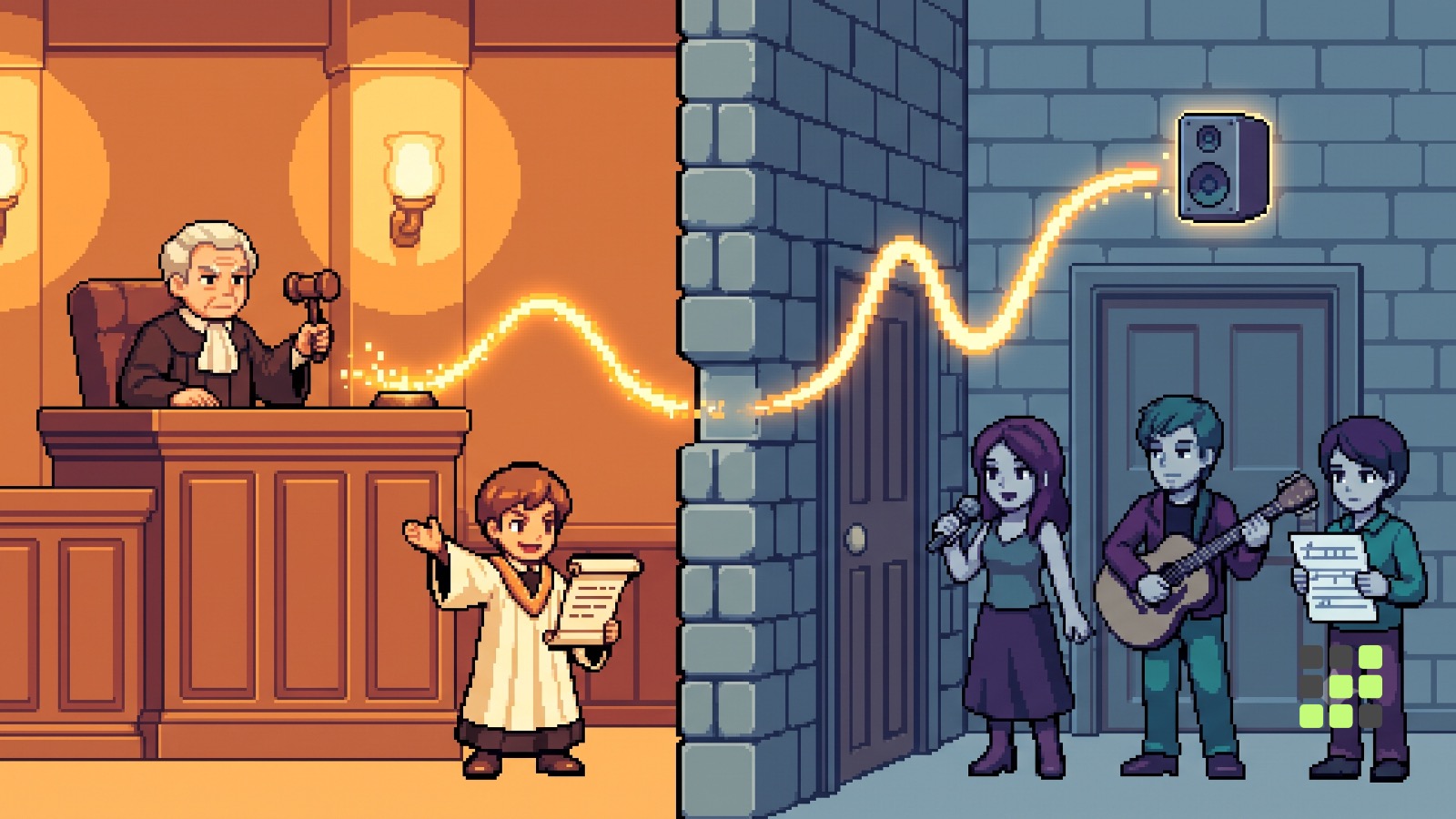
On July 31, 2026, the Munich Regional Court in Germany ruled in favor of GEMA, Germany’s music copyright collecting society. The defendant was Suno, the AI music generation service. Domestic coverage in Korea mostly summed it up as “now even AI has to pay for its training data.” That’s directionally correct, but if you try to lay that ruling on top of Korea’s own statute book, the same lawsuit simply doesn’t hold together. I went through the relevant provisions clause by clause to see exactly what stands in the way.
What the Munich court banned—and what it never touched
GEMA sued over six specific songs it manages—familiar tracks like Boney M.’s “Rasputin.” The court granted most of the claims and banned four kinds of conduct: training-related reproduction carried out in the US, reproduction inside Germany arising from the model’s retention of the songs in memory, communication to the public through offering the model as a service, and reproduction and communication to the public through the generated outputs. The court also ordered disclosure of revenue and recognized liability for damages, though the amount has yet to be determined.
That’s what got reported. But read the commentary on the ruling closely and something more important emerges. The only right at issue in this case was the musical composition—one single category of musical work. Lyrics were excluded from the claims, and the rights of performers and phonogram producers weren’t even asserted. Only the rights managed by the collecting society1 made it into court.
And this is just the first-instance ruling. Suno has said it will consider every option, including an appeal. GEMA’s November 2025 ruling against OpenAI is likewise now on appeal. None of this is settled law yet.
It Was the Trust Organization, Not the Output, That Opened Jurisdiction
The most striking part of this ruling is that the Munich court pulled even the learning activity that took place in the US into its own jurisdiction. On top of that, it applied US copyright law directly—not German law—to reject the fair use defense.
So what opened the door to that jurisdiction? German law firms’ commentary all points to the same spot. The court’s basis was a venue provision available specifically to trust organizations, and this route isn’t open to other rights holders. If an individual artist or a label had filed the same suit, it’s quite likely they wouldn’t have been able to reach the US-based learning activity at all.
So the summary “if there’s a user in the EU, any AI company is on the hook” is only half right. More precisely, this is a door that opens only when that country’s trust organization can take the plaintiff’s seat. Once this distinction crosses over to Korea, it makes a decisive difference.
Korean Law Doesn’t Have That Key
Article 39 of Korea’s Private International Act gives you the answer immediately.
Article 39 (Special Jurisdiction over Actions Concerning Infringement of Intellectual Property Rights) (1) An action concerning infringement of intellectual property rights may be brought before a Korean court in any of the following cases. Provided, that in this case it is limited to results occurring in the Republic of Korea.
- Where the infringing act was committed in the Republic of Korea
- Where the result of the infringement occurred in the Republic of Korea
- Where the infringing act was directed toward the Republic of Korea
If Suno’s output reaches a Korean user, you could file suit under item 2 or item 3. The problem is the proviso. It nails the result down to inside Korea. Training-related copying that happened in the United States isn’t a result that occurred in Korea.
There is one exception. Paragraph 3 of the same article lets a suit cover results occurring abroad if the principal infringing act took place in Korea. But training that happened on an overseas server is unlikely to qualify. And Article 40 provides that protection of intellectual property rights follows the law of the place of infringement. Picture a Korean court applying U.S. copyright law directly to rule on fair use, the way the Munich court did — that picture never even gets off the ground at the training stage, because Article 39’s proviso confines the result to domestic territory.
Above all, Korea has no provision equivalent to the jurisdictional rule that Germany wrote. It’s the same story even if the Korea Music Copyright Association (KOMCA) takes the plaintiff’s seat. KOMCA has already announced a policy requiring prior written permission before its managed musical works can be used for AI training. The policy exists, but there’s no litigation route to push that policy beyond the border.
What about training that takes place inside Korea? Korean copyright law has no dedicated safe-harbor clause for text and data mining2. All there is is the general provision of Article 35-5, fair use. It weighs four factors case by case — the purpose and character of the use, the type and purpose of the work, the proportion of the portion used, and the effect on the market — which makes outcomes hard to predict in advance.
Exclusive: AI-made song cracks Melon’s TOP100… ‘Forest of the Mind’ lands at No. 100A track produced using generative AI has entered the TOP100, the main chart of Melon, Korea’s largest music streaming platform. According to industry sources today (the 7th), artist Joseon Hiphop’s ‘Forest of the Mind’ ranked No. 100 on Melon’s TOP100. As of the previous day, the 6th, the song on MelonOne Song, Three Ways the Rights Split
So what you can actually go after in Korea is the output that reaches domestic ears — the AI cover song being the prime example. But this is where the second mismatch shows up.
| What was used | Rights holder | Legal basis | Enforceability |
|---|---|---|---|
| Original lyrics/composition | The song’s copyright holder | Reproduction and transmission rights under copyright law, managed by a trust organization | Strongest |
| The original recording, if used as source material | The record producer | Neighboring rights | Depends on proving how it was used |
| The mimicked singer’s voice | The singer themselves | Performer’s rights don’t apply | Only through the Unfair Competition Prevention Act |
Why performer’s rights don’t apply is spelled out plainly in the definition clause. Article 2, Item 4 of the Copyright Act defines a “performer” as “a person who performs.” AI-synthesized singing isn’t a performance by that singer. Nor is it a reproduction of that singer’s existing performance. It’s a case of learning the characteristics of a voice and having it sing a different song — which sidesteps the very thing performer-protection provisions were built to target.
What’s left, then, is Article 2, Item 1, Subitem (ta) of the Unfair Competition Prevention and Trade Secret Protection Act.
(ta) The act of infringing another person’s economic interests by using, without authorization and for one’s own business purposes, in a manner contrary to fair trade practices or competitive order, a name, portrait, voice, signature, or other identifying mark of another person that is widely recognized domestically and holds economic value.
It’s a relief that “voice” is explicitly named. But two conditions come attached: the voice must be widely recognized, and the use must be for one’s own business. Because of the first condition, an unknown session musician or a rookie singer’s voice is hard to protect under this provision. Because of the second, a non-commercial cover uploaded just for fun can also slip outside its reach.
The person who wrote the original song has a powerful weapon in the trust organization. The person whose voice was stolen can only pick up a weapon if they’re already famous. It’s a structure where fame itself becomes the precondition for having rights.
On October 29th, the Trust Organization Law Changes — But AI Isn’t in It
Here’s where the timing overlaps. The amendment to neighboring rights3 and copyright law, promulgated on April 28, 2026, takes effect on October 29, 2026. And the content isn’t minor.
- A new Article 105-2 introduces a maximum 5-year validity period for trust management licenses, along with re-licensing reviews
- A new Article 105-4 grants members the right to directly authorize non-commercial use, voting rights at general meetings, and the power to decide executive compensation
- A new Article 106-4 makes conflict-of-interest prevention and disclosure mandatory for executives
- A new Article 108-3 empowers the Minister of Culture, Sports and Tourism to demand reductions in fee rates
But the quietest change is also the one that travels furthest — it’s in the definitions clause. Article 2, Item 26 changes the scope of trust management from “that right” to “all or part of that right.” This means rights no longer have to be entrusted as a whole package; they can be split up. You could carve out just the rights related to AI training use and entrust those separately, or conversely, design a structure where you hold onto them yourself. This changes the very unit of negotiation.
Germany’s side isn’t fully ready either. GEMA released a fully-licensed music dataset called PLAI on July 23, 2026 — just 8 days before the ruling. It contains roughly 178,000 recordings and 57,000 songs, and its first customer was a sheet-music conversion technology company. But GEMA itself drew a clear line: this dataset is meant as a tool to assist creators, not to train generative models that compete with the original songs it was trained on. Right after launch, critics in Germany’s music-tech industry pointed out that this dataset couldn’t be used to train a model capable of producing finished songs. The lawsuit settled the question that “unauthorized use is illegal” — but the very product a company like the defendant could actually buy still doesn’t exist on the market.
Oswarld’s Lens
When I first saw this ruling, here’s what I thought: training data licensing and usage settlement structures would become the default for the music industry going forward. But Warner and Universal had already moved to settlements and licenses in the second half of 2025. Stage two of the lawsuit-to-settlement cycle we covered in Issue 27 had already wrapped up last year, and I’d already covered the settlement structure once before, in Issue 199, on the training royalties for my own book. Standing on the same ground again, I didn’t think I had anything new to offer.
So I opened up the actual statute — and that’s where my judgment changed. What happened in Germany wasn’t a new legal doctrine about AI training. It was a difference in an existing procedural rule about who gets to sue in the first place. And Korea doesn’t have that rule.
What bothers me most is the part where fame becomes a precondition for having rights. A singer whose voice is widely recognized has some room to fight back under unfair competition law; an unknown performer or singer, subjected to the exact same treatment, has no weapon to reach for. The reason AI cover-song creators pick famous voices is that they’re worth listening to — but the standard the law protects happens to be the very same fame. Who gets protected and who’s easy to exploit are being decided by the same yardstick.
Let me be clear about the limits here, too. The Munich ruling is a first-instance decision, and an appeal is still pending. My reading of Article 39 of the Private International Law Act is just that — a reading of the statute — and I haven’t yet found a confirmed case showing how Korean courts have applied this provision in an AI-training dispute. If an actual dispute arises, courts may well interpret “the principal infringing act” under paragraph 3 more broadly than I have here.
Closing
What we should learn from the German ruling isn’t that AI has to pay for licenses. That was already settled last year. What we should learn is who got to bring the lawsuit in the first place. There was a strong collecting society, and there was a jurisdictional rule that only opened the courthouse door to that kind of organization.
Korea has no such combination. Only outputs that reach domestic audiences can be contested, and among the voices that get hurt most by that output, only famous people are protected. On October 29th, the law governing collecting societies changes significantly, but AI isn’t the target of that revision. Still, the change that lets rights be split up and entrusted separately is a tool that could actually get used later, when someone tries to negotiate AI training rights on their own.
Two groups need to rethink their position right now. If you run an AI music or voice service, the risk piles up first on the output that reaches domestic audiences, not on the training data. If you manage rights, you’re better off deciding what to hand over and what to hold onto before the October revision takes effect.
💬 Reader, when you listen to an AI cover song, which side bothers you first — the person who wrote the original, or the person whose voice got mimicked?
📨 If you know someone building AI music or voice services, or someone managing music rights, send them this piece. There are things to settle before October 29th.
Keep the perspective, not the noise.
We choose one consequential shift and trace what sits beneath it, every other day.
Confirm once to finish subscribing.
Already a subscriber? Sign in to join the conversation


References & Further Reading
Primary sources
- Korea Legislation Research Institute, National Law Information Center, “Private International Act, Article 39”. This is where you’ll find the proviso limiting international jurisdiction and remedies for IP infringement suits to domestic scope.
- National Law Information Center, “Copyright Act, Articles 2 and 35-5”. You can read the definition of a performer and the general fair-use clause directly here.
- National Law Information Center, “Unfair Competition Prevention and Trade Secret Protection Act, Article 2”. This lets you check the requirements under item (Ta), which protects voice.
- National Law Information Center, “Partial Amendment to the Copyright Act (promulgated April 28, 2026; effective October 29, 2026)”. You can view the old-versus-new comparison of the reforms to the collective management business here.
Background
- JUVE Patent, “Munich court rules in favour of GEMA in AI copyright case against Suno”, August 2026. Lays out the issues at stake in the ruling and prospects for appeal from a practitioner’s perspective.
- Music Week, “GEMA launches PLAI licensed music dataset for AI”, July 2026. Covers the scale and scope of the dataset.
Related past issues
- How is Hollywood embracing artificial intelligence?
- My book sold for royalties.
- AI swallowed our content, and we got zero clicks

📝 Glossary
Footnotes
-
Copyright collective management business (jeojakgwon sintak gwallieop): A business that receives copyrights or neighboring rights in trust from rights holders, manages them on an ongoing basis, and collects and distributes usage fees. Korea’s KOMCA (Korea Music Copyright Association) and Germany’s GEMA fall into this category. ↩
-
Text and Data Mining (TDM): The mechanical analysis of large volumes of text or data to extract patterns or information. AI model training is a leading example, and some countries carve out a separate copyright exemption for this activity. ↩
-
Neighboring rights (jeojak-injeopgwon): Rights granted not to the creator of a work but to those who contribute to conveying it — performers, phonogram producers, and broadcasters. ↩
Related issues
Why AI Agents Are Logging into BBS Boards via SSH
A look at modern BBSs serving humans via web and agents via SSH or MCP, and what reusing existing interfaces means for deployment costs.
BusinessMeta's Muse Ships With a Built-In Watchdog Agent
What Meta shipped is a control structure—the computer even Meta can't see into is still due later this year.
BusinessMore Sign-Offs Don't Mean More Actual Review
When AI output multiplies, someone still has to read it—so approval counts, review time, and execution risk all need sizing up front.
Business
Your take shapes the next issue
What resonated most in this issue, or where has your experience been different?