

Does a Doctor Next Door Shape a Child's Career?
Linked 1910 and 1940 US census records suggest neighbors' jobs matter—but the '41% higher' finding needs careful reading.
BusinessIs There a Link Between Childhood Neighbors and Later Careers?
Wanting to raise a child in a good environment bundles together several different hopes. We want good schools, and we want children to encounter adults doing all kinds of work. The study I’m covering today zeroes in on one piece of that: the jobs of the people living next door.
A 2025 study by Michael Andrews, Ryan Hill, Joseph Price, and Riley Wilson linked US census records to compare the childhood and adult occupations of more than 6,000,000 boys and 4,000,000 girls. The researchers didn’t track anyone for 30 years in real time — instead, they matched the same individuals across the 1910 and 1940 census records. August 2025 research manuscript
What ‘41% Higher’ Actually Means
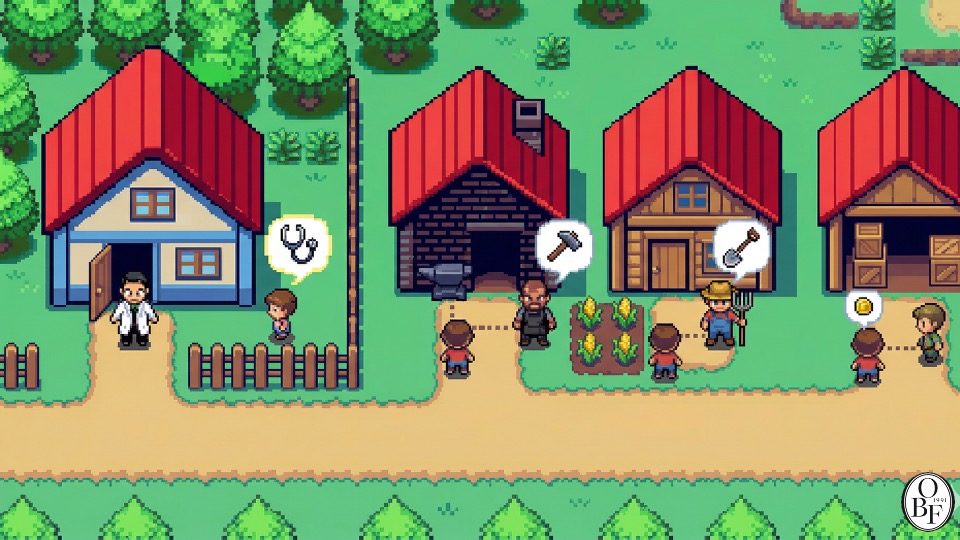
In the study’s analysis of doctors, a boy who lived next door to a doctor was about 41% more likely to become a doctor himself than a boy who lived farther away on the same census page. researchers’ March 2025 manuscript
That doesn’t mean 41% of these children became doctors, nor that the probability rose by 41 percentage points. If the baseline probability were, say, 1%, a relative increase of 41% would put it at 1.41%. This is just an illustration of how relative increases work — it’s not the study’s actual baseline rate.
The researchers inferred adjacency from the order in which census enumerators visited households at the time. The main comparison was between children living next door versus farther away on the same page of records. Since proximity is inferred from records rather than observed directly, it doesn’t perfectly identify every household’s actual next-door neighbor. the study’s method for identifying neighbors
This narrows the comparison considerably compared to simply contrasting wealthy and poor neighborhoods wholesale. Still, this isn’t an experiment where researchers randomly assigned neighbors. We need to think carefully about which differences get controlled for when comparing households that live close together, and which ones remain.
The Study Also Looked at the Likelihood of Actual Contact
Across occupations more broadly, the researchers found that living next to an adult in a given profession raised the odds of ending up in that same profession. The effect was larger in settings where neighbors would likely share common ground or interact more. When a neighbor died early, the effect shrank and lost statistical significance. These patterns support the interpretation that the opportunity for contact with a neighbor matters. the analysis summary in the August 2025 manuscript
There’s a distinction to keep in mind here too. What the records tell us is who lived where and what job they held — not what the neighbor actually said to the child, or how often they met. The child may have picked up career information, or simply developed an interest from watching someone do that job. We should read the findings and the hypotheses that explain them as separate things.
It’s interesting to read this alongside modern research on social ties. Raj Chetty’s research team reported in a 2022 study a strong link between cross-class friendships and economic mobility. Simply having people from different backgrounds in the same place didn’t automatically produce real friendships. Harvard’s write-up of the study
That study and the 1910-neighbor study differ in both era and data. We can’t merge them into a single experiment, but reading them together is worthwhile because it makes clear the distinction between address and actual relationship.
Why Use Old Records, and the Limits of Interpretation
Looking at a study like this, you might wonder: why use records from 100 years ago? Old census data has the advantage of linking names, households, and occupations, making it possible to compare across a long span of time.
US census personal records become public after 72 years. The 1940 data isn’t the most recent release — the 1950 records were released in 2022. Don’t confuse the scope of the linked data this study uses with America’s disclosure system itself. US National Archives and Records Administration
That said, it’s hard to treat the job opportunities, education systems, and neighborhood dynamics of that era as equivalent to today’s. In particular, the range of occupations open to men and women was different back then. There’s no basis for applying figures drawn from these old records directly to apartment complexes or school districts in Korea today.
Oswarld’s Lens
I’ll admit, the age of the data bothered me at first too. But reading further, what struck me was that it’s precisely because these records survive that we can break comparisons down to the level of next-door neighbors. It reminded me, once again, how important it is in data analysis to understand how the records were actually made.
What I find myself focusing on is the adults a child actually encounters. Just saying “environment matters” leaves it vague what exactly we should be looking at. A school’s educational conditions, the people a child meets around the neighborhood, and the conversations they have with them are all different factors.
It’s worth bringing this into Korea’s ongoing debates over hakgunji, prestigious school districts. What if an apartment complex is full of professionals, but they all live as strangers to one another? Conversely, what if a child lives elsewhere but has an adult in their life they talk with regularly? This paper doesn’t compare those two Korean scenarios directly, but that’s exactly the kind of difference I’d like to understand better.
The way the researchers used enumeration order and neighbor deaths to strengthen their analysis was impressive. Still, I don’t want to reduce a child’s future to a single neighbor in a particular profession. What I take from this study is that choosing a good address matters, but so does paying attention to who a child actually forms relationships with, and what kind.
Keep the perspective, not the noise.
We choose one consequential shift and trace what sits beneath it, every other day.
Confirm once to finish subscribing.
Already a subscriber? Sign in to join the conversation


References
- Andrews, Hill, Price, and Wilson, “Like A Good Neighbor,” August 2025 manuscript
- The same study’s March 2025 manuscript: analysis of doctors and data construction
- Harvard Gazette, introducing Chetty’s team’s research on cross-class ties and economic mobility, 2022.08.03
- US National Archives and Records Administration, on census record disclosure scope

Kwangseob Ahn is a professor of business administration at Sejong University and lead consultant at INLEVEL9. He teaches statistics and data analysis courses — including business data management and business analytics — at the university, while in the field he leads go-to-market and AI strategy consulting, designing the intersection of technology and business. He has published an academic paper on HEMA, a memory architecture for AI conversation systems, and runs Daily Arxiv, a project that curates global AI papers daily. He completed a master’s program at Korea University’s Graduate School of Technology Management and holds a KMBA from the same institution. He is the author of 《People Who Outsource Their Thinking: Homo Brainless》.

Related issues
AI Made Tasks Faster. So Why Am I Still Working Late?
AI can save time on one task while quietly adding new work elsewhere—here's what the Jevons paradox and recent studies suggest you track.
BusinessKnowing Jensen Huang's Habits Won't Make You Jensen Huang
Judging founders and building GTM strategy: same effort, different results—learning a success story isn't the same as living it.
SocietyAI Skills Aren't Enough Without Good Taste
People keep asking me what to do in the AI era, and I keep coming back to judgment, not just tool skills.
Society
Your take shapes the next issue
What resonated most in this issue, or where has your experience been different?