

541,000 EV Chargers Later, Drivers Still Ask: Does It Work?
Korea counts chargers by the unit; drivers judge infrastructure by whether one plug actually works and what it costs per kWh.
BusinessChargers multiplied 15-fold in five years. Drivers are still asking the same question.
As of August this year, South Korea has 541,567 EV chargers installed. That’s up from 469,045 at the end of last year—a jump of more than 70,000—and roughly 15 times the 34,714 chargers counted back in 2020.1 Electric vehicles, meanwhile, numbered 1,095,218 as of late June, making up 4.1% of all registered vehicles.1
Almost every number used to describe EV charging infrastructure comes in this same unit: how many chargers were subsidized, how many got installed, how many chargers per vehicle. But the driver standing in front of a charger isn’t asking in that unit at all. They want to know if this particular charger works right now, and what it’ll cost per kWh when they tap their card. For drivers, infrastructure isn’t an aggregate—it’s one charging session at a time.
This piece looks at the gap between those two units of measurement. Government policy clearly shifted direction this year. Whether that shift actually reached the single charging session, though, is a separate question worth checking.
Policy’s Report Card Has Already Started to Change
The criticism that “the government only looks at the number of units installed” is only half right, as of this year. On January 22, the Ministry of Climate, Energy and Environment announced its 2026 charging infrastructure program, saying it would spend ₩545.7 billion (~$393 million) to support 4,450 fast chargers, 2,000 medium-speed chargers, and 65,000 slow chargers (50,000 new, 15,000 replacements).2 So far, this is the familiar “unit count” plan.
But the center of gravity of the same announcement lay elsewhere. The policy official in charge explained that this year’s guidelines went a step beyond simply increasing the number of installations, focusing instead on the quality and reliability that users actually experience.2 Fast chargers are now evaluated on vehicle-to-charger communication, output, energy efficiency, and connector durability; slow chargers are evaluated on standby power consumption, operating rate, connector durability, and wait time — and any charger falling short of the minimum standard is excluded from subsidies. If the power module, a core component of fast chargers, fails to meet the standard, the subsidy is cut by 20%.2 The operator evaluation, which used to look only at service operators, was also changed to include manufacturers.
In April, the scope expanded to pricing and information. The Ministry of Climate, Energy and Environment pre-announced an administrative reform breaking down public charging rates by output level, and alongside it, pre-announced a revision to the subordinate legislation of the Clean Air Conservation Act requiring charging operators to disclose rates, detailed locations, and real-time availability on the integrated eco-friendly vehicle portal.3 On-site rate postings and rate signage at highway rest stops are also part of this plan.3
So it’s hard to say the policy is oblivious to drivers’ frustrations. The question comes after that: in what units are the quality standards and disclosure obligations actually designed?
The Price of a Single Charge Hinges on Three Variables
There’s really only one number a driver wants to know while standing at a charger: how much this particular charge will cost per kWh. That number, though, is actually set by at least three interlocking factors—who operates the charger, what you use to authenticate, and how powerful the charger is.
Let’s start with authentication. The Korea Consumer Agency surveyed the top 20 operators by number of installed chargers and published its findings last December. For Level 2 (slow) charging, the average member rate was ₩293.3 (~$0.21) per kWh, the roaming rate—paid with another operator’s membership card—was ₩397.9, and the non-member rate, paid without signing up at all, was ₩446.4 At some operators, the non-member rate was double the member rate, and roaming rates themselves varied by as much as 69.2% across operators, ranging from ₩286.7 to ₩485.4 Charging 40kWh at these average rates comes to ₩11,732 (~$8.4) for members versus ₩17,840 (~$12.9) for non-members. That’s the same electricity from the same operator—yet which card you pull out can change the bill by more than ₩6,000 (~$4.3). (For what it’s worth, my first car ran on gasoline, but every car since has been electric. I’ve been very happy with the switch.)
You might ask why drivers don’t simply sign up with every operator. But even the Consumer Agency acknowledged that enrolling individually with some 100 different operators is impractical. Its advice: sign up for member rates at chargers you use often, and rely on the Ministry of Climate Energy and Environment’s (Korea’s climate ministry) universal membership card everywhere else—a combination it called both convenient and cost-effective. It also flagged a catch worth watching: some operators’ member rates actually run higher than what the ministry’s card would charge.4 In the end, the burden falls on the driver to carry around a mental spreadsheet of rates by operator.
Then power output enters the equation. Starting August 1, the rate structure for Ministry of Climate Energy and Environment–operated public chargers—and private chargers under partnership agreements, when paid with the ministry’s card—shifted from two tiers to five. Under 30kW costs ₩295.0; 30–50kW, ₩307.2; 50–100kW, ₩325.6; 100–200kW, ₩348.4; and 200kW and above, ₩393.1.5 Slow charging dropped by ₩29.4 per kWh, while ultra-fast charging rose by ₩45.9.5 This is a reasonable adjustment in that it ties rates more precisely to each charger’s actual operating cost. But it also adds one more variable drivers need to check before paying: now you have to know which power bracket your charger falls into just to estimate the bill. Note that the Consumer Agency’s survey predates this overhaul, so the ministry’s current card rates differ from the figures cited above.
Finding the rate information itself isn’t straightforward either. In the Consumer Agency’s survey, 11 of 19 slow-charging operators and 4 of 17 fast-charging operators displayed no pricing at all at the charging site. Among 19 operators running apps, 5 required users to register an account before they could even see the rates.4 The same survey found that among 101 charging-related complaints over the past two years (July 2023–June 2025), 64 cases (63.4%)—the largest share by far—involved rates or payment issues.4 A sample of 101 is too small to represent every driver’s experience. Still, it shows where the frustration concentrates: not the number of chargers available, but the moment of actually paying for one.
Even failures add up, one charge at a time
After price comes the question of charging. When Consumer Insight analyzed responses from 1,809 EV owners between August and September 2025, owners charged their vehicles an average of 9 times a month — 7 times on slow chargers and 2 times on fast chargers.6 73% said that out of every ten fast-charging attempts this year, at least one failed. The most common reason fast charging felt inconvenient was charger malfunction or error (22%), followed by high charging fees (20%) and charger shortages (18%).6
When the Korea Environment Corporation surveyed 1,000 EV users from late 2023 to early 2024, the top charging complaint was a shortage of charging facilities (38.6%), while cost ranked far lower at 8.7%.7 The two surveys differ in questions and samples, so the numbers can’t be compared directly. Still, Consumer Insight itself noted that complaints about infrastructure shortages — the dominant gripe in the market’s early days — had slipped to third place, while complaints about problems that maintenance could have fixed were rising.6 As the number of chargers grows, the more pressing question is shifting from “where is one?” to “does it work, and how much does it cost?”
This is where the unit problem resurfaces. The minimum performance standard for slow chargers includes a metric called “charger operation rate.”2 That rate is measured per charger. But the failures drivers actually experience are broader than that. A charger can be powered on and still fail to read a card, stall out during payment, or deliver less power than expected. The time a charger was switched on and the number of times a charge actually completed are two different numbers.
Oswarld’s Lens
This year’s reorganization by the Ministry of Environment (which oversees climate policy) points in the right direction. A program that once just counted installed units now carries quality standards, pricing tiers have been aligned with actual costs, and operators must disclose rates and real-time availability. What’s left is to shift what gets counted by one more notch — from the charger as the unit of measure to the charging session itself.
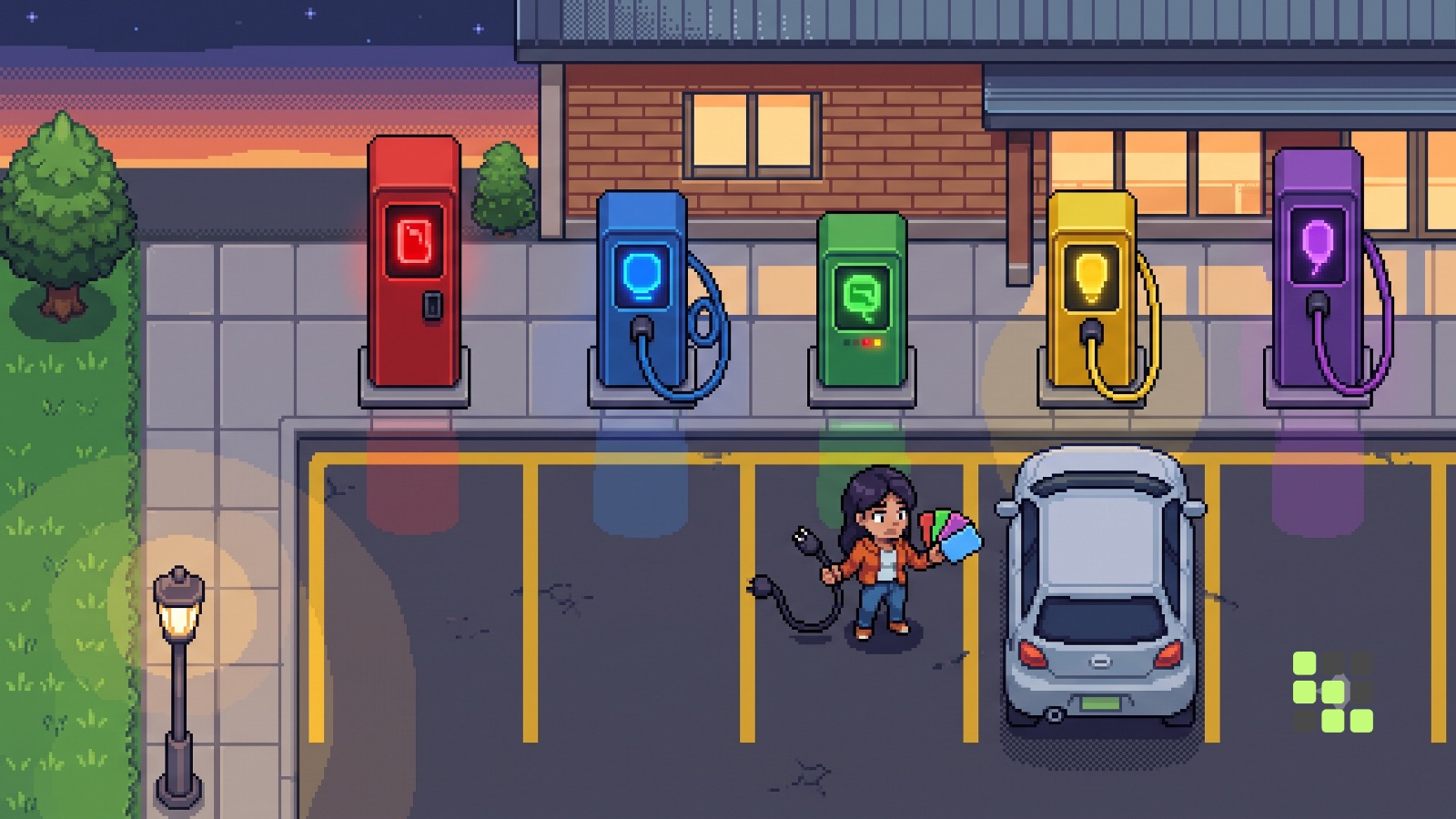
Concretely, there are two questions worth asking. First, what share of charging attempts actually end in a completed payment? If the operation rate is a number seen from the charger’s side, this ratio is the number seen from the driver’s side. Second, can a driver know the price on their specific card before they even arrive? Having rates posted on a website or on-site is one thing, and knowing in advance what it’ll actually cost when you tap your card is another. In a structure where price is determined by the interplay of operator, authentication method, and output, the more posted rate tables there are, the more the arithmetic falls on the driver.
Closing
The number of chargers is a good proxy for how widely the infrastructure has spread. But for someone actually driving an EV, infrastructure comes down to a single charging session: Does it work? How much does it cost? Can I know in advance? Once the subordinate legislation takes effect and the disclosed data starts accumulating, I’d like to check whether that data actually answers these three questions.
💬 Reader, do you check the rate before you plug in, or only find out after seeing the payment record? Let me know in the comments which step is the most annoying to check.
📨 If you know someone weighing whether to buy an EV, or someone working in the charging business, please pass this piece along.
Already a subscriber? Sign in to join the conversation


References & Further Reading

Footnotes
-
Etoday, As EVs approach the 1.1 million mark, the charging infrastructure race shifts from “quantity” to “quality”, 2026-09-14. Cites the Ministry of Land, Infrastructure and Transport’s vehicle registration data (as of end-June) and the integrated zero-emission vehicle charger portal’s charger status (as of August). ↩ ↩2
-
Ministry of Climate, Energy and Environment press release, EV chargers move beyond “installation” to “quality” — both operation and manufacturing to be evaluated, performance standards tightened, 2026-01-22. For details on the performance standards, see Energy News, 2,000 mid-speed chargers to be built this year, raising the public’s “felt” accessibility, 2026-01-22. ↩ ↩2 ↩3 ↩4
-
Ministry of Climate, Energy and Environment press release, Public EV charging rates to be split into 5 tiers — overhaul of EV and hydrogen vehicle management standards announced, 2026-04-29. ↩ ↩2
-
Korea Consumer Agency, Survey on Domestic EV Charging Rates and Rate Disclosure Practices, 2025-12-17. Reported via Newsis, “63.4% of complaints about EV charging concern rates and payment”; Ilgan NTN, EV charging rates vary widely by operator — consumer information disclosure urgently needed. ↩ ↩2 ↩3 ↩4 ↩5
-
Electimes, EV charging rate overhaul into 5 tiers finalized — industry reaction split as slow-charging rates fall and ultra-fast rates rise, 2026-07-01; Financial News, EV charging rates move to 5 tiers starting in August, 2026-07-01. ↩ ↩2
-
Consumer Insight, 73% of EV owners say at least 1 in 10 fast-charging attempts “fails”, 2025-12-02. From responses by 1,809 EV owners in the 4th annual EV survey. ↩ ↩2 ↩3 ↩4
-
Hankyung, 54% of EV users say they’ve experienced inconvenience due to a lack of charging stations, 2024-05-26. Cites the Korea Environment Corporation’s “User Survey Report on Expanding EV and Charging Infrastructure Deployment” (2023.12.19–2024.1.4, 1,000 respondents). ↩
Related issues
They Stole an Nvidia Trailer. It Was 18 Tons of Sand
Two trailers bearing the Nvidia logo vanished, and when thieves pried the doors open, all they found was sand.
BusinessPhone Discounts Now Hide in the Plan, Not the Price
A year after Korea's subsidy cap ended, switching rose only 1.5%—savings now hinge on the whole contract, not the device price.
BusinessHanam Health Center's Page Lists Two Different Co-Pay Caps
A single municipal webpage quotes two different co-payment rates for the same mental health counseling voucher.
Business
Your take shapes the next issue
What resonated most in this issue, or where has your experience been different?