

How Figma Survived AI to Become Its Workbench
Canva and Webflow entered ChatGPT, but coding agents keep turning to Figma to fetch their designs.
BusinessWhere the “Figma Will Die First” Narrative Came From
Reader, when generative AI began churning out UI mockups in seconds, many were quick to name Figma as the first piece of software doomed to vanish. The logic seemed simple: if AI can generate screens from a verbal description, why would anyone still need a tool for humans to draw rectangles one by one?
The market bought right into that narrative. After peaking at $142.92 intraday on its July 31, 2025 IPO debut, the stock began a steady slide. On April 17, 2026, when Anthropic unveiled Claude Design—which generates prototypes and slide decks straight from text prompts—the stock tumbled 7% in a single day. In the first half of 2026 alone, the share price plunged 51.6%.
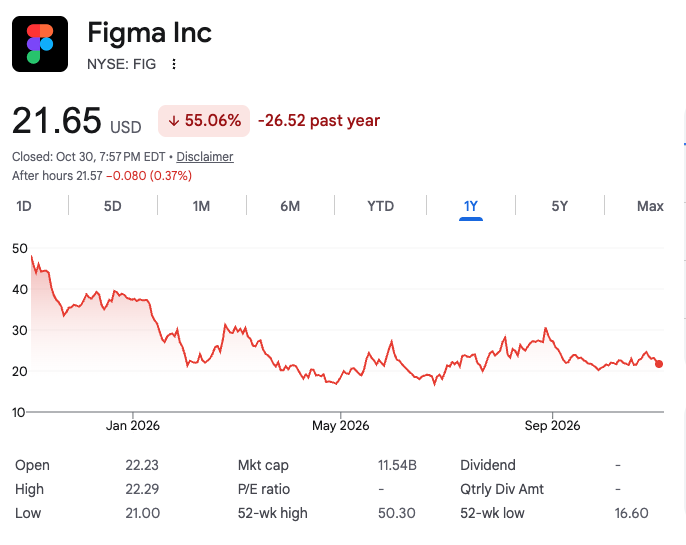
That brings us to the core question of this issue: How did Figma, once written off as doomed, become the very place where AI comes to work? At a time when Canva and Webflow also partnered with AI, why was it Figma that claimed that ground?
October 29: Figma Unveils a Model Fluent in Figma Files
A clue to this question emerged three days ago. On October 29, Josh Clemm, VP of Software Engineering at Figma, published “How we’re training a Figma-fluent editing model” on the company blog. The post outlines how Figma trains an in-house model dedicated to design editing inside Figma Agent.
Their starting point is candid. When they first began, frontier models simply could not grasp Figma’s syntax, and attempting to teach it via system prompts burned through an unmanageable number of tokens. So Figma pivoted. They assembled more than 250,000 examples—each bundling an original design, a synthetic edit request, and a valid edit result—all represented in Figma’s native file format. Supervised fine-tuning2 an earlier-generation Llama 3.3 70B model on this dataset yielded editing performance competitive with the leading models of the day.
Their approach to building training data is just as noteworthy. A larger teacher model first attempts an edit, and a combination of rule-based validators and visual judge models filters whether the output is valid and truly addressed the request. Yet mimicking reference answers has inherent limits: it tends to excel only on designs closely resembling what it saw during training, weakening generalization. To overcome this, Figma noted it is now investing in reinforcement learning3, while migrating base models to newer open-weight models like the Qwen family.
What caught my attention most was the division of labor. Figma relies on best-in-class external models for image generation, vector work, and net-new design exploration, while deploying an in-house model for precise edits and refinements on designs already on the canvas. The criteria for choosing a model come down to two factors: how reliably it follows instructions within Figma, and how fast and cheaply it gets the job done.
On the very same day, Canva unveiled Brush, its proprietary vision-language model for design editing. Starting from open weights and post-trained on design and editing tasks, Brush is reportedly up to 69% faster on common editing tasks and cuts per-task cost by 46% compared to Canva’s previous design agent. Without referencing each other, both companies arrived at the exact same conclusion: Modifying existing designs happens far more often than drafting from scratch—and that work is best entrusted to a model that knows its own files inside out.
Canva, Webflow, and Gamma made it in too. Their places in the workflow are different
We need to sharpen the question here. Factually speaking, it is not as if Canva and Webflow failed to enter the AI ecosystem.
Canva was named alongside Figma as one of the 7 pilot launch partners for ChatGPT apps. In February 2026, it announced that more than 12 million designs had been generated via the Canva MCP server across ChatGPT, Claude, and Microsoft Copilot, with its annual recurring revenue reaching $4 billion by the end of 2025. Webflow also launched its ChatGPT app on July 1, 2026, followed by the rollout of MCP 2.0 on July 21 of the same month. Webflow disclosed that over 30% of its enterprise customers actively use MCP, with nearly 90% of those users connecting through Claude.
The real distinction, then, is not whether they made it in. It lies in the position each company’s files occupy within the AI workflow.
| Dimension | Canva | Webflow | Figma |
|---|---|---|---|
| Primary output | Finished posters, slides, and social media graphics | A live, working website | Screens and rules codifying an agreed-upon product |
| Downstream consumer | The viewer | Site visitors | Developers—and now coding agents |
| Role in the AI dialogue | The exit point delivering finished goods | The operational console for maintaining a site | The ground truth read before writing code |
Canva’s outputs largely end right there. Whether it is a slide deck or a poster, once a human looks at it, the job is done. Inside ChatGPT, Canva excels as an exit terminal: it takes a prompt like “make a presentation from this outline” and hands back a finished product. But serving as the exit terminal means shouldering the generation costs in full. In an August 2026 investor letter, Canva lowered its revenue growth forecast for that year from 30% to 20%, citing higher-than-expected costs of serving AI features. Second-quarter revenue grew 25.2% to $921.9 million, so growth has not stalled; Canva deliberately tapped the brakes.
Webflow’s output is the live website itself. Writing code for websites, however, happens to be one of the things coding agents have mastered most rapidly. It makes sense, then, that Webflow’s MCP 2.0 prioritized governance controls like brand guidelines, permission architecture, testing, and audit logs. The company is shifting its center of gravity from a tool for building sites to an infrastructure for safely operating them.
Figma files are a different breed altogether. A Figma screen is an intermediate artifact, not a final deliverable. It is the codified record of a team’s consensus: which buttons to use, which design tokens define colors and spacing, and how screens flow from one to the next. It does not stop at human consumption; someone has to read it and write code from it. And the moment AI started writing code, coding agents joined that “someone.”
How Figma Files Became Work Orders for Agents
Looking back at what Figma did over the past 1 year, it focused squarely on enabling agents to read and write these intermediate artifacts.
First came reading. The Figma MCP server hands the agent design context, variable definitions, screenshots, and other metadata from selected frames. Hook it up to Code Connect, and it even tells the agent which component in the actual codebase maps to the component in the design. From the agent’s perspective, it isn’t receiving a generic “blue button”—it is receiving “our team’s Primary Button component.” Supported clients already include Claude Code, OpenAI Codex, Cursor, VS Code, and the Gemini CLI.
Next came writing. In February 2026, Figma announced back-to-back workflows: one importing live screens built in Claude Code back into editable Figma designs, and another generating Figma design files directly from Codex. On March 24, it launched a beta for use_figma, a tool allowing coding agents to write directly to design files. By attaching skills to it, you can instruct agents on which tools to call and in what sequence, adhering to team conventions. Figma disclosed that weekly active users of Figma Design’s MCP surged 5x in Q1 2026 alone.

The numbers point in the same direction. As of the end of June 2026, more than 80% of customers with over $10,000 in annual recurring revenue used AI credits weekly, and as of July 31, over half of those customers used Figma Agent every week. Net revenue retention4 for this cohort stood at 136%. In the Q2 earnings release, CEO Dylan Field noted that as code becomes commoditized, value migrates upstream.
In short, Figma did not survive by fighting AI. It owned the files AI needed to inspect to do its job properly, and it opened those files to agents before anyone else did. Anyone can now generate a UI with a single prompt, but knowing whether that screen complies with a team’s components and conventions requires looking at the team’s historical record. And that record lived inside Figma files.
The Market Has Yet to Deliver Its Verdict
Looking only at this, one might be tempted to wrap up with “Figma won”—but that would only be half true. While Figma has solidified its standing across product and ecosystem, public markets remain unconvinced. Its share price tumbled to an all-time low of $16.80 in 2026 and was still trading in the $21 range in early October—well below its $33 IPO price.
One major reason is costs. Figma’s free cash flow margin narrowed from 27% in Q1 to 14% in Q2, with management citing mounting AI inference costs5 as the primary driver behind the year-over-year shift in free cash flow. The company also noted that it has been absorbing inference costs for beta products without billing customers. Q3 revenue guidance pointed to roughly 36% growth, a noticeable deceleration from Q2’s 48%.
Why Canva trimmed its growth forecast and why Figma’s margins contracted point to the exact same reality: AI features cost money the more they are used. That makes it hardly a coincidence that both companies unveiled their proprietary edit models on the very same day, October 29. Unless the repetitive revisions designers make most often can be handled by smaller, cheaper models, surging usage inevitably creates an architecture where profits shrink.
Figma is scheduled to report its Q3 earnings on November 4 (US time). That will offer the first hard figures revealing whether credit revenue scaled alongside agent usage—and just how much its in-house models managed to rein in costs.
Oswarld’s Lens
I often argue that not everyone, and not every task, requires superintelligence. Different jobs and different environments call for different models. In my own workflow, I delegate high-level planning and task decomposition to Claude or GPT-6, and hand off lengthy, repetitive tasks to DeepSeek or GLM.
Reading the section on division of labor in Figma’s blog post, this exact thought came to mind. Offloading open-ended exploration to the best external models while assigning routine, precise edits to a smaller model that understands its own files is Figma solving the exact problem I face in selecting models—except for them, it is an existential imperative. Had Figma routed every single edit through a frontier model, the company would have grown poorer with every surge in usage.
This also reveals why the prediction that “Figma will be the first to fall” missed the mark. That forecast viewed Figma merely as a tool for drawing screens. In terms of sheer rendering speed, AI is indeed faster. But what has accumulated inside Figma files over time was less about drawings than the names and rules agreed upon by teams—and without those rules, an agent cannot produce output that a team can deploy immediately. Yet one thing remains unproven: whether Figma’s revenue can sustain the cost of defending that position is something we will have to watch starting this quarter.
Closing
Figma did not survive by avoiding AI. It held the canonical files agents must pass through, made it easy for agents to read and write to them, and is working to handle the most frequent revisions cheaply with its own models. The remaining question is whether this is a profitable place to sit.
💬 When you receive AI-generated screens or code, what do you cross-check them against first? Your design system, a spec document, or just a quick visual inspection? Let me know in the comments below.
📨 If you’d like to start a conversation with your design or engineering team about whether your files are agent-readable, please share this issue with them.
Already a subscriber? Sign in to join the conversation


References & Further Reading
- Josh Clemm, “How we’re training a Figma-fluent editing model”, Figma Blog, October 29, 2026. : The starting point for this issue. Explores supervised fine-tuning starting from 250,000 examples, plans for reinforcement learning, and the division of labor with external models.
- FourWeekMBA, “Figma Trained Llama on 250,000 Examples as Canva Ships Brush”, October 2026. : A side-by-side comparison of Figma and Canva’s proprietary editing model announcements released on the same day.
- OpenAI, “Introducing apps in ChatGPT and the new Apps SDK”, October 6, 2025. : The launch announcement unveiling the first 7 pilot partners, including Figma and Canva.
- Figma, “Figma Announces Second Quarter 2026 Financial Results”, SEC 8-K, August 5, 2026. : The primary source for revenue growth rates, Net Dollar Retention, and the share of AI credit consumption.
- Figma Help Center, “Guide to the Figma MCP server”. : Outlines supported clients and instructions for connecting skills.
- Fortune, “Canva was the rare startup that grew fast and made money, then AI costs slashed its growth forecast by a third”, August 12, 2026. : An article examining Canva’s lowered growth guidance and Figma’s margin compression as symptoms of the same core challenge: inference costs.
- The Motley Fool, “Why Figma Stock Lost 52% in the First Half of 2026”, July 10, 2026. : A breakdown of the first half of the year, when operational results and share price diverged.
- Webflow Community, “Webflow MCP 2.0 is here”, July 2026. : Offers a clear look at what Webflow prioritizes in the agent era.

📝 Glossary
Footnotes
-
MCP (Model Context Protocol): An open standard protocol defining how AI agents interface with external tools and data. OpenAI’s ChatGPT Apps SDK is also built on top of this protocol. ↩
-
Supervised Fine-Tuning (SFT): A method of post-training an already trained model by exposing it to large volumes of paired demonstrations (“for this input, produce this output”). It is a primary technique in post-training. ↩
-
Reinforcement Learning (RL): A training approach where, rather than imitating fixed target answers, the model receives feedback scores on its outputs and iteratively adjusts its behavior toward higher rewards. ↩
-
Net Dollar Retention (NDR): A metric tracking how much more existing customers spend compared to 1 year earlier. A figure above 100% indicates expanding spend across the retained customer cohort. ↩
-
Inference Cost: The computational expense incurred each time a deployed model processes a user request. It scales directly with feature adoption and usage volume. ↩
Related issues
The Judgment Filter Bubble: 86% of Experts Picked AI's Side
Anthropic secretly paired 50 expert analysts with an AI agent whose opinions were set by coin flips—and most followed along.
BusinessApple's Flash Suppliers Finally Send the Bill
iPhone storage costs jumped from $15 to $66, and this week's Mac price tags show exactly why.
BusinessNeocloud Shakeout: Why Credit, Not GPUs, Decides Survival
Who can actually borrow money is what separates the neoclouds that survive from those that don't.
Business
Your take shapes the next issue
What resonated most in this issue, or where has your experience been different?