

Korea's Top 10 Groups Plan 51,600 Hires—But Where?
Behind Korea's big hiring numbers, most students I meet still picture a Seoul headquarters, not a regional factory floor.
SocietyHiring numbers alone don’t tell the whole story—working conditions matter too
After a corporate roundtable at the Blue House on February 4, 2026, Korea’s top 10 business groups announced plans to hire 51,600 new employees this year. About 66%, or 34,200 of them, will be entry-level hires. The companies also outlined plans to invest roughly ₩270 trillion (~$194 billion) in regional areas over the next five years. Coverage of the roundtable
I welcomed the news of more hiring, but I also wondered whether these were the jobs young people actually want. When I meet students at universities and job fairs, I notice that even a simple wish to “work at a conglomerate” carries specific expectations about location and role.
For a hiring plan to actually translate into applications, job offers, and people settling in the regions, we need to understand those expectations too. Beyond how many people are hired, what matters is where they’ll work, what they’ll do, and what kind of life and career they can build there.
Layoffs abroad and hiring at home need to be measured by the same standard
Layoffs keep making headlines at overseas tech companies. In a shareholder letter on February 26, Block announced plans to cut more than 4,000 jobs. Jack Dorsey explained the reasoning: with AI tools, smaller teams can get more done. Block’s shareholder letter
Placed side by side with Korean conglomerates’ hiring announcements, this looks like a story of two opposite directions. But comparing layoff figures directly against new-hire figures misses something. Companies that are hiring can still lose people to attrition, and companies that are cutting staff can still hire for specific roles. To know whether headcount is actually growing, you need to look at both entries and departures.
The industries and roles are different too. A software company restructuring its organization and a manufacturer investing in plants and equipment don’t create the same kind of labor demand. I started out asking, “Why is Korea alone expanding hiring?”—but I realized I needed to look more closely at where these jobs are and what they actually involve.
Investment locations and hiring roles need to be connected
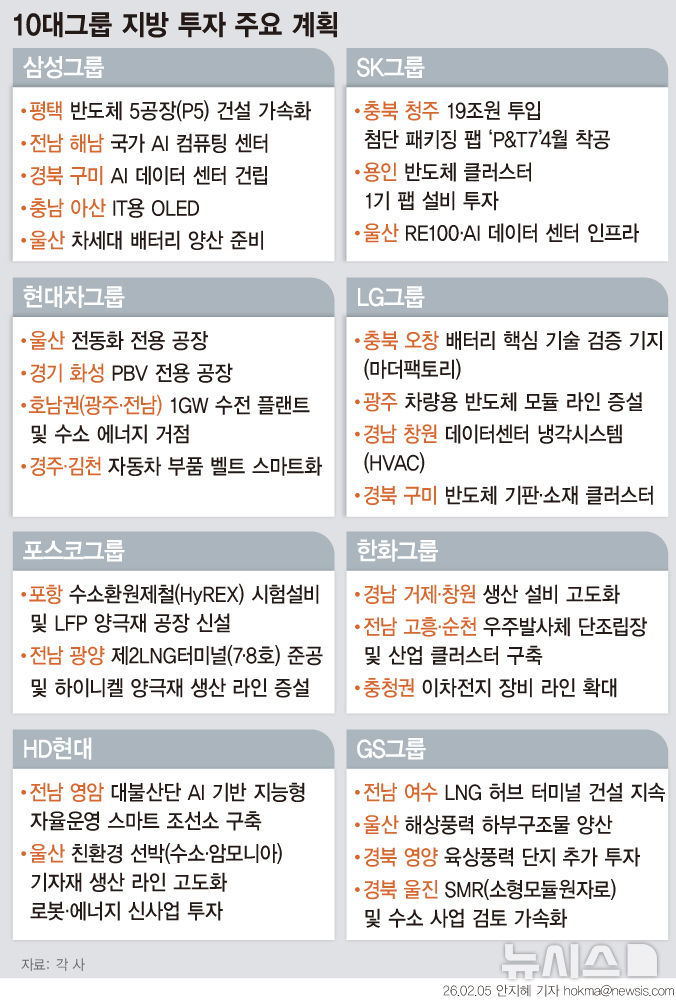
The investment plans above are heavily concentrated in semiconductors, batteries, electrification plants, and data centers. Samsung’s investment in Asan, Chungcheongnam-do, for example, is for IT-use OLED panels, while SK’s plan in Cheongju, Chungcheongbuk-do, is for an advanced packaging plant. LG’s battery verification facility in Ochang, Chungcheongbuk-do, and a data center cooling system investment in Changwon, Gyeongsangnam-do, are also part of the plan.
Pyeongtaek and Yongin are outside Seoul but still within the greater Seoul metropolitan area. So investment outside Seoul headquarters, investment outside the greater Seoul area, and hiring at production sites are three different things that shouldn’t be conflated. And just because an investment is aimed at a factory doesn’t mean every job there is the same kind of production role.
The headline figure of 51,600 hires alone doesn’t tell us how many of those jobs are frontline positions in the regions. I think exactly that kind of detailed placement is what matters. We need to know which regions are hiring people with which majors and experience, and how the work is divided among R&D, process engineering, equipment, and production management, before we can compare that against what applicants are actually choosing.
When students say “conglomerate,” they usually mean the Seoul headquarters

When I talk with students at universities and job fairs, I hear things like this.
“Hyundai Motor? I want to work at the Yangjae twin towers.”
“Samsung? Either the Samsung Tower in Gangnam or the Seocho headquarters.”
“SK? The SK Building in Jongno. I haven’t really thought about Bundang.”
Among the students I’ve met, very few name a regional plant or key facility as their first choice. When they say the name of a conglomerate, they’re usually picturing themselves working at its Seoul headquarters.
I don’t read this as simply seeking the easy option. I see it as a choice that bundles together where they want to apply their education, what kind of career they want to build, and where they want to put down roots. Family expectations about what a “proper job” looks like can shape this too.
According to the OECD’s Education at a Glance 2025, about 71% of Koreans aged 25 to 34 have completed tertiary education—the highest share among OECD member countries. This isn’t the enrollment rate or the share currently in school; it’s the share who have actually finished their education. OECD data on Korea
This figure alone doesn’t prove that young Koreans dislike the regions. But I think what they expect after investing so much time and money in education is a condition companies need to factor into how they design hiring. They also need to spell out concretely what kind of expertise regional technical and production roles require, and where that experience can lead.
Some young people also keep working abroad or starting their own company on the table. I think domestic firms are competing against these options too. Even in entrepreneurship, domestic and overseas investors can judge a venture by different standards. In my view, credentials like which school someone attended and where they last worked often carry real weight domestically, whereas overseas investors sometimes give more credit to sheer market potential. It’s hard to assume that a specific job in Korea is the only option on the table for young people.
What companies need in a hire, and what applicants need in a job
The Korea Employers Federation’s 2025 New Hiring Survey analyzed responses from 500 companies nationwide with 100 or more employees. 81.6% named job-related work experience as the most important hiring criterion. The roles most urgently needing hires included manufacturing/technical/skilled positions at 26.0% and production management at 25.8%. Note that this is a 2025 survey result, not a breakdown of the 10 business groups’ 2026 hiring plan by role. Summary of the Korea Employers Federation survey
In a second-half 2025 survey, the Korea Enterprises Federation (FKI) also named the mismatch between job seekers’ skills and companies’ hiring needs as one of the policy issues to address. Korea Enterprises Federation (FKI) survey
I think it’s just as important for companies to explain where and how applicants can build the skills they want, as it is to describe those skills in the first place. If experience matters this much for entry-level hires, there needs to be a training and placement plan behind it. And if the goal is for people to settle in the regions, companies need to look beyond working conditions to living conditions like housing and transportation.
Compared to the headline hiring numbers, I feel there’s far less said about the conditions under which young people would actually choose to work in the regions. My view is that companies and the government need to design the point where their plans meet job seekers’ actual decisions in much more concrete detail.
Oswarld’s Lens
From my experience building go-to-market strategies, I’ve learned that the conditions a supplier thinks are attractive and the conditions a buyer actually wants can diverge. The same is true in hiring: a company creating a job doesn’t automatically decide an applicant’s choice.
I see the direction of this hiring expansion as a positive thing. But I hope it doesn’t stop at hitting a headcount target—that it extends to the conditions that let young people keep working in the regions after they’ve joined.
I’m especially wary of blaming young people’s willpower when results fall short of expectations. In my experience, this conversation tends to stall at “there just aren’t enough good jobs,” or drift into generational finger-pointing—“young people today don’t have any grit.” Neither explanation tells us what conditions actually need to change.
I’d like to see actual conversations with the young people who would apply. Not just “there’s a job in Ulsan,” but laying out the specific work, training program, pay, housing support, and career path that follows—and then asking whether they’d apply. You can only find what to change once you know what makes them hesitate.
The government and companies aligning on expanded hiring is a good start. I believe that plan needs to also reflect applicants’ own decision criteria, so that it actually leads to people joining and staying.

Kwangseob Ahn is a professor in the Department of Business Administration at Sejong University and lead consultant at INLEVEL9. At the university, he teaches statistics and data analysis courses such as business data management and business analytics, while in the field, he leads GTM strategy and AI strategy consulting, working at the intersection of technology and business. He has published an academic paper on the memory architecture (HEMA) of AI conversational systems, and runs Daily Arxiv, a project that curates global AI papers every day. He completed graduate studies at Korea University’s Graduate School of Technology Management as well as its KMBA program. He is the author of People Who Outsource Their Thinking: Homo Brainless.
Keep the perspective, not the noise.
We choose one consequential shift and trace what sits beneath it, every other day.
Confirm once to finish subscribing.
Already a subscriber? Sign in to join the conversation



Related issues
What the Pentagon Pizza Theory Data Actually Measures
Before treating pizza-shop foot traffic as a war signal, I checked what the data really tracks and how the comparisons hold up.
SocietyOrwell and the Jargon That Passes for Explanation
Rereading Orwell, I revisit the AI jargon in my own consulting work and ask whether specific language actually drives execution.
SocietyKnowing Jensen Huang's Habits Won't Make You Jensen Huang
Judging founders and building GTM strategy: same effort, different results—learning a success story isn't the same as living it.
Society
Your take shapes the next issue
What resonated most in this issue, or where has your experience been different?