

All 21 New Hires at a Shenzhen High School Hold Master's+
Five of the 21 hold doctorates—a glimpse into China's shrinking pool of jobs for PhD graduates.
BusinessAll 21 New Teachers at Shenzhen High School Hold at Least a Master’s Degree
Reader, Shenzhen High School—the most prestigious public high school in Shenzhen, Guangdong Province, China—has published1 its list of teachers it plans to hire this year. All 21 hold at least a master’s degree, and five of them hold PhDs. The business outlet Caixin covered the list on September 17 and highlighted a few cases: a PhD in electrical engineering from Tsinghua University will teach math, a PhD in electrical engineering from Cambridge will teach physics, a PhD in materials physics from Fudan University will teach chemistry, and a PhD from the University of Chinese Academy of Sciences is coming on as a math olympiad coach.
Whenever this kind of news breaks in China, the first reaction online is “what a waste of talent.” The argument goes: why would someone trained to do research end up standing in front of a stack of high school problem sets? But at this particular school, the scene isn’t new. The 2019 hiring list included 20 graduates from Tsinghua and Peking University and one from Harvard, and the school’s current faculty already counts more than 100 PhD holders. In 2021, a post by an applicant went viral after revealing that four of the seven finalists for a biology teaching position at a top Shenzhen high school held doctorates.
So rather than reading this list as a one-line verdict—“there are too many PhDs”—I want to read it as a map of where, in China, jobs still exist for people with doctoral training. That map charts three things together: how fast the supply is growing, how much room universities actually have to absorb new hires, and the order in which the student population is shrinking.
University Faculty Positions Number Only About 35,000 a Year
Let’s start with supply. According to the 2025 Education Statistics Bulletin that China’s Ministry of Education released in July, last year’s PhD graduates numbered 112,900—crossing the 100,000 mark for the first time. There are currently 753,600 doctoral students enrolled. Back in 2014, PhD graduates numbered just 53,700, meaning the figure has more than doubled in 11 years.
The number worth watching more closely, though, is admissions. New PhD enrollments in 2025 reached 201,600, up 17.8% from the previous year—about 2.7 times the 74,400 enrolled back in 2015. This year’s roughly 110,000 graduates are people who mostly enrolled four to six years ago. Which means it will still take a few more years before the expanded enrollment quotas from 2020 onward fully hit the job market. The “PhD glut” we’re seeing now is likely just the leading edge of the wave.
The number of positions available hasn’t grown to match. According to a 2023 estimate by Chinese media, new faculty and research positions across the country’s universities total only around 35,000 a year. Compared simply against the number of graduates, that works out to roughly three PhDs competing for every one university opening. And landing a university job isn’t the end of the story, either. Many Chinese universities run an “up-or-out” system called feisheng jizou2—if you don’t produce sufficient publications and research funding within three to six years, your contract ends. Companies are another important exit route. The Ministry of Education reported that in 2023, more than one-fifth of new PhD graduates went to work at companies. But tech-sector jobs swing sharply with the industry’s business cycle.
Elite High Schools Offer Salary, Security, and Purpose
Into this gap stepped elite urban high schools, offering surprisingly attractive terms. In 2019, Shenzhen’s Longhua District offered new teachers annual salaries of 260,000 to 280,000 yuan, plus a separate 200,000-yuan bonus for full-time PhDs and priority access to talent housing. Guangzhou offered PhD teachers settlement subsidies of 100,000 to 200,000 yuan, while Shengzhou in Zhejiang Province dangled housing subsidies of up to 1,050,000 yuan for PhDs from Tsinghua or Peking University.
It isn’t just about money. Qi Yifan, a PhD in optical engineering from Tsinghua University who took a position at Tianjin No. 1 Middle School, explained the choice on social media: sending hundreds of students to good universities, they argued, can contribute more to society than isolated research work. Faced with a choice between a life spent counting published papers while worrying about contract renewals, and a life of visible results in the same classroom year after year, they chose the latter.
Schools have their own calculus, too. The number of PhD-holding teachers becomes a selling point to show parents. And there are roles—like coaching for olympiads—where doctoral-level expertise genuinely applies. Xiong Bingqi, director of the 21st Century Education Research Institute, said this choice deserves mutual respect, but also pointed out that a good degree doesn’t guarantee good teaching. Schools, he argued, should hire based on teaching ability rather than flaunt their PhD ratios as a badge of prestige.
Taken this far, both individuals and schools were acting rationally. The question is how long that rationality can hold.
Classroom Demand Is Already Shrinking, Starting From the Lower Grades
Caixin ran a story about Guangzhou one day before the PhD piece, on September 16th. It described a contract teacher3 at an elementary school in Huangpu District who, despite having time left on her contract, wasn’t notified to report for the new semester. The school’s stated reason: a drop in incoming enrollment.
Guangzhou’s annual births peaked at 201,000 in 2017. As those children approached elementary-school age, district offices hired teachers aggressively — Huangpu District alone brought on 2,482 contract teachers between 2021 and 2023. The number of first-grade classes peaked at 521 in 2023 and has been declining since. This past summer, teachers across Huangpu, Haizhu, Panyu, and Huadu districts posted about contract terminations or non-renewals.
The national numbers point the same direction. In 2025, China had roughly 29,300 fewer schools than the year before, and about 150,000 fewer full-time teachers. Kindergarten enrollment fell from 48.05 million in 2021 to 32.25 million in 2025 — a drop of more than 15 million in just four years. Middle school, high school, and university enrollment, by contrast, are still growing. Guangzhou’s education bureau expects middle-school enrollment to keep rising through 2029.
Xiong Bingqi, the institute director, has said the demographic pressure will move through the system in sequence — middle school, then high school, then university. Guangzhou’s 2017 birth cohort will enter high school around 2032. If a PhD teacher who joins now, in their early thirties, stays in the classroom for close to 30 years, the moment this largest cohort passes through high school falls within the first third of their career. After that, they’ll be teaching in classrooms that shrink every single year.
Right now, PhDs are flooding into the one compartment of the education system where demand hasn’t started shrinking yet. While elementary-school contract teachers get pushed out first, high schools are hiring PhDs. It’s happening at both ends of the same system, at the same time.
Of course, not every high school will shrink at the same pace. Shenzhen is one of the rare Chinese megacities still gaining population, and when student numbers fall, it’s usually the ordinary schools that close first or cut teaching staff. Elite high schools may even capture a larger share of a shrinking student pool. So the PhDs on this list aren’t betting on the profession of “high school teacher” as a whole — they’re betting on the single seat that will wobble last: a spot at a top high school in a major city. As an individual choice, it’s a remarkably sophisticated calculation.
Oswarld’s Lens
What caught my attention in this list wasn’t the number of PhDs — it’s that two clocks are ticking at different speeds. The clock that produces PhDs shows results 5-6 years after admission quotas are raised. The clock that determines how many seats are available for those PhDs is set by the birth rate from 15 years ago. China was expanding its PhD quotas right as its birth rate was already falling, and these two trends just happen to overlap briefly in today’s elite high school hiring lists.
So summing this up with a single phrase like “credential inflation” misses something important. Each individual is accurately seeking out the position least likely to be shaken next. But viewed at the societal level, this amounts to temporarily parking people trained to do research in the one slot where the demographic cliff arrives last. Once that slot’s time runs out, the next position available to these people may be even narrower than it is now.
From Korea’s vantage point, an even more uncomfortable question remains. In the survey of 2025’s new domestic PhD recipients released this past June, the unemployment rate among the 10,498 respondents hit 33.3% — the first time it has crossed 30% since the survey began. Among those under 30, it’s 51.1%. In Korea, a PhD alone doesn’t qualify you to teach at a public high school. There’s a separate track involving teaching credentials and official appointment, and Korea’s school-age population has been shrinking even longer than China’s. Korea doesn’t even have the kind of “last slot” that China’s PhDs found.
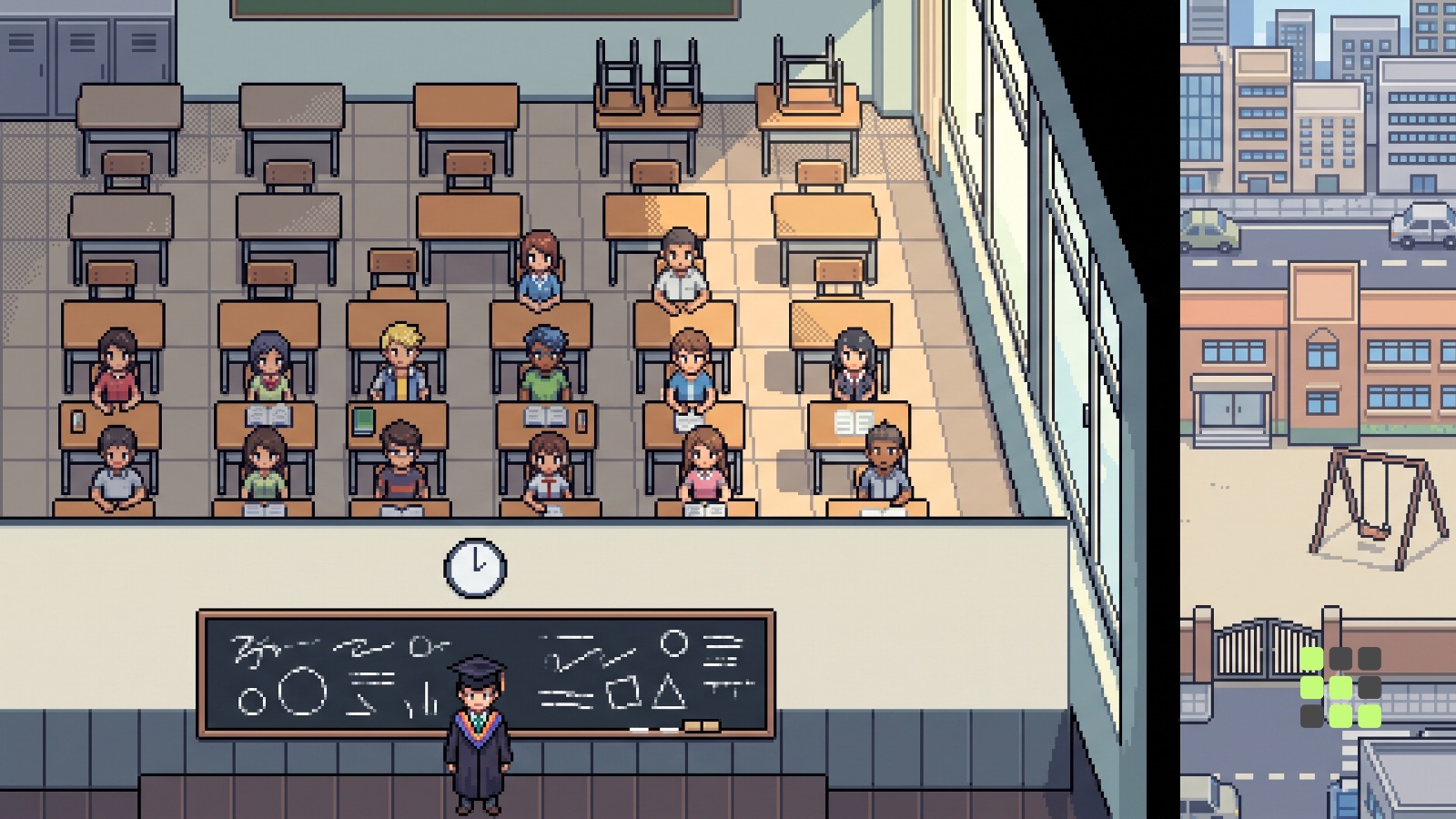
Closing
The list of Seonjeon Middle School graduates is a snapshot taken at the brief moment when the supply of PhDs peaked and the number of high schoolers also peaked. The choices captured in that photo were rational. But that rationality only holds within the shelf life set by the birth-rate graph.
💬 Where do you think PhD-level talent will be able to hold on longest over the next 10 years — universities, corporate research labs, classrooms, or some position that doesn’t even have a name yet? Let me know in the comments.
📨 If you know a grad student wrestling with career choices, or a colleague designing hiring strategy, please share this piece with them.
Already a subscriber? Sign in to join the conversation


References & Further Reading
Where this issue started
- Zhang Can, “China’s PhD Glut Drives Top Graduates to High School Teaching Jobs”, Caixin Global, 2026.9.17. ··· This article lays out the list of Shenzhen Middle School hires, examples of PhD-holding teachers, and the conditions attached to local government subsidies. The full text is paywalled.
- Wang Hongshu, Zhang Can, “In Depth: China’s Shrinking Births Push Guangzhou Schools to Cut Contract Teachers”, Caixin Global, 2026.9.16. ··· Written by the same reporter one day earlier, this piece covers contract teachers in Guangzhou. Read the two side by side and you see both ends of the education system at once.
Checking the numbers
- China’s Ministry of Education, “Statistical Communiqué on National Educational Development in 2024”, 2025.6. ··· The original source for the figures of 97,200 PhD graduates, 676,300 enrolled PhD students, and 171,100 new PhD admissions.
- Guangming Daily, ""Statistical Communiqué on National Educational Development in 2025” Released”, 2026.7.13. ··· Covers the 2025 figure of 201,600 new PhD admissions and the growth rate behind it.
- National Data Agency (Korea) & Korea Research Institute for Vocational Education and Training, 2025 Survey of New PhD Degree Holders in Korea (KOSIS), 2026.6. ··· The source for Korea’s 33.3% unemployment rate among new PhDs. A summary is available via Segye Ilbo’s coverage.
Background
- China Daily, “PhD holders teaching in schools a positive trend”, 2021.10.18. ··· An editorial showing that the same debate was already happening five years ago.

📝 Glossary
Footnotes
-
Gongshi (公示, public notice): A procedure in which Chinese public institutions publish a list of hiring or promotion results for a set period before finalizing them, allowing time for objections. This is why the academic credentials of teachers hired at elite high schools end up fully visible to the public. ↩
-
Fei sheng ji zou (非升即走, “promote or leave”): A system under which staff who fail to pass promotion review within a fixed period must leave the institution. Structurally similar to the tenure track at American universities, it’s frequently cited as a reason young faculty at Chinese universities feel such intense pressure over publications and research funding. ↩
-
Contract teachers: Teachers employed outside the formal staffing system, typically on year-to-year contracts. They tend to be hired quickly when student numbers rise — and are often the first let go when numbers fall. ↩
Related issues
Wages Draw a C, But Assets Still Draw a K
The bottom 50% of Americans hold just 0.6% of all US stocks.
BusinessThe EU Missed Its August Deadline, but February 2027 Stands
Filter out what doesn't apply first — then the paperwork you actually owe comes into focus.
BusinessLegally, Even Spam Filters Are Now 'Superintelligence'
A new executive order renames AI as superintelligence without touching its legal definition.
Business
Your take shapes the next issue
What resonated most in this issue, or where has your experience been different?