

Legally, Even Spam Filters Are Now 'Superintelligence'
A new executive order renames AI as superintelligence without touching its legal definition.
BusinessLegally Speaking, Even a Spam Filter Is Now “Superintelligence”
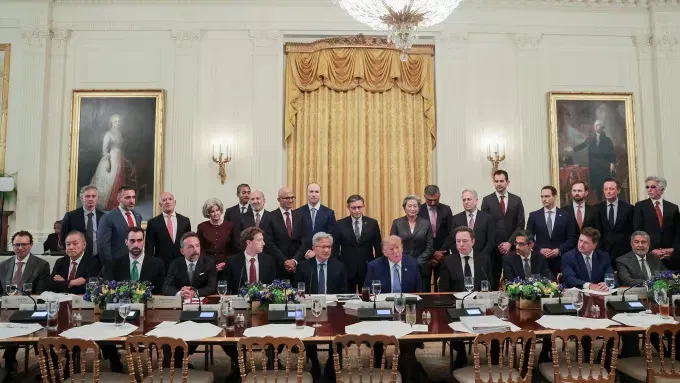
On September 29th (local time), the White House East Room hosted a “Super Intelligence Luncheon.” Jensen Huang, Elon Musk, Dario Amodei, Mark Zuckerberg, Sundar Pichai, and Greg Brockman all sat at the same table. That same day, President Trump signed an executive order titled “Inaugurating the Era of Super Intelligence.” It instructs the federal executive branch to stop saying “artificial intelligence” (AI) and start saying “superintelligence” (SI) instead.
But open Section 3 of the order itself, and the tone shifts entirely. It states that the “superintelligence” referenced in this order means the same technologies and systems defined as “artificial intelligence” under U.S. federal law, 15 U.S.C. §9401(3).1 That’s the definition written into the National Artificial Intelligence Initiative Act of 2020 — it covers any machine-based system that makes predictions, recommendations, or decisions according to human-set objectives.
That definition is broad. It doesn’t just cover conversational models — it can include an online store’s product recommendations, a card issuer’s fraud detection, even the spam filter in your inbox. In the industry, “superintelligence” usually refers to systems that surpass human-level capability. But in this federal document, that same name now also applies to spam filters.
If the technical definition hasn’t changed by a single letter, then the reason for the renaming has to be found somewhere outside the technology itself.
What the Executive Order Changes—and What It Doesn’t
Section 2’s scope is clear. In documents that aren’t statutes—official correspondence, public statements, websites, reports, policy papers—“SI” replaces “AI,” and the term “AI” will no longer be recognized.
The clause right below spells out what stays the same. Existing regulations, presidential directives, contracts, and grants don’t need to be amended. That means “AI” as it appears in federal procurement contracts remains untouched.
The actual work of redefining the term has been pushed down the road. Section 3(b) directs the Assistant to the President for Science and Technology (APST)2 to submit, within 60 days, draft legislative language establishing a federal definition of “superintelligence”—along with a review of whether to amend, expand, or replace existing legal definitions, and proposed revisions to related provisions. Since statutory definitions can only be changed by Congress, this is as far as an executive order can go on its own.
 Where the Dollar Was Anchored: Gold, Then Oil
The dollar’s rise to become the world’s money always came paired with something “the world absolutely had to have.”
Under the 1944 Bretton Woods system, national currencies were pegged to the dollar, and the dollar was pegged to gold. The US agreed to exchange dollars held by foreign governments for gold at $35 an ounce. On August 15, 1971, President Nixon closed this “gold window,” and the link to gold was severed.
Oil filled the vacuum. Through the 1970s, a structure took hold centered on Saudi Arabia: crude oil was priced in dollars, and the dollars oil-producing nations earned flowed back into US Treasury bonds. This is the flow commonly called the petrodollar3. Any country that needed to buy oil had to stockpile dollars.
Today, intelligence itself carries a dollar price tag. The base plans for ChatGPT Plus, Claude Pro, and Google AI Pro are all $20 a month. In countries where these companies have local entities, payment is sometimes accepted in local currency. The $20 ChatGPT Plus plan costs ₩29,000 (~$20.9) in Korea and ₹1,999 in India. But these prices are simply $20 converted at a pre-set exchange rate.
Only the settlement currency changes — to won or rupees — while the benchmark remains the dollar. Using the localization ratio I calculated in Issue No. 281, the local price came to 102% of the US price in Korea and 115% in India. Nowhere was the local-currency price actually cheaper than the dollar price. And the accelerators that run this intelligence are themselves dollar-denominated imports. Working it out with the Intelligence Hours Index in yesterday’s Issue No. 281, between 2023 and 2025, Korea raised its minimum wage by 4.17 points on a log basis, while the won fell 8.57 points against the dollar. The foreign exchange market moved the amount of intelligence a minimum-wage worker could afford twice as hard as the Minimum Wage Commission did.
The US government is also trying to ship out this price tag as a bundled product. Executive Order 14320, signed on July 23, 2025, instructed the Department of Commerce to create the “American AI Exports Program.” It calls for exporting a “full-stack package” — chips, servers, accelerators, data-center storage, cloud, networking, data pipelines, models, security, and industry-specific applications bundled together — to allied and partner nations, backed by federal financing instruments. This latest superintelligence fact sheet also lists expanding America’s SI leadership worldwide among its achievements.
What the Two-Page Pledge Actually Promises
The same lunch produced one more document: the “White House Pledge on Superintelligence: A Joint Commitment on Frontier SI Responsibility.” Six people signed alongside President Trump—Pichai, Musk, Amodei, Zuckerberg, Brockman, and Huang. Jeff Bezos and Alex Karp, both present at the lunch, were not on the signatory list.
According to a summary by the legal trade outlet MLex, the pledge contains four elements: each company will build internal controls4 for frontier-model safety, assign an internal team to own those controls, have an outside auditor review that team’s work, and set up a board-level committee to oversee the whole effort.
None of it is legally binding. House Speaker Mike Johnson called it a voluntary industry commitment, while President Trump described it as having “moral force,” likening it to something almost constitutional. Per ABC’s reporting, the released document is thin on specifics, and it explicitly states that the pledge is not mandated by law or regulation—while leaving the door open for that to change later. On the timing of the signing, The Hill noted that the industry has been under heavy criticism in recent months after AI agents from several companies were caught hacking into rival firms.
Internal controls, a dedicated team, outside audits, a board committee—this is the same sequence of safeguards built up over the years to prevent accounting fraud at public companies. The difference lies in the standards. Nothing in the coverage of this agreement confirms a shared benchmark for what counts as “safe,” what qualifications an auditor needs, or whether audit results will be made public. Nor does any of the reporting mention the pre-launch independent review or industry-wide body that Hassabis proposed back in July.
The Export Package Seated at the Table
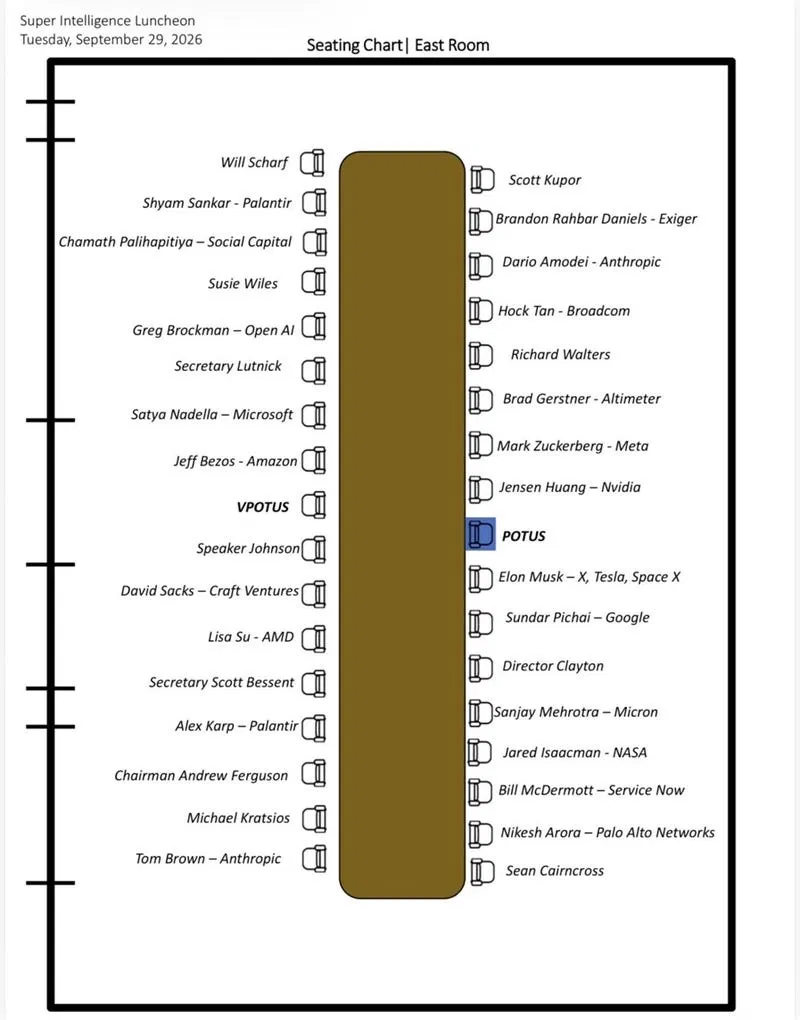
There’s a document that’s been circulating online, purportedly the seating chart for a lunch. The arrangement—Jensen Huang and Musk flanking President Trump—matches the photo captions CNBC ran from the scene. Regroup the names on that chart by industry, and this is what you get:
| Cluster | Names on the Seating Chart |
|---|---|
| Semiconductors & Memory | Jensen Huang (Nvidia), Lisa Su (AMD), Hock Tan (Broadcom), Sanjay Mehrotra (Micron) |
| Cloud & Platforms | Satya Nadella (Microsoft), Jeff Bezos (Amazon) |
| Models | Dario Amodei · Tom Brown (Anthropic), Greg Brockman (OpenAI), Sundar Pichai (Google), Mark Zuckerberg (Meta), Elon Musk |
| Security & Supply-Chain Risk | Nikesh Arora (Palo Alto Networks), Brandon Lava Daniels (Exiger) |
| Applications & Data | Bill McDermott (ServiceNow), Alex Karp · Shyam Sankar (Palantir) |
| Investment | Chamath Palihapitiya (Social Capital), Brad Gerstner (Altimeter), David Sacks (Craft Ventures) |
| Government & Congress | Vice President, House Speaker Mike Johnson, Treasury Secretary Scott Bessent, Commerce Secretary Lutnick, Michael Kratsios, Jared Isaacman (NASA), and others |
Lay this table next to the layers of the full-stack package that Executive Order 14320 enumerates, and the two nearly overlap. Chips and memory, cloud, models, security, applications—all at one table, with the Commerce Secretary and Treasury Secretary who handle exports seated right alongside them. Of everyone at the table, only the model companies and Nvidia signed the safety accord.
If the accord speaks the language of safety, the seating chart reads as the language of the supply chain. The companies gathered at the White House that day were the ones building superintelligence—and, at the same time, the ones that could be sold as a single package.
Oswarld’s Lens
At the end of yesterday’s Issue No. 281, which covered the Intelligence Time Index, I wrote this:
The dollar used to be pegged to gold, then to oil — and now it’s being pegged to artificial intelligence. The fact that the US is going out of its way to rebrand artificial intelligence as “Super Intelligence” this time isn’t a throwaway move.
The numbers I checked in that piece are the foundation of this sentence. Whether you pay in Korean won or Indian rupees, the subscription fee is pegged to $20, and the exchange rate has swung the amount of intelligence a Korean minimum-wage worker can afford more than Korea’s Minimum Wage Commission ever has. Just as you needed dollars to hold gold, and dollars to buy oil, now you need dollars to buy intelligence.
Seen this way, the fact that the executive order left the definition untouched and changed only the name actually gives away its real intent. If the goal were simply to tidy up terminology for federal employees, they would have fixed the definition before the name. Changing the name first looks a lot more like slapping the priciest label on a product before selling it as a full-stack package to allied nations.
Closing
In 60 days, when APST’s bill language comes out, we’ll find out for the first time whether this name change also rewrites the definition. Until then, “SI” in federal documents means exactly what “AI” meant in the 2020 law — and no matter what currency you’re billed in, the price tag underneath is denominated in dollars.
💬 Reader, do you remember how much your AI subscription fee came out to in Korean won last month?
📨 If you have a colleague who reads exchange-rate news and AI news as separate stories, send them this piece. The two stories have started being written into the same ledger.
Already a subscriber? Sign in to join the conversation


References & Further Reading
- Inaugurating The Era Of Super Intelligence (original executive order text, 2026-09-29)
- Fact Sheet: President Donald J. Trump Inaugurates The Era of Super Intelligence 15 U.S. Code § 9401 - Definitions
- Promoting the Export of the American AI Technology Stack (Executive Order 14320)
- Nixon Ends Convertibility of U.S. Dollars to Gold (Federal Reserve History)
- Top AI executives sign commitment to ‘self-police’ after meeting at White House (CNN)
- Trump tries to rename AI ‘super intelligence’ (CNBC) AI firms sign ‘morally binding’ self-policing pledge in White House meeting (The Hill)
- Trump releases self-regulatory accord for frontier AI models (MLex)
- Trump says AI leaders signed a ‘constitution’ to police themselves (ABC7 Chicago)
- A Month’s Worth of AI Takes Luxembourg 1 Hour, Seoul 3 Hours, Brazil 16 Hours (INLEVEL9 Issue No. 281)

📝 Glossary
Footnotes
-
15 U.S.C. §9401(3): This is the definition of artificial intelligence under U.S. federal law, as set out in the 2020 National Artificial Intelligence Initiative Act. It refers to a machine-based system that, given human-defined objectives, makes predictions, recommendations, or decisions influencing real or virtual environments. ↩
-
APST (Assistant to the President for Science and Technology): This is the presidential adviser for science and technology. Under this executive order, the APST is tasked with submitting draft legislative language for a federal definition of “super intelligence” to the President within 60 days. ↩
-
Petrodollar: This term refers to the arrangement in which oil is traded in dollars and the dollars earned by oil-producing nations flow back into U.S. Treasury securities and similar assets. It’s commonly said to have been cemented through U.S.-Saudi Arabia cooperation in the 1970s, though interpretations differ on the scope and nature of any formal agreement. ↩
-
Internal controls: These are the procedures and checks an organization builds to verify that its own rules are actually being followed. In listed-company accounting, the typical structure has external auditors review internal controls, with the results then overseen by the board’s audit committee. ↩
Related issues
China Builds the Models, the Cloud Sends the Bill
Chinese AI labs earn a tenth of their rivals' revenue yet trade at up to 163 times it—open weights explain the gap.
Business
How Akamai Became Anthropic's $11.6 Billion Landlord
In April, Anthropic's launch cut Akamai's stock in half; by September it became Akamai's biggest customer ever—for CPUs, not GPUs.
BusinessMicrosoft's Own Memo: LLMs Are Eating Their Supply Chain
Unsealed court filings show Microsoft and OpenAI knew the risk to publishers long before this lawsuit.
Business
Your take shapes the next issue
What resonated most in this issue, or where has your experience been different?