

Why Gigawatt Buyers Are Now Hunting for 20 Megawatts
OpenAI and Anthropic are splitting demand into small deals, the opposite of Korea's build-first approach.
BusinessLooking at the body, I need to remove the internal editorial notes at line 74 (and similar stray note found mid-document) that aren’t part of the actual translation.
Companies with gigawatt deals are now hunting for 20 megawatts
Reader, data centers keep coming up these days. This newsletter has already covered the power bottleneck where companies wait years for transformers, and the story of the Kentucky landowner who turned down ₩39 billion (~$28 million) for his property. But a CNBC report from September 18th shows a different angle on the same material.
Anthropic and OpenAI, it turns out, are hunting for small data-center deals in the 20-30MW (megawatt) range. These are the same two companies that have spent the past year signing one deal after another measured in hundreds of MW or full GW (gigawatts). According to four sources who asked not to be named, Anthropic has explored deals of this smaller size in the UK and the Nordics. Two sources said OpenAI has been scouting similar opportunities in the Nordics as well. One source said both companies have also discussed deployments of this scale inside the US.
What caught my attention in this piece wasn’t the size, it was the sequence. Here, the user shows up first. That user then goes shopping across multiple countries for a room they can move into right away. Korea is running this sequence backward: build first, find the tenant later.
Why small deals are tagging along with big ones
Both companies typically rent compute capacity from data-center operators or neoclouds1. Until now, the default has been large, long-term contracts. CNBC reported in August that Anthropic struck a deal worth roughly $45 billion with Nscale to lease about 460MW from a development site in West Virginia. OpenAI blew past Stargate’s original target of 10GW back in April, and has since committed to an additional 3GW in Georgia and 8GW in Ohio.
But these big blocks take a long time to materialize. Jabez Tan of the research firm Structure Research described the appeal of smaller deals as “speed to usable capacity.” Rather than waiting for one giant chunk to appear in a single location, it can be more realistic to grab a few MW now at a site where the power is already connected. And if the workload is one that can be split across locations, stitching together several small deployments can add up to a sizable amount of capacity.
That phrase, “a workload that can be split across locations,” is the key detail. Training a model requires enormous numbers of chips packed tightly together, all working in concert. Inference2, by contrast, the process of answering user requests with an already-trained model, can be broken into many small clusters and processed in parallel. That multiplies the number of places where it can physically happen.
Companies themselves frame this somewhat more broadly. An OpenAI spokesperson said the company is diversifying its compute portfolio to match growing AI demand around the world. Different workloads need different infrastructure, so OpenAI talks with multiple partners and weighs requirements, performance, reliability, timing, and cost before choosing an opportunity. The company declined to comment on individual negotiations, and Anthropic did not respond to a request for comment.
The balance between the two workloads is shifting too. A report from the real estate services firm JLL, cited by CNBC, found that inference accounted for 9% of global data-center workloads in 2025 and training for 14%. By 2027, inference is projected to overtake training, and by 2030, the split is expected to be 37% inference versus 13% training. The Wall Street Journal has reported that Crusoe, which built the massive Texas complex OpenAI uses, is now investing in small data centers of its own. Crusoe announced the same day that it had raised $3.9 billion, valuing the company at $30.9 billion post-money.
Put it together, and the picture is this: the buyers are slicing their own demand into small pieces and moving in wherever power is already available, right now. This isn’t a market where the room waits for a tenant. It’s one where the tenant goes hunting for the room.
In Korea, the Building Comes First
Korea runs differently. As I see it, in Korean data centers, the construction side usually moves first, and tenants3 get lined up afterward. But that’s only accurate once you split the picture into the capital region (Seoul and its surrounding metro area) and everywhere else.
In the capital region, it’s actually the users who are queued up. From August 2024 to March 2026, data centers in the capital region filed 522 applications for the first-stage technical review of the Power System Impact Assessment4, requesting a combined 33,592MW. Only 10 of those, totaling 1,010MW, received final supply approval. Meanwhile, of the capital-region capacity that actually came online, the share already pre-leased5 was 99.7% in 2024 and 99.4% in 2025. In the capital region, in other words, it’s the tenants who wait on the power.
Outside the capital region, the order flips. Over the same period, 187 of 214 first-stage technical reviews filed outside the capital region came back with a “supply available” notice. The Special Act on AI Data Centers, promulgated in June this year and taking effect in March next year, adds an exemption from the Power System Impact Assessment and a permitting-timeout rule for AI data centers built outside the capital region. Building is getting easier, but who’s actually going to use the space remains fuzzy.
An analysis published today by Bit Planet, the research arm of Block Media (a Korean crypto and tech news outlet), illustrates this gap well. Of four major projects in Paju (a city in Gyeonggi Province), Ulsan (a southeastern industrial city), Haenam (a county in South Jeolla Province), and Gumi (an industrial city in North Gyeongsang Province), only one—LG Uplus’s (a Korean telecom carrier) Paju AIDC—had both confirmed power supply and a pre-completion lease agreement locked in. Paju is in Gyeonggi Province—that is, the capital region. Here’s where the other three stand:
- Ulsan is a joint push by SK and AWS, but whether the AWS relationship amounts to a simple lease or a revenue-sharing arrangement hasn’t been disclosed.
- The Haenam National AI Computing Center (40MW) is public infrastructure offering usage rights and fee discounts to startups and research institutions.
- As of September 15, it hasn’t been confirmed whether Samsung SDS’s Gumi project (60MW) has actually broken ground.
So in the capital region, tenants wait on power; outside it, power waits on tenants. Current policy is mainly cutting the cost and time of building outside the capital region. Bringing in the people who’ll actually occupy those buildings is still left to the operators and local governments.
Even at Full Capacity, Few People Work There
There’s another reason local governments hesitate before welcoming a data center: it occupies vast tracts of land, yet employs very few people once running.
This week, the Gangwon Province chapter of the Justice Party criticized the province’s plan to attract AI data centers, citing several figures. When Sejong City courted a Naver data center, it projected an employment effect of 3,064 jobs — but once the facility went live, actual staff on site numbered just 120. The site Naver disclosed at the planning stage was about 132,000㎡. Applying Meta’s own benchmark of 0.2 people per megawatt, the Justice Party’s Gangwon chapter calculated that Donghae’s 2.4GW facility would employ just 480 people. Stargate in Abilene, Texas tells a similar story: construction deployed roughly 1,500 workers, but the expected permanent headcount after completion was only around 100.
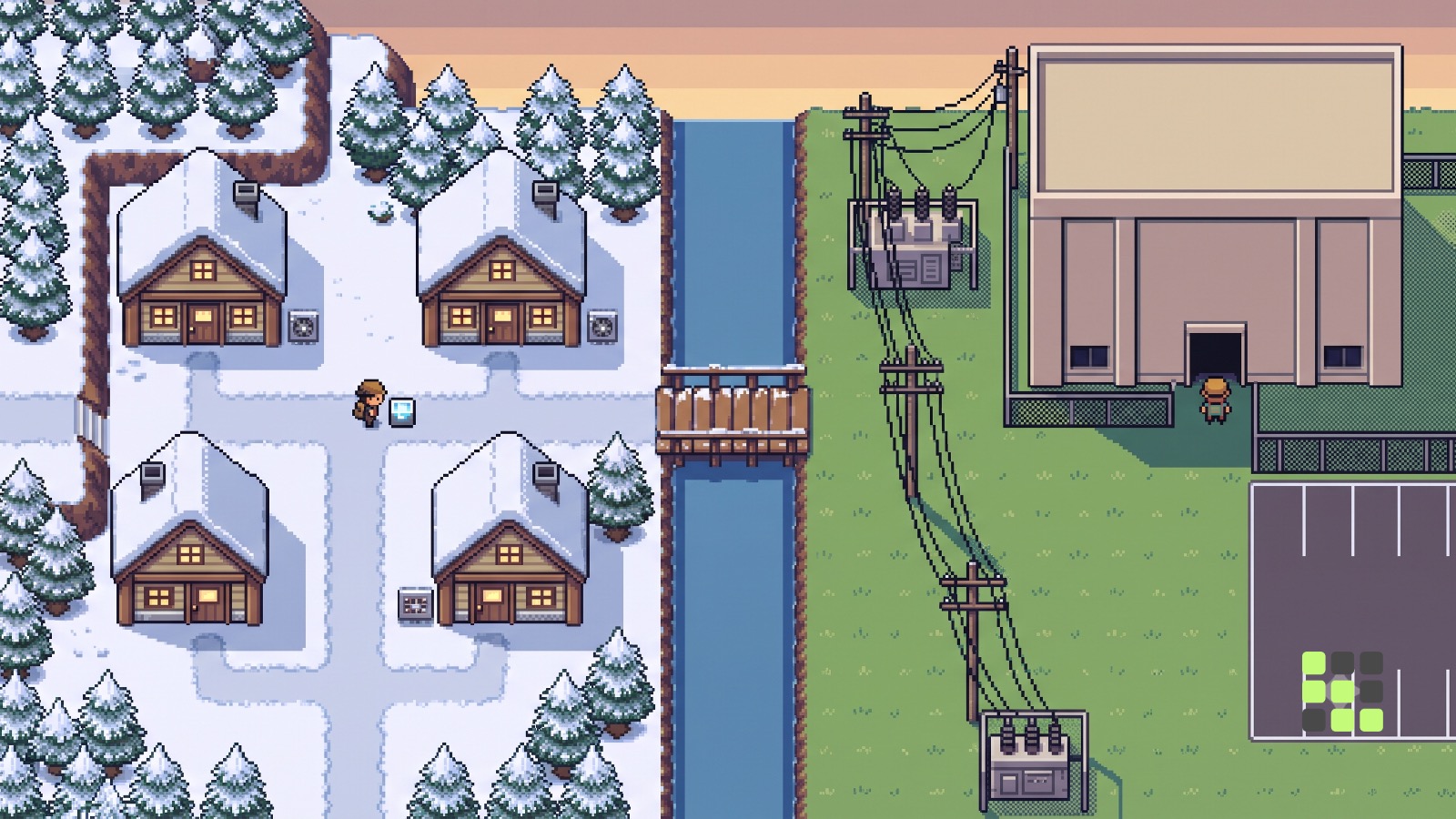
And in Korea, there’s a question that precedes this worry entirely. The “few jobs” problem only applies once the building is fully occupied. If there are no tenants, low employment isn’t even the issue — all that’s left is one giant building with power running to it.
💡 Oswarld’s Lens
Frontier companies in the US and China decide what they’ll use power for before they go looking for space. Like in this story, they’ll shrink their contract size if that’s what it takes to find electricity they can use right now. Korea does it the other way around — preparing sites, power, and permits before the demand-side player is even identified. Build first, find the tenant later.
This shift could be an opportunity for Korea. The first-phase scale of domestic AI data centers — 40MW in Haenam, 41MW for Ulsan’s phase 1, 60MW in Gumi — isn’t far off from the 20–30MW chunks labs are hunting for right now. Judging purely by the criterion of “mid-sized site with power already connected,” there’s a real fit here.
But the flip side of more small contracts is that each individual site becomes that much easier to swap out. As OpenAI itself put it, to a company assembling a portfolio, any single site is just one slot in that portfolio. If another slot offers better performance, reliability, timing, or cost, they’ll move there without a second thought. The mere fact that something has already been built doesn’t by itself create negotiating leverage. There has to be a reason to pick a site in Korea over one in the UK or the Nordics — whether that’s proximity to Korean users for a given service, or customers who need their data to stay within the country.
That’s why I think local governments and developers need to answer “who’s going to use this power” before they answer “how many jobs will this create,” let alone before any groundbreaking ceremony. If there’s an answer to that first question, the jobs and tax-revenue story can follow. If there isn’t, no amount of job-number arithmetic changes the fact that the premise underneath it is empty.
Closing
Small data center contracts are a signal that AI demand is shifting from training to inference. Buyers are already hunting for exactly the amount of room they need, broken down into smaller pieces. Whether an AI data center outside Korea’s Seoul metro area makes it onto that list depends less on the building’s size than on who the first tenant turns out to be.
💬 If there’s been news of a data center coming to your area or near your company, let me know in the comments whether the announcement mentioned who would actually be using it.
📨 If you have colleagues working in local government or infrastructure investment, please pass this piece along to them.
Already a subscriber? Sign in to join the conversation


References & Further Reading
Primary sources
- CNBC, “Anthropic and OpenAI hunt for smaller data center deals, sources tell CNBC, in race to deploy AI capacity”, 2026.9.18. ··· The starting point for this piece: 20-30MW deals under discussion, JLL’s inference-vs-training workload projections, and Crusoe’s funding round.
- Bitplanet (Block Media Research), “What Does It Take to Succeed at Data Centers? Mapping Korea’s AI Data Centers”, 2026.9.18. ··· Power-approval statistics for the Seoul metro area versus the rest of the country, plus a side-by-side look at leasing and power status in four sites: Paju, Ulsan, Haenam, and Gumi.
- Financial News, “‘AI Data Center Jobs Barely Register’ — Justice Party’s Gangwon Chapter Demands Explanation from Provincial Government”, 2026.9.15. ··· Includes Sejong Naver data center’s projected versus actual headcount, and the 0.2-jobs-per-megawatt calculation.
Further Reading
- The Wall Street Journal, “The Startup That Built OpenAI’s Biggest Data Center Is Now Making Tiny Ones”, 2026.9.
- CBRE Korea, “Data Center Investment in Korea: Assessing the Scarcity Premium from Supply Constraints and Exit Prospects”, 2026.7.12.
- Korea Law Information Center, “Special Act on the Promotion of the AI Data Center Industry”, promulgated 2026.6.9, effective 2027.3.10.
- Bizwatch, “The Fight to Host Naver’s Data Center — Why Bother When There’s No Tax Revenue or Job Gain?”, 2019.7.19.
- AI Times, “If South Jeolla’s ₩50 Trillion (~$36 Billion) AI Data Center Goes Through, What Jobs Will It Actually Create?”, 2025.3.1.

📝 Glossary
Footnotes
-
Neocloud: A new breed of cloud provider specializing in renting out GPU compute capacity. Crusoe and Nscale are examples. ↩
-
Inference: The process by which a fully trained AI model takes a real user request and generates a response. ↩
-
Tenant: A company that leases space and power inside a data center. ↩
-
Power grid impact assessment: A review process that evaluates in advance how a large new power demand will affect the grid. It’s been in effect since June 2024 under Korea’s Special Act on the Promotion of Distributed Energy. ↩
-
Pre-leasing: Signing a lease agreement before a building is actually completed. ↩
Related issues
Microsoft Built Autopilot on OpenClaw, Once Deemed Unsafe
Microsoft's new agent runs on the very runtime it called unfit for work PCs just seven months earlier.
BusinessChina Builds the Models, the Cloud Sends the Bill
Chinese AI labs earn a tenth of their rivals' revenue yet trade at up to 163 times it—open weights explain the gap.
Business
How Akamai Became Anthropic's $11.6 Billion Landlord
In April, Anthropic's launch cut Akamai's stock in half; by September it became Akamai's biggest customer ever—for CPUs, not GPUs.
Business
Your take shapes the next issue
What resonated most in this issue, or where has your experience been different?