

Why Search Interest Isn't the Same as Usage for OpenClaw
A falling Google Trends chart doesn't prove users left—I checked OpenRouter's data and tried the tool myself to find out.
BusinessSearch Interest in OpenClaw Has Cooled Off
In the newsletter I sent back in March, I covered the “crayfish craze” that was sweeping China. It was about an open-source AI agent called OpenClaw that had people lining up outside Tencent’s headquarters and drawing attention from cloud and messaging companies.
Two months later, search interest in OpenClaw on Google Trends has dropped well below its peak.
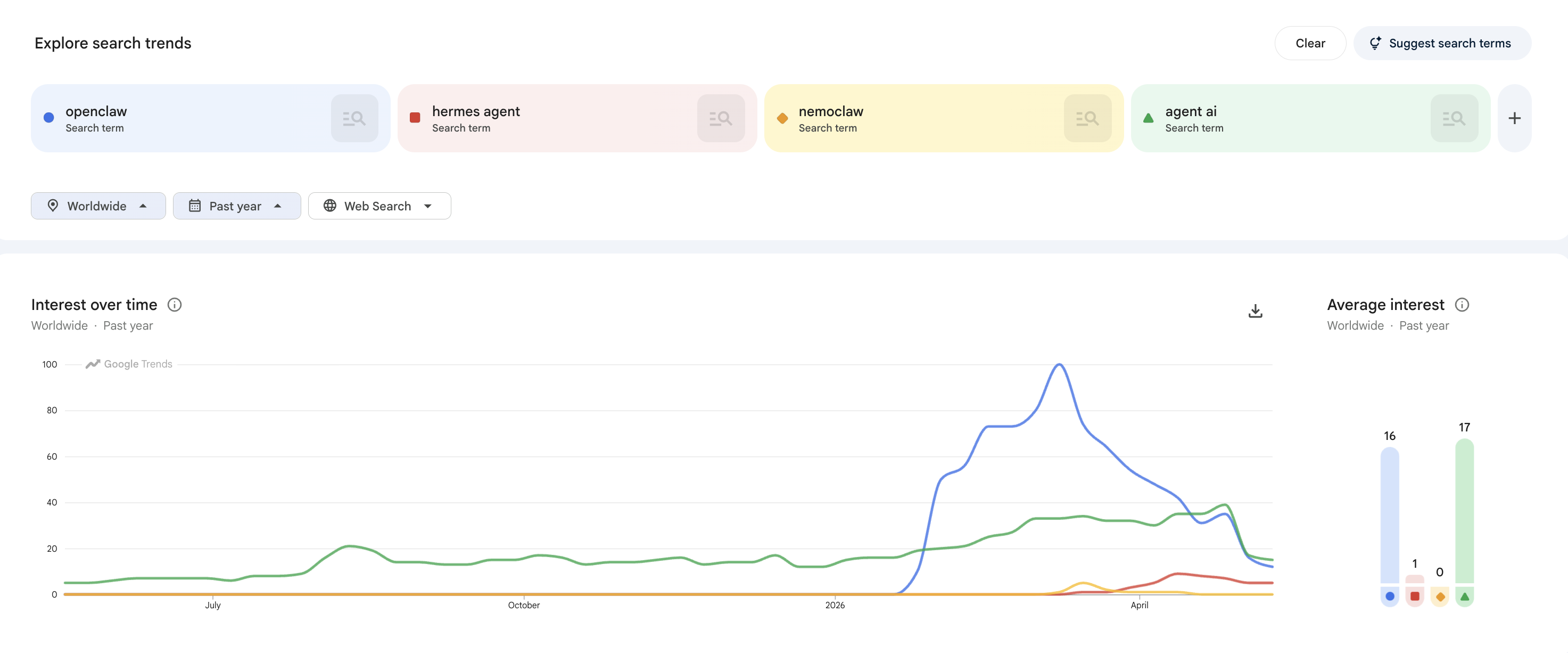
In the graph above, the search interest index for “openclaw” fell from a peak of 100 to about 12 in the most recent period—roughly an 88% decline in index terms. This figure represents relative search interest within a chosen time period and region, not the actual number of searches or users. As Google explains, the number reflects a given term’s share of total search volume, converted to a scale of 0 to 100.
We should separate the fact that search interest has dropped from the conclusion that people have stopped using the tool. Someone who already installed it doesn’t need to search the name again to keep using it, and someone who only searched for it may never have become a user in the first place.
What Your Search Terms’ Graph Actually Shows
The screen above compares openclaw, hermes agent, nemoclaw, and agent ai under global, past-12-months, web search conditions. What you see can shift depending on which terms you choose to compare.
The blue line, openclaw, spiked sharply and then fell, with a period average of 16. The red line, hermes agent, averages 1, and the yellow line, nemoclaw, sits at 0. A 0 doesn’t mean there were no searches at all. This reading can appear when the relative volume is small or there isn’t enough data.
The green line, agent ai, has a period average of 17. This line also moved up and down over the period, and toward the latter half it rises and then falls again. The magnitude of its swings differs from OpenClaw’s, but it’s hard to call it steady across the whole year.
What’s mixed together here are search terms with fundamentally different characters. OpenClaw is the name of a specific tool, while agent ai is a phrase people might use to search for a much broader concept.
That said, you can’t treat agent ai alone as a proxy for search interest in the entire AI agent market. People also search using “AI agent,” “AI eijeonteu” (the Korean-language rendering of “AI agent”), or other product names. What this graph actually confirms is the relative movement of these four specific expressions — nothing more.
Hermes Agent is a separate open-source agent built by Nous Research. NemoClaw is software Nvidia offers for running and managing OpenClaw. It’s also not fair to lump both of them together as “failed knockoffs” just because their search interest happens to be low.
Real usage needs to be checked against other data
One resource for looking at actual usage is OpenRouter1’s token2 throughput. But even this is usage aggregated through OpenRouter—it’s not a number that combines usage across every channel.
According to a MarkTechPost article citing OpenRouter rankings from May 10, daily totals were 224 billion tokens for Hermes Agent and 186 billion tokens for OpenClaw—410 billion tokens combined. This is data showing that model calls through these two tools were happening at considerable scale even during a period of declining search interest.
The same article put OpenClaw’s cumulative throughput at 9.17 trillion tokens, with over 370,000 GitHub stars. Cumulative throughput is a value built up over time, and stars are a count of expressed interest. Neither figure tells you how many users were active that day, or what share of users stuck around.
There have also been changes around OpenClaw. In February, founder Peter Steinberger announced plans to join OpenAI and to run the project as a foundation. A security vulnerability with an assigned CVE3 was also disclosed for OpenClaw. Changes to the development organization and security issues are both factors users weigh when deciding whether to keep using a tool.
Agents can access files and accounts and execute commands. You need to check what permissions you’ve granted and whether externally sourced capabilities can be trusted. Easy installation and being ready to hand over company data are two different things.
It’s plausible that the security issue made people hesitate to install the tool, or reduced existing usage. But the figures cited here alone can’t quantify that effect. A total can grow even if fewer users are consuming more tokens each, and it could also simply reflect tasks being retried multiple times.
Search indices show shifts in interest; tokens show aggregated model throughput. How much the user base has actually grown, and how well the work actually gets done, need to be checked separately.
The draft looks accurate and complete. No corrections needed.
Things to consider behind the drop in search interest
There are a few possible explanations for why search interest has declined. What follows isn’t a measurement of the actual causes of the shift — it’s simply the set of factors I look at when evaluating whether to adopt a tool.

The first is that initial curiosity fades. When a new tool gets attention, even people who have no intention of installing it will search for its name. Once they understand what it does, they may search less. But the graph alone can’t tell us who exactly stopped searching.
The second is operating cost. I consider this burden particularly important. Reading a PDF once and answering a question is a very different call pattern from reading it, organizing the output, reviewing it, and revising it again — the number of API calls involved is not the same. Depending on the model and workflow, costs can vary, but more repeated calls generally means higher expense. The change on April 4th, when Claude’s standard subscription usage limits stopped covering external tools like OpenClaw, was itself a moment that forced people to re-examine the cost equation.
The third is that there are simply more alternatives to choose from now. In March, Anthropic released Dispatch along with computer-use capabilities — features that let you issue commands from your phone and have them executed on a desktop. If a service you’re already using offers the functionality you need, there’s less reason to install a separate agent. That said, the supported environments and connection methods differ enough that it’s hard to say these new features fully substitute for everything OpenClaw does.
The fourth is limitations that show up in actual use. Agents that move across multiple apps or carry out long-running tasks can fail midway through. Even Anthropic, in announcing its computer-use feature, noted that complex tasks may require retries and that screen-based manipulation can be slower than direct integration. Task success rates need to be checked tool by tool — you can’t take one product’s numbers and apply them to OpenClaw’s performance.
I was directly affected by the security scare in February–March myself. I tried to cleanly uninstall OpenClaw, but the global NPM package, the ~/.openclaw directory, log files, and background processes wouldn’t come out neatly. So I built a small CLI utility called OpenShears and published it on GitHub — a tool for checking and cleaning up installed files and running processes. Building it made me realize that post-installation management and uninstallation are also important criteria when evaluating a product.
Curiosity, cost, alternatives, and real-world usage experience can all play a role together. We still don’t know how much each factor explains the drop in search interest. If you’re considering adopting one of these tools, it’s worth checking these four factors against your own workflow.
There’s still work to do after the hype fades
Gartner’s Hype Cycle4 is a model describing how inflated expectations about a technology give way to more realistic assessments over time. In its January 2026 outlook, Gartner projected that companies will weigh AI’s profitability carefully and adopt new capabilities mainly through their existing software vendors.
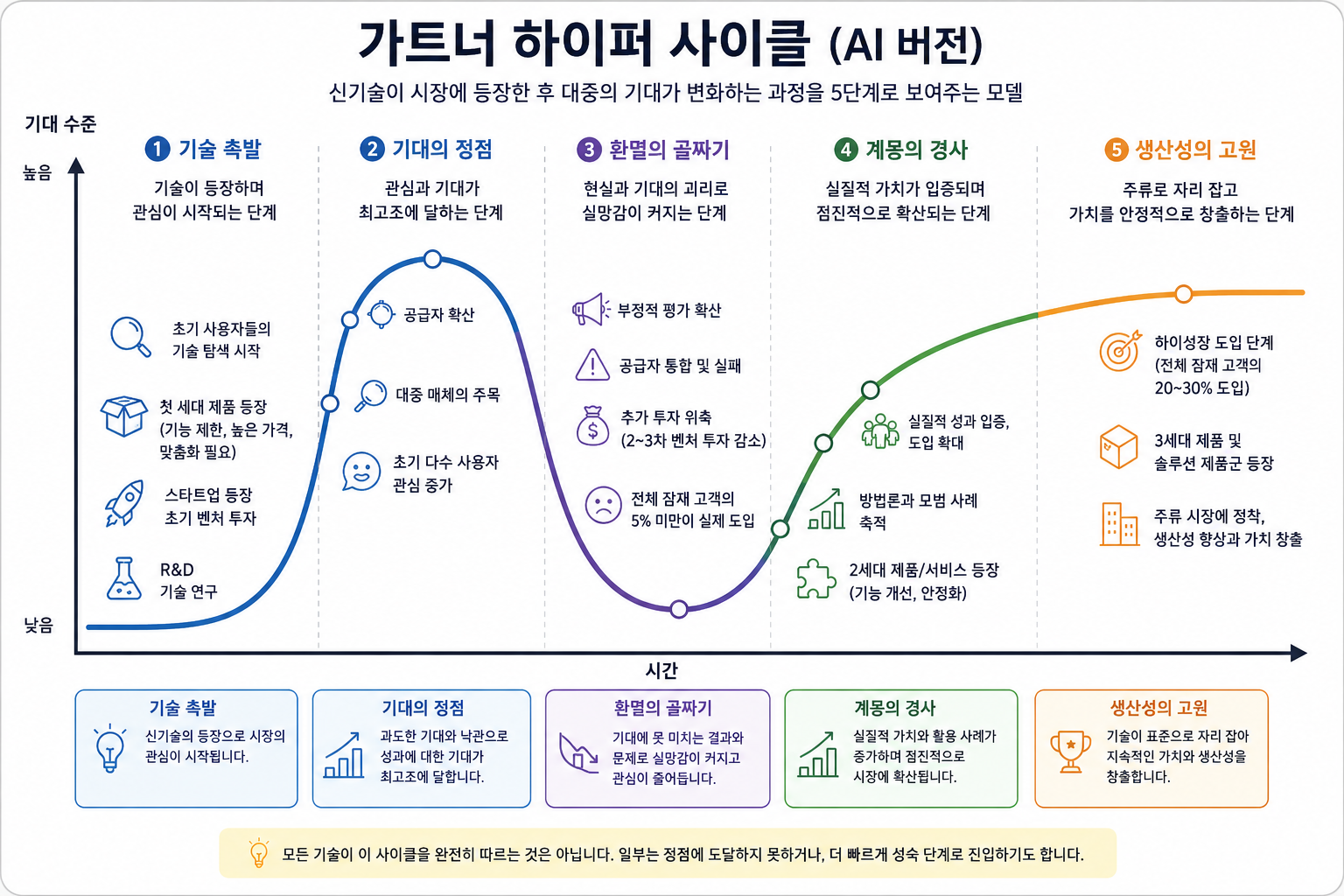
Gartner’s outlook suggests that features bolted onto familiar products may see easier adoption than standalone AI projects. That said, it isn’t a rule that every technology whose hype has cooled goes on to succeed later.
The same logic applies to OpenClaw: the decline in interest around the name needs to be separated from the question of its actual practical viability. Similar capabilities could get folded into existing services, and there may still be users who continue to prefer tools they install and manage themselves.
Which approach ends up more widely used isn’t something a single search-trend curve can settle. Whether users stick around, whether the work gets done in proportion to the cost, and whether things can be recovered when something breaks — these are far more direct grounds for judgment.
A decline in search interest is a signal worth investigating further. It’s not sufficient evidence to declare either failure or normalization.
Oswarld’s Lens
Having worked with GTM strategy for a while, I’ve seen how the tool that first gets noticed can end up different from the tool customers actually keep using. When features are similar, what tips the decision is installation, billing, permission setup, and maintenance. When I evaluate OpenClaw, I want to look at these same conditions.
In cloud consulting too, what matters is which tasks actually get executed, and how often. Agents don’t just call models — they also handle work like browsing, file processing, and connecting to external services. So operating costs need to include not just model fees but CPU, memory, storage, and the time spent on management. Just because search interest has dropped doesn’t mean these costs and this demand have dropped along with it.
Given how fast new tools and features keep coming out, I think checking in after adoption matters more than any single verdict on what’s trending. My experience building OpenShears drove this home for me. It’s not enough for something to install smoothly at first — you need to know whether you can keep managing it in your own environment over time.
Closing
Looking at the graph showing OpenClaw’s declining search interest, I want to draw a distinction between three separate things.
- Search interest: In the Google Trends graph above, OpenClaw’s relative index has fallen from its peak.
- Aggregate usage: The OpenRouter token totals cited in the May 10th report show that both tools were being used. They don’t tell us anything about user growth rates or retention.
- What comes next: I need to figure out whether a feature bolted onto an existing product or a tool installed directly fits my own work, budget, and management constraints.
Over the next few months, I plan to watch not just how often the name comes up, but what tasks people keep using these agents for. A product only lasts if it has users who stick around after trying it—and tasks that actually get finished.
Looking at this fragment, everything matches the Korean source correctly — headings, footnotes, links, images, numbers, and glossary terms all align. No corrections needed.
Keep the perspective, not the noise.
We choose one consequential shift and trace what sits beneath it, every other day.
Confirm once to finish subscribing.
Already a subscriber? Sign in to join the conversation


References & Further Reading
Primary sources
- “Hermes Agent vs OpenClaw: Why Nous Research’s Self-Improving Agent Now Leads OpenRouter’s Global Rankings”, MarkTechPost, 2026.5.10. : An article citing OpenRouter’s rankings and figures as of May 10.
- “Anthropic just shipped an OpenClaw killer called Claude Code Channels”, VentureBeat, 2026.3.20. : An article introducing Claude Code’s messenger-integration feature.
- “Anthropic to OpenClaw users: Pay up”, The Media Copilot, 2026.4.6. : Covers the change that excluded external-tool use from Claude subscription limits.
- “OpenClaw Security Crisis 2026: What Happened and What To Do”, Get AI Perks, 2026.2.23. : A February article covering OpenClaw’s security problems.
Background
- Gartner, Worldwide AI Spending Will Total $2.5 Trillion in 2026, 2026.1.15. : Explains how enterprises are buying AI and what the investment outlook looks like.
- “Why does Gartner describe 2026 as a Trough of Disillusionment year for AI”, Christian & Timbers, 2026.1. : A commentary on Gartner’s outlook.
Oswarld’s work
- oswarld/openshears : The CLI utility mentioned in the piece, which safely removes traces of OpenClaw. You can check the repo’s usage instructions and what it cleans up before running it.

Footnotes
-
OpenRouter: A unified gateway that lets you call different AI models (OpenAI, Anthropic, Google, Chinese models, and more) through a single API. The public rankings reflect usage that passes through OpenRouter — they don’t capture usage via other APIs or local models. ↩
-
Token: The basic unit AI models use to process text. A word, part of a word, or a punctuation mark can each count as one token. Throughput includes both input and output, so it doesn’t translate directly into pages of finished text. ↩
-
CVE (Common Vulnerabilities and Exposures): An official ID assigned to a security vulnerability found in software. Severity is scored using CVSS, where 9.0–10.0 is rated “Critical.” The actual impact depends on the vulnerable version and the install/access conditions. ↩
-
Hype Cycle: Gartner’s model for charting how awareness of a new technology changes over five stages: “Innovation Trigger → Peak of Inflated Expectations → Trough of Disillusionment → Slope of Enlightenment → Plateau of Productivity.” It isn’t a predictive rule that guarantees any individual technology’s success. ↩
Related issues
GPT-4 Citation Found in Kim Il Sung University's Journal
A North Korean university journal cited GPT-4 and REALM papers, prompting a look at what reading public research actually reveals about AI capability.
BusinessA Company Claims '500% Growth'—From What to What?
Growth percentages only mean something once you know the baseline number and how it was measured.
BusinessMeta's New 2-5% Ad Fee: Who Pays the Digital Tax?
Meta will add extra fees to ads in six countries — but that cost isn't the same as a price hike for consumers.
Business
Your take shapes the next issue
What resonated most in this issue, or where has your experience been different?