

SanDisk's Customers Just Guaranteed $16.5 Billion
Even as demand explodes, neither company will build new factories—so buyers are locking in four-year deals instead.
BusinessNo New Factories, Yet Customers Just Guaranteed $16.5 Billion
I went to buy an extra drive to fill out the NAS hard disk I’d picked up last year, but closed the browser tab the moment I saw the price. Since early this year, hard disk and SSD prices have been climbing steadily. The reason is the one everyone already knows: AI data centers are buying up capacity in bulk, and supply has gotten tight.
That much has already been said many times over. But yesterday (August 5), Western Digital and SanDisk reported earnings on the same day, and buried inside was something much stranger. Demand is exploding, yet both companies said they have no plans to build new factories. And customers, fully aware of this, are signing four-year contracts anyway.
What caught my attention this time was the attempt to use long-term contracts to lock in future volumes and price floors in advance — an effort to dampen the memory-price swings that have repeated for 40 years. The market, it seems, is skeptical about how long this arrangement can actually hold.
The Numbers From Yesterday
Let’s start with earnings. Both companies posted record numbers.
Western Digital reported quarterly revenue of $3.75 billion, up 44% year over year, with a gross margin of 54.4% — up 13.1 percentage points in a single year. EPS came in at $3.56, more than double the prior year.
SanDisk’s numbers are even more dramatic. Quarterly revenue of $8.97 billion, up 372% year over year. Gross margin of 84.6%. To put that in perspective: a NAND company just posted margins on par with a software company. Within that, data center revenue hit $2.98 billion, up 1,298% year over year. On a supplied-bits1 basis, data center’s share jumped from 12% to 38% in just one year.
Here’s something worth flagging. Hard disks and NAND have historically competed in the same storage market. “SSDs get cheap enough and hard disks die” has been the standing prophecy for 20 years now. But this quarter, both hit all-time highs simultaneously. Western Digital’s nearline2 exabyte shipments grew 23%, while SanDisk’s data center SSD volume grew 13-fold — at the same time.
That means NAND isn’t replacing hard disks — the two demands are growing together. AI didn’t redirect existing storage demand; it added entirely new demand on top. Training is served by high-performance flash, inference by high-capacity enterprise SSDs, and the ever-growing pile of raw data still goes to hard disks. As Western Digital’s management emphasized on the call, roughly 80% of hyperscale data still sits on hard disks.
And yet, after these excellent earnings, Western Digital’s stock dropped about 16%. SanDisk has also had a single-day drop of 13% recently. To understand why such strong earnings triggered such a sharp stock reaction, let’s start by looking at the contract structure.
$93.9 Billion in Minimum Committed Revenue From 8 Customers
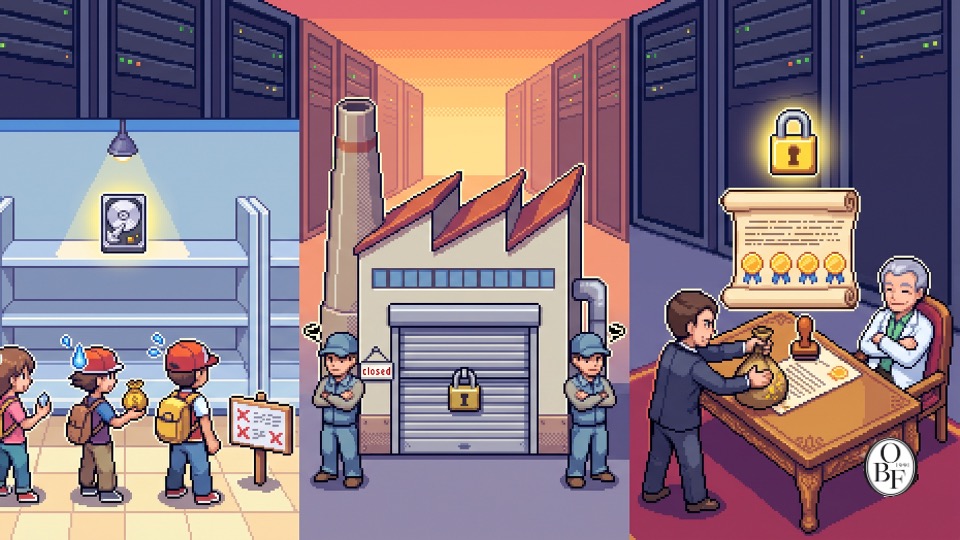
SanDisk calls this new contract structure the “New Business Model (NBM),” but the substance matters more than the name. It’s a binding supply agreement that locks in volume, price floors, and even how breach of contract gets handled — all in advance.3
Let me walk through the numbers.
- Signed with 8 customers spanning data centers and OEMs
- Weighted-average contract term of 4+ years (typical memory long-term supply deals run around 1 year)
- Minimum contracted revenue of $93.9 billion, based on the price floor
- 80%+ gross margin even at that floor price
- Remaining performance obligations (RPO) of $91 billion
- Plus $16.5 billion in financial guarantees
- Roughly 50% of FY27 shipment bits and 66% of FY28 bits already committed
$93.9 billion is about ₩130 trillion. This is the minimum revenue calculated at the contract floor price — what comes in if everything sells at the floor. If market prices land above that, actual revenue climbs higher. Unlike contracts that cap the price ceiling, what stands out here is that a price floor is set to lock in minimum revenue.
The $16.5 billion — about ₩23 trillion — in financial guarantees means customers didn’t just say “we’ll buy this much.” They put money down. SanDisk CFO Luis Visoso explained the mechanism this way in a meeting with JP Morgan: if a customer breaks the contract, funds flow to SanDisk immediately — either directly or through a third-party financial institution — according to pre-agreed terms.
“No litigation, no negotiation. It’s just a very simple process.”
Western Digital is no different. Management said customers are actually asking for long-term supply contracts running through 2029, 2030, and even 2031 — booking hard drives today for use five years from now.
This is a genuinely strange sight in the memory industry. Suppliers have historically held the weaker hand at the negotiating table. Boom times bring everyone rushing to expand capacity, oversupply crashes prices, and customers buy cheap at the bottom — that’s been the 40-year pattern. In 2023 alone, the NAND market shrank 40% year-over-year to $36.7 billion, and prices buckled again from oversupply in early 2025. That was barely a year and a half ago.
Visoso pinpointed the structural cause precisely: suppliers invest in equipment with a 10-year horizon in mind, but NAND selling prices get reset every quarter. That mismatch between the investment payback period and the pricing cycle is what has driven the boom-bust pattern, he explained. Today’s long-term contracts are an attempt to close that gap.
But They’re Not Building New Fabs
Here’s the demand outlook. By SanDisk’s internal estimates, the NAND market will top $300 billion this year and reach roughly $500 billion next year—a 67% jump in a single year. Western Digital, for its part, expects exabyte demand to grow more than 25% annually.
Normally, when forecasts like this come out, the next sentence is about capacity expansion. But both companies said the opposite.
Western Digital said it will meet demand without adding new drive units, relying instead on higher-capacity, higher-density conversions. It’s rolling out 40TB ePMR starting this quarter, with 44TB HAMR4 coming in the first half of next year and 50TB in the second half. The number of drives won’t increase—only the capacity packed into each one will.
SanDisk went a step further. To protect supply reliability for its contracted volumes, the company said it will deliberately build up inventory in FY27—and as a result, its sellable bit growth rate will come down to the mid-teens. That’s the low end of the company’s own long-term target range of mid-to-high teens. So while market revenue is expected to grow 67%, actual unit volume sold, measured in bits, is only set to grow around 15%. Since the revenue figure includes price fluctuations, the two growth rates aren’t directly comparable.
I read this restraint on capacity expansion as a way to avoid overinvestment—and a choice that’s only available in a market with few suppliers. It’s partly a lesson learned by executives who lived through the 2023 crash, and partly just the natural behavior that emerges when only a handful of suppliers remain. NAND is effectively a 5-to-6-company market; nearline hard disks, effectively a 3-company one.
That said, let me be honest about the counterargument. Some hyperscalers, including Meta, along with the QLC5 camp, are arguing that “the time has come for high-capacity SSDs to replace hard disks.” Their logic is that QLC already wins on total cost of ownership once you factor in power and operating costs. The counter-counter is that QLC’s limited write endurance, along with NAND’s own supply shortage, holds it back. This debate isn’t settled yet.
Oswarld’s Lens
So why did the stock price drop, Reader?
Citi’s price target for SanDisk is 9 times its projected 2027 (CY27) earnings per share (EPS). Working backward from that multiple gives an implied EPS of roughly $233. Divide the share price at the time of writing by that EPS, and you get under 6 times projected 2027 earnings.
I read this low multiple as the market pricing in doubt that these elevated profits can last.
The 4-plus-year contracts and the $16.5 billion guarantee lock in volume and price ranges for years ahead. How much these contracts stabilize earnings is exactly what’s worth examining when judging that low multiple.
I think the market is wrong here. More precisely, I think the market is evaluating these companies by mechanically applying the memory industry’s past pricing cycles. For reference, I treat memory as a consumable with a 2-year lifespan — 4 years at the outside. That’s a different question from how long a supply contract stays in force.
While building GTM strategy, I’ve had the chance to look closely at supply contracts across various industries, and I keep seeing the same pattern: the moment a customer is the one demanding a long-term contract, the bargaining power in that market has already shifted. Normally, it’s the supplier who proposes a long-term deal first, to stabilize its own revenue. It’s a different story when the customer comes forward first, committing to 4 years and even drafting the penalty clauses themselves. That’s a signal that says, “I’m afraid I won’t be able to get the volume I need.”
And this signal doesn’t usually disappear on a quarterly timescale. In my experience, once this kind of structure forms, it tends to hold for around 5 years, because volume and price ranges stay fixed for the duration of the contract.
Of course, I could be wrong. No matter how long a contract runs, the price a supplier receives can still get pinned near the floor, and if it ever becomes cheaper for a customer to pay the penalty and walk away, this structure loses its force. There’s also a view that things will look different by late 2027. Still, I think what mattered most this quarter wasn’t margin or revenue — it was the shape of the contract. Earnings figures rise and fall with the cycle, but when contract length and penalty terms change, the way business gets done changes for a long time.
⚠️ To be clear, this piece is an analysis of industry structure. It isn’t investment advice on any specific stock — the price targets and multiples cited are used only as indicators of how the market is currently reading this industry.
Closing
First, hard disk drives and NAND both posted record-high results at the same time. AI demand didn’t replace existing storage demand — it stacked new demand on top of it.
Second, SanDisk locked in 8 contracts averaging over 4 years and $16.5 billion in guarantees, while Western Digital is securing long-term supply agreements running through 2029-2031. In an industry that had repriced every quarter for 40 years, this is the first time multi-year volumes and price ranges have been bundled together in advance.
Third, though, both companies said they won’t be expanding production capacity. These elevated storage prices flow into cloud costs, which then feed into AI service fees — and into the price I see when I go to buy a NAS hard drive. Contrary to the conventional wisdom that “AI gets cheaper over time,” storage prices are climbing.
 The next thing to watch happens next week. On the night of Thursday, August 13th (Korea time), SanDisk holds its Investor Day. How much more specific the contract structures and target financial models turn out to be there will be the first piece of evidence for whether today’s story holds up. I’ll take a look and write it up afterward.
If you’ve noticed cloud storage costs or server quotes at your company jump noticeably this year, let me know in the comments which line item moved and by how much. And if you haven’t seen any change yet, that’s important data too. Since the timing of when this hits will vary depending on infrastructure contract cycles, once enough cases come in, I’d like to write a follow-up issue on the theme of “how long it takes for a price increase to actually reach the end user.”
📨 If you have a colleague who manages infrastructure or data costs, please pass this along to them.
Keep the perspective, not the noise.
We choose one consequential shift and trace what sits beneath it, every other day.
Confirm once to finish subscribing.
Already a subscriber? Sign in to join the conversation


References & Further Reading
Primary sources
- Sandisk Corporation, “Sandisk Reports Fiscal Third Quarter 2026 Financial Results”, 2026.4.30. ··· This is the document where the term NBM first appears officially. It’s also where the company itself uses the phrase “multi-year contracts plus committed financial terms.”
- TIKR, “SanDisk Locked In $42 Billion in Contracts: What Management Told JPMorgan”. ··· This is the source for the CFO comments and the floor/ceiling structure I cited in today’s piece. I’d recommend reading the middle section if you want to understand the contract mechanics.
- Investing.com, “Western Digital Q4 FY26 slides: margins soar but shares tumble 16%”, 2026.8. ··· This covers the disconnect between the earnings and the stock reaction — it lays out why the shares fell despite the strong numbers.
- Businesswire, “Sandisk Announces Investor Day on August 13, 2026”, 2026.7.8. ··· This is the announcement for next week’s Investor Day. The webcast is free, so it’s worth watching directly if you’re interested.
Background
- StorageNewsletter, “2023 NAND Flash Market Declining Y/Y at 40% on $36.7 Billion”, 2024.4.5. ··· This is the most recent hard evidence of just how brutal the memory cycle can be. Keep this figure nearby when reading the current situation.
- The Register, “NAND flash prices plunge amid supply glut, factory output cut”, 2025.2.17. ··· This article is only about a year and a half old. It shows the exact opposite phase of the same industry.
- Data Center Dynamics, “Storage wars: Is this the end for hard drives in the data center?”. ··· This goes into detail on the QLC-replacement debate I touched on briefly in the piece. Start here if you want to see the counterargument to today’s view.
- The Register, “AI blamed again as hard drives are sold out for this year”, 2026.2.20. ··· This covers the hard drive shortage from earlier this year — the prehistory of today’s story.
Past issues worth reading alongside this one
- Issue 240: The challenge ASML faces in feeding tacit field knowledge to AI
- Issue 162: The real-asset investment behind 20% of global household wealth growth, and the Korea-US AI partnership

📝 Glossary
Footnotes
-
Bit-based shipments: The memory industry measures sales not by unit count or dollar value, but by the volume of information stored, in bits. Selling the same number of units at higher capacity per unit still increases bit shipments, which is why this is the most accurate way to gauge actual volume. ↩
-
Nearline hard drives: High-capacity hard drives that hold data you don’t access often but need to reach instantly when you do. Think of them as the layer in a data center where raw data and backups pile up. ↩
-
NBM / long-term agreement (LTA): A contract that fixes, in advance, how much a customer will buy and at what price range over the next several years. It typically sets a floor and a ceiling, so that no matter how far prices fall, they can’t drop below the floor. ↩
-
HAMR (heat-assisted magnetic recording): A technology that briefly heats the surface of a hard disk with a laser to pack data more densely. It’s a key way to expand capacity on a disk of the same physical size, without building new factories. ↩
-
QLC: A method of storing 4 bits in a single NAND cell. It packs more into the same area and is therefore cheaper, but its write endurance is shorter, making it a poor fit for data that gets rewritten frequently. ↩
Related issues
Zero Solo Unicorns Yet, But $1M Solo Companies Have Doubled
No one-person unicorn exists yet, but verifiable evidence of solo-founder success is piling up fast.
BusinessThe $800 Billion Figure Every Big Tech Earnings Call Cites
Goldman Sachs recalculates the number, finding it misjudges both global and US AI investment by roughly $200 billion each way.
BusinessWhy a Developer Bills 50 Hours for a 10-Minute Fix
The real problem isn't honesty—it's that hourly billing breaks down once time spent stops tracking the value created, in jobs and in software alike.
Business
Your take shapes the next issue
What resonated most in this issue, or where has your experience been different?