

The Drunk Monkey Hypothesis and Korea's Drinking Puzzle
A famous tipsy-monkey study offers surprising context for a shift in who's drinking heavily in Korea today.
SocietyThe Chimp That Drinks Two Glasses a Day and Never Gets Drunk
In 2004, on Barro Colorado Island in Panama, a howler monkey was observed. It devoured palm fruit for 20 minutes straight, and when researchers analyzed the fruit it dropped, they estimated it had consumed the alcohol equivalent of 10 standard human drinks. This observation gave rise to the “drunk monkey hypothesis.” The idea: humans’ taste for alcohol traces back to the senses our primate ancestors used to sniff out ripe fruit. You’ve probably heard this story somewhere, Reader.
But over the past 20 years, the substance of this hypothesis has quietly shifted. Only the name has stayed the same.
Koreans are drinking less these days. Soju (Korea’s clear distilled liquor) has had its alcohol content lowered 8 times, and shipment volumes keep falling. Yet over the same period, one group has actually seen high-risk drinking rise. This shift is hard to explain by individual willpower alone. We also need to consider how, as the shared drinking occasions where people once tracked how many glasses everyone had disappear, it’s become harder to see who’s drinking how much.
The Drunken Monkey Was Never Actually Drunk
Let’s start with the hypothesis itself. The 2004 picture was vivid, but it rested on a single observation. Since then, actual measured data has piled up, and the picture has kept getting revised.
In 2022, the first study to directly measure alcohol intake in wild primates came out. Researchers analyzed the pulp of jobo fruit that black-handed spider monkeys had discarded half-eaten, on that same Barro Colorado Island, and found ethanol concentrations generally around 1-2%. The team also collected the monkeys’ urine for analysis, and five out of six samples contained ethyl glucuronide and ethyl sulfate1. That meant the monkeys were actually metabolizing alcohol. But the lead researcher’s comment is telling: he thought the monkeys weren’t eating the fruit to get drunk, but for the calories — fermented fruit simply packs more energy.
In September 2025, an even more precise measurement arrived. A UC Berkeley team analyzed 21 species of fruit eaten by wild chimpanzees in Ngogo, Uganda, and Taï National Park, Côte d’Ivoire. The average ethanol concentration in the fruit pulp was 0.31-0.32% by weight — very low. But chimpanzees eat 4.5kg of fruit a day. Do the math and that works out to about 14g of pure ethanol, or 1.4 standard drinks by international standards. Chimpanzees weigh around 40kg, so scaled up to human body weight, that’s more than two drinks.
In other words, they’re drinking roughly two drinks a day. And yet none of the chimpanzees the researchers observed showed any signs of intoxication.
The genetic evidence is also something the 2004 piece never had. A 2015 study found that a specific mutation in ADH42, the enzyme that breaks down alcohol, became fixed in our ancestral lineage about 10 million years ago — and that this mutation boosted alcohol-metabolizing efficiency by 40-fold. The timing is significant: it’s right around when our ancestors came down from the trees and started living on the ground. Fruit that falls to the ground ferments far more than fruit still hanging on branches.
Of course, there’s pushback too. A 2020 review study pointed out that ethanol metabolism capacity varies enormously across mammal species, and argued that the whole popular notion of “animals in the wild getting drunk” is closer to an exaggerated myth. I actually think this pushback fits neatly with the revised hypothesis rather than contradicting it.
Here’s the summary. What evolution handed down to us wasn’t a tendency to get drunk. It was an attraction to the faint scent of alcohol, paired with a body that processes it without difficulty. The “drunken monkey” image the public remembers is frozen at the 2004 version, and that image often gets used as an alibi narrative — “blame my ancestors for my drinking.” Meanwhile, the actual science has moved in exactly the opposite direction: toward precision.
Two Conditions That Limit Alcohol Intake in the Wild
So how do chimpanzees drink the equivalent of two glasses a day without getting drunk? It’s not self-control. Nature has two caps built in.
The first is concentration. Yeast stops producing once the ethanol concentration it creates hits 10–15%. Ethanol is yeast’s own metabolic byproduct, and once the concentration climbs that high, the yeast itself can’t tolerate it and production halts. On top of that, fruit still hanging on the tree hasn’t fermented fully, so in practice it stays around 0.3–2%. Still, low concentration alone doesn’t mean you can eat any amount without getting drunk. The research team notes that intake speed, total volume, and metabolic capacity all need to be considered together.
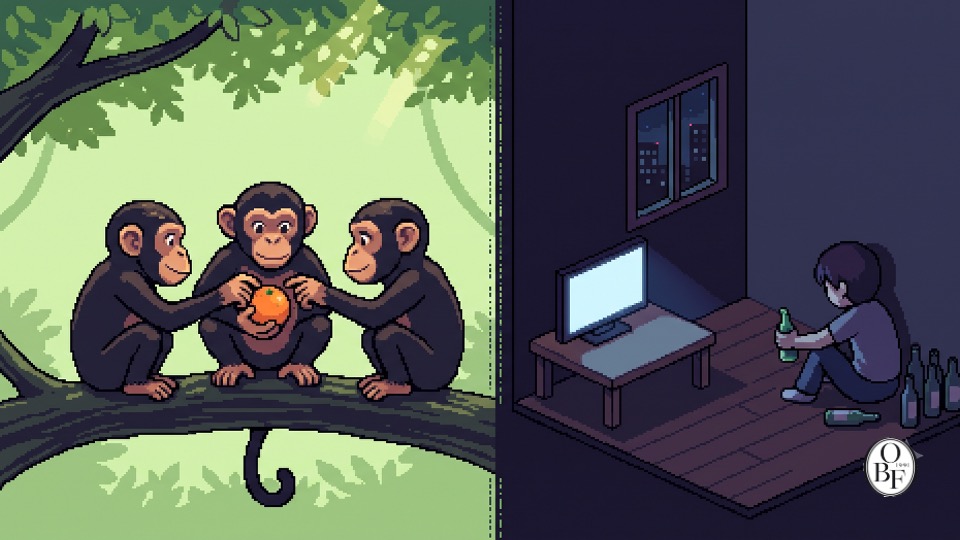
The second is a bit more interesting. In 2025, a camera trap in Cantanhez National Park in Guinea-Bissau, West Africa, captured footage that became a published paper. It showed wild chimpanzees sharing fermented African breadfruit with each other. The fruit’s ethanol concentration topped out around 0.6%. That same year, another research team discussed this sharing behavior in connection with the origins of human feasting culture.
I want to draw a clear line here. What these studies actually claim is that fermented fruit is linked to social bonding—nothing more. The idea that sharing functions as a mechanism for limiting portion size is my own interpretation. Structurally, though, I think it’s a natural inference: when a limited resource is split among many, there’s less room for any single individual to binge.
Humanity removed the first of these two caps. Distillation did it. Before distillation technology, which originated in Central Asia, reached Europe in the Middle Ages, alcoholic drinks that humans could consume generally topped out below 5%. But once distillation spread, liquids at 12%, 20%, 40% entered everyday life. This is why we need to distinguish between the low-concentration alcohol found in fermented fruit and the concentrated liquor produced by distillation.
And right now in Korea, the second cap is starting to change.
Alcohol Content Is Falling, So Why Do the Numbers Diverge?
It’s true that Korea is drinking less. Shipment volumes and per-capita consumption figures are both declining clearly.
Shipments of diluted soju fell from 915,596kL in 2019 (before the pandemic) to 792,912kL in 2025 — a drop of about 13%. Beer fell 7.2% in 2025 alone. According to the Korea Health Promotion Institute, per-capita domestic alcohol consumption among people 15 and older dropped 18%, from 8.4 liters in 2015 to 6.9 liters in 2023. Real household spending on alcohol has declined for ten consecutive quarters, falling to a monthly average of ₩13,000 (~$9.4) per household in Q1 2026.
Alcohol content keeps dropping too. Chum Churum, a leading soju brand, launched in 2006 at 20% ABV and has been diluted eight times since, down to 16% ABV. Saero went from 16% ABV to 15.7% ABV this January, and Chamisul was adjusted to the same level in June. We’ve entered the era of 15%-ABV soju. The non-alcoholic and low-alcohol market is estimated to have grown from around ₩20 billion in 2021 to roughly ₩200 billion in 2025.
According to the Korea Disease Control and Prevention Agency’s analysis of its 2025 Community Health Survey, the high-risk drinking rate3 among men fell across every age group over the past decade. Men in their 20s saw the sharpest relative decline, from 17.8% to 10.4% — a 41.6% drop. Men in their 30s fell from 25.5% to 16.3%, a 36.1% decline. This is the group most affected by the shrinking of hoesik, the mandatory after-work company drinking gathering.
Women show the opposite pattern. Only women in their 20s declined, from 9.2% to 7.5%. Women in their 30s rose from 6.8% to 8.1%, and women in their 40s rose from 5.8% to 7.6%. That 40s group posted the largest relative increase of any gender-age combination — 31.0%. Women in their 50s and 60-plus also edged up slightly.
The Korea Disease Control and Prevention Agency’s National Health Information Portal sums up the situation precisely: overall drinking volume is falling, but as drinking habits change, high-risk drinking is rising within specific generational and gender groups. And it points to the spread of honsul (solo drinking) and homsul (drinking at home) as the shift in habits behind it.
The international comparison sharpens the picture further. In the OECD’s 2025 health statistics, Korea’s monthly binge-drinking rate ranked fifth-highest among 27 comparable countries as of 2023. Alcohol content is dropping, shipments are falling — yet Korea’s binge-drinking ranking remains near the top.
There’s data pointing the other way, of course. A survey report by Pickply from early 2026 found that only about 2% of respondents who had recently attended a drinking occasion felt they’d been pressured to drink, and argued that honsul and homsul — which peaked during the pandemic — are actually moving back outdoors. A 2025 survey by the Daehaknaeil 20s Research Lab found that 45.3% of respondents had drunk alone within the past 3 months, roughly on par with drinking with friends (49.9%) or family (48.0%). Among unmarried single-person households, though, the figure was noticeably higher, at 58.1%.
These two surveys look contradictory, but I think they’re capturing the same phenomenon from different angles. What matters isn’t whether you’re drinking alone — it’s that nobody’s keeping track of how many drinks you’ve had anymore. At a hoesik, the person next to you knew exactly how many glasses you’d downed. Pressure to drink came from that setting, but so did the mutual awareness of how much everyone was drinking. Once the pressure disappeared, so did the chance to track each other’s intake. Whether I’m drinking with friends or alone, I’m now the only one who knows my running total.
One more thing worth noting. Reading the decline in alcohol content purely as a response to consumer demand is only half the story. Industry data show that every 0.1 percentage-point drop in soju’s ABV saves about ₩0.6 in cost per 360ml bottle. Ethanol is the single largest line item in major alcohol makers’ raw-material purchases, accounting for 35–46% of the total. Health trends and margin protection just happen to point in the same direction. Both are real, but corporate ABV cuts shouldn’t be mistaken for evidence of society’s growing sobriety.
Oswarld’s Lens
I don’t see this structure as just a story about drinking. It’s a textbook case of a broader problem: when you eliminate a system, you often lose the side functions it quietly performed — functions that had nothing to do with its original purpose.
In my consulting work, I’ve helped with organizational culture transformation projects many times. Cutting back on hoesik (company dinners with mandatory drinking) came up as an agenda item almost everywhere, and I was generally in favor. Forced drinking sessions deserve to disappear. But the implementation plans always had only one side of the ledger worked out. What to eliminate was spelled out in detail; what would replace the function of the thing being eliminated was left blank.
Hoesik was a setting that pressured people into drinking, but it was also a setting where everyone could see how much everyone else was drinking. How much the new hire drank, which team lead was struggling — all of it surfaced there. It was a bad mechanism, but at least it was visible. Now it isn’t. Changes in high-risk drinking rates among women in their 40s are hard to detect just by watching hoesik gatherings. It hasn’t been proven that the decline in hoesik caused the rise in high-risk drinking in this group, but the question of how to track drinking volume at all deserves separate thought.
This pattern repeats identically in GTM (go-to-market) work. It happens whenever a bad KPI gets scrapped. Retiring a flawed metric is the right call, but the field-level information that metric happened to surface alongside its flaws disappears with it. Then, a few quarters later, the question comes back around: “why did nobody notice this?” The same thing happened during the shift to remote work. Commuting was eliminated, but most organizations never decided what would replace it as a way to gauge each person’s actual workload.
So I have doubts about the direction of moderation campaigns. Most of the messaging targets individual willpower. But the reason chimpanzees don’t get drunk isn’t willpower — it’s the 0.3% ceiling. Whatever intervention actually works on humans is probably cut from similar cloth: caps on alcohol content, mandatory labeling, restricted sales hours, and above all, a way for people to track their own total consumption. Right now, people check their bank balance every day but have no idea how much they drank in a week.
For reference, the World Health Organization’s position is that there is no safe level of alcohol consumption for health. It’s also worth remembering that switching to lower-alcohol drinks doesn’t guarantee lower total intake — lower alcohol content can just mean drinking longer and more often.
Closing
First, the drunken monkey hypothesis kept its name but lost its substance. Wild chimpanzees consume the human equivalent of more than two drinks a day without getting drunk. What evolution handed down wasn’t a taste for intoxication — it was a sensitivity to trace amounts.
Second, alcohol intake in the wild is capped for two reasons. Yeast stops producing ethanol once concentration hits 10-15%, so fermenting fruit never gets any stronger. And fermented fruit tends to get shared among many mouths. Humans eliminated the first constraint the moment we invented distillation.
Third, South Korea’s overall drinking is clearly declining. But while the indicator for men in their 20s dropped 41.6%, the indicator for women in their 40s rose 31.0%. I think we also need to consider that as shared drinking occasions shrink, so do the chances to gauge each other’s consumption. That said, this single factor can’t fully explain why the two indicators moved in opposite directions.
I’d like to suggest just one thing to try this week: count, in glasses, everything you drank over the past week. Not how many times you drank — the total number of glasses. If you can’t quite remember, that itself tells you something: your own total intake has become invisible even to you. That’s the point this piece was trying to make.
Is there a habit that’s actually grown since your hoesik — after-work drinking gatherings — declined? It doesn’t have to be alcohol — delivery food, gaming, short-form video all count. Tell me in the comments about any experience where moving from a shared, visible setting to a solitary one caused your total consumption to rise.
💬 Tell us in the comments about a habit that grew after your hoesik gatherings declined — we’ll factor it into the next issue. 📨 If a colleague has recently brought up drinking culture, send them this piece.
The draft matches the source accurately with no distortions, omissions, number mismatches, or glossary violations. No corrections needed.
Keep the perspective, not the noise.
We choose one consequential shift and trace what sits beneath it, every other day.
Confirm once to finish subscribing.
Already a subscriber? Sign in to join the conversation


References & Further Reading
Primary sources
- Stephens, D. & Dudley, R., “The Drunken Monkey Hypothesis”, Natural History, December 2004 issue. ··· This is where today’s piece starts. Reading the 20-year-old original alongside the papers that followed shows how much more precise the hypothesis has become.
- Maro, A., Sandel, A. A., Blaiore, B. Z. A., Wittig, R. M., Mitani, J. C. & Dudley, R., “Ethanol ingestion via frugivory in wild chimpanzees”, Science Advances, 2025. Link ··· This is the source for the “14g a day” figure. The table of ethanol concentrations across 21 fruit species is the highlight.
- Campbell, C. J., Maro, A., Weaver, V. & Dudley, R., “Dietary ethanol ingestion by free-ranging spider monkeys (Ateles geoffroyi)”, Royal Society Open Science, 2022. Link ··· The first study to directly measure alcohol intake in wild primates. Start with the section on detecting urinary metabolites.
- Bowland, A. C. et al., “Wild chimpanzees share fermented fruits”, Current Biology, 2025. ··· A study that caught on camera the moment chimps share fermented fruit with each other. I used this as the basis for the “second ceiling” in today’s piece.
- Janiak, M. C., Pinto, S. L., Duytschaever, G., Carrigan, M. A. & Melin, A. D., “Genetic evidence of widespread variation in ethanol metabolism among mammals: revisiting the ‘myth’ of natural intoxication”, Biology Letters, 2020. Link ··· The most useful counterargument to this hypothesis. If you want balance, read this alongside the rest.
- Korea Disease Control and Prevention Agency, “2025 Community Health Survey: Analysis of Drinking Indicators,” July 2026. ··· The source for the 41.6% drop among men in their 20s and the 31.0% rise among women in their 40s.
- Korea Health Promotion Institute, 2025 Alcohol Statistics Compendium. ··· Contains the trend data on per-capita consumption.
- Tax Statistics Portal (TASIS), shipment statistics by liquor type. Link ··· Lets you check the raw shipment figures for soju and beer directly.
Background
- Dudley, R., The Drunken Monkey: Why We Drink and Abuse Alcohol, University of California Press, 2014. ··· The book written by the hypothesis’s own originator. At 154 pages, it’s short enough not to feel like a burden.
- Carrigan, M. A. et al., “Hominids adapted to metabolize ethanol long before human-directed fermentation”, PNAS, 2015. ··· The study on the ADH4 mutation. This is where you can confirm the significance of that 10-million-year mark.
- OECD, Health at a Glance 2025. ··· Contains Korea’s international ranking for binge-drinking rates.

📝 Glossary
Footnotes
-
Ethyl glucuronide and ethyl sulfate: byproducts left behind when the body processes alcohol. Finding these two substances in urine is evidence that alcohol was actually consumed and metabolized. They’re also used in human drinking tests. ↩
-
ADH4: one of several enzymes that break down alcohol, present in the mouth, esophagus, and stomach — meaning it’s the first enzyme alcohol encounters upon entering the body. Variation in how well this enzyme performs from person to person is one factor behind differences in alcohol tolerance. ↩
-
High-risk drinking rate: the proportion of people who consume 7 or more drinks (for men) or 5 or more drinks (for women) in a single sitting, more than twice a week. This is the official indicator used by the Korea Disease Control and Prevention Agency, and the key point is that it captures repetition, unlike occasional binge drinking. ↩
Related issues
Insightful's 92% Utilization Score Doesn't Add Up
A vendor's own CEO says scores above 90% look suspicious, even as its customer testimonials brag about hitting 92%.
SocietyKentucky Mother and Daughter Reverse $26M Land Deal
A Kentucky mother and daughter signed a $26.48 million land deal, then reversed it after an NDA hid what the buyer really wanted.
SocietyJD.com's 150,000 Free Helmets — and One Hidden Camera
JD's free smart helmets for delivery riders hide a built-in camera, and I wonder who profits from that first-person footage.
Society
Your take shapes the next issue
What resonated most in this issue, or where has your experience been different?