

Kentucky Mother and Daughter Reverse $26M Land Deal
A Kentucky mother and daughter signed a $26.48 million land deal, then reversed it after an NDA hid what the buyer really wanted.
SocietyWhy a Kentucky Mother and Daughter Walked Back Two ₩39 Billion (~$28 million) Land Deals
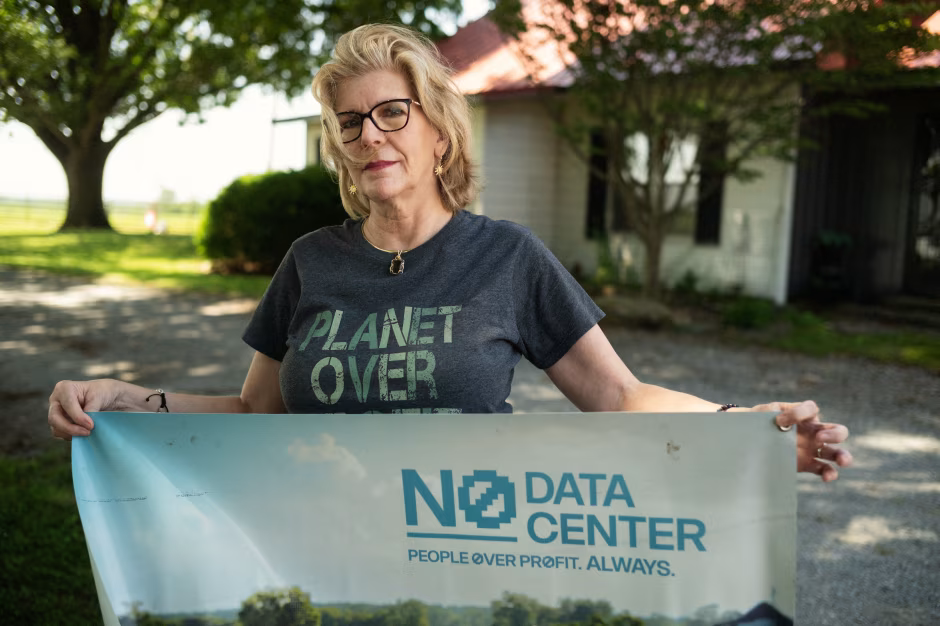
Maysville, Kentucky is a small town of 8,700 people. Last year, an unfamiliar company approached farmers there and offered to buy their land — at roughly 10 times the going market rate.
Delcia Bear and her mother, Ida Huddleston, were offered a combined $26,480,000 — about ₩39 billion in Korean currency. They signed at first. Then, months later, they walked the deal back.
Stories like this usually end with some version of “some things matter more than money.” But what actually unraveled this deal wasn’t the size of the check — it was information. The two women reversed their signatures only after they learned what clauses were buried in the contract and what was actually going to be built on their land. And the thing that had been blocking that information all along was a non-disclosure clause the buyer had inserted into the contract to close the negotiation quickly.
A ₩39 Billion (~$26.7 Million) Offer Landed on the Table
The deal on Bear’s farm was to buy 463 acres at $48,000 per acre, and on the mother’s land, 71 acres at $60,000 per acre. Combined, the two parcels come to $26.48 million.
Let me put that against income levels in Maysville. The median household income here is about $39,000. That’s less than half the US average, and nearly 40% below the Kentucky state average. One in four residents lives below the poverty line. So this is money that changes a life completely.
The reason for buying the land was a hyperscale data center1 spanning 2,080 acres. Its power capacity is 2.2 gigawatts — roughly the electricity used simultaneously by 1.65 million households. In other words, a facility consuming as much power as several mid-sized cities combined was about to move in next to a town of 8,700 people.
 There were clearly attractive terms from the region’s perspective, too. 400 full-time jobs, plus hundreds of construction workers. Given that this county’s working-age population is only about 11,000, that’s not a small number. Projections suggested property and facility taxes could double or triple the city budget, and there were pledges of at least $15 million for police, fire, and emergency services, plus $80 million for water system upgrades. For context, the water pipes in this town burst about once a month.
Tyler McHugh, the local economic development officer, summed up public opinion this way: 20% strongly opposed, 20% strongly in favor, and the remaining 60% just want the debate to be over. I found myself curious about what that 60% — the ones who just want it to end — actually know.
The Line on Page Seven of the Contract
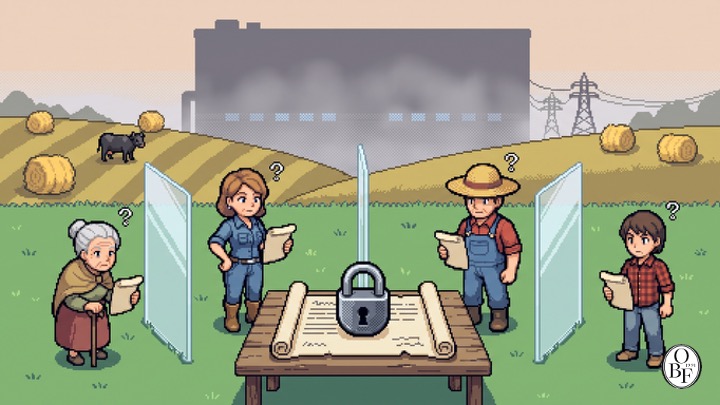
At the top of the seventh page of the purchase agreement was a clause. It stated that no information related to this transaction could be disclosed—verbally or in writing—to any other individual or organization. Bear’s mother, Huddleston, reportedly got angry at this clause. And she did exactly the opposite of what it demanded. She called her neighbors together and started comparing the offers each of them had received.
Here’s why this scene matters: up to that point, none of the sellers had any basis for judging whether their terms were good or bad. The figure of “10 times market rate” was information the buyer’s side had provided. They had no idea what the house next door was getting, what would be built on the land, or who the buyer actually was. The one line the development agent could disclose was “a Fortune 500 tech company.”
Economics calls this situation information asymmetry2. When only one side knows the true nature of a deal, the market stops being a matter of price and becomes a matter of trust. And in a market where trust has collapsed, even good terms get rejected.
That’s exactly what happened. In July 2025, residents learned that the project was a massive data center. Bear succeeded in unwinding both contracts—his own and his mother’s—on the grounds that they had signed without fully understanding the buyer’s plans. What’s interesting is how the buyer’s side responded. According to McHugh, the company would have terminated the contracts anyway. Having a reluctant seller as a neighbor, they said, wasn’t a good way to start.
To be fair, one thing should be noted here: a nondisclosure agreement isn’t inherently a malicious device. The moment a candidate site becomes known, land prices spike, competitors move in nearby, and all negotiating leverage disappears. For a company comparing multiple sites, an NDA is a rational tool. It’s standard practice in the data center industry, in fact, and McHugh himself had signed one, which put him in the position of being unable to disclose what he knew.
The problem lies in the premise the tool was designed around. NDAs are built on the assumption that the counterparty is a company. But here, the counterparty was a neighborhood community that had lived in the same place for nearly 200 years. In a place where knowing each other’s business is simply the norm, cutting off information doesn’t help a negotiation—it breaks the trust between neighbors instead.
The people who benefit and the people who bear the cost aren’t the same
Blocking information hides one more thing: the fact that benefits and costs flow to different people.
The person who sold the land gets a check. The person who didn’t gets no payment at all — and a 2.2-gigawatt facility next door. Behr himself admits the irony. His refusal alone doesn’t stop the data center from getting built. In fact, the company simply redrew its plans around the land of those willing to sell. That leaves an ending where the people who said no bear the burden with no compensation at all.
This structure produced a lawsuit. Opponents filed two suits challenging the ordinance and the rezoning3, but under Kentucky legal procedure, they had to name as defendants the landowners who had consented to the rezoning. People who’d never expected to see the inside of a courtroom found themselves served with legal papers by neighbors living 3 kilometers away. The judge assigned to the first case was found to have a conflict of interest — his spouse, as county clerk, had been taking the meeting minutes, and his nephew was active in an online group supporting the project — so the case was transferred to another jurisdiction. In the fallout from the litigation, the company delayed its payments for the land it had bought, leaving other farm owners who were waiting on that money caught in the same bind.
By contrast, there’s a case where disclosure created bargaining power the moment it happened. The 28 households in a mobile home park located on the site were initially notified they’d receive $20,000 in relocation costs. Janet Garrison, a former local IT instructor, contacted a television station and arranged interviews with elderly residents; within days, the relocation payment rose to $50,000. Garrison later ran for county commissioner on an anti-project platform and lost by 75 votes out of 1,631 cast.
Here’s the upshot: secrecy protected the buyer’s bargaining position, but it also stripped the community of its ability to reach its own consensus. When nobody knows who’s getting how much, collective action becomes impossible, and all that’s left is everyone fending for themselves amid mutual distrust.
For what it’s worth, the buyer’s identity still hasn’t been officially confirmed. Public records requests turned up circumstantial evidence that the registered agent of the corporation set up for this project had been involved in several projects later revealed to be Meta sites — but Meta’s position is that it has made no decision to enter that region. I think it’s premature to name the company at this stage. Still, I want to flag that the very fact that it can’t be named is the core of today’s story.
What’s missing in Korea isn’t information — it’s process
There’s a reason this story is hard to dismiss as somebody else’s problem.
In 2025, at least 48 data center projects across the United States were halted or delayed by resident opposition. Korea’s own recent tally shows something similar: of 33 data center permit cases in the greater Seoul metropolitan area, 17 were delayed or scrapped due to resident opposition. That’s more than half. In Doksan-dong, Geumcheon District, Seoul, construction was fully halted and the case went to litigation over the revocation of the building permit. In Yongin and Anyang, Gyeonggi Province, the plans were withdrawn. In Goyang, the project was pushed back roughly 10 months. And in Ichon-dong, Yongsan District, Seoul, the fight is still ongoing.
 In Korea, the identity of the developer is generally known from the start. There’s little of the Kentucky-style anonymous land buying. And yet projects still get delayed or killed by resident opposition.
So what’s missing in Korea isn’t information about the buyer. It’s a defined process for when, in what capacity, and on what matters residents get to weigh in. A resident briefing session held after the permit is effectively locked in isn’t a briefing — it’s a notification. And once you’ve been notified rather than consulted, your only remaining tools are a protest banner and a lawsuit.
In the American cases, what opposing attorneys kept demanding wasn’t project cancellation — it was a Community Benefits Agreement4. If you can’t stop the company from taking its profit, the argument goes, at least put in writing what the community gets in return. Korea has essentially no equivalent mechanism. Instead, compensation tends to take the form of donations or funding for long-standing local pet projects, handed out individually. Individual payouts convert what should be a shared community burden into money for a handful of people — and that’s exactly what breeds conflict among residents. It’s the same path that led neighbors in Maysville into suing each other.
Korea’s private data center market is projected to grow from roughly ₩6,220,000,000,000 (~$4.5 billion) in 2024 to roughly ₩10,190,000,000,000 (~$7.4 billion) in 2028. Without designing the process now, a substantial share of that growth will end up tied down in permit delays and litigation.
Oswarld’s Lens
A few years ago I wrote a paper on how information asymmetry hardens into exploitative business structures. I landed on one conclusion that stuck with me. Information gaps do more damage not when one side lies to the other, but when one side is denied the material it needs to judge for itself. The Kentucky case fits that structure exactly. Nobody lied. They simply made sure no one could speak.
I’ve watched this pattern play out repeatedly in corporate strategy work. Companies treat land acquisition as a procurement problem — lowest price, shortest timeline, minimum exposure. From a procurement standpoint, an NDA is the right answer. But securing a site isn’t a transaction that ends once the paperwork clears. It’s the start of a relationship in which you’ll share water and electricity with the same neighborhood for the next 20 years. Seen that way, shutting off information from the very first conversation is a bad call.
The choice made to save time often ends up costing more time than it saved. Hiding contract details was supposed to speed up negotiations, but in Maysville it produced two lawsuits, delayed payments, and a court schedule with no end date in sight. I use a simple test in consulting: if the time you’d lose when a shortcut fails is more than three times the time it saves, it isn’t a shortcut — it’s a bet. This was, unmistakably, a bet.
And this isn’t just a data-center story. The same thing happens inside organizations. Whether it’s a business-unit reorganization or a change in HR policy, consent given by people who don’t have the full picture always gets revoked later. Not because the signature itself is invalid, but because trust evaporates the moment the missing information finally arrives. I’ve seen change-management projects treat “when to disclose” as a communications question many times over — but it isn’t a communications question. It’s a question of whether consent was ever valid in the first place.
The English draft looks accurate and complete. No Hangul characters, numbers match the source, and structure is preserved. Here’s the fragment with no changes needed:
Closing
Let me sum this up in three lines.
First, the reason they turned down ₩3.9 billion (~$2.8M) wasn’t the amount — it was information. The sellers signed without knowing what they were agreeing to, and once they found out, they reversed course.
Second, the non-disclosure agreement protected the buyer’s negotiating leverage, but it stripped the community of its ability to reach its own consensus. The result was lawsuits between neighbors and delayed payments.
Third, Korea is experiencing the same outcome even when residents know who the developer is. What’s missing isn’t information — it’s a procedure defining when and in what capacity residents get to weigh in. 17 of 33 permitting cases in the Seoul metropolitan area are currently caught in that gap.
If you’re preparing for a major change inside your organization, I’d suggest asking this question before you set a date for the announcement: once the information we’re currently withholding reaches the other party, will this agreement still hold? If it seems like it won’t, then you don’t actually have an agreement yet — you’ve just postponed the moment the pushback arrives.
What about you, Reader? If you’ve ever looked back at the full picture and thought, “I wouldn’t have agreed if I’d known this,” tell me in the comments what information was missing at the time. Once enough cases come in, I’ll put together a piece on patterns of information asymmetry inside organizations for a future issue.
💬 If you’ve ever regretted agreeing to something once you learned the full picture later, tell me in the comments what information was missing at the time. I’ll factor it into the next issue. 📨 If you have a colleague working in permitting or local negotiations, pass this issue along to them.
The draft looks accurate and complete. No Hangul remains, all numbers match, and structure/counts align with the source.
Keep the perspective, not the noise.
We choose one consequential shift and trace what sits beneath it, every other day.
Confirm once to finish subscribing.
Already a subscriber? Sign in to join the conversation


References & Further Reading
Primary sources
- Joseph Pisani, “The ‘Country Hicks’ Who Refused $26 Million from an AI Data Center”, The Wall Street Journal, 2026. ··· This is the backbone of today’s piece. Pay special attention to the passage about the 7-page non-disclosure clause in the contract.
- Ledger Independent, “Second complaint filed amid proposed data center project in Mason Co.”, July 2026. ··· The plaintiff and defendant lists from the actual complaint are here. You can see the structure that forced neighbors to name each other as defendants.
- WEKU, “Mason County gives final approval on rezoning properties for data center construction”, May 26, 2026. ··· Contains the opposing counsel’s remarks demanding a Community Benefits Agreement.
- Newspim, “Yongsan data center construction: can the August 6 resident briefing find a solution?”, Aug 6, 2026. ··· The source for the figure that 17 of 33 permitting cases in the greater Seoul metro area were delayed or scrapped. This is the evidentiary basis for the Korea section.
Background
- WVXU, “Data center near Maysville sparks debate about land use”, Aug 4, 2026. ··· The most detailed local reporting on the situation facing mobile-home park residents.
- Gihu Energy Economy, “Power- and water-guzzling data centers: 48 projects derailed by resident backlash in the US”, 2026. ··· A roundup of stalled projects across the US, showing that Kentucky is no exception.
- Electimes, “The AI Power War Has Begun”, Jan 15, 2026. ··· A feature examining both the outlook for Korea’s domestic data center market and grid bottlenecks.
Related past issues worth reading
- Issue 189: Why Google Chose a Reactor Design It Had Never Built
- Issue 173: The Luddites Never Hated the Machine — They Resisted the Terms of Its Introduction

📝 Glossary
Footnotes
-
Hyperscale data center: A massive facility housing hundreds of thousands of servers on a single site. While an ordinary data center draws 10–25 megawatts, these facilities easily exceed 100 megawatts — from the grid’s perspective, it’s like a whole new city springing up. ↩
-
Information asymmetry: A situation where one party to a transaction holds critical information the other lacks. The classic example is the used-car market, where only the seller knows about the car’s defects — leaving the buyer to judge not by price, but by suspicion. ↩
-
Rezoning: The administrative process of changing the designated use of a piece of land — turning farmland into industrial land, for instance. It requires approval from local planning commissions and councils, making it the point where resident opposition actually collides with the process. ↩
-
Community Benefits Agreement: A binding contract that a large developer signs with the local community. It locks in commitments — hiring quotas, infrastructure investment, noise limits — in writing, as a safeguard against verbal promises being reversed later. ↩
Related issues
JD.com's 150,000 Free Helmets — and One Hidden Camera
JD's free smart helmets for delivery riders hide a built-in camera, and I wonder who profits from that first-person footage.
SocietyTwitch Quietly Turned On AI Training by Default
Comparing Twitch's new AI-training toggle with a free-cleaning startup in New York shows who actually gets to consent.
SocietyThe 1979 Report That Predicted Seoul's Overcrowding
I dug up a 47-year-old land-use report—and its warnings about Seoul read like today's headlines.
Society
Your take shapes the next issue
What resonated most in this issue, or where has your experience been different?