

Xiaomi's 1.22TB/s vs Apple's 1.2TB/s: Different Scopes
Xiaomi's 1.22TB/s measures the O100 chip's near-memory bandwidth, while Apple's 1.2TB/s covers the entire 512GB unified memory.
AI & TechThe Same Week Brought Us Xiaomi’s AI Cube and a New Mac Studio
On August 24, Xiaomi held a technical briefing for its Xuanjie (玄戒, “mysterious armor”) chips and unveiled three self-developed chips along with an “AI Cube” mini PC prototype that bundles them together. Just days later, Apple rolled out a new Mac Studio powered by the M5 Max and M5 Ultra, plus a new Mac mini running the M6 and M5 Pro. Pre-orders opened on August 27, with shipping set for September 22.
So in the same week, two different AI boxes for your desk showed up. And the two announcements happened to share almost the same number. Xiaomi cited 1.22TB/s. Apple cited 1.2TB/s.
But the two figures measure different things. And there’s a more important thing the two companies have in common. Both design their own chips but buy manufacturing and memory from outside vendors. And on that supplier list sits a Korean memory company.
Spec Rundown: What Both Companies Actually Announced
Let me lay out the announcements precisely first, because the numbers get mixed together in a way that’s easy to misread.
The Xiaomi Xuanjie O3 is a SoC for flagship smartphones. It’s built on a 3nm process with 24 billion transistors and a die area of 133mm². The 10-core CPU runs up to 4.35GHz, paired with a 16-core GPU and a 200 TOPS NPU. What stands out is that it’s the industry’s first chip to support LPDDR61. It hits 10,667Mbps with 113.8GB/s of bandwidth — 48% wider than LPDDR5X 9600.
The Xuanjie O100 is a chip built for accelerating large models. It uses a 6nm process with 3D wafer-level stacked packaging, and with 28,672 effective data lines, Xiaomi claims it delivers up to 1.22TB/s of bandwidth for near-memory computing2.
The Xuanjie D100 is a chip for smart driving. It’s built on 3nm with a 20-core CPU and a 16-core NPU, supporting up to 160GB of memory. Mass production is reportedly slated for 2027.
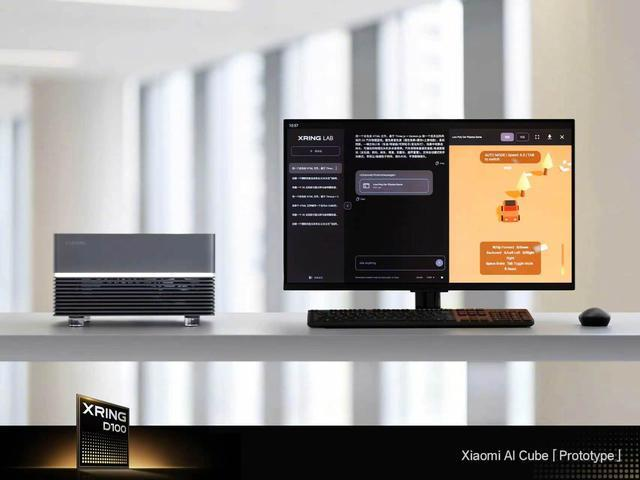
The AI Cube is the box that bundles all three together: 150W sustained performance, up to 160GB of unified memory, and the ability to run local models ranging from 3B to 120B parameters. The chassis — aerospace-grade aluminum with 33,874 CNC-drilled holes — is unmistakably built to be shown off. There’s no price and no launch date. It’s an engineering prototype.

1.22TB/s and 1.2TB/s: Numbers That Belong to Different Scopes
Xiaomi’s 1.22TB/s and 160GB aren’t figures you should read side by side.
1.22TB/s is O100’s near-memory bandwidth, and 160GB is the memory capacity D100 supports. They’re different numbers for different chips. Nowhere in the announcement does it describe a system that “reads 160GB at 1.22TB/s.”
Apple’s 1.2TB/s is a different animal. It’s the bandwidth attached to the entire 512GB unified memory pool — one chip, one memory pool.
| Max Memory | Memory Bandwidth | Scope | Price | Status | |
|---|---|---|---|---|---|
| Xiaomi AI Cube | 160GB (D100) | 1.22TB/s (O100) | Separate per chip | Unannounced | Prototype |
| Mac Studio M5 Ultra | 512GB | 1.2TB/s | Entire unified memory | ₩9,490,000 (~$6,830)~ | Ships 9/22 |
| Mac Studio M5 Max | 128GB | 614GB/s | Entire unified memory | ₩4,290,000 (~$3,090)~ | Ships 9/22 |
| Mac mini M5 Pro | 64GB | 307GB/s | Entire unified memory | ₩2,990,000 (~$2,150)~ | Ships 9/22 |
| Mac mini M6 | 32GB | 170GB/s | Entire unified memory | ₩1,499,000 (~$1,080)~ | Ships 9/22 |
| NVIDIA DGX Spark | 128GB | 273GB/s | Entire unified memory | $3,999 | On sale |
Lay it out in a table and the real meaning of this announcement becomes visible. Loading an entire large model into memory and reading all of it at 1.2TB/s — right now, only Apple can do that.
This is the price a heterogeneous-chip design pays. Xiaomi has stitched together three chips with different characteristics, but you can’t simply add up each chip’s bandwidth and capacity and use the sum. Moving data between chips takes its own process, which means you shouldn’t read each chip’s published spec as the performance of the whole system.
This isn’t about Apple being good and Xiaomi being bad. If you just pull the biggest number off each spec sheet and compare them, the two products look like they’re in the same class — but in reality, they’re entirely different kinds of machines.
The English draft is accurate and complete. No corrections needed.
Where the Process and Memory Come From
Now it’s time to look at what these two have in common.
The Xuanjie O3 is manufactured on TSMC’s N3P process. Xiaomi designs it; Taiwan fabricates it. The memory story is even more interesting. That LPDDR6 — which O3 claims to be the industry’s first to support — is widely expected to come first from SK Hynix. The company finished developing its 10nm-class 6th-generation (1c) process in March and plans mass-production shipments in the second half of the year. SK Hynix hasn’t confirmed the customer, but the industry consensus is that the first volume goes to Xiaomi’s next-generation flagship. Samsung Electronics is also in the same supply race, having unveiled its 1b-process LPDDR6 in January.
Apple’s situation isn’t so different. Apple doesn’t own a foundry either. The M-series chips are made at TSMC. Even the “unified memory” — despite the branding — is DRAM Apple buys from outside memory makers. What Apple actually owns is the design, the system integration, and the software layered on top.
Put simply, the two companies’ structures are strikingly similar.
- Design: In-house
- Manufacturing: TSMC
- Memory: External DRAM vendors
In other words, doing the design in-house while sourcing manufacturing and memory externally isn’t a Xiaomi-specific arrangement — it’s the industry’s standard playbook. Apple proved it works over 20 years, and Xiaomi is now following the same path.
This is where the difference with Huawei shows up. Because Huawei is under sanctions, it can’t access TSMC’s leading-edge process, and has to build Ascend using SMIC’s process and self-sourced memory. That makes Huawei’s chip both a symbol of technological self-reliance and the product of process constraints. Xiaomi, sitting outside the sanctions line, can simply buy the best foundry and the best memory available. The reason Xiaomi’s chip uses a more advanced process than Huawei’s isn’t superior technology — it’s the difference between being sanctioned and not.
The O100’s use of 6nm with 3D stacking reads the same way. HBM3 is expensive, and supply is effectively locked up by data-center GPUs — hard to fit into a consumer device. So Xiaomi took a workaround: stacking compute and memory directly at the wafer level to shorten the distance between them. And in areas where the leading edge isn’t necessary, it saves cost by using a process generation behind.
Why the autonomous-driving D100 ended up in a desktop AI box
In this presentation, the thing I lingered on longest was the D100.
The D100 is a smart-driving chip, and it’s sitting inside a desktop AI box. That looks strange at first, but once you line up the requirements, it makes sense. An automotive AI chip needs to support large-capacity memory, keep heat and power under control, and run reliably in an always-on state. That’s almost exactly what a local LLM box needs too.
So Xiaomi didn’t build a new chip for a new category. It simply added one more use case for a chip it was already building for cars. The picture is one chip family spanning phones, cars, appliances, and PCs. It’s the same structure Apple used when it scaled up its A-series for the iPhone and carried it over to the Mac — only the direction is different.

To be honest about it, the AI Cube is still a prototype. There’s no price, no release date, and given that mass production of the D100 is slated for 2027, this box won’t become an actual product to buy until at least the year after next. Meanwhile, the Mac Studio ships next month. That gap in timing — the AI Cube arriving at the earliest the year after next, the Mac Studio next month — is the real distance between the two companies right now.
Oswarld’s Lens
I disagree with reading this announcement as “China’s semiconductor rise.” If anything, the launch made it clearer than ever that leading-edge process nodes and memory still have to be bought from outside China. But that’s true of Apple too.
What catches my attention is that you can open a new category with design alone. One thing I’ve seen repeatedly while building GTM strategy is that new categories aren’t opened by the company that invented a component — they’re opened by the company that redefines how existing components combine.
If that’s the case, Xiaomi’s battleground isn’t performance — it’s price. Apple sells 512GB of unified memory with 1.2TB/s of bandwidth starting at ₩9,490,000 (~$6,850). For Xiaomi to matter in this market, it needs to either put out similar specs at half the price or capture the low end that Apple doesn’t bother with at all. That’s exactly what Xiaomi has done best for the past 15 years.
I run local AI myself. I keep a Mac Studio as a resident inference server and use a MacBook as the client, and hooking a coding agent up to a local model now actually works. Still, I’m cautious about saying it works “with no constraints at all.” It hits a wall in two places. If the context window is set too small, the beginning of a long conversation gets silently truncated without warning, and on hard reasoning tasks that span multiple files, retries noticeably pile up.
So my read is that local isn’t replacing the cloud — work is splitting into two kinds. Repetitive, sensitive tasks are moving to local, while tasks that require difficult judgment stay on the cloud. What both companies are chasing is the market that’s shifting to local, and there, the battleground is likely to be memory capacity and price — not performance.
Closing
Let me sum this up in three lines.
- Xiaomi’s 1.22TB/s and Apple’s 1.2TB/s apply to different scopes. Loading an entire large model at once and reading all of it at that speed is something only Apple can do right now.
- Neither company is fully self-sufficient — both follow a model of designing in-house while sourcing everything else. Both depend on TSMC’s process and memory from outside DRAM makers, so structurally they’re the same. The reason Xiaomi can do what Huawei can’t isn’t technology — it’s whether you’re inside or outside the sanctions line.
- Local AI hardware isn’t opening up as a new category — it’s emerging as a derivative market off existing chip families. For Xiaomi, that root is its autonomous-driving chip; for Apple, it’s the iPhone chip.
When you read a spec announcement, I’d suggest starting by separating out which chip each number belongs to and what scope it applies to. In presentations that lump together chips with different characters, just making that distinction alone filters out a good deal of the exaggerated comparisons.
💬 Has anyone here tried pairing a coding agent with a local model? Tell us in the comments — along with the model name — what kind of work stayed local and where you ended up falling back to the cloud. Once we’ve gathered enough cases, I’ll put together a “tasks safe to run locally” list for the next issue.
📨 If you have a colleague weighing a Mac Studio configuration, please pass this piece along to them.
Keep the perspective, not the noise.
We choose one consequential shift and trace what sits beneath it, every other day.
Confirm once to finish subscribing.
Already a subscriber? Sign in to join the conversation


References & Further Reading
Primary sources
- Apple Newsroom, “Apple unveils new Mac Studio with M5 Max and M5 Ultra,” August 2026. Link ··· The 512GB, 1.2TB/s, ₩9,490,000 (~$6,860) baseline this piece compares everything against comes straight from here.
- Apple Newsroom, “Apple unveils even more powerful Mac mini featuring the all-new M6 and M5 Pro,” August 2026. Link ··· This is where you can check pricing and bandwidth for the entry tier of local AI. The M6’s 32GB and 170GB/s is a realistic floor.
- IT之家, “Xiaomi AI Cube prototype unveiled,” August 24, 2026. Link ··· The most detailed original writeup of the day-of specs. Start here if you want the three chips’ numbers broken out separately.
- Notebookcheck, “Xiaomi unveils AI Cube mini PC with three Xring chips and 150 W performance,” 2026. Link ··· This is where the D100’s 2027 mass-production plan is laid out.
- HotHardware, “Xiaomi Taps TSMC For 3nm Xring O3 Chip With LPDDR6,” 2026. Link ··· The source for the N3P process, 24 billion transistors, and 133mm² die — the key evidence behind the assembly thesis.
- Herald Corp, “[Exclusive] SK Hynix to mass-produce LPDDR6 in H2, Xiaomi first customer,” July 28, 2026. Link ··· Shows where Korean memory fits into this picture, including a note on CXMT’s market share.
- MoneyToday, “Xiaomi phone resembling the Fold8 incoming — ‘industry-first LPDDR6’ as its own-chip gambit,” August 25, 2026. Link ··· The most accurate domestic Korean coverage of the O3’s numbers. I confirmed the 113.8GB/s figure and the 48% improvement claim here.
Background
- EXO Labs, “Combining NVIDIA DGX Spark + Apple Mac Studio for 4x Faster LLM Inference.” Link ··· Useful for anchoring reference points like the DGX Spark’s 128GB and 273GB/s. Gives you a feel for why bandwidth and capacity move independently.
- Guides for hooking up Ollama and Codex CLI to local models ··· Covers the process of wiring coding agents to local models, along with fixes for the problem of context getting silently truncated.

📝 Glossary
Footnotes
-
LPDDR6: The next-generation standard for the low-power DRAM used in smartphones and laptops. It can move more data on the same amount of power than the previous generation, LPDDR5X. AI models often bottleneck on moving data rather than on computation itself, so for on-device AI, this standard shift translates directly into perceptible performance gains. ↩
-
Near-Memory Computing: A design that places the compute chip and memory physically as close together as possible to shorten the distance data has to travel. Think of it like moving a warehouse right next to the factory. Shorter distance means more data moved in the same amount of time, and less power used doing it. ↩
-
HBM (High Bandwidth Memory): Memory made by stacking DRAM vertically to dramatically boost bandwidth. It’s mostly used in AI accelerators, but it’s expensive and production volume is limited, so putting it into personal devices remains difficult for now. ↩
Related issues
My Laptop Got Stuck on 'Thinking' Forever
Running Qwen 3.8 27B locally, I got no answer—only an endless "thinking" spinner—until I traced it to mismatched default settings.
AI & TechNvidia Raises Server Prices 15% on Memory Costs
Nvidia admitted it can no longer absorb rising memory costs, and that says a lot about where AI chip competition is headed.
AI & TechWhy Alibaba Put 51 Billion Parameters in CPU RAM
Alibaba stores 51 billion N-gram parameters in server RAM, not GPU HBM—raising questions about its release-night numbers.
AI & Tech
Your take shapes the next issue
What resonated most in this issue, or where has your experience been different?