

US Federal White-Collar Prosecutions Fall to 340 in a Month
Federal white-collar prosecutions dropped 14.4% year-over-year, and I ask what falling oversight means for corporate diligence.
Business340 White-Collar Prosecutions in a Month from US Federal Prosecutors
In March 2026, US federal prosecutors filed 340 new white-collar crime cases. That’s down 14.4% from the same month a year earlier. Widen the lens to the first half of the fiscal year and you get 2,008 cases — at this pace, the full 2026 fiscal year, which ends in September, will land somewhere in the 4,000s. That’s a sixth lower than five years ago, and roughly half of what it was 20 years ago.
So have America’s executives and financiers gotten that much more honest in two decades? There’s not much reason to believe that.
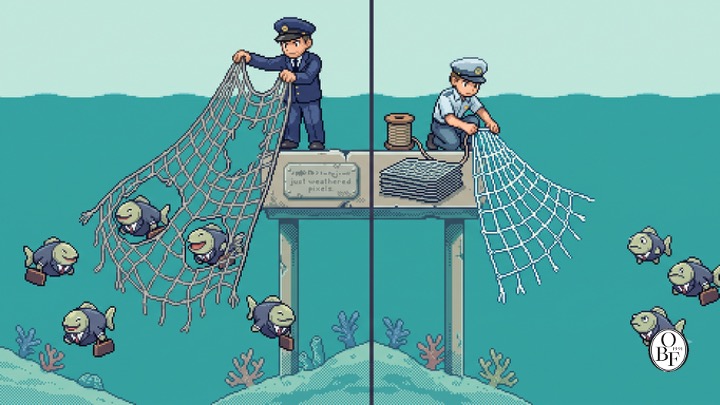
I’ve been paying attention to what happens to the burden on investors and counterparties when public oversight recedes. When it becomes harder to trust that regulators are doing the verifying, companies may end up having to check things for themselves.
Prosecutions, Prosecution Rates, and Accounting Sanctions Are All Down
Data compiled by TRAC (Transactional Records Access Clearinghouse), a U.S. judicial data repository, shows the decline across three separate metrics.
The first is the number of prosecutions. Prosecutions, which topped 10,000 a year around 1995, briefly rebounded in 2011 in the wake of the financial crisis before resuming their decline. They now sit in the 4,000s.
The second is the referral-to-prosecution rate—the share of cases that investigative agencies refer to prosecutors that actually result in charges being filed. This rate, which stood at nearly half a decade ago, fell to a third by 2025. Over the same period, immigration-related cases were prosecuted almost every time they were referred. That said, this figure alone can’t cleanly separate the effects of staff shortages from shifting case priorities.
The third is accounting and audit sanctions outside of criminal prosecution. The accounting oversight apparatus built up over more than 20 years since Enron’s collapse has gone noticeably quiet. According to consulting firm Cornerstone Research, sanctions imposed by the U.S. Securities and Exchange Commission (SEC) against accounting and audit firms fell 68%, from 31 cases in 2024 to 10 in 2025—a 9-year low. Even more dramatic are the fines: over the same period, they dropped from $907 million to $3.1 million, roughly a 300-fold decline. Sanctions from the Public Company Accounting Oversight Board (PCAOB)1 also fell, from 51 cases to 37, with associated fines cut in half.
The number of attorneys at the U.S. Department of Justice has shrunk by a fifth under the current administration. Much of the remaining staff has been reassigned from areas like cryptocurrency and tax to immigration enforcement.
Why White-Collar Cases Keep Shrinking
There’s a common misreading I need to clear up first. It’s hard to pin this decline entirely on the Trump administration. The trend itself has been running for nearly 30 years. It’s just that the drop in recent years has been especially sharp.
One factor worth examining is the budget and staffing required to process these cases.
White-collar cases follow a completely different cost curve than other crimes. In drug or immigration cases, the evidence is right there at the scene, and the processing cycle is short. Building a single financial fraud case, by contrast, can take dozens of lawyers several years. A separate TRAC analysis found that over the year ending September 2022, prosecutors spent an average of 452 days reviewing whether to refer white-collar cases. That’s more than 3.5 times the average across all case types.
Here’s what that means: the moment budgets get trimmed even slightly, white-collar investigations are the first thing cut. They’re the most expensive per case and the slowest to produce results. After 9/11, investigative manpower shifted toward counterterrorism; more recently, immigration and drug enforcement have taken that same spot. A 2021 study by Trung Nguyen, then at Harvard Business School, analyzed the effects of this post-9/11 shift of investigative resources toward counterterrorism. It’s worth reading that period as distinct from the recent reallocation of personnel.
And there’s a timing problem layered on top of this. Many white-collar crimes in the U.S. carry a 5-year statute of limitations. Even if the next administration decides to redeploy investigators, if the statute of limitations expires in the meantime, prosecution can become impossible. Ramping up enforcement staff later doesn’t mean you can go back and catch every case that slipped through in the interim.
The economist John Kenneth Galbraith coined the term “bezzle”2 in 1955. His point was that during boom times, an undetected inventory of embezzlement quietly accumulates, only to be exposed when the market collapses. Enron and WorldCom blowing up after the dot-com bubble was exactly that cycle playing out.
Right now, U.S. asset prices are red-hot again — the perfect condition for bezzle to build up. The problem is that this time, the mechanism meant to expose it has grown noticeably thin.
Looking at the fragment, I compared it against the Korean source carefully.
The English draft is accurate in meaning, structure, and numbers. Let me verify:
- Headings: 1 heading (
##) — matches source. - Numbers: 2001, 33%, 10%, 1.6%, 2021, $830 billion — all present and match source digits.
- No Hangul characters present.
- No footnotes/links/images in this fragment — none in source either.
- Paragraph count and bullet list structure match.
- Bold text positions match the source’s bolded claims.
One issue: the dollar amount “$830 billion” should follow the glossary rule of first ₩ amount formatting — but this is USD, not KRW, so that rule doesn’t apply. The number is correctly preserved as digits.
Minor polish: “no new fraud surfaced” phrasing and flow are fine; no distortions found.
The draft is faithful and clean. Only very minor stylistic tightening needed.
Where does the cost go when oversight shrinks
This is the crux of today’s issue.
A study by Alexander Dyck of the University of Toronto, along with Adair Morse and Luigi Zingales, published in the Review of Accounting Studies, offers a useful reference point. They treated the 2001 collapse of the accounting firm Arthur Andersen as a natural experiment: when Andersen’s clients suddenly came under intense re-monitoring, fraud that had previously gone unnoticed came to light. By working backward from how much new fraud surfaced once scrutiny intensified, they estimated the detection rate under normal conditions.
Here’s what they found. Only about a third of corporate fraud gets caught. Roughly 10% of large public companies are engaged in conduct equivalent to securities fraud in any given year. The resulting losses were estimated at 1.6% of equity value annually — which translates to $830 billion as of 2021.
This study shows that you can’t gauge the true scale of fraud just by looking at detected cases. That said, the 33% detection rate estimated from historical data can’t simply be applied to today’s U.S. market as-is. Whether weaker oversight is increasing undetected fraud right now is a question worth examining — but this study doesn’t measure any current increase.
Let’s push one step further, though.
For companies, regulatory oversight has long been treated purely as a “cost” — audit responses, disclosure preparation, compliance staffing. So when oversight weakens, it looks like that cost simply goes down.
I think that math is only half the picture. Public oversight was actually a verification service shared collectively by every market participant. Audited financial statements carried credibility not because accounting firms were excellent, but because there was an enforcement body standing behind them, ready to impose sanctions. Once that body goes quiet, the value of the financial statement as a signal drops right along with it.
So does verification just disappear? No — it gets pushed onto individual actors.
- Investors attach a risk premium. That means the cost of capital goes up.
- Counterparties widen the scope of due diligence. First-pass verification that used to end with checking an audit report and a sanctions record now falls to in-house investigation.
- Companies have to prove their own credibility. To stand apart from the rest, they end up having to disclose more, not less.
I believe that as public oversight weakens, the burden of separate private verification can grow. Investors will scrutinize transaction risk more closely, and companies may find themselves directly checking a partner’s financial standing and sanctions history. Smaller companies that can’t afford their own due-diligence teams will have a harder time responding to this added scrutiny. Still, whether the combined cost of public and private verification stays constant overall, and how much financing rates actually shift, are questions that need to be measured separately.
Korea Is Moving in the Exact Opposite Direction
Korea has been on a streak of tightening its investigation and enforcement of unfair trading practices. The scope of U.S. white-collar crime overall and Korean capital-market cases isn’t directly comparable, but the shifts in enforcement staffing and institutions are worth setting side by side.
In 2025, the Korea Exchange referred 98 suspected unfair-trading cases to the Financial Services Commission. Of these, misuse of undisclosed information accounted for the largest share at 58 cases (59.2%), followed by fraudulent trading (18 cases) and price manipulation (16 cases). By market, KOSDAQ accounted for 66 cases (67.3%) — more than double KOSPI’s 28. The average illicit gain per case rose 33%, from ₩1.8 billion (~$1.3M) in 2024 to ₩2.4 billion (~$1.7M) in 2025.
The institutional changes are moving even faster.
Starting in January 2024, regulators gained the legal basis to impose fines of up to twice the illicit gain for the three major categories of unfair trading. The design is explicit: don’t wait for criminal prosecution — claw the money back first through administrative penalties. In July 2025, a “one-strike-out”3 policy was formalized: a single violation now triggers not just a heavy fine but also a bundled package of restrictions — a ban on serving as an executive at a listed company, and account freezes.
 The enforcement apparatus itself is expanding. On July 30, 2025, the Financial Services Commission, the Financial Supervisory Service, and the Korea Exchange jointly launched a “Joint Response Unit to Root Out Stock Manipulation.” Starting with 36 people at launch, the team had grown to 62 people across 6 teams by April 2026, with a target headcount of around 100. The unit’s entire reason for existing is to cut investigation-and-review time from the current 1.5–2 years down to 6–7 months. The Exchange has also compressed its own review period, from 6 months to 3.
And in May 2026, reports emerged that the Financial Services Commission is pushing to delegate its coercive investigation powers — search and seizure, on-site inspection, confiscation — to the Financial Supervisory Service. Purely in terms of headcount, this makes practical sense: the Financial Supervisory Service has roughly 80 investigators versus the Commission’s roughly 10. This would effectively restore a power that vanished 22 years ago, after Korea’s Board of Audit and Inspection ruled in 2004 that “a private body holding coercive investigation powers is inappropriate.”
One country is scaling back oversight; the other is scaling it up. Over the next five years, it will be possible to compare the cost of capital between the two markets. But interest rates, industry composition, business cycles, and other factors also diverge, making it hard to isolate the effect of enforcement changes alone.
Oswarld’s Lens
I’m interested in how stronger enforcement in Korea might affect market trust and the cost of raising capital.
Reducing the “Korea discount” is a major challenge here. Low corporate valuations have many causes, but trust in financial disclosures and market order is one factor worth examining. I think stronger enforcement could be a lever for raising that trust. In the US, too, we need to watch how changes in public oversight feed into companies’ verification burdens and deal terms.
While building GTM strategies, I’ve run partner and vendor due diligence more times than I can count. It used to be that first-pass screening was fairly simple: check the audited financials, look up any regulatory sanctions history, skim the litigation record, and that would filter out most problems. All three of those checks rested on one assumption — that someone else had already verified this. Lately, looking at US partners, I get the sense that assumption isn’t as solid as it used to be.
Here’s the one suggestion I want to offer practitioners: stop treating compliance as a “regulatory cost” and start treating it as a “deal term.”
As oversight weakens, regulatory risk does go down — that part’s true. But the burden of directly verifying a counterparty’s fraud or non-performance can rise. And unlike fines, which are predictable amounts, that burden shows up as deals collapsing entirely. In a market where public verification has weakened, staying voluntarily verifiable becomes something you get a premium for — in financing terms and in contract terms. Not because you’re afraid of an audit, but because that’s what sells.
Of course, this doesn’t apply equally across every industry. The effect will be larger in regulated industries and large-scale procurement markets, and slower to show up in B2C consumer goods.
Closing
Here’s today’s story in three lines.
- U.S. white-collar enforcement has seen a sharp recent drop layered on top of a 30-year downward trend. Prosecutions are half what they were 20 years ago, and SEC accounting and auditing penalties have fallen to roughly 1/300th of their prior level in just a single year.
- As public oversight weakens, investors and counterparties may need to verify more things on their own.
- In Korea, capital market enforcement is being strengthened. I want to look at how this shift affects market trust and companies’ cost of capital.
Because of the 5-year statute of limitations, much of what happens during this current gap won’t be reversible even if attitudes change later. So this isn’t a problem where “the next administration can fix it” — it’s a problem that requires each of us to adjust our own due diligence standards right now.
If you’ve run due diligence on a partner company or vendor in the past 1-2 years, have you noticed more items that now require direct verification than before? If you let me know in the comments which items got added, I’ll gather what practitioners are actually reinforcing and put together a summary in the next issue.
💬 If you’ve added new items to your due diligence checklist, tell me in the comments. I’ll try to reflect it in the next issue. 📨 If you think this piece would help a colleague working in finance, investment, or partnerships, please share it.
Keep the perspective, not the noise.
We choose one consequential shift and trace what sits beneath it, every other day.
Confirm once to finish subscribing.
Already a subscriber? Sign in to join the conversation


References & Further Reading
Primary sources
- Transactional Records Access Clearinghouse, “White Collar Crime Prosecutions for March 2026”, Syracuse University, 2026. Link ··· This is the raw monthly data. If you want to trace the long-term trend yourself, start here.
- The Economist, “There’s never been a better time to commit financial fraud”, 2026. ··· The article that sparked today’s newsletter. The interviews with US insiders are especially good.
- Cornerstone Research, “SEC Accounting and Auditing Enforcement Activity: 2025 Year in Review”, 2026. Link ··· The original source for the 10 SEC accounting/auditing enforcement actions and the $3.1 million in penalties. It also includes the PCAOB figures.
- Dyck, A., Morse, A., & Zingales, L., “How pervasive is corporate fraud?”, Review of Accounting Studies, 29(1), 2024. Link ··· The core evidence behind today’s piece. The identification strategy in chapters 3–4, which uses the Arthur Andersen collapse as a natural experiment, is the highlight.
- Korea Exchange Market Surveillance Commission, “2025 Status of Unfair Trading Referrals”, March 2026. ··· The source for the 98 cases, the 59.2% share involving use of undisclosed information, and the ₩2.4 billion (~$1.7 million) in average illicit gains per case.
- Financial Services Commission, “Comprehensive Measures to Eradicate Stock Manipulation and Other Unfair Trading”, July 2025. Link ··· The original text laying out the one-strike-out rule and the joint response task force design. The original document is far more detailed than any news summary.
Background
- John Kenneth Galbraith, The Great Crash 1929, Houghton Mifflin, 1955. ··· The book that coined the term “bezzle.” Written 70 years ago, but it’s even scarier to read now.
- Trung Nguyen, “The Effectiveness of White-Collar Crime Enforcement”, Harvard Business School, 2021. ··· An empirical study of how white-collar enforcement weakened as investigative resources shifted toward counterterrorism after 9/11.

📝 Glossary
Footnotes
-
PCAOB (Public Company Accounting Oversight Board): A US body created after the 2001 Enron scandal to oversee accounting firms. Think of it as the organization that re-checks whether the accounting firms that performed an audit actually audited properly. ↩
-
Bezzle: A term coined by economist John Kenneth Galbraith for the total sum of embezzlement that has already occurred but that no one has yet noticed. During this window, both the thief and the victim feel rich — the thief has the money, and the victim doesn’t yet know it’s gone — so society’s perceived wealth briefly inflates. ↩
-
One-strike-out: A sanctions scheme under which a single detected instance of unfair trading triggers not just a fine but also a bundle of penalties at once — restrictions on serving as an officer of a listed company, limits on trading financial investment products, and more. The design intent is to deny offenders any chance at a second violation. ↩
Related issues
Insightful's 92% Utilization Score Doesn't Add Up
A vendor's own CEO says scores above 90% look suspicious, even as its customer testimonials brag about hitting 92%.
SocietyWhy AI Agent Recommendations Fail: Not Yet One Category
Different tools are all sold as 'AI agents'—compare their autonomy, execution rights, and approval steps before you pick one.
BusinessWhat $100 of AI Capex Buys, and How Long It Lasts
Using BNP Paribas's capex breakdown, I trace chip, network, power, cooling, and facility costs—and why replacement cycles vary by supplier.
Business
Your take shapes the next issue
What resonated most in this issue, or where has your experience been different?