

The AI Comedian With 300K Followers Stole Every Joke
AI-generated comedians are lifting American stand-up sets verbatim, and Korean comedy stands on the same exposed ground.
BusinessAI took the joke about AI taking our jobs
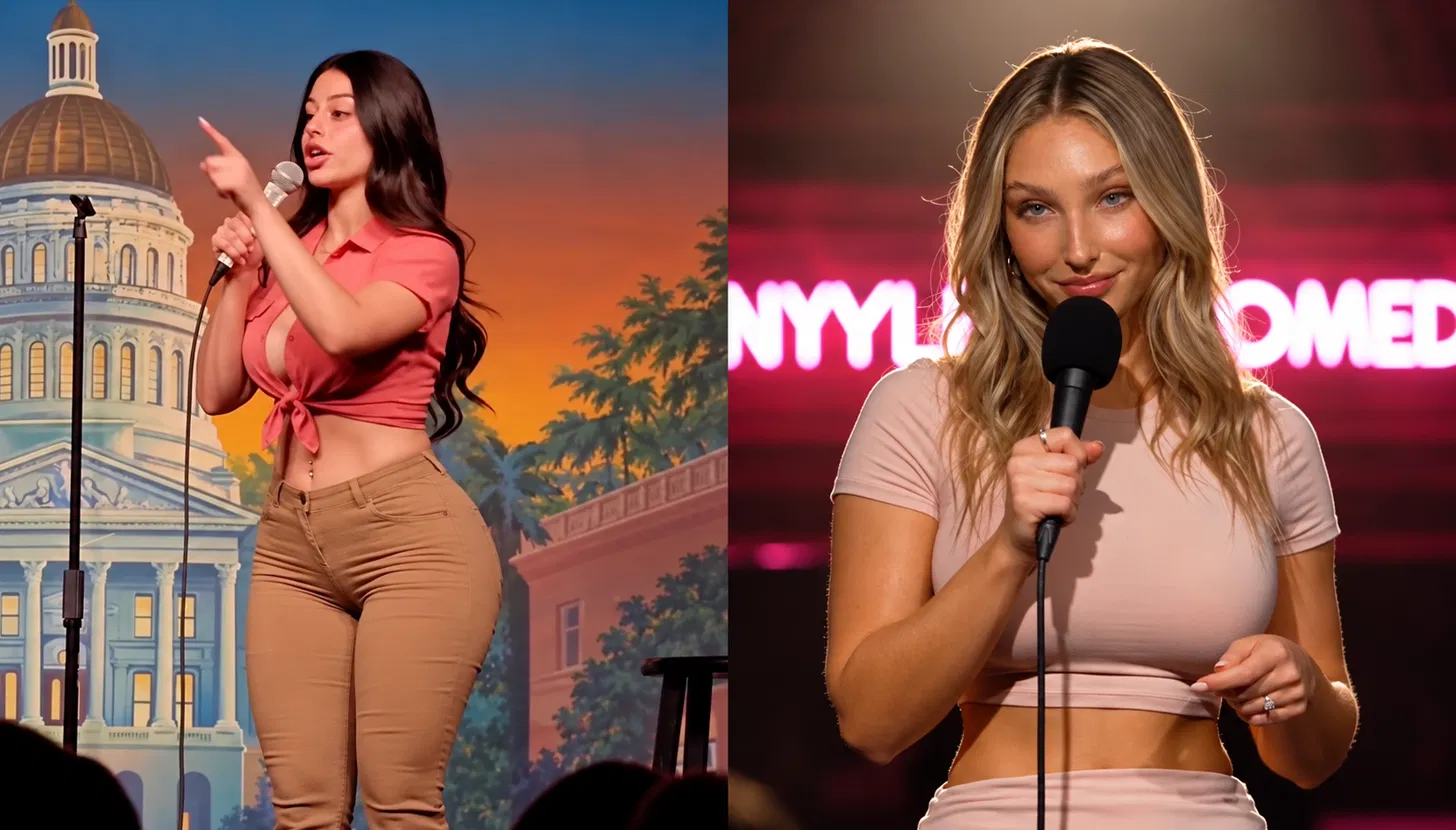
Reader, a joke by American comedian George Brett Olson got copied word for word this month. The bit was about AI threatening human jobs, with billionaires like Instagram parent company co-founder Mark Zuckerberg playing their part in it. The account that performed the exact same joke, without changing a single word, was an Instagram account with 300,000 followers. The stage backdrop matched the venue where Olson had performed, and even the outfit was similar. The only differences: the performer standing on that stage was an AI-generated woman who doesn’t actually exist, and the account linked out to OnlyFans, the adult subscription platform.
Olson posted a side-by-side video of the two clips, calling it “the most ironic thing that’s ever happened to me.” A few days later, comedian Julia Jaesunas posted something similar. An AI comedian on an account with 250,000 followers had performed Jaesunas’s joke verbatim — down to an ad-libbed line Jaesunas had thrown at an audience member.
I watch a lot of Korean stand-up comedy, and I think the same thing is about to happen there, at scale. Today I want to walk through what happened in the US, why reporting these accounts hasn’t stopped them, and where Korean stand-up stands on exactly the same exposed ground.
How These Accounts Actually Operate
The UK comedy outlet Chortle tracked down a string of accounts running the same playbook. One, called “Aylen Skye,” lifted jokes from comedians Jaesu Nas, Czar Lamtin, Olivia Carter, and Hannah Berner — bits about dating an older man, about asking a personal trainer out. A clip recreating a scene from the British sketch show The Sketch Show racked up more than 660,000 views on TikTok. The account that ripped off Olsen’s material was called “Tiffany Sloane.”
Instagram instagram.com
Instagraminstagram.com
The mechanics are simple. First, pick a joke that’s already been battle-tested on stage and online. Then re-shoot it with an AI-generated female performer in revealing clothing lip-syncing the bit. Once the views and followers pile up, drop an OnlyFans or FanVue1 link in the bio or story. The funnel is built to pull people in for a laugh and send them straight to a subscription page.
The speed is striking, too. According to foreign press reports, Tiffany Sloane’s first post went up on September 11, and by October 5 the account had around 375,000 followers — in under a month. On October 4, a16z partner Justine Moore called it a “genius OnlyFans marketing hack,” and was promptly criticized for it.
Follower counts vary by outlet. Olsen cited 300,000; Gizmodo put it at 375,000; Moore said 360,000. Other accounts were tallied at 180,000, 240,000, and 250,000. The discrepancies likely come down to different accounts and different measurement dates. What’s clear is that these accounts grew into the hundreds of thousands.
How much money these accounts actually make is unclear. Ryan Broderick of the newsletter Garbage Day estimated, based on publicly visible like counts, that Tiffany Sloane’s OnlyFans earnings probably top out at a few hundred dollars a month — an outside estimate, to be clear. Broderick also noted that several accounts share the same images and posting patterns, suggesting this isn’t a single operator but possibly a content farm running multiple accounts in parallel. The AI video tool company Higgsfield has even advertised that its models can produce viral clones like these.
Reported It — “Not a Violation”
Comedians put their faith in the platform. The results weren’t good. Olson said his followers reported the accounts, but Instagram’s reporting tools were no help. As he put it: “The most absurd part is that this isn’t a Terms of Service violation.”
Jesunas’s case makes the problem even clearer. According to reports, when Jesunas filed an impersonation report, Meta rejected it on the grounds that the AI performer wasn’t pretending to be Jesunas.
This is the crux of the whole affair. Right now, platform reporting systems are built almost entirely around one question: “Who is pretending to be whom?” Fake accounts, deepfakes, stolen faces and voices — these are all framed as identity problems. But these accounts never stole a comedian’s face. The face was invented from scratch — what got stolen was the joke. There are rules to protect identity, but no rules exist for when someone else’s work gets grafted onto a brand-new face.
Instagram’s head, Adam Mosseri, responded in an Instagram comment: “I don’t think banning AI content from the platform is realistic. It’s only going to get harder to identify, and not all of it is bad. That said, we’re investing heavily in driving traffic to original creators, and if an AI creator is copying content wholesale, it’s worth figuring out what we can do about that. I don’t know yet what that looks like, but I’ll talk to the team.” A Meta spokesperson added that the same problem is cropping up on other platforms like YouTube and TikTok.
There’s also the legal route. But the math doesn’t work. Olson said an intellectual property lawyer told him that unless the other side is pulling in millions of dollars on OnlyFans, bringing up a lawsuit would cost more than it’s worth. If Broderick’s estimate is right — that a single account might earn only a few hundred dollars a month — the picture becomes even starker. It costs almost nothing to copy a joke, each account only makes small money off it, and the time and expense of fighting back falls entirely on the comedian, alone.
Taking content down doesn’t end it, either. Olivia Carter had been blocked by the first account, so she couldn’t even see its posts. A friend’s report got one post taken down — but the same joke resurfaced on a different AI account soon after.
What a comedian loses isn’t just one joke
Where Carter’s anger landed was unexpected. He told Straight Arrow News that “it wasn’t upsetting that someone stole my joke.” What worried him was that viewers believed an AI performer had written it. Jes Tom had the same worry. These accounts were going viral, and people thought they were real people.
Since then, Carter has stopped posting new jokes online, sticking to old material or crowdwork2 clips. Another comedian, Sarah Tiana, said she’s reconsidering whether to keep posting online at all.
Why this choice carries so much weight is captured in what Jes Tom said: “When a comedian posts a standup clip online, it’s to get people to come see live comedy.” A short clip is promotional material for a live show. But it’s also proof of authorship. Jes Tom said that posting a clip first creates a “timestamp” with your name attached to the work, and Tiana said having the clip makes it easy to prove the joke is hers.
So the easier copying becomes, the harder it gets for comedians. Post a new joke and it’s easy to steal; don’t post it, and you lose both the channel that brings in audiences and the proof that it’s yours. As more comedians like Carter pull back from posting new material, the pipeline that once turned clip views into theater seats may weaken too.
Korean stand-up comedy draws crowds through the same channel
Let’s turn to Korea. A story Segye Ilbo, a major South Korean daily newspaper, ran this past August describes a structure for Korean stand-up that’s almost identical to what Jaesunass described. As the narrow gate of broadcaster open auditions has shrunk, YouTube and short-form platforms have become comedians’ channel for promotion and distribution. Short clips posted to YouTube Shorts and Instagram Reels work as trailers, and people who watch them go find the live show.
Wonsoyun built a name for herself as her self-deprecating jokes spread on YouTube, and Isangjun Show drew roughly 18,000 people across 10 cities last year. Dedicated venues like Metacomedy Club in Hongdae, a nightlife and youth-culture district in Seoul, host regular shows. (Personally, I’d really recommend “Scratch,” the episode with Wonsoyun and Park Cheolhyun. It’s genuinely funny.)
What’s also worth noting is the kind of jokes the AI theft accounts in the US tend to pick. Straight Arrow News reported that the jokes these accounts used were mostly about dating or about the experience of being a woman — material that lands immediately without setup and still gets a laugh even when cut down short.
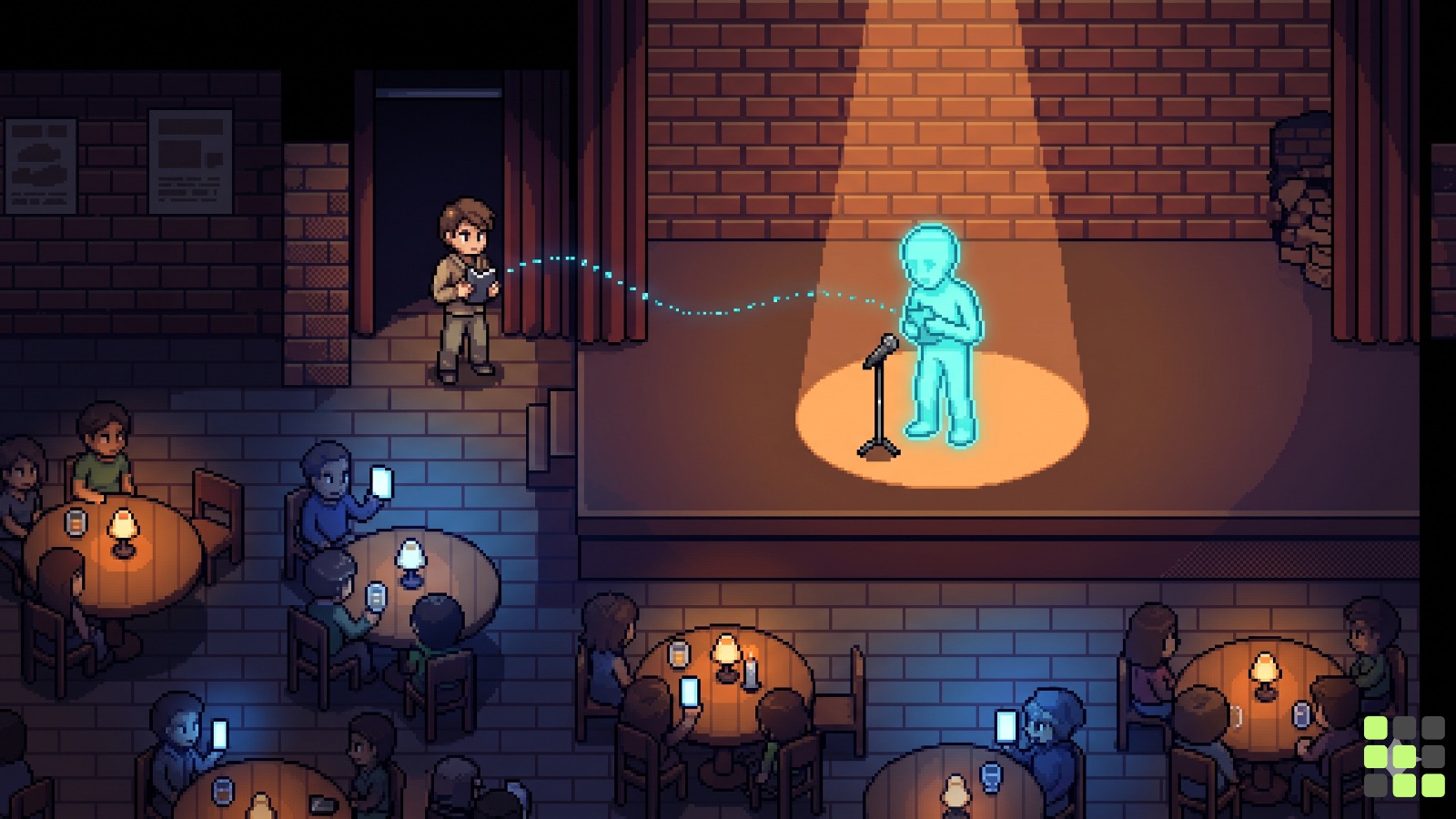
Copyright law. Korea’s copyright law defines a work as “a creative production that expresses human thought or emotion,” and lists lectures and speeches as examples of literary works. The definition of a performer includes “oral narration” (guyeon). That means spoken-word pieces performed on stage, and the performances themselves, can fall within the scope of the law. But whether a single short joke clears the bar of originality, and whether rights can actually be enforced against an anonymous overseas account, are different questions. The cost problem American comedians ran into doesn’t simply disappear in Korea.
AI Basic Act disclosure obligations. Article 31, Section 3 of the AI Basic Act, which took effect on 1/22/2026, requires that when providing a synthetic video or similar content that’s difficult to distinguish from reality, the provider must clearly notify or label it so users can recognize it was made by AI. The party bound by this obligation is the “AI business operator.” Whether an individual running one of these accounts counts as such an operator remains open to interpretation. There’s also a more fundamental limitation: a disclosure label can tell you “this performer isn’t human,” but it can’t tell you “this joke belongs to someone.”
Platform monetization policy. According to a report from Newsis, a South Korean news agency, YouTube has started excluding channels that mass-produce near-identical AI videos, or that churn out formulaic content with only minor variations, from ad revenue eligibility. But these accounts make their money off-platform — the revenue comes from whatever’s on the other side of the subscription link. Cutting off ad revenue is unlikely to put direct pressure on accounts like these.
Oswarld’s Lens
I watch a lot of Korean stand-up comedy. And I think the same thing that’s happening on American accounts is about to happen a lot in Korean stand-up too.
The reason I see it that way is that the conditions American accounts leaned on exist in Korea as well: short clips spreading through Shorts and Reels, dating and everyday-life material that lands without any explanation needed, and the situation new comedians find themselves in — needing clips online just to draw an audience. The American accounts didn’t write a single new joke. All they needed was already-proven clips and a generation tool.
Korean has, up to now, been a kind of fence. But AI translation and voice synthesis are lowering that fence from both sides. Korean jokes could end up coming out of the mouth of an AI performer in another language, and jokes from the English-speaking world could just as easily come out of a Korean-speaking AI performer’s mouth. In that second case, Korean viewers have almost no way of recognizing the original.
There’s something audiences can do too. As Jaesunas (a comedian cited earlier in this series) put it: go to live shows, and when you share a clip, share the video from the comedian’s own account instead of a reupload account. It’s a small difference, but given that proof of origin and the channel for gathering an audience sit on the very same video, which clip you share becomes a way of standing on the comedian’s side.
Closing
These accounts didn’t write their own jokes. The cost of grafting someone else’s joke onto a different face has nearly disappeared, and in an age where views equal money, this kind of theft is happening abroad first. I think Korean stand-up comedians are exposed to the same risk, since many of them also build their audiences through Shorts and Reels. The same comedy bits could simply get copied and performed identically by an AI-generated, appealing character. Fortunately—if that’s the word—Korea has organizations like Metacomedy Club and Seoul Comedy Club, so some kind of organized response does seem possible.
💬 Think back to a comedy short you watched recently — do you even remember the comedian’s name? If a name comes to mind, drop it in the comments.
📨 Pass this piece along to a friend who loves stand-up.
Already a subscriber? Sign in to join the conversation


References & Further Reading
Primary sources
- WIRED, “AI-Generated Hot Girls Are Ripping Off Comedians to Boost Their Horny Content,” October 2026. ··· This is the article that sparked today’s piece. The cases of Olson and Jaesoonas, Mosseri’s comment, and Meta’s spokesperson statement all come from here.
- Steve Bennett, “The AI ‘comedians’ stealing jokes wholesale”, Chortle, October 15, 2026. ··· The most thorough breakdown of which account lifted whose jokes.
- Kyle Torpey, “AI ‘comedians’ are stealing jokes on Instagram to sell OnlyFans subscriptions”, Gizmodo, October 6, 2026. ··· Confirms when the accounts launched, how fast followers grew, and OnlyFans’ rules on AI content.
- Rosie Thomas, “Have you heard the one about AI stealing real comedians’ work?”, Straight Arrow News, September 30, 2026. ··· The report that first covered this phenomenon. It includes the story of Carter no longer posting new jokes.
- Ryan Broderick, “A genius OnlyFans marketing hack”, Garbage Day, October 7, 2026. ··· An analysis that examines revenue estimates and the possibility of a content farm behind this. Keep in mind the revenue figures are estimates based on public metrics.
Korea Context
- Lee Bok-jin, “Unpredictable wit… gut-punched, belly laughs!”, Segye Ilbo, August 18, 2026. ··· Covers how Shorts and Reels have become trailers for Korean stand-up comedy.
- Shim Ji-hye, “‘AI copy-paste videos’ no longer sell… YouTube blocks ad revenue”, Newsis, July 26, 2026. ··· Summarizes the revisions to YouTube’s monetization guidelines.
- Korea Law Information Center, “Copyright Act,” Articles 2 and 4; “Framework Act on the Development of Artificial Intelligence and Establishment of Trust,” Article 31. ··· You can read directly the definitions of copyrighted works and performers, along with the obligation to label AI-generated content.

📝 Glossary
Footnotes
-
Fanvue: A subscription platform where creators sell content to paying subscribers. It permits AI-made creators to operate as long as they disclose they’re AI. ↩
-
Crowd work: A stand-up technique where comedians improvise with the audience in real time instead of relying on prepared material. Because the exchange only happens in that moment, it’s difficult to lift and reuse directly. ↩
Related issues
Inside AI Chips, the Memory Interface Eats the Edge
On Nvidia's Rubin die, HBM4 controllers and PHY reportedly claim about 16% of the priciest silicon real estate.
BusinessDark Patterns: Do Users Search for the Law or Coupang?
Korea's FTC released new dark pattern guidelines, revealing a stark divide between what the law bans and what frustrates users.
BusinessThe Same EMF-Blocking Sticker Test, Run Four Times in 12 Years
Government notices say both 'it's safe' and 'reduce exposure' on the same page
Business
Your take shapes the next issue
What resonated most in this issue, or where has your experience been different?