

Anthropic Earned $16.8B in Q3. Why Call It 'Over'?
What comparison makes 45% quarterly growth look disappointing—and a slowdown cause I experienced firsthand.
BusinessAnthropic made $16.8 billion in three months, and people said it’s over
On Wednesday, October 14, Anthropic held a pre-IPO investor meeting at its San Francisco headquarters. Here are the numbers that came out of it: $4.7 billion in revenue for Q1 2026, $11.6 billion in Q2, and $16.8 billion in Q3. Quarterly revenue had grown roughly 12x year-over-year, and the company said it had posted two consecutive profitable quarters on an adjusted basis. I’ll note upfront that this wasn’t an official disclosure — it comes from Reuters, CNBC, Bloomberg, and the Financial Times, all citing attendees and people familiar with the matter.
And yet the reaction was strange. The market-research account Geiger Capital posted the revenue chart with the caption: “Not good enough. It’s over.” Citrini Research chimed in with a similarly “it’s completely over” tone. Andrew Yang wrote that the quarterly growth rate of 45% would be read as a disappointment and would put pressure on the whole AI-hypergrowth narrative. Gary Marcus dug up Anthropic’s old revenue projections — implying: doesn’t this look absurd in hindsight?
Growth from Q1 to Q2 was 139%. From Q2 to Q3, it was 45%. Taken at face value, “growth slowed down” is technically correct. But if a company that just made $16.8 billion in three months is being called “over,” you have to ask: compared to what, exactly, does 45% look bad? This piece is about finding that comparison point. And since one of the reasons cited for the slowdown is something I personally experienced this year, I’ll get into that too.
Before I start, let me say upfront: I’m not a doomer here — I’m an optimist on the AI industry.
The Benchmark Was $110 Billion
The baseline for disappointment comes from a number reported by the Wall Street Journal. Investors were reportedly expecting Anthropic to hit an annualized revenue run rate1 of $110 billion by the end of this year. The run rate is calculated by multiplying the most recent quarter’s revenue by 4. Simply quadrupling Q3’s $16.8 billion gives $67.2 billion. To reach $110 billion, Q4 alone would need to bring in $27.5 billion—which would mean 64% growth over Q3. That’s asking a company that just posted 45% growth to suddenly deliver 64% in the next quarter.
Conversely, if 45% growth continues for one more quarter, Q4 revenue comes out to roughly $24.4 billion, or about $97 billion annualized. That’s almost exactly where the Financial Times’ forecast landed—“it will stay below $100 billion annualized.” SemiAnalysis, meanwhile, revised its annualized estimate upward, from $65 billion in late July to $74 billion. So here’s what’s actually happened: performance went up, estimates went up, and yet expectations were pinned even higher than both. The “disappointment” isn’t about revenue shrinking—it’s the gap between the $110 billion mark and the $97 billion mark.
Measuring the 45% figure itself with a different yardstick tells its own story. Four consecutive quarters of 45% growth compounds to 4.4x over a year—a pace almost unheard of among public software companies. But that math rests entirely on the assumption that 45% holds going forward, and given the slope from the prior quarter’s 139% down to 45%, that assumption doesn’t sit comfortably. Both things are true at once: this company is growing fast, and it’s slowing down fast.
The numbers Anthropic gave this time—and the ones it didn’t
What stands out in this round is the type of number on offer. Anthropic didn’t produce a new “annualized” figure. Instead, it gave actual quarterly revenue, paired with an adjusted operating margin2 of 11% (excluding stock-based compensation), a gross margin of 85%, positive free cash flow, and a ratio of $1.70 in revenue for every $1 spent on compute. Ed Zitron needled the company over this, quipping that Anthropic’s defenders are angry because the company didn’t hand them a shiny new annualized figure to parrot.
Back in April, in “The End of the MAU Era—Can We Even Trust MRR Anymore?,” I covered the gap between Anthropic’s announced $14 billion annualized run rate and the $5 billion in cumulative revenue disclosed in a court filing. I wrote at the time that “the makeup covering up ARR is coming off faster and faster.” This time, the company volunteered quarterly revenue up front. That’s a natural step anyway, since an IPO eventually requires audited quarterly figures. Either way, the ruler investors are handed is more honest than it was six months ago.
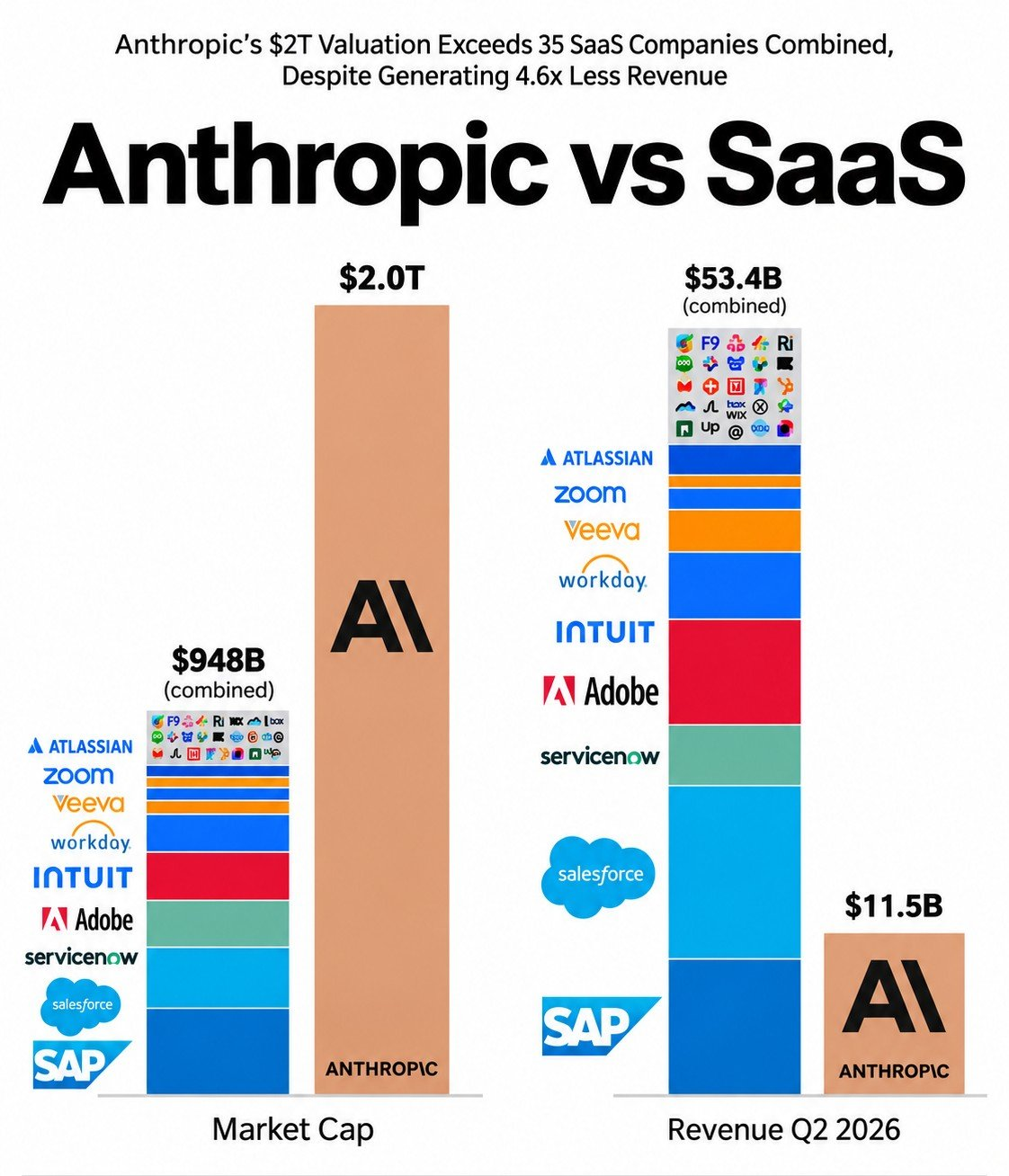
Let’s apply the same ruler to the valuation side. According to Reuters, Anthropic is targeting a valuation north of $2 trillion. Divide that by the $67.2 billion annualized run rate, and you get roughly 30 times revenue. That’s less than half of what I noted in June, in “A $135 Rocket: Dream or Bubble?,” about SpaceX’s offering price running at 94 times projected 2025 revenue, but it’s higher than the 22 times I cited for Nvidia at the time in that same piece. The logic behind the $2 trillion figure is that revenue is growing so fast the denominator will quickly expand—which is exactly why the growth rate slipping from 139% to 45% stings more than the raw numbers suggest. The price tag, after all, is a bet on how fast that denominator keeps growing.
One Reason Cited for the Slowdown Sits on My Own Desk
In a Business Insider piece, a user who sparred with Gary Marcus attributed the Q3 slowdown to the “death of token-maxing”3 and to competition from Chinese open-source models. That’s not Anthropic’s own explanation — it’s one user’s guess. But I’ve lived through exactly the mechanics of that guess this year, firsthand.
This year I changed which models I assign to long-running, highly repetitive tasks. Work I used to hand off to Sonnet-class or Luna-tier models now goes to DeepSeek and GLM. I run them on Ollama Cloud, and even burning through trillions of tokens, it’s overwhelmingly cheaper than Claude or GPT-6 — and if you set up your harness files (Skill.md, soul.md) properly in markdown, the performance holds up fine. But I still send full planning, multi-agent orchestration, and initial blueprinting to Claude or GPT-6. As I keep saying: not everyone needs superintelligence for every task. There’s a model suited to the job and the environment.
Revenue for a frontier-model company ultimately comes down to token volume times unit price. Once customers start sorting their work — sending only “judgment-required” tasks to the expensive model and routing “long-running grind” to the cheap one — the count of expensive tokens falls. The customer hasn’t left. The kind of work sent to Anthropic has just changed. In my own case, the token volume I send to Claude dropped, but the unit price of the work Claude now handles actually went up. Planning and orchestration are expensive when you get them wrong.
I should draw a line here. This is a story about my own desk — I can’t claim my usage pattern explains Anthropic’s revenue slowdown. I don’t know what share of that $16.8 billion comes from users like me, and the company has never explained the cause of the slowdown itself. What I can show is what the phrase “death of token-maxing” actually looks like in practice. The heaviest users are the first ones to start splitting their workloads.
And this figure isn’t Anthropic’s alone. I’ve recently been advising and conducting due diligence for AI data center projects across several regions, and when a review request comes in, before I look at the site or the GPU count, I check whether there’s a confirmed tenant — and whether the lending syndicate is moving on that tenant’s credit. Anthropic, having committed hundreds of billions of dollars, is a company sitting in that tenant’s seat. The moment a 45% growth rate reads as “disappointing,” what shakes isn’t just Anthropic’s valuation in a future offering — it’s also the math of the data center lenders who staked their money on that credit.
 Oswarld’s Lens
When I’m designing an enterprise deployment or an AI rollout, I always work from the premise that “the model only ever gets better.” When I’m setting up a closed-network environment for a government agency, I design the project around roughly what the open-weight model 6-12 months out will be capable of. For a company like Anthropic, this premise cuts both ways. As models improve, more work migrates to AI — which is how revenue grows 12x in a single year. But at the same time, the cheap models are improving too, so the share of that migrated work that genuinely requires a frontier model keeps getting recalculated.
That’s why, in this quarter’s numbers, I spent more time on the ratio of “$1.7 of revenue per $1 of compute” than on the growth rate itself. A growth number can be cheered or booed depending on where the bar was set. But a structure that turns $1 into $1.7 tells you something more concrete: whether expensive tokens can keep commanding a premium price, no matter how customers choose to split up the work. For me, how this ratio moves next quarter matters more than whether 45% becomes 35%.
I don’t buy the claim that it’s “over.” If a company pulling in $16.8 billion in three months, profitable on an adjusted basis, counts as “over,” I’m not sure how many companies would clear that bar. But the criticism that the math is wobbling for whoever pinned expectations at $110 billion and then priced the company at $2 trillion — that one lands. What disappointed wasn’t the company’s performance. It was the people who had staked their expectations on it.
Closing
A 45% growth rate can mean “4.4x in a year” or “falling short of ₩110 billion (~$79.7M),” depending on which ruler you use. This week’s verdict of “it’s over” came from the second ruler. Once the IPO filings are out, we’ll be able to measure it again — not against quotes from insiders, but against audited numbers.
💬 Reader, have you changed how you use AI models this year? Let us know in the comments which tasks you’ve shifted to which model.
📨 If someone around you is arguing over whether AI company earnings are “a bubble” or “not a bubble,” share this piece with them. It’ll help settle, first, which ruler they’re actually using.
Already a subscriber? Sign in to join the conversation


References & Further Reading
Primary sources
- Reuters (via US News), “Anthropic’s Q3 Revenue Surges 45% to Nearly $17 Billion”, 2026.10.14. — Source for the quarterly revenue figures ($4.7B, $11.6B, $16.8B), the $2 trillion valuation target, and the hundreds of billions of dollars in long-term commitments.
- CNBC, “Anthropic’s third-quarter revenue is said to hit $16.8 billion ahead of IPO”, 2026.10.15. — Rounds up the adjusted profitability, the $1.7 in revenue per $1 of compute (citing the FT), and the expected $110 billion annualized run-rate by year-end (citing the WSJ).
- Bloomberg, “Anthropic Revenue Jumps to $16.8 Billion in Quarter Before IPO”, 2026.10.14. — Source for the location of the investor presentation and the comments on adjusted profitability.
- Yahoo Finance, “Anthropic Reports 45% Revenue Growth to $16.8 Billion in Q3 Ahead of Planned IPO”, 2026.10.15. — Relays the Financial Times’ reporting. This is where the forecast of an annualized run-rate falling short of $100 billion appears.
- Business Standard, “Anthropic’s Q3 revenue jumps to $16.8 billion ahead of planned IPO”, 2026.10.15. — Source for the 12x year-over-year growth, the 85% gross margin, and the 11% adjusted operating margin.
- TipRanks, “Anthropic’s Q3 Revenue Jumps to $16.8 Billion Ahead of Planned IPO”, 2026.10.15. — Confirms SemiAnalysis’s revision of its annualized run-rate estimate (from $65 billion to $74 billion).
- Business Insider, “‘Not good enough. It’s over’: The AI doomers are going off on Anthropic’s revenue figures”, 2026.10. — Collects reactions from Geiger Capital, Gary Marcus, Andrew Yang, Citrini Research, and Ed Zitron. This is where the piece begins.
Past issues worth reading alongside this one
- The End of the MAU Era — Can We Even Trust MRR Anymore? ··· Covers the gap between Anthropic’s $14 billion annualized run-rate and the cumulative $5 billion figure cited in a court filing. The “run-rate” thread in this piece picks up right where that one left off.
- A $135 Rocket: Dream or Bubble? ··· Examines SpaceX’s IPO price through the lens of revenue multiples. The yardstick used to measure that $2 trillion figure was borrowed from here.

📝 Glossary
Footnotes
-
Run-rate: A figure obtained by multiplying the most recent quarter’s revenue by 4, or monthly revenue by 12, to project “at this pace, this is what a year would look like.” It isn’t actual annual revenue — for a growing company it understates the true figure, and for a company in decline it overstates it. ↩
-
Adjusted operating margin: A profitability measure calculated by subtracting items like stock-based compensation from GAAP operating income. What exactly gets added or subtracted in the “adjustment” matters as much as the number itself. In this reporting, stock-based compensation was excluded. ↩
-
Tokenmaxxing: A term used by a commenter quoted in the article. It isn’t official terminology, but in context it appears to describe a usage pattern of routing as much work as possible to expensive frontier models to maximize token consumption. Calling it a “death” signals that this pattern is coming to an end. ↩
Related issues
OpenAI Fired the Researchers Who Studied AI Oversight
A DNS leak, a canceled model launch, and three researcher firings all converged at OpenAI within a single month.
BusinessBrexit at Ten: How Much Has Britain Actually Lost?
Tracing where the '6% loss' figure comes from—and how much of it is really Covid, the energy crisis, and seven prime ministers
BusinessGoogle Open-Sources ML Drift, Its On-Device GPU Engine
I read this release through the lens of Vons, a tiny decision model I'm building for CPUs and browsers.
Business
Your take shapes the next issue
What resonated most in this issue, or where has your experience been different?