

Apple's Five New AI Models, Explained
Apple's WWDC 2026 reveal shows how on-device and cloud models split the work, with Google's tech quietly powering part of the stack.
BusinessApple’s Five AI Models, Unveiled
At WWDC on June 8, 2026, Apple unveiled its third-generation foundation models1 — five in total. Two run on-device, and three run in the cloud. It was an announcement meant to show how Apple would respond to criticism that Siri improvements were lagging and that the company had fallen behind in the AI race. What caught my attention wasn’t just the models’ performance, but Apple’s collaboration with Google and the way the models are designed around Apple’s own devices and operating systems.
Apple is drawing on Google’s models and cloud technology while also running its own training and device-level optimization in parallel. It’s a strategy that combines bringing in outside models with building its own.

Why CapEx Numbers Alone Can’t Compare AI Strategies
Companies racing to secure AI and cloud demand are planning massive capital expenditures, or CapEx2. In its February 2026 earnings call, Amazon projected roughly $200 billion in total CapEx for the year. That figure covers not just AI but other businesses too—robotics, semiconductors, satellites.
Apple’s fiscal year 2025 spending on property and equipment came to about $12.7 billion. That’s a small figure next to the major cloud providers’ direct infrastructure spending, but it’s not a number you can use to compare AI development spending on its own. R&D costs, external cloud usage fees, and model licensing deals don’t all land in the same line item.
Apple is a company that sells devices and operating systems, while Amazon, Microsoft, and Google also run businesses supplying compute infrastructure to other companies. Simply dividing figures from companies with different business structures and fiscal years and declaring “Apple invested only one-fortieth as much in AI” misses the real differences.
The core of the criticism against Apple isn’t really about spending less money—it’s about failing to deliver the AI features it promised, on time and at sufficient quality. Wall Street’s assessment, as reported by CNBC in 2025, also reflected concerns about Siri’s delays and Apple’s performance relative to competitors.
This WWDC announcement gives us material to examine where Apple is relying on outside technology and what it has decided to handle in-house.
The English draft is accurate, complete, and faithful to the Korean source. No corrections needed.
Collaborating with Google, but Training for Apple’s Own Products
Apple and Google officially announced a multi-year partnership on January 12, 2026. Under the deal, Apple’s next-generation foundation models will be built on Google’s Gemini models and cloud technology. Bloomberg had earlier reported in November 2025 that a deal worth roughly $1 billion annually was under discussion, but the two companies’ joint announcement did not disclose the contract value.
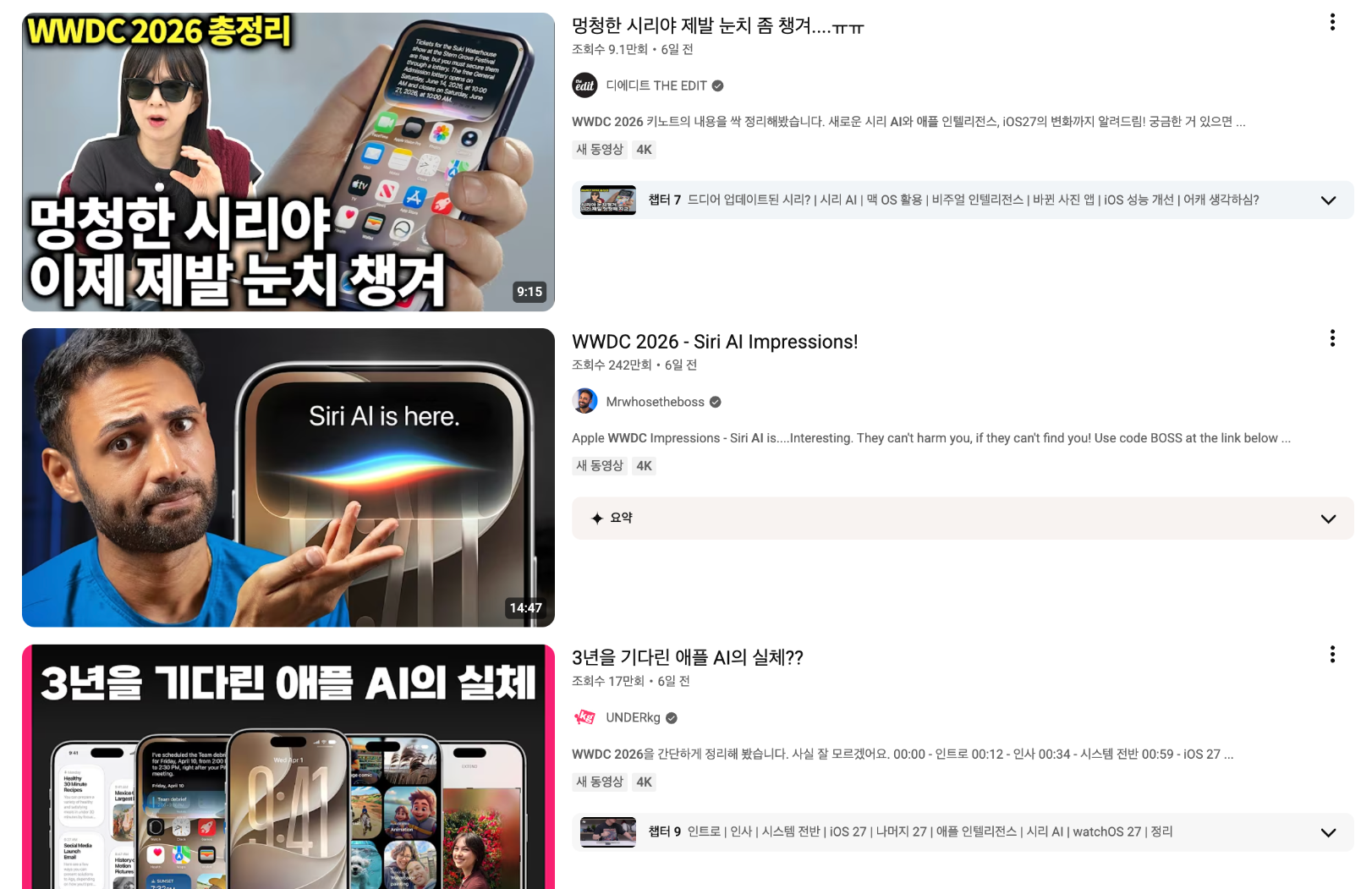
At a technical briefing held right after WWDC, Apple explained that it trained models on its own data and then further refined them using outputs from Gemini frontier models. This is related to distillation3, a technique that uses another model’s outputs as a training signal.
Craig Federighi explained that this doesn’t mean Apple is simply running Google’s consumer-facing Gemini app or Google Assistant as-is. Rather, it’s a system built to work with Apple’s operating system, its approach to privacy, and its app execution capabilities.
Amar Subramanya, Apple’s VP of AI, explained that four models — Core and Core Advanced for on-device use, and Cloud and an image model for server-side use — were built for Apple silicon. Cloud Pro, used for the most complex tasks, was designed to run separately on Nvidia GPUs within Google Cloud.
The announcement is easier to understand if you split it into the training process and the runtime environment.
- Training: Apple collaborated with Google to build a shared foundation, then carried out pretraining, post-training, and hardware optimization tailored to each model’s purpose. In describing its four models, Apple also disclosed its use of Gemini outputs.
- On-device execution: Handled by AFM 3 Core and Core Advanced.
- Cloud execution: Handled by AFM 3 Cloud, ADM 3 Cloud for image generation and editing, and AFM 3 Cloud Pro. All of these fall under the Private Cloud Compute framework.
So it’s hard to characterize this as a structure where every user request gets passed straight through to Google’s consumer Gemini service. That said, it doesn’t mean Apple’s reliance on Google’s technology and operational infrastructure has disappeared either.
This kind of collaboration is one way to put a high-performing model to work in a product. The mere fact that distillation was used doesn’t mean Apple skipped its own R&D. You have to look together at the rights to use the data and models, the training actually carried out in-house, and how the final service is operated. The industry controversy surrounding distillation is something I covered in the piece below.
Related: The Distillation Controversy Revealed in the Musk-OpenAI LawsuitFor Google, this is an opportunity to supply not just model technology but cloud infrastructure as well. Apple officially stated that it extended Private Cloud Compute to include Nvidia GPUs on Google Cloud for Cloud Pro. What conditions governed access to the training model’s weights, and how much of the infrastructure cost is baked into the contract price — these details aren’t knowable from the public disclosures alone.
Fortune tied this collaboration to a broader debate: will models become interchangeable, commodity services, or will they remain technology that continues to generate durable competitive advantage? My own read is that Apple is weighing the cost of building every model entirely in-house against the cost of leveraging outside technology, all while trying to preserve its ability to integrate deeply with its devices and OS. Whether this collaboration proves cheaper in the long run depends on the contract terms, operating costs, and performance.
How to Run a 20-Billion-Parameter Model on a Device
Core Advanced, designed to run on-device, reveals what Apple built in-house.
AFM 3 Core Advanced has 20 billion total parameters, but activates only about 1–4 billion depending on the request. It handles voice and image processing, and powers features like natural speech synthesis and dictation. Apple says it tuned this model to fit its own high-performance silicon systems. It doesn’t run on every iPhone.
The on-device language model Apple first unveiled in 2024 had about 3 billion parameters. Core Advanced’s total size is larger than that, but it doesn’t use every parameter every time. One of the design choices that makes this possible is IFP (Instruction-Following Pruning)4.
- The full model’s weights sit in the NAND flash5 storage that also holds photos and apps.
- When processing an input, the system selects which parts it needs and pulls the relevant weights into DRAM, its working memory.
- It combines a common portion that’s always used with a portion selected per request. How much gets activated depends on the task.
Unlike a typical MoE6, which swaps weights token by token, this approach avoids overloading the transfer between flash and DRAM. Core Advanced picks which parts to use based on the input, then periodically re-selects during generation. It doesn’t just choose once at the start of a request and stop there.
On-device processing has the advantage of not needing to send content to a server for inference. Complex requests can still use the cloud. Apple says it designed Private Cloud Compute so that data used to process a request isn’t stored, and can’t be accessed by Apple or any other party. It’s worth checking both the scope of what’s handled on-device versus in the cloud, and the safeguards involved at each step.
Apple already has an installed base of more than 2 billion active devices. Beyond announcing standalone new services, this lets it introduce AI features through OS updates and default apps. But the number of active devices isn’t the same as the number of AI-capable devices or actual users. Available features vary by device model, language, and region, and a single person often uses multiple devices.
In Apple’s own human evaluations, AFM 3 Cloud’s responses were preferred over its predecessor’s. In text evaluation, the new model was preferred 64.7% of the time versus 8.7% for the previous version; for image understanding, the figures were 37.8% and 9.6% respectively. The remainder reflects cases where neither was clearly favored. This is a comparison against Apple’s own prior model — not evidence that it outperforms other companies’ latest models. The Foundation Models framework, offered to developers, is another distribution channel that lets apps tap into the model directly.
I think Apple’s strength lies in integrating AI into the devices and apps people already use. But Google also delivers AI through Android and a range of default services, so it would be too simplistic to frame the competition as “one company’s app versus Apple’s entire OS.”
Oswarld’s Lens
Watching this announcement, what caught my attention first wasn’t the technology — it was the distribution strategy.
In my work on tech management strategy, I’ve repeatedly found that product performance alone rarely explains customer choice. If performance meets the purpose at hand, what matters more is how easily accessible the product is and how well it fits into existing workflows. Apple is well positioned here, since it can make AI feel like a natural extension of the devices and apps people already use every day.
As performance gaps between AI models narrow for a given task, the influence of accessibility and integration only grows. That said, I don’t think all models have converged to the same level across all tasks. Differences can still show up in complex reasoning, coding, or specific languages, and a handful of benchmark scores can’t substitute for real-world usage experience.
So rather than praising Apple’s choice as clever simply because it required a smaller investment, I read it as a strategy of splitting what to build in-house from what to source through partnership, in order to deliver value to its existing customer base. The real test is whether the benefits of product integration are worth the costs of collaboration and external dependency.
There are also limits to the rollout. At the June announcement, Apple stated that the new Siri AI would not be available at launch on iPhones, iPads, and Apple Watches in the EU. Supported Macs and Vision Pro in the EU would be treated differently, and China would not receive the new Siri AI or other new Apple Intelligence features. This doesn’t mean AFM 3 as a whole won’t function in the EU. How useful it actually turns out to be on supported devices will only become clear after the launch this fall.
Closing
Apple combined its own model training, on-device optimization, and OS integration with model and cloud collaboration from Google. It also split tasks between what gets processed on-device and what requires the cloud.
Whether this strategy succeeds depends on whether it can deliver the quality users need while managing cost, privacy, and ease of use all at once. When I look at AI companies, I think we need to look not just at model benchmark scores, but also at how those capabilities actually reach users’ devices and daily work.
💬 How much do you actually use the AI features that come built into your device? I’d love to hear what difference you notice compared to using a separate AI app.
Keep the perspective, not the noise.
We choose one consequential shift and trace what sits beneath it, every other day.
Confirm once to finish subscribing.
Already a subscriber? Sign in to join the conversation


References & Further Reading
Primary sources
- Apple Machine Learning Research, Introducing Apple’s Third-Generation Foundation Models, 2026.06.08. Covers model composition, training, memory design, and evaluation against prior generations.
- Bairu Hou et al., Instruction-Following Pruning for Large Language Models, ICML 2025. The research behind IFP, which selects which parameters to activate based on the input.
- Google·Apple, Joint statement, 2026.01.12. The official scope of the two companies’ collaboration, as disclosed by both parties.
- 9to5Mac, remarks from the post-WWDC technical briefing, 2026.06.08. Contains Federighi and Subramanya’s explanations of the model, training, and runtime environment.
Background
- Apple Security Research, Expanding Private Cloud Compute, 2026.06.08. The security architecture expanded to include Google Cloud and Nvidia GPUs.
- Apple, Siri AI announcement and scope of support, 2026.06.08.
- Apple, Fiscal Year 2025 consolidated financial statements. Shows capital expenditure on property and equipment.
- Amazon, Q4 2025 earnings release, 2026.02.05. Contains the company’s capex outlook for 2026 as of that date.
- Bloomberg, reporting on the Apple-Google AI contract negotiations, 2025.11.05. The source for the figure of roughly $1 billion a year.
- CNBC, Wall Street’s assessment of Apple’s AI strategy, 2025.07.30.
- Fortune, analysis of Apple’s AI investment and integration strategy, 2026.02.17.

Footnotes
-
Foundation Model: an AI model pre-trained on massive datasets so it can be applied broadly across many tasks. GPT, Gemini, and Claude are representative examples. ↩
-
CapEx (Capital Expenditure): spending a company puts toward facilities, infrastructure, and equipment. It can include GPU purchases and data center construction, though the specific composition varies by business. It’s distinct from R&D spending. ↩
-
Distillation: a training technique that transfers the knowledge of a large “teacher model” into a smaller “student model.” By having the student model learn to mimic the teacher’s outputs, it can achieve strong performance despite its smaller size. ↩
-
IFP (Instruction-Following Pruning): a dynamic pruning technique developed by Apple. It analyzes the user’s input (prompt) and activates only the parameters needed for that specific task. Unlike conventional pruning, which permanently shrinks a model, IFP can activate different parts of the model for each request. ↩
-
NAND flash: non-volatile memory used to store data in smartphones and SSDs. It’s slower than DRAM but offers far greater capacity and retains data even when power is off. Core Advanced keeps the full model’s weights here and pulls the needed portions into DRAM as required. ↩
-
MoE (Mixture of Experts): an architecture that houses multiple “expert” networks inside a model and activates only some of them depending on the input. It reduces the actual computation required relative to the total parameter count, making it useful for efficiently running large-scale models. ↩
Related issues
Smartphones and Birth Rates: What Teen Data Actually Shows
I unpack a new hypothesis linking smartphones to falling birth rates, and why teen pregnancy data doesn't equal adult fertility trends.
BusinessWhy Uber Capped AI Coding Tools at $1,500 a Month
Uber caps AI coding tool spend at $1,500 per employee monthly, spotlighting how firms must weigh cost against value as usage grows.
BusinessCan You Tell AI Search Not to Use Your Content?
The UK's CMA now forces Google to let publishers block AI search from using their content—how does that compare to Korea's copyright rules?
Business
Your take shapes the next issue
What resonated most in this issue, or where has your experience been different?