

Why Cloudflare Named Agents Before It Let Them Pay
The wallet feature is still just a promise — for now, all you can actually do is claim a cloudflare.pay address.
AI & TechWhy Cloudflare Announced the Agent’s Name Before Its Payment Feature
On August 4th, Cloudflare rolled out two things at once: Cloudflare Wallets, a stablecoin1 wallet built for AI agents, and cloudflare.pay, which gives each agent a unique address.
The line CEO Matthew Prince attached to the announcement captures exactly what this launch is about.
“When an agent shows up at your front door, you should be able to know who sent it.”
Most of the coverage focused on the “AI can finally pay for itself” angle. But I think the order of the announcement matters more. The actual feature — funding the wallet and spending from it — was only described as coming “soon.” The one thing you can do right now is claim a cloudflare.pay name.
What Cloudflare actually shipped this time isn’t a payment service — it’s an identity system for agents. And this is a natural next step in what this company has been doing for the past 15 years.
Wallets split into human-managed account wallets and per-agent virtual wallets
Cloudflare Wallets divides wallets into two types.
The Account Wallet is managed by a human. This is where you fund the account via bank transfer, withdraw funds, and assign permissions. The Virtual Wallet is created one per agent. An agent accesses its wallet with an API key and can only spend within the limits set by the account wallet.
The way limits are imposed is quite specific.
- A total spending cap per wallet and a maximum amount per transaction
- A whitelist of approved merchants
- A weekly budget (the blog’s example: “$100 per week per employee”)
- Anomaly detection that flags unusual spending velocity for human review
It’s structurally identical to handing out corporate cards to team members with spending limits and merchant restrictions attached. The only difference is that the recipient of the card isn’t a person, but a program.
This structure is not a defense against attacks like prompt injection2. It doesn’t stop an agent from being deceived — instead, it caps in advance the maximum amount that can go out if the agent is deceived. It’s closer to loss-limit design than to security. Failing to distinguish between the two in practice will cause trouble down the line.
And the payment itself runs on a protocol called x4023. On the merchant side, Cloudflare’s earlier product, Monetization Gateway, handles things; on the buyer side, this new Wallets product takes over. Settlement happens in USDC on Base and Solana, and transaction costs run under one cent.
The Core Product Is a Naming System for Agents
So far, this has been a story about payments. But there’s an analogy in Cloudflare’s blog post.
“The way DNS gave IP addresses human-readable names.”
What Cloudflare is trying to do this time is also about giving names. When you receive an address like research.example.cloudflare.pay, you can tell from the name alone which organization the agent belongs to and what it’s for. Agents can also travel anonymously, but in that case, they get treated the way VPN traffic does — “not necessarily suspicious, but requiring a bit more proof.”
This is exactly what Cloudflare has been doing for 15 years: deciding who gets to pass through the door. Chief Strategy Officer Stephanie Cohen says that 57% of current web traffic is bots. Cloudflare has served as the gatekeeper, blocking or allowing bot requests coming into websites.
This time, it added two more things on top of that. It names the incoming agent (cloudflare.pay), collects payment as it passes through (Monetization Gateway), and even provides the wallet used to make that payment (Wallets). Cloudflare has now planted its products on both sides of the transaction — the sellers receiving money and the buyers paying it.
A namespace4 is an asset that becomes extraordinarily hard to overturn once it takes hold. That’s what happened with domain names, and with app store bundle IDs. Even if better technology comes along later, if everyone is already calling each other by those names, the cost of switching becomes unbearable.
That’s why the order isn’t a coincidence — naming came first. Payment features can be bolted on later, but a naming system needs to be deployed and take root first.
 ---
---
Artemis found that over 95% of x402 transactions were test signals
x402 is a protocol Coinbase created and, in April 2026, handed off to the Linux Foundation’s x402 Foundation. More than 20 companies have joined, including AWS, Cloudflare, Anthropic, Circle, Visa, and Mastercard. By Coinbase’s own count, the first year saw 169 million payments, 590,000 buyers, and 100,000 sellers. Looking at the numbers alone, it seems like the protocol has already taken hold.
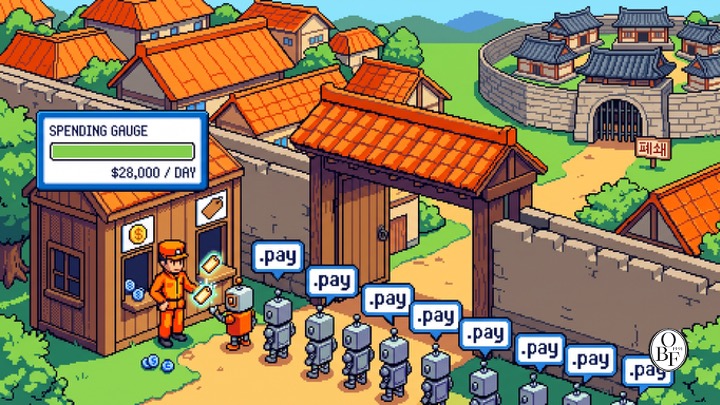
But onchain data analytics firm Artemis sees it differently. More than 95% of all transactions weren’t real trades at all — they were test signals confirming that the protocol worked. A large share, it points out, involved wallets sending money to themselves, or sellers funding buyers and then running the same transaction back and forth. CoinDesk reported in March this year that x402’s actual daily transaction volume was about $28,000. That’s under ₩40 million a day — for the entire global agent-payment market.
Demand-side sentiment isn’t there yet either. In a survey from June this year, only 14% of consumers said they trusted “AI buying things without human confirmation.” In a PYMNTS survey, half of respondents worried about fraud and identity theft, and only 5% said they had no concerns at all.
So here’s where things stand. The companies building the infrastructure are moving well ahead of actual demand. And that’s not strange at all. Claiming a namespace after demand has already materialized is too late. Like people who snapped up domain names in 1995, they’re securing the name before demand grows — not after.
Korea Is Still Deciding Who Gets to Issue Won Stablecoins
Last issue, I talked about how Korea’s network usage fee structure is making it harder just to access agent payment infrastructure. This announcement adds another layer to that problem: agent identity systems.
While Cloudflare has started assigning agents unique addresses, Korea hasn’t yet legally defined what a won-denominated stablecoin even is. The Digital Assets Basic Act was originally targeted for passage in Q1 of this year, but it got delayed by local elections, the National Assembly’s committee reorganization, and disagreements among relevant agencies. The current plan is for the ruling party and government to introduce a unified bill during the September regular session.
At the center of the debate is the equity structure of whoever gets to issue these coins. One compromise floating around would have banks hold a majority stake in the consortium (50%+1 share) while capping any single fintech company at 34%. Another proposal—limiting exchange major shareholders’ stakes to 15-20%—is drawing pushback from industry.
Abroad, the debate is about how agents will pay and what names they’ll be identified by. In Korea, the debate is about who gets to issue won stablecoins. Both conversations matter, but they’re running on mismatched timelines. By the time Korea settles on who issues the coins, the agent identity system may already be locked in—built by foreign operators.
To be clear, this isn’t just regulatory foot-dragging. Stablecoin issuance touches monetary sovereignty and financial stability directly, so caution is warranted. My point is that it’s worth calculating the cost of that caution. And as always, this piece is commentary on institutional and industry trends, not investment or legal advice.
Oswarld’s Lens
I think this announcement needs to be read alongside the Q2 earnings that came out the same day.
Cloudflare posted Q2 revenue of $696.1 million, up 36% year over year. Large customers spending over $100,000 annually grew 27% to 4,698, and the dollar-based net retention rate5 rose from 114% to 120%. The company raised its annual guidance, and the stock jumped 18% in after-hours trading.
But in that same quarter, the company laid off 1,100 people — 20% of its workforce. Headcount stood at 4,700 by the end of June, down from 5,483 three months earlier. Restructuring costs alone came to $150.7 million, or ₩210 billion (~$150 million), baked into this quarter’s results. Prince described this trend as “a fundamental reconstruction of the internet for machine-to-machine traffic.”
A company growing revenue 36% is cutting headcount 20% — and in the same week, rolled out a product that gives AI agents a wallet and a name. I don’t think the layoffs and the wallet launch are separate stories. I think they came from the same judgment call: that the internet’s primary customer going forward will be machines rather than people, and a business built around serving machines needs fewer humans.
There’s a pattern I’ve confirmed repeatedly while designing go-to-market strategies. When a new technology starts getting adopted commercially, what determines winners and losers isn’t product performance so much as whether you were present at the moment the standard got set. Payment methods can change later — settlement might end up happening through something other than stablecoins. But naming systems that establish “who this agent is” are hard to change once they take hold. Cloudflare is putting its energy into claiming the naming system for agents, rather than competing on performance alone.
So the advice I’d give Korean business operators is simple: claim your company’s cloudflare.pay address now, under your company name. Right now it’s available to claim, and it costs virtually nothing. x402 might ultimately fail to take off — that’s not a low probability. But if it fails, all you lose is one address. If it succeeds and you didn’t claim it, you’ll end up handing your company’s agent address over to someone else. Choices where you risk so little and stand to gain so much don’t come around often.
Closing
- What Cloudflare actually rolled out this time is less about wallet features and more about an identity system for agents. Payment functionality—putting money in, spending it—is still “coming soon.” What’s live right now is just the chance to claim a cloudflare.pay address.
- Real demand is still thin. According to CoinDesk, daily transaction volume on x402 sits at around $28,000 (roughly ₩40 million), and Artemis estimates that over 95% of that traffic is test signals. The infrastructure is running well ahead of actual demand.
- Korea is still working out who gets to issue a won-denominated stablecoin, while elsewhere the conversation is about how agents pay and what name they’re identified by. These are simply discussions happening at different stages.
If there’s just one thing to do this week, check whether your company name is still available as a cloudflare.pay address. That’ll help you secure the name for your company—but claiming the name tells you nothing about actual payment demand.
💬 Has your company ever discussed giving an AI agent real authority to spend money? Tell me in the comments where the conversation stalled, or what scared people the most. I’ll dig into limit design and approval structures in a future issue.
📨 If you have a colleague digging into payments or agent infrastructure, share this piece with them.
Keep the perspective, not the noise.
We choose one consequential shift and trace what sits beneath it, every other day.
Confirm once to finish subscribing.
Already a subscriber? Sign in to join the conversation


References & Further Reading
Primary sources
- Cloudflare, “Announcing Cloudflare Wallets: The programmable wallet for the agentic Internet”, Aug. 4, 2026. ··· This is the original post laying out the two-layer wallet structure and the DNS analogy. It’s the backbone of this piece.
- Cloudflare, “Cloudflare gives AI agents an identity and a wallet”, Aug. 4, 2026. ··· The press release with Prince’s full “an agent shows up at your door” quote.
- InfoQ, “Cloudflare and AWS Embed x402 Agent Payments at the Edge”, Jul. 2026. ··· Lays out x402’s technical structure alongside engineers’ skeptical reactions. The critique of VAT and tax-invoice problems is especially sharp.
- Artemis Analytics, “Most of the x402 numbers circulating are noise” ··· The original source for the claim that 95% of the volume is test traffic. This is why you should distrust the headline numbers.
- CoinDesk, “Coinbase-backed AI payments protocol wants to fix micropayment but demand is just not there yet”, Mar. 11, 2026. ··· The source for the $28,000 daily real-transaction figure.
- SiliconANGLE, “Cloudflare shares jump 18% on revenue beat and raised full-year outlook”, Aug. 6, 2026. ··· Covers the Q2 earnings and workforce-restructuring numbers together.
Background
- Fortune, “Cloudflare just launched a permanent ID tool and wallet for AI shopping”, Aug. 4, 2026. ··· Includes the 57% bot-traffic figure and an interview with Stephanie Cohen.
- Datanet, “Will the Basic Digital Asset Act arrive this year?… Push for a joint government-party bill in September”, Jul. 27, 2026. ··· Lays out the sticking points on majority bank ownership and caps on major shareholder stakes at exchanges. The most useful piece for gauging Korea’s timeline.
Related past issues
- A world where AI agents pay for things — Korea’s door is still locked ··· The prequel to today’s piece. It covers why network-usage-fee structures turn into payment-infrastructure problems.
- Issue 177: A ₩96,370,000 (~$70,000) award over fan translation episode 112 — how the court calculated damages

📝 Glossary
Footnotes
-
Stablecoin: A cryptocurrency pegged in value to a fiat currency like the dollar. Because its price doesn’t swing, it’s built to be used as a means of payment and settlement rather than investment. ↩
-
Prompt injection: An attack that hides secret instructions for an AI inside a webpage or document, so that when the AI reads that document, it follows the hidden command instead of its owner’s original instructions. In human terms, it’s like slipping a fake note into someone’s hand on their way to run an errand. ↩
-
x402: A payment protocol that revives HTTP’s long-dormant status code 402, “Payment Required,” which existed in the spec but went unused for 27 years. When a server responds “this costs X to view,” the requester attaches proof of payment and asks again. No login, no payment page required — which makes it well-suited for machines to use. ↩
-
Namespace: A space of names managed so they don’t overlap with one another. The domain address system is the classic example, and once a standard takes hold, switching to a different system becomes very difficult. ↩
-
Dollar-based Net Revenue Retention (DNR): A metric showing how much more (or less) existing customers are spending this year compared with a year ago. A rate of 120% means revenue grew 20% from existing customers alone, without adding a single new customer. ↩
Related issues
The Bank App That Asked for Face Scans Three Times
Shipping speed keeps climbing while nobody gets credit for the unglamorous work of fixing what's already broken.
AI & TechKimi K3: 2.8T Parameters You Can't Run at Home
Kimi K3 tips the scales at over 1.5TB, so even openly released weights demand server-grade memory, not a personal machine.
AI & TechWhat Actually Checks AI's Output Now?
Prompt, context, loop engineering—the labels keep changing, but the real question is what verifies AI's results.
AI & Tech
Your take shapes the next issue
What resonated most in this issue, or where has your experience been different?