

Fan Translator Fined ₩96.37M for 112 Webtoon Chapters
A Seoul court's per-chapter damages formula shows why 'I did it for free' no longer works as a legal defense
SocietyThree Illegal Sites Shut Down, and a Fan Translator Ordered to Pay ₩96,370,000
On the night of April 27, three of Korea’s largest illegal content sites closed down on the same day: Newtoki, the country’s biggest illegal webtoon site; Manatoki, an illegal site for scanlated Japanese manga; and Booktoki, an illegal site for web novels. As if they’d coordinated it, all three vanished with the identical notice: “We are deleting all data at once. We have no plans to resume service.”
Then, on July 10, the Seoul Central District Court quietly handed down a ruling. It was a civil judgment ordering an individual who had produced translations for an illegal manga site to pay ₩96,370,000 (~$71,000) in damages. This wasn’t even paid work — in the person’s own words, it was “a personal hobby, a fan activity.” As I write this on August 4, the story is only just starting to circulate, picked up by the press under headlines like “First Case: Even Uploading Translations Just for Fun Can Cost You ₩100,000,000 in Damages.”
Around the same time, a completely different kind of case erupted in Korea’s developer community. An open-source developer who had been feeding data from Blue Ribbon Survey, a Korean restaurant-rating service, into an AI agent received a formal legal complaint.
A manga fan translator, an illegal webtoon site, open-source crawling — three unrelated incidents, but they’re all fighting over the same point. In the summer of 2026 in Korea, neither the courts nor the developer community are accepting excuses like “I wasn’t paid for it,” “it was already public anyway,” or “I meant well.”
The Price of Translating for Fun
The facts behind this ruling, released by the Korea Copyright Commission on July 28, 2026 (Seoul Central District Court 2025Gahap9142), go like this.
In early 2024, a publisher acquired an exclusive publication right1 to publish the Korean translation of a Japanese manga. But this manga already had fan translators. Active on a community site, these people had been translating the manga themselves and posting it online even before the publisher secured its official publishing rights.
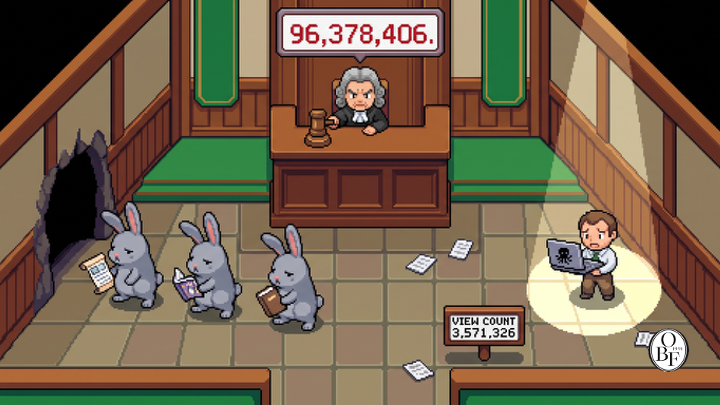
The publisher announced the official release and requested that the existing translations be taken down. If it had stopped there, this ruling probably wouldn’t exist. But the translator didn’t stop. From March to June 2024, they contacted the operator of an illegal manga site via Telegram and handed over translations covering a total of 112 chapters. The cumulative view count for the translations posted on the site topped 3.57 million.
The criminal case concluded first. In January 2025, the Chuncheon District Court issued a summary order2 imposing a fine of ₩1,000,000 (~$720) for violating the Copyright Act. But while the criminal fine was ₩1,000,000, civil liability for damages was assessed separately.
The civil case was different. At trial, the defendant made two arguments. One: “I only translated—I didn’t conspire in posting it to the site.” The other: “This was a hobby with no profit motive, a fan activity, so it counts as fair use3.”
The court accepted neither. On the conspiracy question, the already-finalized criminal verdict served as strong evidence. The ruling on fair use is the heart of this decision, and the court cited three grounds: the manga is sold commercially, the defendant translated the entire work, not a portion of it, and this conduct led to a decline in paying customers and damage to the work’s market value. The court did not recognize fair use on the basis of hobbyist motive alone. It also factored in the possibility of undermining market value by displacing paid use.
How the Court Calculated the Damages
What I found most interesting about this ruling is the process behind the number ₩96,378,406 (~$69,700). From the perspective of someone who works with data, this case was essentially an argument over how to estimate damages.
The publisher-plaintiff’s initial claim was about ₩339,100,000 (~$245,300). Here’s the formula: they took the per-episode view counts on the illegal site and multiplied them by 4.904 — the “estimated overall multiplier for actual illegal-route viewers,” derived from the Ministry of Culture, Sports and Tourism’s “2023 Comic Industry White Paper.” That figure came from dividing 61.3% (the share of people who had experienced illegal manhwa, Korean comic, consumption) by 12.5% (the share who had specifically used overseas scan sites). The logic was: “since piracy surely spread through other illegal channels too, we should scale up by 4.9x.”
The court rejected this multiplier. It found no reasonable explanation for why that multiplication should hold, and no basis for making this particular defendant liable for damage spread through other channels. This was a rebuke of the method of dividing two different survey-question ratios to manufacture a “diffusion multiplier” — and I think that’s a fair criticism. Just because a statistic comes from a government white paper doesn’t legitimize whatever processing you apply to it afterward.
Instead, the court invoked Article 126 of the Copyright Act4 — a provision allowing courts to determine a “reasonable amount of damages” by weighing the arguments and evidence presented, in cases where damage clearly occurred but the exact amount is hard to calculate. Here’s how the calculation went: the translation covered 112 episodes, but since some episodes were split across multiple posts, there were 122 total uploads. The licensed platform, meanwhile, offers the manhwa in 38 episodes, so the total damages were calculated using the licensed platform’s episode count as the baseline.
- The average view count of 29,273 — total views of 3,571,326 across the 122 illegal posts, divided by the number of posts — was treated as the number of users per episode.
- 39.7% — the share of white paper respondents who answered “I’d pay for it even if illegal routes were blocked” — was accepted as the estimated paid-conversion rate.
- This was then multiplied by the estimated revenue per episode (₩45.9 (~$0.03) for episode 1, ₩222.9 (~$0.16) from episode 2 onward), based on the plaintiff platform’s own purchase and rental data.
Holding that the defendant couldn’t be held liable for damage spread through other illegal channels, the court recognized only ₩96 million of the ₩340 million claimed.
The result: roughly ₩530,000 to ₩2.59 million per episode, totaling ₩96,378,406 — about 96 times the criminal fine of ₩1 million. The figure of roughly ₩27 per illegal-site view isn’t a per-view rate the court actually set; it’s simply the total damages divided by the total view count.
Two things stand out here. First, the illegal site’s own view counter became the key piece of evidence for calculating damages. The view count that the pirate site tallied and displayed itself ended up being the material used to calculate damages owed by the person who had handed the translation over to that site. Second, of the two white paper figures, the 4.904 multiplier was rejected while the 39.7% figure was accepted. Even from the same source, only “numbers whose derivation logic can be explained” survived in court. I think there’s a lesson here for anyone who builds an argument on data.
Why Three Sites Shut Down on the Same Day: The Emergency Blocking System
The defendant in this ruling was an individual translator, but the real center of the illegal distribution was the site operators. Newtoki, Manatoki, Booktoki — three sites that all shut down on the same day, April 27. That’s not a coincidence.
Two weeks later, on May 11, the so-called “emergency access-blocking system” under the revised Copyright Act took effect. Previously, blocking a single illegal site required a review process that took 2-3 weeks. For site operators, that meant a block was effectively meaningless — even after being shut down, reopening took just a day, with one digit changed at the end of the domain. The revised law flipped that logic. Now, if infringement is clear and there’s risk of irreparable harm, the site is blocked first, with a post-hoc review required within 5 days.
And starting the following week, on August 11, follow-up measures take effect. Providing links to pirated content for commercial purposes becomes a punishable offense, and willful infringement can now trigger punitive damages of up to 5 times the actual loss. The maximum sentence also rises, to 7 years in prison or a ₩100,000,000 (~$74,100) fine. Given that the ₩96,370,000 awarded in this ruling was a conservative figure calculated under Article 126, future cases that meet the revised law’s requirements could see far larger damages.
The scale explains why this policy shift happened. According to industry estimates reported in the press, Newtoki alone was causing roughly ₩39,800,000,000 in monthly damages, with around 12,200,000 monthly users, and the combined annual damage estimate for all three sites reached about ₩721,500,000,000. Of course, these damage estimates rest on the assumption that “every instance of illegal use would have converted into a paid subscription,” which makes them hard to accept at face value. Interestingly, this very ruling addresses that overestimation problem by factoring a 39.7% response rate for willingness-to-pay into its calculation.
 However, this downfall has an unsettling side to it. The operators of all three sites are reportedly now naturalized citizens of Japan, and the investigation has effectively stalled. A “mass data deletion” sounds like it protects users, but flip it around and it also means the evidence for ongoing lawsuits has vanished. This isn’t a case of the problem being solved — it’s closer to the operators slipping out of reach of accountability. That’s why rights holders are shifting the target of their civil suits: away from operators overseas who can’t be caught, and toward domestic participants who can. The fact that the defendant in this ruling wasn’t a site operator but an individual who passed along translations shows exactly that shift.
The Same Question Moves to Developer Territory
Now for the third case. This time the stage isn’t manhwa—it’s an open-source project published on GitHub.
Earlier this year, an open-source project called “K-Skill” drew considerable attention in the Korean developer community. It’s a collection of skills5 that let AI agents handle Korea-specific everyday services—checking SRT and KTX train schedules, weather, legal search, stock information. The direction itself was interesting: building touchpoints for Korean services in the agent era.
The trouble started when one of those skills pulled data from Blue Ribbon Survey, a restaurant-review service. Piecing together the public record, here’s how it unfolded. In late March, Blue Ribbon Survey announced a ban on unauthorized crawling and AI training use of its data, and converted its location-based restaurant search into a premium paid feature at ₩11,000 (~$8) per year, cutting off the automated access that had existed before. In response, the developer personally paid for a premium account and tried building a structure where his account acted as a kind of proxy server, letting other users bypass the restriction through him. When the automated requests started getting blocked with 403 errors, he even merged code designed to circumvent the blocking logic. Blue Ribbon Survey filed a criminal complaint alleging copyright infringement, violation of the Information and Communications Network Act, and obstruction of business by computer interference.
What happened after the complaint makes the character of this case even clearer. The developer protested that it “was open source for the public good,” and went a step further, floating a plan to build his own restaurant-data service under the name “OpenRibbon”—only to be talked down by the community. He eventually posted an apology and took down the related posts. One comment from the community cut right to it: “How is that any different from building Newtoki [a manhwa piracy site]?”
The Blue Ribbon Complaint: Where Are the Boundaries of Data Use in the AI Era?Looking at the criminal complaint against the K-Skill developer over Blue Ribbon data, I wrote up some thoughts on why data and development ethics deserve renewed attention in the AI era.To be clear, this case is still just at the complaint stage, and the facts are contested. No guilt has been established. But look at the underlying structure: data that someone else paid to build up, behind a paid wall, gets redistributed for free by circumventing an explicit block—and the whole thing gets justified in the language of “open source” and “the public good.” It’s the exact same kind of justification the manhwa translator gave when he called it “fan activity.” Only the object has shifted from comic books to a database, and the method from translation to crawling. The developer took down his original posts, but other users had already taken screenshots, and search-engine caches still hold the complaint document and posts he’d shared on Threads and LinkedIn. The lesson that once data is public it’s nearly impossible to erase has now come back around to bite him—though it’s still unclear what evidentiary role any of this will play, or how a court will ultimately rule.
And this case has one dimension the previous two didn’t: the AI agent. Until now, crawling disputes have been fights between human-built bots and services. In the agent era, it becomes routine for AI acting on a user’s behalf to access a service. When that happens, services have to decide whether to allow agent access, block it, or sell it. The Blue Ribbon episode is an early instance of this question surfacing in Korea as an actual legal dispute.
The English draft is accurate and complete. No corrections needed.
Oswarld’s Lens
Here’s how I read the shift running through these three cases: the excuses that have long justified unauthorized use in Korea no longer hold up. It’s just fandom. It’s just a hobby. It’s for the public good. It’s open source. These excuses, in circulation for over 20 years, have been rejected all at once — in court rulings, in regulatory reform, and in community opinion. That last one matters most. In the BlueRibbon case, the developer’s harshest critics weren’t the rights holders — they were fellow developers. Whether a norm has actually changed shows up more clearly in how people within the same industry talk about it than in any statute.
In my work doing GTM strategy consulting, I kept running into the same item whenever I reviewed business plans from content and data companies: the practice of treating damage from illegal distribution as “a cost you can’t stop anyway” — a condition the company simply can’t do anything about. Because it couldn’t be stopped, it wasn’t calculated. Because it wasn’t calculated, it never made it into the strategy. This is exactly what the ruling changes. Average view count, multiplied by a 39.7% conversion rate, multiplied by revenue per episode. This case shows what kind of data — view counts, willingness to pay for legitimate access — can be used to estimate damages. That doesn’t mean this exact calculation method transfers directly to other cases. But as the amount recoverable through litigation grows, rights holders will be more willing to sue in the first place, and starting August 11th, willful infringement can be met with claims for up to 5 times the damages.
At the same time, I think this creates homework for the companies that supply the data. “Block it and sue,” BlueRibbon’s approach, is a defense, not a strategy. The flow of agents searching, booking, and paying on a customer’s behalf doesn’t disappear just because you try to block it. What’s actually needed is designing agent access as a product — pricing, scope of permitted use, logging, and settlement structures all included. I think these cases are an opportunity to design a proper, legitimate channel for data use alongside everything else. The fastest-moving companies have already started turning this kind of data access into a legitimate revenue business, offering it through APIs or MCP and charging usage fees.
One caveat: this piece is a general commentary on specific cases, not legal advice.
Closing
There are three things this issue confirmed.
- A hobbyist fan translation was hit with ₩96,370,000 (~$69,700) in damages. The court didn’t recognize fair use just because the motive was a hobby, and traffic figures from the illegal site became evidence for calculating damages.
- The simultaneous shutdown of Newtoki, Manatoki, and Booktoki looks more like the operators slipping away to dodge punishment — and as a result, accountability is shifting toward “participants who can actually be caught.” Starting August 11, punitive damages get added on top of that.
- The Blue Ribbon case is the same question migrating over to data in the age of AI agents. The next flashpoint won’t be manga copyright — it’ll be AI agents’ data access rights.
Before you “just go ahead and use” outside content or data next time, I’d recommend asking yourself just one question. “Does this replace something someone would otherwise pay for?” Whether it substitutes for paid use is the question I weighed most heavily in comparing these three cases. In actual legal judgments, of course, you’d also have to factor in the specific rights involved and how the material was used in each case.
So — at your company or in your product, where have you been drawing the line on what’s “fine to just use” when it comes to outside data and content? If you’ve ever wrestled with a fuzzy boundary around crawling, scraping, or collecting data for AI training, share it in the comments. I’ll factor it in when I cover “data access rights in the age of agents” next issue.
📨 If you have a colleague who works in crawling or content businesses, please share this piece with them.
Keep the perspective, not the noise.
We choose one consequential shift and trace what sits beneath it, every other day.
Confirm once to finish subscribing.
Already a subscriber? Sign in to join the conversation


References & Further Reading
Primary sources
- Seoul Central District Court, 61st Civil Division, Case No. 2025Gahap9142, Damages Ruling, decided July 10, 2026. ··· This is the backbone of today’s story. The section on calculating damages (Reasoning 3.b) is the highlight.
- Exclusive: Even a “just for fun” translation posted on an illegal manga site draws a ₩100 million ($72,000) judgment — a first, Nate News (August 4, 2026) ··· The article that first reported on this ruling.
- Illegal webtoon, manga, and novel sites Newtoki, Manatoki, and Booktoki shut down simultaneously, HuffPost Korea (April 2026) ··· Lays out how the three sites were shut down and estimates of the damage caused.
- Illegal webtoon site “Newtoki” shuts down voluntarily, “no plans to reopen,” Daum News (April 27, 2026) ··· Contains the original shutdown notice and the timeline for the emergency blocking system.
- Ministry of Culture, Sports and Tourism, 2023 Comics Industry White Paper, 2024. ··· The source the court relied on for the 39.7% paid-conversion rate. Includes statistics on illegal usage patterns.
Blue Ribbon / K-Skill case
- NomaDamas/k-skill, GitHub ··· The repository at the center of the controversy. Separate from the legal issue, it’s worth a look if you’re curious about the agent-skill ecosystem.
- A timeline of the Blue Ribbon lawsuit, Velog ··· A chronological account from the developer’s point of view. Since the case is still ongoing, keep in mind the facts may be disputed.
Related past issues worth reading
- Issue 173: The Luddites never hated the machine — they resisted the terms on which it was introduced

📝 Glossary
Footnotes
-
Exclusive publication right: An exclusive right granted by a copyright holder stating “only you may publish this work in this format.” In this case, it referred to the exclusive right to distribute and sell Korean-language translations of Japanese manga — so an unauthorized third-party translation posted online directly infringed this right. ↩
-
Summary order (yaksingmyeongryeong): A simplified criminal procedure in which a fine is imposed based on written review alone, without a formal trial. If the defendant doesn’t object, it becomes final and carries the same effect as a court judgment. ↩
-
Fair use (Copyright Act Article 35-5): A provision allowing a work to be used without permission when doing so doesn’t conflict with its normal use and doesn’t unreasonably harm the copyright holder’s legitimate interests. Judged by weighing the purpose of use, the nature of the work, the amount used, and the effect on the market. ↩
-
Copyright Act Article 126 (recognition of a reasonable amount of damages): A provision letting courts, when damage clearly occurred but the exact amount is hard to prove, use their discretion — informed by arguments and evidence — to determine a “reasonable amount of damages.” This is the provision underlying the ₩96.37 million figure in this ruling. ↩
-
Agent skill: An extension module that lets an AI agent handle a specific service or task. Think of it like plugging in one ability at a time — say, “knows how to book a train ticket” — the way you’d add a plugin. ↩
Related issues
The 57% 'Never Dated' Stat Has the Wrong Denominator
Fix the denominator and it drops to 21% — the real story is shrinking social time.
SocietyStudents Booed Eric Schmidt's AI Graduation Speech
Grads booed Schmidt's 'just get on the rocket' line, echoing Luddites who resisted the terms of machines, not the machines themselves.
SocietyThe Harvard Student Who Fed ChatGPT an Entire Novel
A Harvard student mistook a 1962 novel for Old English, revealing how reading itself is splitting society in two.
Society
Your take shapes the next issue
What resonated most in this issue, or where has your experience been different?