

The Fake Delivery App That Never Delivers Food
Chasing the business model behind 'dopamine sites' leads straight back to a real payment button.
BusinessYou Order Chicken, You Pay, and Nothing Arrives
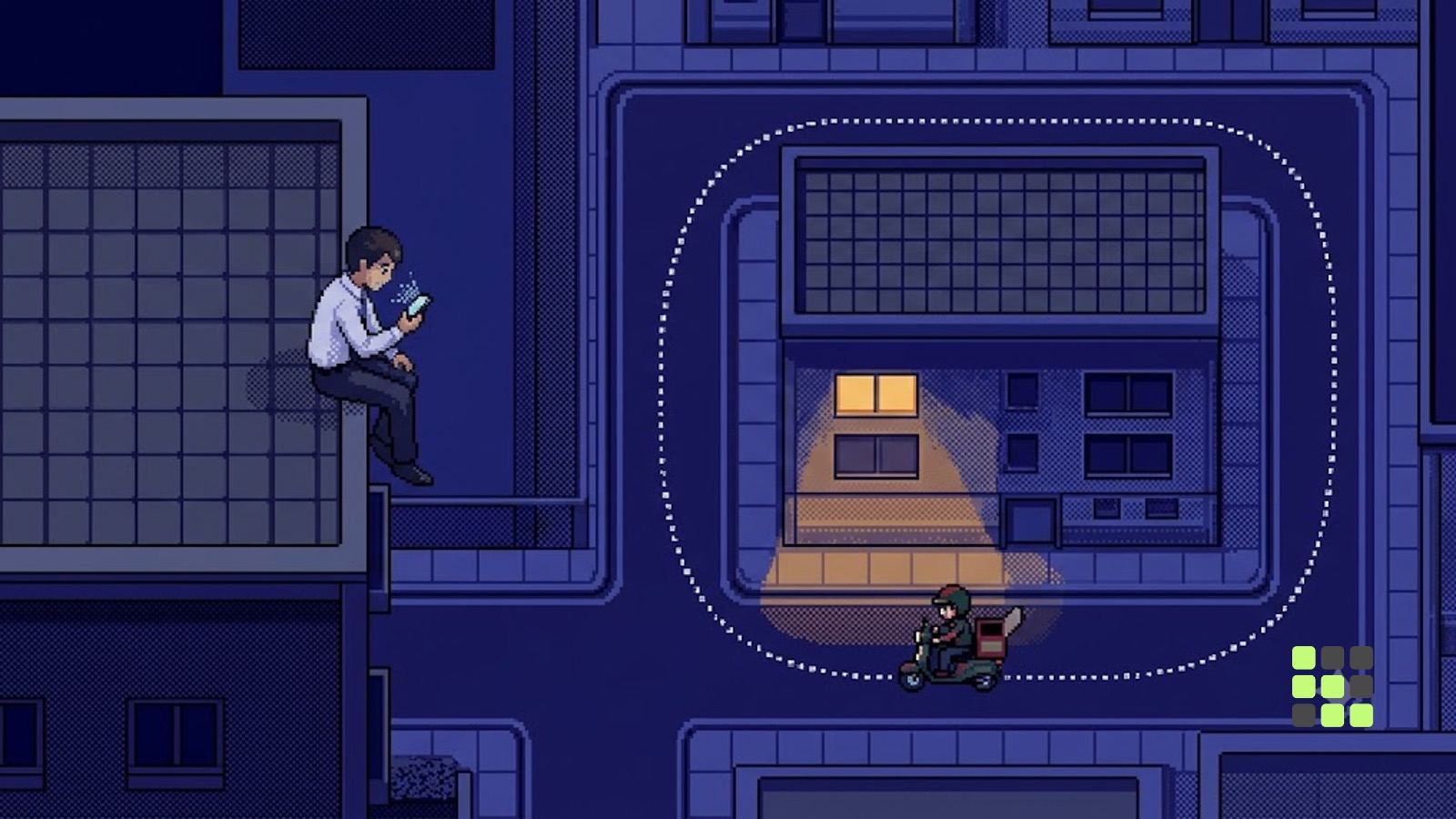
Reader, there’s a site called FoodNeverComes. You pick from 22 countries’ worth of cuisine, drop items into a cart, watch the total climb, and then hit “checkout.” The payment screen comes pre-filled with a fake card number. A delivery rider’s icon races across a map, and when the “arrived” notification pops up, the rider actually calls you. He says he can’t find the door. And then he tells you there was never any food to begin with.
The site’s tagline is “The food never comes, but the dopamine does.” It was built by two 26-year-old developers in Udaipur, Rajasthan, India — Purvanshi Parmar and Anshul Sharma — who say it’s drawn more than 2.7 million visitors since launching in June. The BBC covered the site last week and, in doing so, gave a name to a whole genre: “dopamine sites.” These are sites that keep every step of the consumption ritual intact and simply remove the consumption itself.
The genre actually started in Korea. Earlier this spring, a fake delivery site mimicking real delivery-app names made the rounds, along with a site called “Damta” — a play on “damtae,” office slang for a cigarette break — that simulated the ritual of stepping out for a smoke. My gut read at the time was that this was a brief, flash-in-the-pan trend. The first time I saw it, I filed it away as a vibe-coded concept toy — something thrown together quickly, nothing more.
But then I saw the number out of India — 2.7 million visits — and a question started forming. Could this actually become a business model? Would it be as simple as gathering traffic and slapping on some ads?
I’ll give you the conclusion up front: I don’t think advertising gets you there. There are a few paths that could actually make money here, but follow any of them far enough and you end up back at the very thing this site removed in the first place — a real payment. Today I want to trace that paradox.
From Seoul at 2 AM to Udaipur
A May 27 Korea Times article relaying reporting from the Hankook Ilbo features Ms. Kim, a 25-year-old office worker. At 2 AM, she opens a fake delivery app, picks out menu items, and drops them into her cart. She never actually places the order. She often resists the urge for late-night snacks to save money, but because the app looks exactly like the real thing, she finds herself opening it again and again. With a real app, she says, she’d hesitate at the order button because of the delivery fee—but here, since there’s no way to actually order anyway, she can browse without any guilt.
“I want to eat it, but I hold back” … Gen Z hooked on ‘fake delivery apps’Ms. A (28), an office worker on a diet, opens the app ‘Eumsikmananwayo’ (literally, “Food Never Comes”) every night. She filled her cart with everything she was craving—fried chicken, tteokbokki (Korean spicy rice cakes), even pizza. But she never taps the payment button. Instead, she checks how much money she “saved” and how many calories she “didn’t eat,” then closes the app. No food actually arrives, but the satisfaction of having placed an order remains. Ms. A said, “Resisting late-night cravings is incredibly hard, but the process of ordering—”The same article also covers a site called Damta (a portmanteau of “cigarette” and “break time,” Korean slang for a smoke break), which has a slightly different flavor. Hitting the start button shows you how many people are logged in alongside you right now, and you can leave a short, anonymous note—something like “hanging in there today” or “I want to go home.” There are no actual cigarettes involved, just the shared mood of taking a break together.
The founders behind the Indian versions had similar origin stories. Parmar said that during two months working in Mumbai, he spent 5,000–10,000 rupees a week on delivery food, and looking back, he suspects what he really wanted wasn’t the food itself but the process of ordering it. Sharma, after cracking his phone screen, spent a week comparing six or seven replacement phones and loading them into his cart—only to end up just fixing the screen and buying nothing at all. He said the process itself was enjoyable.
Copycats followed fast. Microsoft engineer Jack Yang launched FakeHaul, a Temu knockoff, in July, and the FoodNeverComes team built TripNeverLeaves, which lets you book a trip and board a plane that never actually leaves the runway. That one, too, reportedly drew more than 100,000 visitors.
Why Not Just Run Ads
The obvious thought is that with this much traffic, you could just slap ads on it. But this traffic isn’t shaped the way the ad business wants it to be.
The first obstacle is repeat visits. University of Michigan neuroscientist Kent Berridge argued that fake orders might trigger intense craving, but that novelty inevitably wears off. He went so far as to say he’d be surprised if many people came back to place a fake order more than 10 times. 2.7 million is the cumulative visitor count the site has reported. If most people arrive once, laugh, screenshot it, share it, and leave, its value as ad space is far smaller than the raw number suggests. Since repeat-visit rates have never been disclosed, there’s no way to confirm which scenario is closer to the truth.
The more fundamental obstacle is the advertisers themselves. The parties who could pay the most for ads on this site are delivery apps and shopping platforms. The moment someone drops fried chicken into their cart at 3 a.m. is precisely when purchase intent is at its sharpest. A single “Want to actually order this?” button would likely convert at a solid rate. But the instant you add that button, the site’s entire reason for being — “the joy of not having to buy” — disappears. The exact spot where ad efficiency would be highest is the spot that breaks the service’s core promise.
The Site Itself Already Gives You the Answer
The founders told the BBC that this wasn’t a moneymaking site and that they’d keep it free forever. But look closely at FoodNeverComes’s homepage, and you’ll find quite a few mechanisms set up for distribution and revenue.
The page code contains a Google AdSense account verification tag. I couldn’t confirm whether ads are actually being served, but the groundwork is clearly laid. There’s an Instagram follow button, a sign-up box for “Daily Craving,” a once-a-day email newsletter, an app install button, and a page for a browser extension. The 319 free recipes linked across every menu are exactly the kind of content built to absorb search traffic. And there are multiple links to a sister app called RewireHeaven, pitched as a tool to help you break bad habits.
The most telling detail sits in a single line at the very bottom. It states that the site was funded and built by NeuroX AI, alongside a company blurb claiming it can turn an AI prototype into real software in 30 days. NeuroX AI is a company run by the same two founders, producing software and AI products as well as Instagram content.
I think this is the site’s actual business model right now. 2.7 million visits and a BBC article aren’t the kind of sales material you can simply buy with ad spend — they’re a portfolio proving you can build something and get it in front of people within 30 days. This doesn’t contradict the initial impression that it’s a toy project. If anything, this is precisely how toy projects turn into money.
When the Parody Starts to Resemble the Original
Spend a bit more time on the site and something uncomfortable surfaces. In the “Lightning Deals” section, ten items discounted 40–60% rotate out entirely every 60–90 seconds, countdown timer and all. Order history, visit streaks, and badges accumulate. There’s even a group-order feature where you send a link to friends so you can shop together. It’s pulled almost every retention mechanic straight out of food-delivery apps — minus the money.
Jack Yang, the creator of FakeHaul, ran into the same wall. He asked a Reddit community for people recovering from shopping addiction whether he could share the site there, and they turned him down — the reasoning being that rehearsing the buying motion over and over might actually tighten the loop he was trying to break. He admitted to Fast Company that the line between satirizing an engagement loop and simply running that loop is thin. His site, he said, is entertainment, not therapy, and he’s ready to take it down if it’s shown to be making things worse.
Anna Lembke, a Stanford addiction psychiatrist, leans toward the same worry. There’s no evidence yet, and outcomes will likely vary by person, but her bet is that over time, sites like this will end up reinforcing the very addiction circuitry they’re mimicking. On the other side, Ravi Dhar of Yale’s Center for Customer Insights points to virtual consumption in video games and leaves open the possibility that this could function as a kind of outlet instead. Both agree on one thing: the data simply isn’t there yet.
Every other path leads back to payment, too
There are other paths worth considering besides ads and portfolios. But trace each one far enough, and they all end up in roughly the same place.
Purchase-intent data. A cart where price doesn’t matter is a pure record of desire. It preserves what people add when money isn’t a worry, where they hesitate, and what they remove—the same kind of information as a painted-door test1, where a brand floats a fake product page before launch just to gauge reaction. The founders said they’d share the data with neuroscientists and psychologists. For research purposes, that’s meaningful. But if you look for who’d actually pay for this data, it’s companies that ultimately want to sell something real. The advertising problem comes back, just wearing a different shape.
A feature inside an existing platform. A standalone site can’t generate repeat visits, but things change once you’re inside an app people open every day. Imagine a delivery app or a shopping app building in “just save it for later” as a built-in feature. An app that accumulates records of what you resisted buying today is an app you’ll open again tomorrow. Even the experience of restraint becomes time spent on the platform.
An impulse-control tool. Card companies or fintech apps could build something that asks you again, two days later, about an item you added to cart. As a consumer-side feature, it’s useful for building trust. But it becomes a problem the moment its effectiveness gets marketed as therapy. As Lembke warned, there’s a real possibility of the opposite effect, and there’s no evidence for it yet. And whoever pays for this feature is, again, a company that ultimately makes its money from payments.
Games. The most proven business built on monetizing virtual consumption is gaming. People pay real money to collect skins and decorate virtual rooms. The evidence Dhar cited for the effects of virtual consumption comes from this same space. If a dopamine site pivots into gaming, it gets a revenue model—but at that point, it’s no longer shopping without spending. It’s just shopping for something else.
In all four paths, the party paying is someone who ultimately wants people to buy something. A service built by removing payment, once it goes looking for revenue, ends up bringing payment back in.
What people actually bought was never quite the payment itself
Let me flip the question. If people still showed up even with checkout removed, what was it they were actually buying when they paid?
Berridge is a neuroscientist who distinguishes between “wanting” and “liking.” Wanting is the pull toward something; liking is the pleasure of having it. The two often travel together, but not always. In his account, dopamine moves at the front end. A tasty-looking dish on screen, a discount badge — these are signals that trigger wanting, something he calls incentive salience2. A person can end up wanting something intensely without ever enjoying it much. Lembke makes a similar point: calling dopamine a “pleasure chemical” is an oversimplification — it’s closer to a molecule that nags you to do more.
Dhar’s idea of anticipated utility3 points the same way. The more an object stirs the imagination — new shoes, a trip — the more the pleasure of anticipation becomes part of the experience itself, and the more the excitement deflates once it’s actually in hand and the tension releases.
Oswarld’s Lens
I still think my original call was right: these sites work as toy projects. This genre is hard to turn into a standalone business. A one-time visit that ends in a laugh doesn’t generate ad revenue, and the moment you go looking for revenue, you collide with the promise the service made.
That’s not to say toy projects are useless, though. A toy is a tool for cheaply testing an expensive hypothesis. The hypothesis tested this time was whether people want the procedure of shopping even without the payment, and the answer was yes — at least once. Delivery apps and shopping malls probably understand the value of that answer better than the two people who built these sites ever could.
So I think it’s more useful to ask, not “can a dopamine site make money,” but “where in our service do customers actually experience enjoyment?” If that zone sits before checkout rather than after it, then how you design that zone becomes a question of trust. Do you keep stoking desire and push it toward checkout, or let people enjoy the wanting and buy only what they need? Whether the same cart screen becomes one or the other is entirely up to whoever builds it.
Closing
2.7 million people showed up for a food delivery app that doesn’t deliver food. That’s a hard number to monetize through ads, but for the company that built it, it’s already earning its keep as a portfolio piece. And the more they search for other revenue paths, the more that vanished “pay” button keeps reappearing. If Berridge’s thesis holds, this fad won’t last long — but the fact that people enjoy the process before the purchase isn’t going anywhere.
💬 Is there anything you’ve left in your cart and never bought? I’m curious whether you regretted it, or whether just adding it to the cart was enough.
📨 If you know someone who designs commerce or app services, pass this piece along to them.
Already a subscriber? Sign in to join the conversation


References & Further Reading
Primary sources
- “Indians are discovering the thrill of shopping without paying”, BBC, September 2026. ··· This single article brings together an interview with the founder of FoodNeverComes and explanations from Berridge, Lembke, and Dar.
- “Gen Z turn to ‘dopamine sites’ for quick comfort”, The Korea Times (translated from a Korean article), May 27, 2026. Link ··· Features voices of people in Korea using fake delivery sites and “damta” (fake smoke-break) sites. A good look at how this genre has been used in the Korean context.
- FoodNeverComes official site. Link ··· You can see the flash deals, group orders, recipes, sister-app links, and the NeuroX AI credit at the bottom firsthand.
- “Fake Temu site gives shoppers a dopamine boost without buying anything”, Fast Company, July 22, 2026. Link ··· Covers FakeHaul creator Jack Yang’s motivations and raises questions about the design choice to keep habit-forming mechanics in place.
Background
- Jack Yang, “FakeHaul” project page. Link ··· The creator’s own introduction. You can read, in the original text, his stance that this is entertainment rather than therapy, and his note that he’ll take it down if problems arise.
- “Fake Carts, Real Cravings: Inside the Dopamine Sites Going Viral From Seoul to Udaipur”, Gizbot, September 2026. Link ··· Traces the trend’s spread from Korea to India, along with anecdotes of pushback from Reddit communities.

📝 Glossary
Footnotes
-
Painted door test: An experiment that shows a feature or product that hasn’t actually been built yet, as a realistic-looking button or page, to gauge demand by how many people click it. Like a door painted on a wall — open it and there’s nothing behind it. ↩
-
Incentive salience: The brain mechanism that makes something stand out and feel pulling. Berridge explains that dopamine produces this pull more than it produces pleasure itself. ↩
-
Anticipatory utility: The pleasure felt while waiting for and imagining something, before actually experiencing it. The excitement you feel after booking a trip, before you’ve even left, is a classic example. ↩
Related issues
The Exchange That Hit No. 1 by Never Asking Questions
Binance founder CZ built an empire by chasing whichever country had the loosest rules.
BusinessTokens Flowed to Open Models, But Money Didn't Follow
In three months, DeepSeek's share jumped from 25% to 64%, but the same gateway's spending chart told the opposite story.
BusinessTransformer Exports Hit Records, but Stocks Diverge
Exports rose 6.7% while orders jumped 51%, illustrating why trade figures and corporate earnings move at fundamentally different speeds.
Business
Your take shapes the next issue
What resonated most in this issue, or where has your experience been different?