

OpenAI's $20 Billion Gap: A Counting Trick, Not a Loss
Thursday's panic over a missing $20 billion in OpenAI revenue was really a clash between gross and net accounting.
BusinessThe Thursday $20 Billion Went Missing
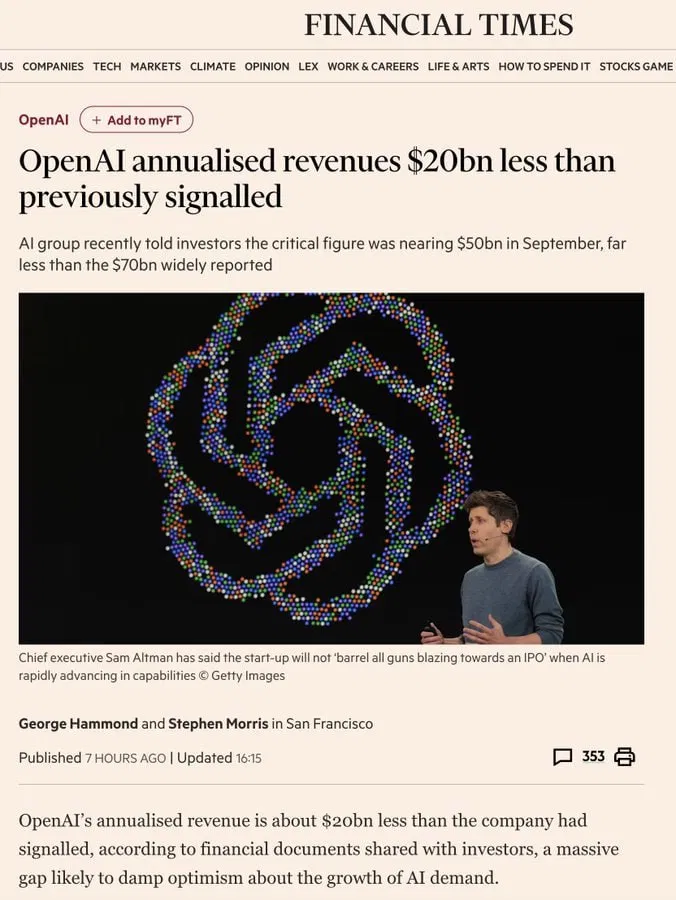
On October 8, a headline on the Financial Times caught my eye. The story claimed OpenAI’s annualized revenue1 was $20 billion lower than previously reported. OpenAI had apparently told investors its annualized revenue as of September was close to $50 billion — but the widely reported figure had been $70 billion. The FT itself had reported, in a September 29 article, that OpenAI’s annualized revenue had grown more than 70% following the July launch of GPT-5.6, reaching roughly $70 billion.
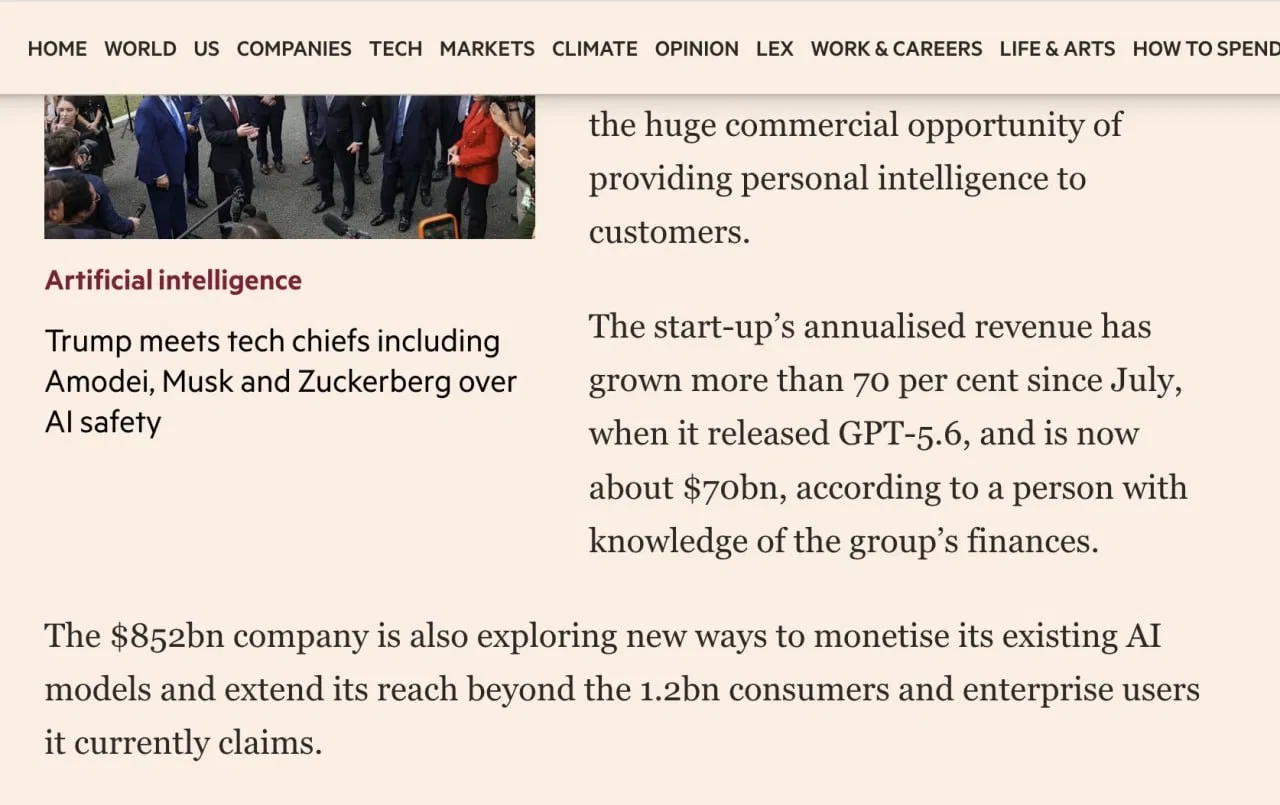
But the FT later corrected its story. As of September, OpenAI’s annualized revenue was $50 billion on a net basis and $70 billion on a gross basis. The $20 billion hadn’t vanished anywhere. It was the same revenue, counted two different ways — as the full sale price, or as the company’s own cut.
Two Companies Counting the Same Dollar Differently
Say a customer pays $1 for Claude usage through a cloud provider like AWS. Anthropic books the entire $1 as revenue. The cut the cloud company takes isn’t subtracted from revenue — it’s recorded separately as a sales and marketing expense. This is called gross recognition.2
OpenAI does the opposite. According to a report by The Information this past March, when a customer spends $1 on OpenAI’s models through a cloud partner, OpenAI books only its own cut — about 20 cents — as revenue. This is net recognition. The $50 billion figure OpenAI presented to investors as its “key metric” is on this net basis.
Which is correct? Accounting standards permit both. The dividing line is whether the company acts as the “principal” or the “agent” in the transaction.3 If the company controls the service before it reaches the customer, sets the price, and bears responsibility for fulfillment, it’s treated as the principal and records gross revenue. If it’s merely arranging another company’s sale and taking a commission, it’s treated as the agent and records net revenue. Anthropic told Reuters that it qualifies as the principal, since it sets the prices and delivers the service itself.
Whether the two companies made different choices about transactions of the same nature, or whether differences in their cloud-partner contract structures simply led to different conclusions, can’t be determined from public disclosures. Per Bloomberg, investors tried to recalculate both companies’ numbers on a common basis, but concluded that an accurate conversion wasn’t possible with the information currently available. NYU’s Aswath Damodaran has said that whether a company uses gross or net is, in principle, not a problem as long as it applies its chosen standard consistently — what matters is making that choice as clear as possible to investors.
What happened on Thursday was exactly what occurs when that “clarity” is missing. When a company doesn’t disclose which standard its numbers follow, and reporting mixes the two together, $20 billion can vanish and reappear without a single entry in the ledger ever changing.
The Size of the Gap Differs by Company
What’s interesting is that even though both companies show a gross-versus-net difference, the size of that gap is completely different between the two.
Per the FT’s correction, OpenAI’s figures as of September are $70 billion gross and $50 billion net. Net comes to about 71% of gross, meaning the gap is roughly 29%.
For Anthropic, we can estimate using 2025 figures that Reuters reported after reviewing confidential IPO filing documents in late September.
| Item (Anthropic, 2025) | Amount |
|---|---|
| Total revenue (gross basis) | ~$4.6 billion |
| Revenue via cloud marketplaces4 | ~$2.16 billion (47% of total) |
| Fees paid to cloud companies (Reuters estimate) | ~$350 million (about 16 cents per dollar sold) |
The $350 million fee figure isn’t a number written directly in the filing — it’s a calculation Reuters made. If we take that figure at face value and convert to a net basis, 2025 revenue comes to about $4.25 billion. That’s roughly an 8% reduction from $4.6 billion.
So we have the same “gross versus net” comparison, yet one side shows 8% and the other 29%. The difference comes down to how much the cloud company takes per dollar. On Anthropic’s cloud-marketplace revenue, the cloud company takes about 16 cents and Anthropic keeps 84 cents. If, as reported, OpenAI receives only 20 cents per dollar through its partner channel, then in that channel the partner is taking 80 cents — the reverse structure. Even though both are cloud sales, who keeps how much differs, so the size of the cut when converting gross to net inevitably differs too. That said, it hasn’t been confirmed whether OpenAI’s $70 billion gross figure was calculated using the same definition as Anthropic’s.
So what happens if we measure both companies with the same ruler? Comparing gross to gross, it’s Anthropic’s $65 billion (end of July) versus OpenAI’s $70 billion (September). The two-month gap in timing makes it hard to say definitively which is larger. Comparing net to net isn’t possible, since Anthropic hasn’t disclosed a recent net figure. If we simply apply the 2025 ratio of 8%, we’d get something in the neighborhood of $60 billion — but since we don’t know how much the share of cloud-marketplace revenue has shifted this year, that’s only a reference-point calculation.
Where Does the ‘Half’ Come From
The Bloomberg report had other numbers too. OpenAI’s projected actual revenue for this year is about $35 billion — roughly half of its year-end annualized run-rate forecast. Anthropic’s actual 2025 revenue was also about $4.6 billion, while the annualized figure it disclosed around that time topped $9 billion. This detail is what fed the narrative that “the numbers were inflated.”
Annualized revenue is typically calculated by taking the most recent month’s revenue and multiplying it by 12. That means the faster a company grows, the wider the gap becomes between its year-end annualized figure and its actual revenue for the year. If December’s monthly revenue is much larger than January’s, then multiplying December by 12 will inevitably produce a number larger than the actual cash that came in over the full year. Back in April, Issue 67 covered how far apart annualized revenue and actual revenue can be — today I want to measure how much of that gap is simply explained by growth rate.
Let’s run the numbers for Anthropic. Its reported annualized revenue was about $1 billion at the end of 2024 and just over $9 billion at the end of 2025 — a 9x increase in one year. If we assume the company grew at the same rate every month and sum up monthly revenue from January through December, we get roughly $4 billion. Actual revenue was about $4.6 billion. The actual figure is slightly higher than what you’d back-calculate from the publicly disclosed annualized number. In this case, the “half” gap looks less like inflated numbers and more like what naturally results from a company growing at this pace every month.
Running the same calculation for OpenAI is harder. For the annualized figures reported this year — about $24 billion at the end of March, surpassing $40 billion in July, $70 billion in September — it’s largely undisclosed whether each is gross or net. Nor is it clear what basis underlies the $35 billion actual revenue figure or the year-end forecast that Bloomberg reported. If you stitch together figures measured on inconsistent bases to draw a growth curve, you end up computing a second layer of optical illusion on top of the one from Thursday. So for now, I think it’s right to withhold judgment on whether OpenAI’s “half” is a product of growth rate, or of mismatched bases layered on top of each other.
Where These Numbers Start to Matter
There’s a reason the dispute over revenue figures doesn’t end as a mere calculation spat among investors. An enormous set of promises sits on top of both companies’ revenue.
According to Anthropic documents reviewed by Reuters, non-cancelable computing and hosting commitments stood at $54.6 billion as of the end of 2025, and long-term commitments entered into by early 2026 exceeded $417 billion. Of the $909 million in customer billings not yet collected at the end of 2025, 60% was money being collected on Anthropic’s behalf by cloud partners. Nearly half of revenue flows in through cloud companies that are simultaneously Anthropic’s investors and its computing suppliers. The documents also note that two unnamed customers each accounted for 12% of revenue.

That black box opens up with an IPO. Once public, a company must regularly file financial statements5 that conform to accounting standards, and from that point on, judgment rests on recognized revenue and cost structure rather than annualized run-rate figures. Both companies are preparing to go public, and reports continue to suggest Anthropic will be the first of the two to list.
Oswarld’s Lens
These days I’m traveling to various regions advising on, designing, and reviewing AI data center projects. When a review request comes in, there’s something I look at before the site or the GPU count. I check whether there’s a confirmed tenant6 in place, and whether the lending syndicate is moving on the strength of that tenant’s credit. I laid this out in a ZDNet column last month.
Reading this latest episode through that lens, what lenders actually want to know isn’t whether the figure is $70 billion or $50 billion — it’s what basis that number was counted on, and how much of it actually ends up in the company’s hands as real cash. What ultimately backs a computing commitment worth hundreds of billions of dollars is the net figure and the cash that’s actually collected. So before I look at the size of an annualized revenue run rate, I check whether the basis for that number is disclosed right next to it, and how much of it the cloud partner is collecting on the company’s behalf.
The fact that $20 billion vanished and then reappeared in a single Thursday shows that two private companies put out a single metric without disclosing its basis, and the entire market was leaning on that one number. The number itself wasn’t wrong — what was missing was the one word that should have been sitting right next to it.
Closing
Both gross and net figures are acceptable ways to report revenue. But at Anthropic the gap between the two is around 8% as of 2025, while at OpenAI, as of September, it’s $20 billion — 29%. Even when two numbers share the same name, it’s not safe to line them up side by side until you’ve checked what each one is actually measuring.
💬 Reader, when you read an article about an AI company’s revenue, which number catches your eye first — annualized revenue, actual revenue, or the cost side? Let me know in the comments.
📨 If you have a colleague who did a double-take at Thursday’s “OpenAI’s $20 Billion in Revenue Vanishes” headline, pass this one along to them.
Already a subscriber? Sign in to join the conversation


References & Further Reading
Primary sources
- George Hammond·Stephen Morris, “OpenAI annualised revenues $20bn less than previously signalled”, Financial Times, 2026.10.8. (later corrected): This article was later corrected to put net revenue at $50 billion and gross revenue at $70 billion.
- Financial Times, 2026.9.29.: This article reported that OpenAI’s annualized revenue had grown more than 70% since July, to roughly $70 billion.
- Dong Jing, “Behind the Trillion-Dollar Valuation, a ‘Revenue Accounting Shell Game’: OpenAI and Anthropic’s Revenues Turn Out to Be Impossible to Compare Directly”, Wallstreetcn, 2026.10.10.: This piece summarizes Bloomberg’s October 10 report. I relied on this article rather than the original Bloomberg piece.
- Echo Wang·Krystal Hu, “Exclusive: Anthropic IPO prospectus lays bare deep dependence on Big Tech partners”, Reuters (reprinted by The Star), 2026.9.29.: The 47% cloud-channel revenue figure, the fee estimates, and the scale of the computing commitments all come from this report.
- Semafor, “Anthropic is gaining on OpenAI’s revenue, but hasn’t yet eclipsed it”, reprinted by Yahoo Finance: This article reported the “$1 versus 20 cents” comparison.
Background
- Futurum Group, “Anthropic Files For IPO, Looking to Beat OpenAI to the Punch”, 2026.6.2.: This explains the structure by which cloud partners’ cut gets booked as sales and marketing expense.
- Yonhap (English edition via Nocut News), “Anthropic’s ‘explosive growth’… Annualized revenue hits $65 billion, overtaking OpenAI”, 2026.8.: This reported the late-July figure of $65 billion in annualized revenue.
Past issues worth reading alongside this one
- What You Need to Check Alongside an AI Company’s ARR (Issue 67): This piece looks at why annualized revenue diverges from actual revenue, and at the other metrics worth watching in AI businesses.

📝 Glossary
Footnotes
-
Annualized Run Rate (ARR): A figure obtained by multiplying the most recent month’s or quarter’s revenue by 12 or 4 to project a full year’s worth. It shows current momentum, but it isn’t money the company has actually earned over a year. Calculation methods vary somewhat from company to company. ↩
-
Gross vs. net revenue recognition: When a sale passes through another company along the way, booking the customer’s full payment as revenue is gross recognition; booking only your own cut, after subtracting the intermediary’s share, is net recognition. The profit amount can be identical even as the reported revenue looks vastly different. ↩
-
Principal / agent: This is the accounting standard that distinguishes gross from net recognition. If a company controls the good or service before it reaches the customer and bears responsibility for pricing and fulfillment, it’s treated as the principal; if it merely arranges someone else’s sale and collects a fee, it’s treated as the agent. ↩
-
Cloud marketplace: A sales channel operated by a cloud provider such as AWS, Google Cloud, or Microsoft Azure. Enterprise customers can buy another company’s software or AI models using the cloud account and billing relationship they already have. ↩
-
GAAP-compliant financial statements: U.S. public companies must disclose revenue, expenses, and cash flow according to Generally Accepted Accounting Principles (GAAP), following a prescribed format. Unlike self-reported metrics such as ARR, these numbers can be compared across companies and audited. ↩
-
Tenant: A customer who leases data center space and power under a long-term contract. In the data center business, which tenants sign on can determine the terms on which financing is available. ↩
Related issues
The Blockchain Use Case Hiding in SK Hynix Futures
A Bloomberg columnist who once mocked blockchain now credits perpetual futures for his change of heart.
BusinessSearching Tax Arrears, Finding a Debt Collector Job Ad
Korea's National Tax Service hired thousands of debt collectors this year, quietly linking two very different searches.
BusinessThe Inspector Sets AI's Speed Limit
What Amodei really wanted was a health inspector stationed in the kitchen.
Business
Your take shapes the next issue
What resonated most in this issue, or where has your experience been different?