

The Blockchain Use Case Hiding in SK Hynix Futures
A Bloomberg columnist who once mocked blockchain now credits perpetual futures for his change of heart.
BusinessThe Columnist Who Mocked Blockchain Changed His Mind
Hello Reader, Joe Weisenthal, host of Bloomberg’s “Odd Lots” podcast, ran a pretty candid headline in his October 20 newsletter. The gist: we might have gotten blockchain wrong.
He confesses that about a decade ago, at some conference, he used to roll his eyes at suits saying things like, “Bitcoin itself is a speculative asset, but the blockchain technology underneath it shows real promise.” But the Weisenthal of 2026 admits those people might have been right. The thing that changed his mind: perpetual futures1.
This isn’t someone else’s story for Korean readers, because SK Hynix shows up on the list of products he cites as examples — right alongside Brent crude and gold. On overseas platforms, products tracking the SK Hynix price now trade around the clock, nights and weekends included, and that price has grown influential enough to be cited as a factor explaining the next day’s opening price back home. Today, let’s trace how Weisenthal changed his mind, then look at what happened when that experiment collided with Korean stocks.
From Censorship Resistance to Neutrality, and Then Stablecoins
What first drew Wisenthal to Bitcoin was peer-to-peer transfer without intermediaries. When you send money through PayPal, it looks like two individuals exchanging funds directly, but what’s actually happening is that you’re sending an instruction to a company, which then decreases your balance and increases someone else’s. That company can cut off the transaction at any time—because it’s illegal, or because it doesn’t want to be associated with a certain industry or person. Satoshi Nakamoto solved the “cash on the internet” puzzle that the cypherpunk2 movement had wrestled with for years, and so for him, blockchain’s one and only virtue was censorship resistance. If you’re fine having an intermediary, there are already plenty of fast, nearly free centralized databases out there.
What cracked that conviction was a conversation he had with Austin Campbell, a crypto-industry veteran, at Odd Lots in 2024. Campbell’s argument went like this: every financial company runs its own massive legacy IT system, and merging all of them into one giant shared ledger is theoretically possible but never actually happens in practice. In that case, even if blockchain can’t resist censorship, it still has value as a neutral protocol—one that can be trusted precisely because it doesn’t belong to any single company. It’s far from the cypherpunk spirit, but purely as a piece of technology, it has a use.
He says stablecoins3 didn’t make sense to him at first either. In a world where the whole point is coins that go up in value, why would you need one whose price is pinned down—and besides, since an issuer like Circle can block transactions, doesn’t that just introduce another intermediary? Still, the use case of cheap cross-border transfers was obvious. He thinks programmable money will prove useful in scenarios where an AI agent pays for a database on the spot, every time it uses one, without a human having to set up an account first. Micropayments far below 1 cent might finally become possible. On this point, though, he reserves judgment—it’s something still worth watching.
And this time, the thing that moved his thinking the most was perpetual futures.
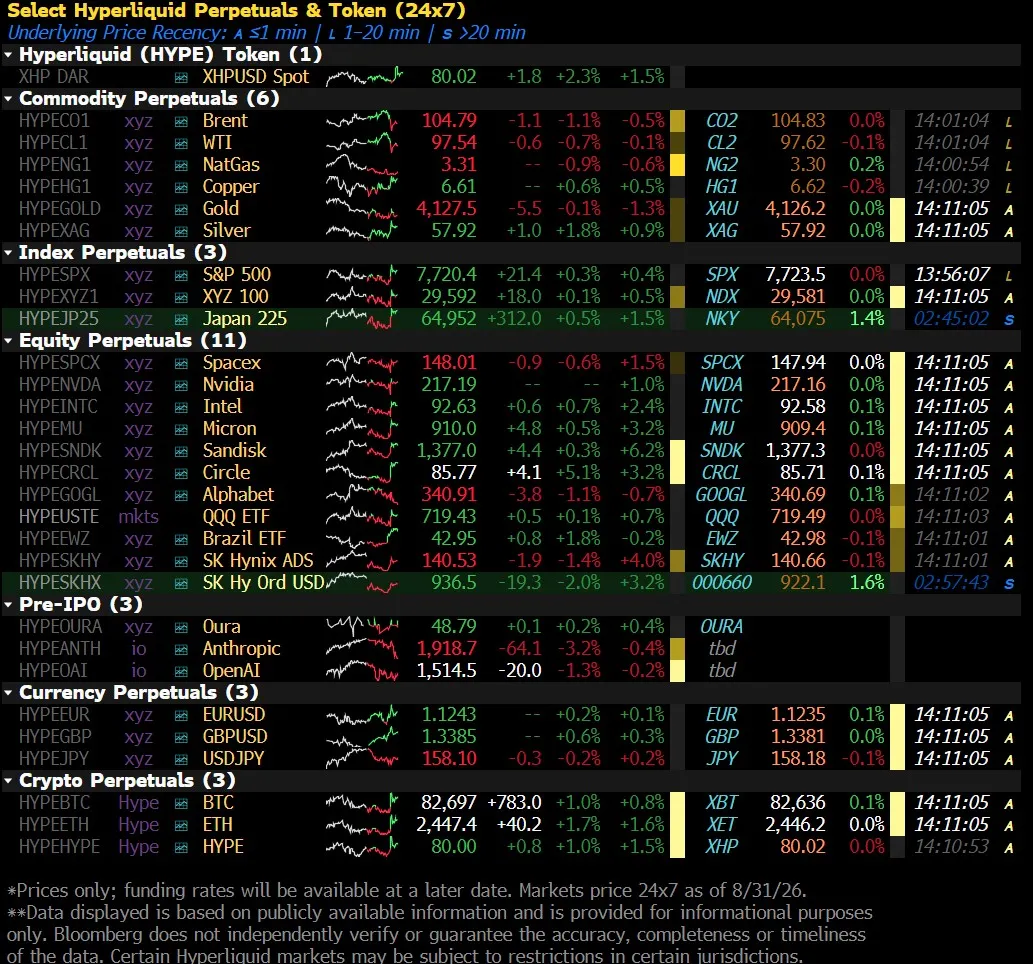
How a Futures Contract With No Expiry Date Tracks the Price
Futures normally have an expiration date. When that date arrives, you either deliver the actual asset or settle in cash for the equivalent amount. Perpetual futures are a product that removes this expiration entirely. But without an expiration date, there’s nothing to pull the futures price back if it drifts away from the underlying asset. That job falls to the funding rate4.
Let me walk through this with gold perpetual futures. An oracle5 carries the real-world gold price onto the blockchain. If the futures trade above that price, the buy side (longs) periodically pays the sell side (shorts). The bigger the gap, the bigger the payment. Conversely, if the futures trade below that price, shorts pay longs. Whichever side bought in at the inflated price ends up footing the bill, which pulls the price back toward the underlying asset — assuming, of course, that the oracle is feeding in accurate numbers.
This structure originally came out of crypto. Weizenthal explains it as a product born from traders who found even bitcoin’s volatility insufficient and wanted still more leverage. BitMEX popularized it in 2016, and perpetuals now make up the bulk of crypto derivatives trading. But the structure itself doesn’t actually require bitcoin. As long as you can feed in a price via an oracle, you can build the same thing for stocks, oil, euros, or yen.
Blockchain isn’t essential either. Centralized exchanges like Binance also sell perpetual futures. Where Weizenthal finds the blockchain meaningful is in the next question: who gets to create and list the product in the first place.
Hyperliquid’s Design for “Neutral Ground”
Weisenthal recently interviewed Jeff Yan, CEO of Hyperliquid Labs. Hyperliquid is a blockchain built specifically for perpetual futures trading. In his view, this is a place meant only for products with real economic utility — a world apart from venues littered with thousands of dog-themed meme coins.
The mechanism that makes this possible is a rule called HIP-3. Hyperliquid doesn’t list products itself. Outside companies open their own trading markets and list products on top of the platform. But the bar is high. According to Hyperliquid’s official documentation, opening a market requires staking 500,000 of Hyperliquid’s token, HYPE, and holding it for at least 183 days. Galaxy Research estimated this amount at roughly $27 million at late-July prices. Adding more than the first three products also requires going through an auction — a Dutch auction where the price gradually falls over 31 hours. It’s an expensive structure for anyone hoping to mint a random token, pump the price, and dump it.
The way responsibility is divided is also spelled out in advance. The company that opens a market — the deployer — sets the oracle, contract terms, and leverage limits. If a market is run poorly, validators can vote to slash up to 100% of the staked HYPE. But per the official documentation, slashed tokens are simply burned — they don’t go back to affected users.
Weisenthal named Trade.xyz as one of the ecosystem’s major deployers. The next scene he envisions is a well-known ETF manager like VanEck stepping into this space to issue tokens. Different companies each doing business on neutral ground — the real-world version of the neutral protocol Campbell described. Still, he adds that no established financial firm has actually joined yet.
The scale is already not small. According to CryptoBriefing, Hyperliquid’s total open interest6 surpassed $18 billion by the end of September, up from about $13 billion at the end of August.
One of the hottest products in that market was SK Hynix
Citing figures compiled by Eugene Investment & Securities, the Digital Times reported that from February 19 to August 8, cumulative trading value of perpetual futures on individual Korean stocks across 11 global exchanges—including Binance and Hyperliquid—reached $176 billion, roughly ₩243 trillion (~$176B). Of that, SK Hynix alone accounted for $161 billion, about ₩222 trillion (~$161B), or 92%. On Hyperliquid specifically, SK Hynix ranked first in all three categories: cumulative trading value, average daily trading value over the past 30 days, and open interest.
This figure needs careful reading. Cumulative trading value sums up the same money changing hands over and over, so it doesn’t equal actual invested capital. Nor does it break out what share of that belongs to Korean investors.
Still, the link to the domestic market shows up. The same analysis found that the correlation coefficient between post-close price moves in Hyperliquid’s SK Hynix futures and the next day’s KOSPI opening gap was 0.98. Direction matched on 33 of 35 trading days. A high correlation doesn’t prove that overseas futures are driving Korean stock prices—both markets could simply be reacting to the same overnight news. But one thing is clear: somewhere outside Korea’s own exchanges, a venue has emerged that shows the “overnight price” of Korean stocks first.
Leverage is rising too. According to a Financial Post report, Binance listed products tracking Samsung Electronics, SK Hynix, and Hyundai Motor on June 2, and raised the maximum leverage from 20x at launch to 50x by August.
One Share, Two Minutes, Millions in Liquidations
At 8:00 a.m. on July 28, the moment the pre-market session opened on Nextrade (NXT)7, Korea’s alternative trading system, a single share of SK Hynix traded at ₩1,272,000 (~$920) — roughly 30% below the previous day’s close, effectively a lower-limit price. About two minutes later, buy orders came in and the price snapped back into the ₩1.7 million range.
In Korea’s market, this was a two-minute curiosity. On Hyperliquid, it was not. According to Galaxy Research’s analysis, Trade.xyz’s SK Hynix futures market was designed to reference external exchange prices starting at 8:00 a.m., the moment NXT opens. The oracle pulled in that single-share print exactly as it was. A price buffer absorbed part of the shock, but the mark price8 still dropped about 18%, triggering roughly $57.4 million in forced liquidations on long positions. Galaxy Research estimated the figure could run as high as $80 million, spread across roughly 960 accounts. Some profitable short positions were also force-closed by the system in the process.
What happened next matters. Hyperliquid stated that it neither deployed nor operated this particular market. On its blockchain, anyone can permissionlessly launch a market, and it’s the deployer who sets the oracle and the mark-price inputs. Under HIP-3’s design, that’s technically accurate. Trade.xyz maintained that its oracle performed exactly as specified, yet on July 29 it announced it would compensate liquidation losses from the anomalous print as a one-time discretionary decision. It was under no obligation to do so.
A similar incident occurred again on August 6. In NXT’s pre-market session, 11 shares of SK Hynix traded near the lower-limit price. This time Hyperliquid’s liquidation total was much smaller, around $230,000, which analysts attributed to the fact that most of the excess leverage had already been shaken out by the earlier event. NXT, for its part, decided to introduce a static volatility interruption mechanism starting September 14: any order deviating more than 10% from the prior price will now trigger a two-minute single-price auction.
Everyone’s Explanation Was Correct That Day
The structure Weisenthal praised worked exactly like this on July 28th.
From his perspective, no single company owning the marketplace is an advantage. Anyone can list a product by paying the fee, and the marketplace operator can’t arbitrarily pull a specific listing. But when the problem hit, Hyperliquid could say the market wasn’t theirs. The deployer said the oracle worked as specified. NXT explained that its alternative trading system prioritizes execution over price discovery. Within each party’s own boundaries, every explanation checks out. And in the gaps between those boundaries, the losses on roughly 960 accounts ended up being covered entirely at one company’s discretion.
In the US, incumbent exchanges are confronting this structure head-on. According to CoinDesk, the Commodity Futures Trading Commission (CFTC) approved prediction market Kalshi’s crypto perpetual futures in late May and also cleared Coinbase to trade them with customers. In response, the Chicago Mercantile Exchange (CME) sued the CFTC in June. Its argument: without an expiration date, these are swaps, not futures — and swaps must follow stricter margin and registration rules. CME Chairman Terry Duffy said the exchange has the technology and operational capacity to launch perpetual futures but hasn’t heard demand from customers. This is the context behind Weisenthal writing that he met Duffy in Chicago and talked at length about perpetual futures.
Korea’s Clock Stops at 8 PM
On October 16th, Korea’s Financial Services Commission and Financial Supervisory Service issued a warning notice on perpetual futures trading. Perpetual futures on overseas platforms allow leverage from 10x to 200x on the underlying asset’s price movement, and the warning noted that for a product tracking a Korean stock index at 150x leverage, a mere 0.66% intraday move against the position could trigger forced liquidation, wiping out the entire principal. The regulators made clear this product isn’t permitted domestically, and that if an overseas operator goes bankrupt or halts trading, recourse under Korean law is difficult. The authorities said they would refer illegal solicitation targeting Koreans to investigative agencies, request major platforms to cooperate with domestic law compliance, and carefully review whether to introduce similar products domestically.
Domestic trading hours have only just begun to expand. Starting September 14th, the Korea Exchange opened an after-market for all listed stocks running from 4 PM to 8 PM. That added 4 hours to the regular 6.5-hour session. An early-morning pre-market was pushed back, reportedly due to the burden it would place on brokerages’ systems.

Oswarld’s Lens
I think Wiesenthal’s self-criticism is honest. The idea that multiple companies who don’t fully trust one another can still do business on the same ledger remains valid even after July 28th. In fact, Hyperliquid’s matching and settlement on that day worked exactly as designed.
But the fact that the ground is neutral doesn’t mean the prices traded on top of it are neutral too. The oracle is the gateway through which the world outside the ledger enters the ledger, and that gateway is designed by a single deployer. Where you once had to trust the exchange, now there’s a spot where you have to trust the oracle’s designer instead. And the gateway was exactly where things broke on July 28th.
So the question Korea needs to ask isn’t whether blockchain is good technology, but who sets the overnight reference price for Korean stocks, and who’s accountable when that price is wrong. Right now the answer is: a single overseas deployer sets it, and if it’s wrong, that same company decides at its own discretion what to do. Korean regulators have already said upfront that redress would be difficult.
Wiesenthal advises readers to take the time to actually study how perpetual futures work. I’d like to add one line to that. When you look at a perpetual futures contract, check where the oracle sources its price before you check the leverage multiple. Because what went wrong for the long positions liquidated on July 28th wasn’t the direction of SK Hynix.
Closing
Weisenthal wrote that he regretted having dismissed blockchain so easily. As he put it, blockchain is becoming neutral ground where multiple financial firms do business together — and one of the most heavily traded products on that ground is Korean equities. At the same time, the rules governing that ground sit entirely outside Korea’s trading hours and investor-protection framework. It’s worth holding both facts in mind at once.
For the record, this piece is a commentary on market structure, not a recommendation to invest in or trade any particular product. The liquidation figures cited in the body are estimates from research firms and media reports.
💬 Before reading this, did you know that perpetual futures tied to Korean stocks trade on overseas platforms even at night and on weekends? Feel free to just leave a comment saying “I knew” or “first time hearing this.”
📨 If you have colleagues keeping an eye on SK Hynix or semiconductor stocks, please share this piece with them.
Already a subscriber? Sign in to join the conversation


References & Further Reading
Primary sources
- Joe Weisenthal, “Maybe We Were Wrong About Blockchain”, Bloomberg Odd Lots newsletter, 10.20.2026. ··· This is where today’s piece starts. It traces the shift in thinking from censorship resistance to neutral protocols, stablecoins, and perpetual futures.
- Hyperliquid Docs, “HIP-3: Builder-deployed perpetuals” ··· Covers the deployer’s requirement to stake 500,000 HYPE, hold it for 183 days, oracle accountability, and the burn rules for slashed tokens.
- Hyperliquid Docs, “HIP-1: Native token standard” ··· The rules for the 31-hour Dutch auction that HIP-3 reuses directly.
- Will Owens, Hyperliquid/TradeXYZ oracle liquidation analysis, Galaxy Research, 7.31.2026. ··· The most detailed breakdown of how the oracle pulled a one-week-old trade price on July 28th and of Trade.xyz’s decision to make users whole.
- Mijeong Kim, “SK Hynix perpetual futures hit ₩222 trillion in trading volume… regular-session supply-demand variable emerges”, Digital Times, 8.12.2026. ··· Source for the cumulative trading volume across 11 exchanges and the 0.98 correlation coefficient with opening prices.
- “Even a 0.66% move in the opposite direction wipes out the entire position… financial authorities warn on ‘perpetual futures’”, Financial News, 10.16.2026. ··· Summarizes the key warnings from Korea’s Financial Services Commission and Financial Supervisory Service, along with planned follow-up measures.
- “Inside the CME and CFTC’s battle over onchain perpetual futures”, CoinDesk, 7.28.2026. ··· Lays out the reasoning behind CME’s lawsuit against the CFTC and quotes from Chairman Duffy.
Background
- Jeonghwa Lee, “SK Hynix hit the lower limit, but perpetual futures liquidations stayed limited — NXT avoided the price distortion”, Block Media, 8.6.2026. ··· Covers the August 6th recurrence and NXT’s plan to introduce volatility dampening measures.
- “Hyperliquid Explains $57 Million SK Hynix Perp Liquidations After Oracle Anomaly”, BeInCrypto, 7.28.2026. ··· Hyperliquid’s same-day response explaining that it does not directly operate this market.
- Jaeyoung Jung, “Why are regulators struggling with investors trading high-leverage futures overseas?”, Financial Post, 10.19.2026. ··· Covers Binance’s expanded leverage offerings alongside the relevant issues under Korea’s Capital Markets Act.
- Vivian Nguyen, “Maybe we were wrong about blockchain, Bloomberg suggests, as perps go mainstream”, Crypto Briefing, 10.20.2026. ··· Source for the trend data on Hyperliquid’s open interest.
- “6.5→10.5→12… the after-market era begins, as KRX dreams of 24-hour trading”, Money Today, 9.13.2026. ··· Covers the Korea Exchange’s after-market rollout and the schedule for extending trading hours.
Past issues worth revisiting
- Liquidated Even When You Were Right ··· Looks at that same one-week-old trade print from July 28th, but from the angle of an AI hedge fund’s forced liquidation.
- 92% of Buyers of SK Hynix Leverage Were Retail Investors ··· Covers the two months during which Korea’s single-stock leveraged products opened and then closed. Think of it as the domestic counterpart to today’s piece.

📝 Glossary
Footnotes
-
Perpetual futures (perps): Futures contracts with no expiration date. Since there’s no settlement date, positions can be held indefinitely; instead, a recurring payment called the funding rate keeps the price tethered to the underlying asset. On offshore platforms, they trade 24 hours a day and allow high leverage. ↩
-
Cypherpunk: A movement, active roughly around the 1990s, that sought to protect individual privacy and freedom through cryptographic technology. Digital cash exchanged without intermediaries was a long-standing goal of the movement. ↩
-
Stablecoin: A cryptocurrency pegged in value to a fiat currency like the US dollar. Because its price doesn’t fluctuate, it’s used more for remittances and payments than for investment. ↩
-
Funding rate: When the price of a perpetual future trades above the underlying asset, longs pay shorts on a recurring basis; when it trades below, shorts pay longs. The payment grows larger as the gap widens, pulling the price back toward the underlying asset. ↩
-
Oracle: A mechanism that feeds information from outside the blockchain — stock prices or oil prices, for example — into the blockchain. Since a blockchain cannot know external prices on its own, if an oracle delivers a wrong value, that value becomes the settlement benchmark as-is. ↩
-
Open interest: The total size of contracts that remain open and haven’t been settled. Where trading volume shows how much was bought and sold over a day, open interest shows how much money is currently at stake. ↩
-
NXT (Nextrade): Korea’s first alternative trading system, launched in 2025. It opens its pre-market session at 8 a.m., earlier than the Korea Exchange. ↩
-
Mark price: The reference price an exchange uses to calculate gains and losses and to determine forced liquidations. Rather than relying on the last trade price alone, it blends in the oracle price and other inputs as a safeguard against momentary price manipulation — but if the oracle input is wrong, the mark price wobbles along with it. ↩
Related issues
Searching Tax Arrears, Finding a Debt Collector Job Ad
Korea's National Tax Service hired thousands of debt collectors this year, quietly linking two very different searches.
BusinessThe Inspector Sets AI's Speed Limit
What Amodei really wanted was a health inspector stationed in the kitchen.
BusinessBefore the KFTC Reviews a Merger, You Must Self-Certify
Filing comes before review—here's the order of judgment calls Korean merger filers must make before opening KFTC forms.
Business
Your take shapes the next issue
What resonated most in this issue, or where has your experience been different?