

One Month of AI Costs 1 Hour in Luxembourg, 16 in Brazil
A new 'Intelligence Hours' index across 37 countries shows Korea's minimum wage gains were erased twice over by exchange rates.
SocietyA $20 Subscription Is $20 Everywhere
ChatGPT Plus, Claude Pro, Google AI Pro — all three companies’ base plans cost $20 a month. That’s the same number whether you’re in Seoul, Berlin, or Lagos. But the minimum-wage hours needed to earn that $20 differ wildly. As of 2025, it takes 1.1 hours in Luxembourg, 2.8 hours in Korea, 11 hours in Mexico, and 16 hours in Brazil.1
No one had a ruler for this gap, so I built one. I call it Intelligence Hours: the price of one month of baseline AI intelligence divided by that country’s statutory minimum wage, measured in hours. I calculated it using 2023–2025 data from the 37 OECD countries that publish minimum-wage figures, wrote it up as a paper (currently under review at the International Labour Review), and launched a site, intelligence-hours.org, where you can compare countries directly.2
The trigger was September 10. OpenAI stopped accepting new sign-ups for its $200-a-month Pro plan, citing system load. It didn’t raise the price or lower it — it simply stopped selling.3 Everyone knows that $200 is the same $200 everywhere. What no one had counted was that earning it takes 12.7 hours in Germany, 27.6 hours in Korea, 98 hours in Mexico, and 752 hours in Nigeria.4 One price, one currency — and the labor time it takes to buy it varies by more than tenfold.
Flip the Big Mac Index and You Get Intelligence Hours
The Economist has been building the Big Mac Index since 1986, and it was never really about the burger. It’s the same product sold in more than 100 countries, but its cost comes from local beef, local wages, and local rent — so comparing prices across countries reveals whether exchange rates are fairly valued. When researchers broke down the Big Mac’s cost, most of it turned out to be local labor.5
An intelligence subscription is exactly the opposite. Servers run on accelerators priced in dollars, and electricity trades on global markets. Local labor barely enters the cost structure at all. If the Big Mac Index measures “a local price for a global product,” Intelligence Hours measures “local labor spent buying a global price.” The Big Mac Index says currencies should eventually converge; Intelligence Hours says the price of intelligence has already converged, while the price of labor hasn’t.
Of course, measuring prices in units of labor time isn’t new. A 2012 study already converted McDonald’s employees’ hourly wages into “Big Macs per hour” to compare real wages across countries.6 What’s new here is the object being measured. A Big Mac disappears once you eat it, and a smartphone is just a tool, but a frontier model replaces the very work the worker buying it used to do. No index had ever measured how many hours of labor it takes to buy a substitute for that labor.
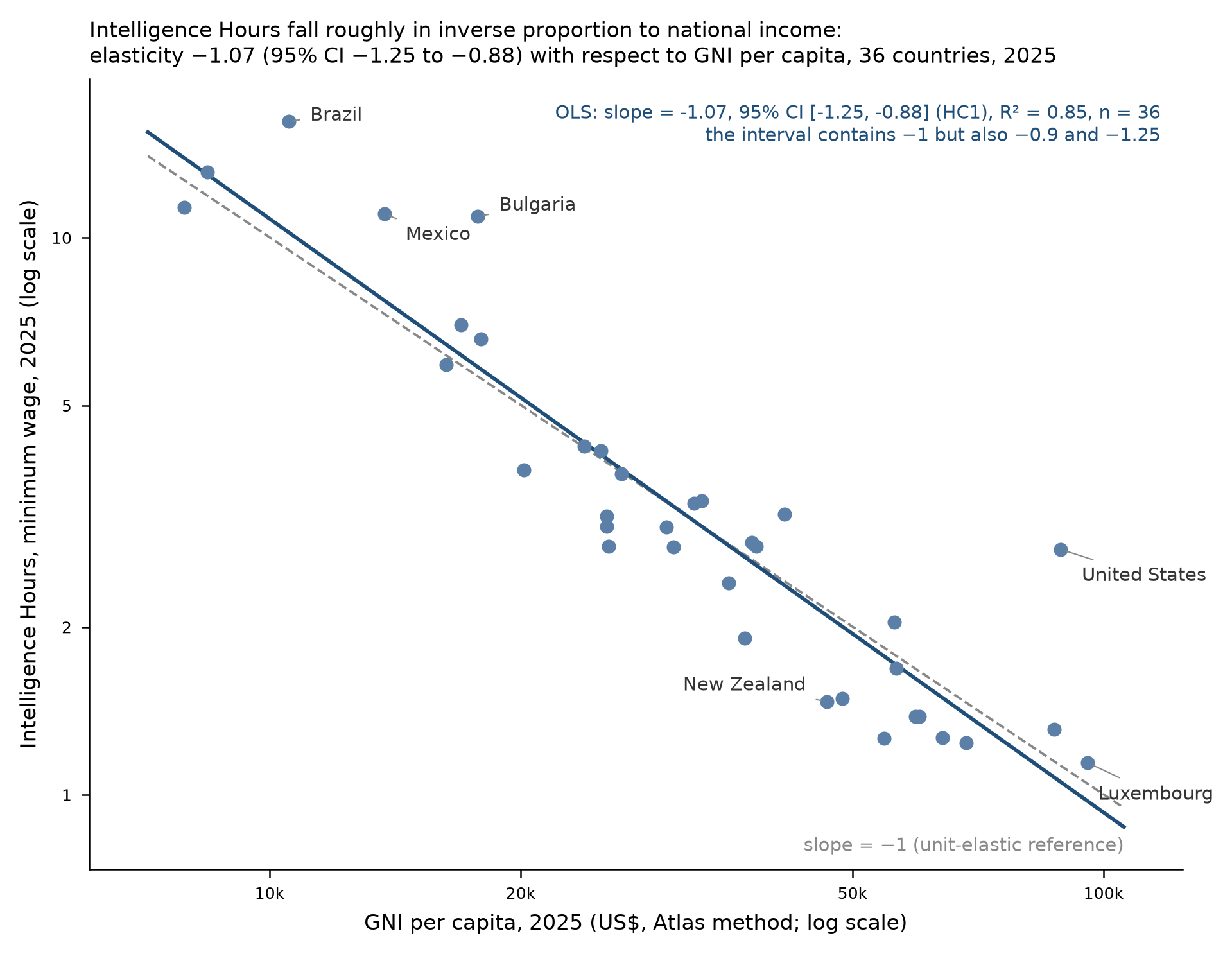
South Korea Is 0.5 Cents From the US Federal Minimum Wage
In the 2025 table covering 37 countries, the time needed to earn a $20 subscription ranges from 1.14 hours in Luxembourg to 16.20 hours in Brazil — a 14-fold gap, with the median country sitting at 2.93 hours. Four distinct tiers emerge: nine countries across Western and Northern Europe plus Australia and New Zealand fall below 1.5 hours; the US federal rate, Japan, South Korea, and Poland sit at 1.5-3 hours; 11 countries across Central-Eastern Europe and the Mediterranean fall between 3-6 hours; and seven countries, mostly in Latin America, sit above 6 hours.8
Recalculating with the minimum wages taking effect on January 1, 2026, and adding China, India, and Nigeria from outside the OECD, the picture looks like this:
| Country | Minimum Hourly Wage (USD) | $20 Plan (hrs) | $200 Plan (hrs) |
|---|---|---|---|
| Luxembourg | 17.66 | 1.13 | 11.3 |
| UK | 16.08 | 1.24 | 12.4 |
| Germany | 15.71 | 1.27 | 12.7 |
| France | 13.58 | 1.47 | 14.7 |
| Poland | 8.35 | 2.40 | 24.0 |
| Japan | 6.84~8.19 | 2.44~2.93 | 24.4~29.3 |
| US (Federal) | 7.25 | 2.76 | 27.6 |
| South Korea | 7.26 | 2.76 | 27.6 |
| China | 2.43~3.85 | 5.19~8.22 | 51.9~82.2 |
| Mexico | 2.05 | 9.77 | 97.7 |
| India | 0.26~1.02 | 19.6~78.3 | 196~783 |
| Nigeria | 0.27 | 75.2 | 752 |
Exchange rates are 2025 annual averages. For Japan, China, and India, minimum wages vary by region, so I’ve listed the low-to-high range; the 2026 figures for India and Nigeria are unverified since I couldn’t confirm the original statutes. Adding Korea’s 10% VAT brings its figure to 3.03 hours.9
Look at Korea’s row. The 2026 minimum wage of ₩10,320 (~$7.26) converts to $7.2551 per hour at 2025’s average exchange rate — a 0.07% difference from the US federal minimum wage of $7.25, less than half a cent. That’s a coincidence, and a currency-sensitive one at that: a 1% move in the won shifts the figure by 7 cents. Still, the picture is clear. Korea’s intelligence-hours are 2.16 times Germany’s.10 Korea is often called an AI powerhouse, but by intelligence-access standards, it sits in a different tier from Western Europe.
“Does the minimum wage really represent a country’s wage level?” is a fair objection. So I recalculated using median wages instead. Rankings shifted for 25 of the 33 countries, and the US dropped 10 places toward the cheaper end — because its federal minimum wage is pinned at just 24% of the median wage. Korea barely moved. Its minimum wage sits at 60% of the median, roughly in the middle, so Korea’s position is shaped by its actual wage level, not by policy choices.11
One sentence remains from all this. In this index, “intelligence is expensive” and “labor is cheap” mean the same thing. The ratio can’t tell the two apart. Korea’s 2.76 hours isn’t a sign that intelligence is expensive — it’s a sign that labor is cheap, and this index is indifferent to the difference.
The FX market clawed back double what the minimum wage board gave
The real usefulness of an index lies in its time axis. Since the numerator stayed fixed at $20 for all three years, the change in Intelligence Hours splits precisely into two components — the exchange rate and the minimum wage. This isn’t an approximation; it’s an identity.12
Between 2023 and 2025, Intelligence Hours fell in 33 of 36 countries, because minimum wage hikes were outpaced by currency swings. Poland went from 4.11 hours to 2.79 hours; Croatia, Bulgaria, Romania, and Colombia all dropped by roughly a quarter to a third. Turkey’s currency lost over 40% of its value, but the country raised its minimum wage 2.2-fold, so its index actually shrank.13
Only two countries saw an increase: New Zealand, and South Korea. Korea raised its minimum wage twice during this period — from ₩9,620 (~$7.0) to ₩10,030 (~$7.3), a gain of 4.17 points on the log scale. Over the same span, the won weakened from 1,306 to 1,422 per dollar, a drop of 8.57 points. The net result: Intelligence Hours rose from 2.71 to 2.84 — but Korea’s rank fell from 14th to 18th out of 36 countries.14 The foreign exchange market took back double what the minimum wage board handed out. The dollar, once anchored to gold and then to oil, is now anchored to artificial intelligence. America’s sudden insistence on rebranding AI as “Super Intelligence” is not a throwaway gesture — it’s positioning.
With the 2026 minimum wage set at ₩10,320 (~$7.5), the index would fall back to 2.76 hours — but only if the exchange rate holds at its 2025 average. The exchange rate that would erase this entire wage increase is 1,463.6 won per dollar.15 The amount of intelligence a minimum-wage worker can afford is jointly determined by the minimum wage board and the currency market — and over the past two years, the market has held twice the power.
The site I built shows this every day. Using the exchange rate on September 29th, Seoul’s Intelligence Hours come to 2 hours 38 minutes — shorter than the paper’s 2.76 hours, because the won strengthened in the meantime.16 If the claim that exchange rates determine access to intelligence still sounds abstract, just check this number again in a month.
Regional Pricing Wasn’t a Discount — It Was a Downgrade
Let me flip the question. Netflix, Spotify, and YouTube all eventually moved to country-by-country pricing. So why did AI subscriptions stay at $20 everywhere for over two years?
Netflix can sell cheap in India because sending one more stream costs almost nothing. When marginal cost is close to zero, you can price to match local willingness to pay. Frontier models are different. Every token carries a real cost in GPU time and electricity, and that cost is the same whether you’re in Lagos or Luxembourg. The Big Mac has a local cost structure, streaming has no cost structure, and intelligence has a global cost structure. Economics has one answer for this situation: if you can’t sell the same cheap product, you sell a deliberately degraded one.17
That’s exactly what happened. When OpenAI launched ChatGPT Go in India at ₹399 in August 2025, it wasn’t a price cut — it was a downgraded tier, with a lesser model and reduced usage limits. And regional pricing only ever touched this downgraded tier. If you calculate a “localization ratio” — local price divided by the US price for the same plan — Go comes in at 57–58% of the US price in India, Indonesia, and Nigeria, meaning a 43% discount. Plus, the frontier-access tier, was 115% of the US price in India, 106% in Indonesia, and 102% in South Korea. Not a single market got a discount on the frontier tier. South Korea stands out even further here: ChatGPT Go’s Korean price of ₩13,000 (~$9.3) is 114% of the $8 US price. Even excluding VAT, it’s 104%. Users in India pay 43% less for the downgraded tier; users in South Korea pay a premium for the exact same thing.18
The rollout order for Go fits this logic too. India (August), Indonesia (September), 16 Asian countries and 54 African countries (October) all came first, while the US, South Korea, Japan, and the UK came last, in the global launch of January 2026. The rank correlation between launch order and national income is 0.67. The exceptions are Norway, Denmark, Sweden, and Austria, which got it before the US — and that can’t be explained by income. Among rich countries, the order seems to be set by market size, payment infrastructure, and regulation.19

Oswarld’s Lens
The question I kept asking myself while building this index was “so what’s actually new here?” Looking at a single point in time, Intelligence-Hours is nothing more than the dollar-converted minimum wage turned upside down. I said as much in the paper itself. What’s new is three things: reading the same number as an automation threshold; splitting it, along the time axis, precisely into exchange rate and wages; and the fact that once local pricing plans, taxes, and rationing enter the picture, the numerator stops being a constant. That third point is what this index will be tracking going forward.
I’ve always said not everyone, and not every task, needs superintelligence. There’s a model suited to each job and each setting. I myself hand off full planning and orchestration to Claude or GPT-6, but for long, repetitive work I’ve lately been offloading to DeepSeek or GLM. So I don’t think poorly of a stripped-down tier like ChatGPT Go on its own terms. The problem is that the gap doesn’t show up in the statistics. Counted by subscriber numbers, a Go subscriber in India and a Plus subscriber in Seoul both register as exactly one person. The access gap looks closed while the quality gap remains untouched — and that’s precisely the part you can’t see without this index.
The debate over sovereign AI can also become a bit more honest with this number. You can explain the desire for your own models and your own data centers with something other than national security or pride: the only way to lower the numerator without lowering intelligence is to build intelligence in your own currency, at your own cost — and that’s classic import substitution. What becomes local, though, are electricity, land, and people; the accelerators are still imports bought in dollars. So this logic only closes once domestic compute costs fall below the price of imported intelligence, and Intelligence-Hours tells a country exactly what number it has to clear.21
I’ll add just one thing about Korea. This index doesn’t say Korea is a country that buys intelligence at a high price. It says Korea is a country with cheap labor. It might be uncomfortable that those turn out to be the same number, but if the question this index is trying to answer is “who can’t afford frontier intelligence, and what fraction of a month’s labor does it cost them” — then that indifference is exactly the right attitude to have.
Closing
Economics has long measured wages by how many loaves of bread they can buy. This paper’s argument is that we should now also measure them by how many hours of intelligence they can buy. That price ranges from one hour to sixteen hours worldwide, and Korea sits somewhere in the middle.
You can check the numbers yourself on the site. Pick a country, switch subscription tiers, plug in your own hourly wage. It recalculates daily using current exchange rates. The full methodology and sources are on the methodology page, and the paper’s data and code are all on Zenodo. If my calculations are wrong, feel free to catch me on it there.
💬 Reader, what AI subscription plan are you on right now? Have you ever worked out how many hours of your own wage that comes out to?
📨 If you know someone who, whenever the minimum wage comes up, always asks “so what can you actually buy with that money” — send them this piece.
Already a subscriber? Sign in to join the conversation


References & Further Reading
- Ahn, K. (2026). Intelligence Hours: The Labor-Time Price of Frontier Artificial Intelligence in 37 Countries, 2023–2025. International Labour Review, under review. All figures in this piece are drawn from this paper.
- Ahn, K. (2026). Intelligence Hours: replication data and code for the 2023-2025 panel and exploratory 2026 extensions (1.0.0). Zenodo. The package that reproduces the paper’s panel, scripts, and tables.
- Intelligence Hours Index: a cross-country comparison site. Verified rankings for 25 countries as of September 29, 2026, updated with daily exchange rates.
- Methodology, sources and research: the site’s formula, basket definition (median of ChatGPT Plus, Claude Pro, Google AI Pro), and list of wage and exchange-rate sources.
- OpenAI Help Center: About ChatGPT Pro tiers: an explanation of the $100 and $200 Pro tiers.
- OpenAI sets ChatGPT Pro Max subscription at $500: coverage of the September 10 suspension of new $200 Pro sign-ups.

📝 Glossary
- Intelligence Hours: One month’s frontier-model subscription fee divided by that country’s statutory minimum hourly wage. The numerator is the median of the lowest-tier frontier-access plans from OpenAI, Anthropic, and Google (currently $20).
- Kaitz ratio: The minimum wage divided by the median wage of full-time workers. It shows how high the minimum wage is set relative to a country’s wage distribution.
- Localization ratio: The locally listed price of the same plan divided by the exchange-rate-converted U.S. price. Below 1 means a local discount; above 1 means a local markup.
- Automation threshold: The point in a given task at which machine cost falls below labor cost, causing the machine to take over the task.
Footnotes
-
Table 1 of the paper. Based on 2025 OECD annual average minimum wages and World Bank annual average exchange rates. Luxembourg: 1.14 hours; Korea: 2.84 hours; Mexico: 11.04 hours; Brazil: 16.20 hours. ↩
-
Paper, Sections 3.1–3.3 (data and definitions). The site uses the minimum wage of the capital jurisdiction and same-day exchange rates, while the paper uses OECD annual averages and federal/national benchmarks, producing slightly different figures. ↩
-
OpenAI Help Center and September 2026 news coverage. Paper, Section 1. ↩
-
Paper, Section 1, Table 4. Based on 2026 minimum wages and 2025 average exchange rates. India ranges from 196 to 783 hours by state; Nigeria’s figure reflects an unconfirmed 2026 statute. ↩
-
Parsley & Wei (2007), cited in the paper’s Section 2.4. ↩
-
Ashenfelter (2012), cited in the paper’s Section 2.6. ↩
-
Paper, Section 2.2. Task-based automation models from Zeira (1998) and Acemoglu & Restrepo (2018, 2019). ↩
-
Paper, Section 4.1, Table 1. ↩
-
Paper, Section 4.5, Table 4. ↩
-
Paper, Section 4.5. Germany’s 2026 Intelligence Hours figure is 1.27 hours. ↩
-
Paper, Section 4.2. U.S. Kaitz ratio: 0.24; Korea: 0.60. ↩
-
Paper, Section 3.5, Equation 3. ↩
-
Paper, Section 4.4, Appendix Table B1. For Türkiye, the exchange-rate term is +50.8 log points and the wage term is −79.8 log points. ↩
-
Paper, Section 4.4, Table 3. ↩
-
Paper, Section 4.4. ↩
-
intelligence-hours.org, accessed September 29, 2026. Seoul: 2.63 hours, converted at a $7.6 hourly wage. ↩
-
Paper, Section 5.1. The “damaged goods” logic of Deneckere & McAfee (1996). ↩
-
Paper, Section 4.8, Table 6. Korea’s Go price is ₩13,000 (~$9.4), VAT included, as of April 2026. ↩
-
Paper, Section 4.7, Table 5. Spearman correlation of 0.67, based on 38 explicitly listed countries. ↩
-
Paper, Section 4.8. ↩
-
Paper, Section 5.3. ↩
Related issues
US Women Now Outnumber Men in Paid Jobs
What the payroll flip reveals about male job losses—and what Korea's decade of data already showed.
SocietyThe Drunk Monkey Hypothesis and Korea's Drinking Puzzle
A famous tipsy-monkey study offers surprising context for a shift in who's drinking heavily in Korea today.
SocietyInsightful's 92% Utilization Score Doesn't Add Up
A vendor's own CEO says scores above 90% look suspicious, even as its customer testimonials brag about hitting 92%.
Society
Your take shapes the next issue
What resonated most in this issue, or where has your experience been different?