

The Memex: A 1945 Machine Built for Trails, Not Storage
Vannevar Bush's memex wasn't meant to hoard books—it was meant to preserve the paths your thinking takes.
BusinessA Peacetime Assignment Written Before the War Ended
In July 1945, an essay titled “As We May Think” appeared in the American magazine The Atlantic Monthly.1 Its author was Vannevar Bush, who had spent the war years running the U.S. Office of Scientific Research and Development (OSRD), coordinating the work of roughly 6,000 scientists. In a note introducing the piece, the magazine’s editors laid out his credentials and framed the essay as a statement of the task scientists should take up once the fighting was over.
The war hadn’t actually ended when the piece ran. An abridged version was reprinted in Life on September 10 of that same year — and between the two printings fell the atomic bombings of Hiroshima and Nagasaki.2
The assignment Bush handed to scientists was recordkeeping. Research was piling up like a mountain range, he argued, while any single researcher had neither the time to understand nor the time to remember the conclusions thousands of others were producing. He pointed to Mendel’s laws of heredity as his example: the paper failed to reach the small circle of people capable of grasping and carrying it forward, and so it lay buried for a generation. Bush suspected the same thing was quietly happening all around him. Records were multiplying at a ferocious pace, but the method for cutting through that maze to find the one thing you needed hadn’t moved past the age of sailing ships.
This essay is usually introduced as the one that prophesied the web. In this issue, I want to walk through the original text in order and separate out which problems Bush treated as easily solvable — and which one he kept wrestling with to the very end.
How Storage Got Solved in a Few Paragraphs
When Bush looked at technology, what he weighed first wasn’t performance but cost and failure rate. He points out that Leibniz had already built a calculating machine two centuries earlier, yet it never caught on. Before mass production, the labor needed to build the machine exceeded the labor it would save, pencil and paper could do the same job, and the machines broke down too often to be trusted. Babbage’s engine, in Bush’s view, had the right idea too, but it couldn’t survive its own construction and upkeep costs. He even jokes that if you handed a pharaoh the blueprints for a car, carving out the thousands of parts would bankrupt the kingdom’s treasury — and the car would break down on its very first trip to Giza.
1945 was different. The symbol Bush singled out was the vacuum tube inside a radio: a component with spiderweb-fine metal arranged with precision inside a glass tube, something a guild craftsman might have spent months making by hand — yet now it was stamped out by the hundreds of millions, sold for 30 cents, and simply worked the moment you plugged it into a socket. His starting premise was that once an era arrives where something can be simultaneously complex, cheap, and reliable, something new has to emerge from it.
The storage problem resolves quickly under this logic. At the time, microfilm could shrink text to one-twentieth its length (20 times smaller) and still be enlarged for reading. Bush pushed that assumption to one-hundredth, and calculating film thickness as equivalent to paper, worked out that volume would shrink to one ten-thousandth. At that rate, the Encyclopedia Britannica fits in a matchbox, and a million-volume library fits on the corner of a desk. Even if you tallied every record humanity had produced since the invention of printing at a billion volumes, he said, it could all be hauled away in a single moving truck. He even priced it out: a microfilm edition of the Britannica would cost about 5 cents in film materials, with postage running around 1 cent.
The moment Bush finishes this calculation, he draws a sharp line. Compression alone isn’t enough — a record isn’t just something you create and pile up, it has to be something you can actually retrieve. He points out that even today’s great libraries, in practice, only get lightly thumbed through by a handful of people. Later, in his description of the memex, he writes that even adding 5,000 pages a day would take centuries to fill its storage, so the user should feel free to stuff in as much as they like. To Bush, storage was already a solved problem.
Thoughts to Hand to the Machine, and Thoughts to Keep
Bush divides thinking into two kinds. Mature thought has no mechanical substitute, but creative thinking and thinking that’s essentially repetitive are entirely different animals, he said. Adding up a column of numbers is repetitive thinking, and that work was handed over to machines long ago. He placed formal logic in the same category. Feed in the premises, turn the crank, and you could build a relay-circuit machine that cranks out conclusions one after another with an error rate no worse than a calculator’s.
What stands out in this distinction is how Bush defines a mathematician. A mathematician isn’t someone who handles numbers quickly, nor someone skilled at transforming equations through calculus, he argued. Rather, it’s someone who works with higher-order symbolic logic and, above all, makes intuitive judgments about which method of processing to choose. The rest, he said, can be entrusted to machinery the way you entrust the actual motion of a car to whatever’s under the hood.
But Bush wrote that once you expand record-keeping and hand calculation over to machines, things might actually get worse. Records can grow enormously, but we can’t even properly search through the volume we already have. He saw the first act of writing a record as selection. And in the broader sense of selection, the tools available at the time were, in his assessment, no more advanced than a stone axe in a furniture maker’s hand.
Selection in the narrower sense was already being done by machines. A factory’s personnel officer could feed thousands of employee cards into a sorting machine, match a code, and instantly get a list of employees who live in Trenton and speak Spanish. A telephone exchange selects differently. Instead of scanning a million lines one by one, it narrows the range by the first digit, zeroing in step by step until it connects to a single line. Bush believed both methods would get much faster, but he said speed alone wouldn’t get at the heart of the problem.
The human mind doesn’t search by index
Bush’s central point was that indexing systems are artificial. When we store information, we file it alphabetically or numerically; when we retrieve it, we move from broad category down to narrow subcategory. Unless you make a copy, an item can live in only one place, and the rules for which path leads you there are cumbersome. Once you find what you’re after, you have to step back out of the system and re-enter it along a new route. The sentence that follows is the most quoted line in the entire essay.
“The human mind does not work that way. It operates by association.”
The human mind, he said, doesn’t work that way — it works by association. Grasp one item, and you leap straight to the next by following a thread of thought. Bush also noted that the mind’s own trails have weaknesses: paths rarely traveled grow faint, and memory isn’t permanent. So while he doubted a machine could ever match the mind’s speed and flexibility of association, he believed it could clearly beat the mind on the permanence and clarity of whatever it retrieved.
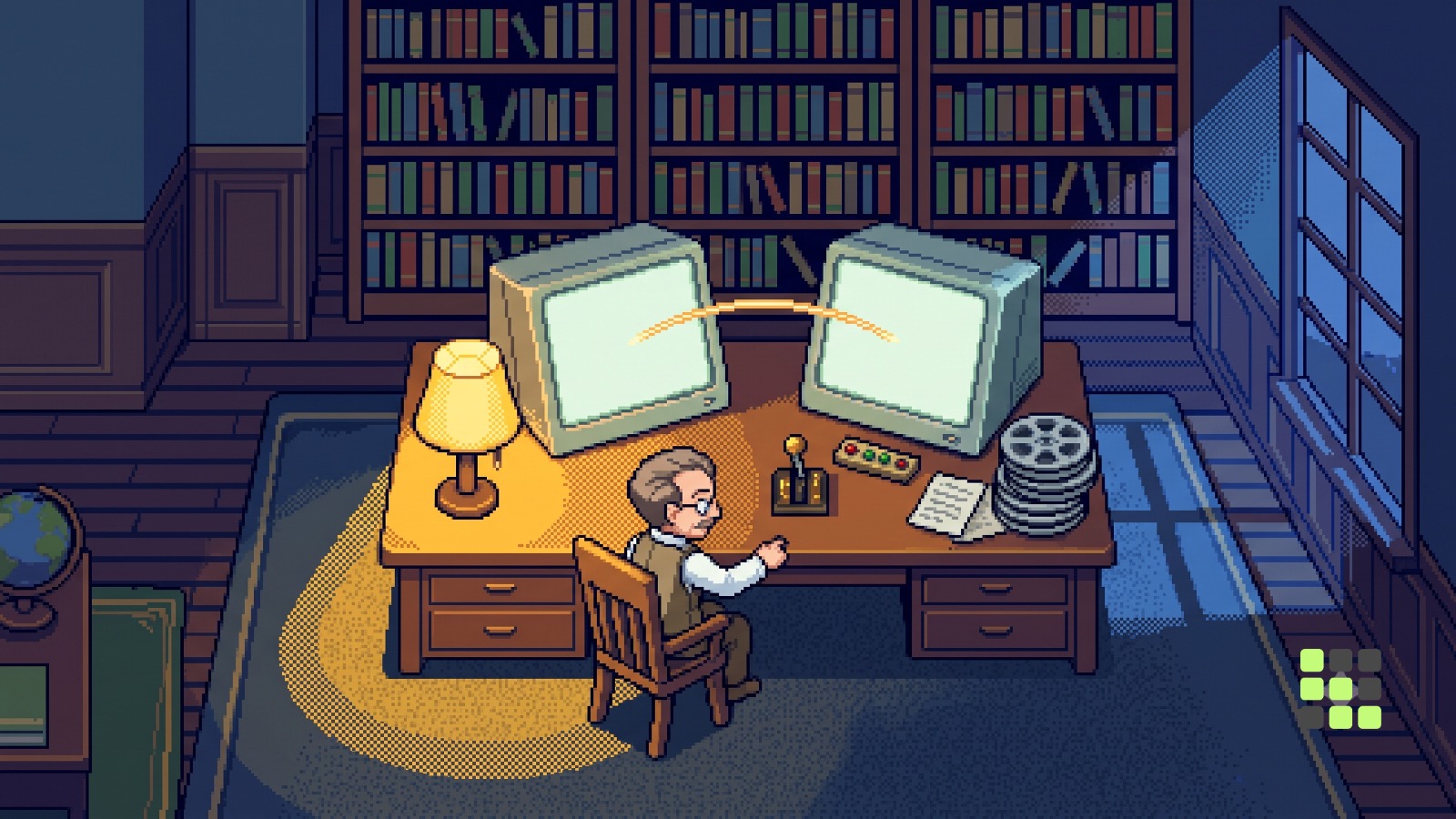
He coined a name for the device embodying this idea on the spot: the memex. It’s a device where a person keeps all their books, records, and correspondence, searchable with great speed and flexibility — a private supplement to that person’s memory, vastly enlarged. Outwardly, it looks like an ordinary desk. On its surface are several slanted translucent screens, a keyboard, buttons and levers, and at one end a microfilm vault. Nudge a lever slightly to the right and the pages turn one at a time; push further and they turn ten at a time, then a hundred at a time. Place a handwritten note or a photograph on a transparent plate, press the lever, and it’s photographed straight onto the film.
Bush himself called everything up to this point a conventional picture — simply an existing kind of device, extrapolated forward.
The Key Component Was the “Link” Button
The essential function Bush singled out for the Memex was associative indexing — a mechanism that lets any item instantly and automatically call up another whenever you want. He insisted that the very act of linking two items together was the important work.
Here’s how it worked. When a user decides to build a trail, they name it and record it in a code book. They bring up the two items to be linked side by side, press a single key, and the two are permanently connected. From then on, whenever either item is on screen, pressing one button summons the other. Once several items are chained together this way, you can flip through them in sequence with a lever, like turning pages. Bush said this was like assembling a new book out of scattered material — and more than that, since a single item could belong to multiple trails at once.
His example is concrete and specific. The Memex’s owner is interested in the origin and properties of the bow — particularly why, in the small-scale skirmishes of the Crusades, the short Turkish bow seemed to outperform the English longbow. He finds an interesting but sloppy encyclopedia entry on the subject and pulls it up, then finds a relevant passage in a history book and links the two. Along the way he inserts his own comments. When it becomes clear that the elasticity of materials is the key factor, he branches off and links in a textbook on elasticity and a table of material properties, adding a page of handwritten analysis of his own.
What the friend receives in this scene isn’t a one-line conclusion that “the Turkish bow was better.” It’s the entire path — which materials were read in which order, where the detours happened, even the person’s own handwritten analysis along the way.
When Trailblazing Becomes a Profession
Bush also sketches what the world looks like once this capability spreads. A new kind of encyclopedia emerges, one that arrives with associative trails already woven densely into it from the start, and users feed it into the memex to make it grow further. A lawyer keeps at their fingertips a web of precedents and opinions drawn from their own experience and that of colleagues and authorities; a patent attorney lays trails connecting millions of patents to whatever a given client cares about. A doctor puzzled by a patient’s unusual reaction follows trails built from studying earlier, similar cases to survey comparable medical histories, and a chemist uses trails that track similarities among compounds.
And Bush says a new profession would be born from this: people who take pleasure in carving useful trails through humanity’s vast shared record — trail blazers. He thought what gets passed down from mentor to student would change too. It wouldn’t just be the finished work a mentor added to the world’s record — the scaffolding used to build that work would pass to the student as well.
The essay closes with a meditation on forgetting. Civilization, Bush argued, has grown so complex that without further mechanizing our records, the limits of human memory will force us to abandon experiments halfway through rather than see them to completion. He also believed the journey would become more enjoyable if we could forget most of what we don’t need right now, confident that we could retrieve it again once it mattered. For Bush, the memory aid wasn’t really a tool for making us remember more — it was a tool that let us forget in peace.
Rereading the Memex, 81 Years Later
There’s an actual record of this essay changing someone’s career path. In a 1962 letter to Bush, Douglas Engelbart recalled finding this essay at a Red Cross library on the edge of a jungle on Leyte Island in the Philippines in the fall of 1945, and reading it closely.3 In the letter, he explained that he was preparing a research program to boost human intellectual efficiency, and asked Bush’s permission to quote the essay at length in a report he was drafting for the Air Force Office of Scientific Research.
Bush himself was careful not to let this vision tip into reckless prophecy. He admitted he’d brushed past every technical difficulty, but wrote that he had stayed close to known methods and to elements that were advancing rapidly at the time. A forecast that extends what’s already known has substance, he argued, while one that leans on the unknown is just a doubly tangled guess. That’s also why the Memex was drawn not as a network but as a desk loaded with microfilm. The materials he had on hand were photography, telephone switchboards, and punch cards.
81 years on, storage has long since outrun Bush’s calculations, and search performs the switchboard-style selection he described at a speed beyond anything he imagined. Generative AI links multiple sources together to produce an answer to a single question. Bush himself wrote that associative selection might one day be mechanized, so this direction wasn’t something he ruled out.
But inside the Memex, it was the user who drew the trail. The trail carried the name that person had given it, held that person’s comments and handwritten analysis woven in, and didn’t fade even years later. What got handed to a friend was not a conclusion but a path. What we get from AI today is, for the most part, closer to the opposite. The linking happens inside the machine, and what lands in the recipient’s hands is a conclusion. Unless you go out of your way to keep it, there’s no grounds left for trusting that answer, nor any trail you could pull back out in a different conversation years later.
Even the condition that a trail shouldn’t fade turned out to be harder than it sounds. As covered in Issue No. 215, “The URL Berners-Lee Chose Died in Four Months,” a web link disappears once nobody keeps taking responsibility for the address. Bush singled out permanence as the point where the machine would beat the human mind, but the network we actually built has only half kept that promise.
Oswarld’s Lens
Looking again at how Bush defined the mathematician, he drew the line between machine work and human work not by task type but by where judgment sits. Choosing which method of processing to use, which two sources to connect, and what to name that path — that was the human’s share. If you use a tool merely to receive the finished output, the faster the calculation gets, the less occasion you may have to exercise your own trail-blazing ability.
So when you hand work off to AI, the question to check isn’t just whether the answer is correct. You also need to ask whether you can explain the path you took to reach that answer, and whether you can hand that path down to your future self or a colleague years from now. The trail blazer Bush envisioned wasn’t someone who possessed a lot of material — it was someone who cut a useful path through that material.
Closing
Bush wrote near the end of his essay that science had built humanity a well-appointed house, while also handing it brutal weapons. He added that humanity might destroy itself in conflict before it ever learned how to properly handle that record. Still, he closes by saying this is too promising a stage to stop the process or give up hope now. He wrote these lines just weeks before the atomic bomb was dropped.
💬 Reader, when you’re holding onto a subject for a long time, where and how do you leave the connections between your materials?
📨 If you have a colleague wrestling with the path between records, search, and AI tools, share this piece with them.
Already a subscriber? Sign in to join the conversation


References & Further Reading

📝 Glossary
- Memex: The name Bush gave to a hypothetical personal record-keeping device in this essay. Conceived as a desk fitted with microfilm storage and multiple screens, it was designed to retrieve material quickly and link items together.
- Associative indexing: A method of linking items so that calling up one instantly calls up another. Bush proposed this as a contrast to conventional indexing, which requires working top-down through a classification hierarchy.
- Microfilm: A recording method that photographically shrinks documents onto film, to be read later by projecting an enlarged image.
- Office of Scientific Research and Development (OSRD): A US government agency that coordinated military scientific research during World War II. Bush served as its director.
Footnotes
-
Vannevar Bush, “As We May Think”, The Atlantic Monthly, July 1945 issue. Original text: https://www.theatlantic.com/magazine/archive/1945/07/as-we-may-think/303881/ . Quotations and summaries in this piece are based on the electronic PDF edition prepared by Denys Duchier in April 1994. ↩
-
Wikipedia, “As We May Think”. On the abridged version published in Life magazine on September 10, 1945, and the timing of the atomic bombings relative to the two editions. https://en.wikipedia.org/wiki/As_We_May_Think ↩
-
Douglas C. Engelbart, “Letter to Vannevar Bush and Program on Human Effectiveness”, May 24, 1962. https://web.stanford.edu/class/history34q/readings/Engelbart/Engelbart_LettertoBush.html ↩
Related issues
Same PVC Resin, Five Different Anti-Dumping Rates
Each line of the tariff schedule reflects its own company ledger.
BusinessCrypto's 2026 Shutdown Wave: 81 Projects Gone Quiet
Prices held up, but trading vanished—stacking 81 shutdown notices reveals what actually died and what survived.
BusinessServers Take 2 Months, Foundries Take 4 Years
The further upstream in the supply chain, the later today's decisions are graded.
Business
Your take shapes the next issue
What resonated most in this issue, or where has your experience been different?